The problem
Have you ever found yourself embarking on a research project, only to feel overwhelmed the moment you start exploring the topic? It's a common hurdle for researchers and students alike—entering a keyword and being inundated with hundreds of papers, each seemingly more complex than the last.
Our project
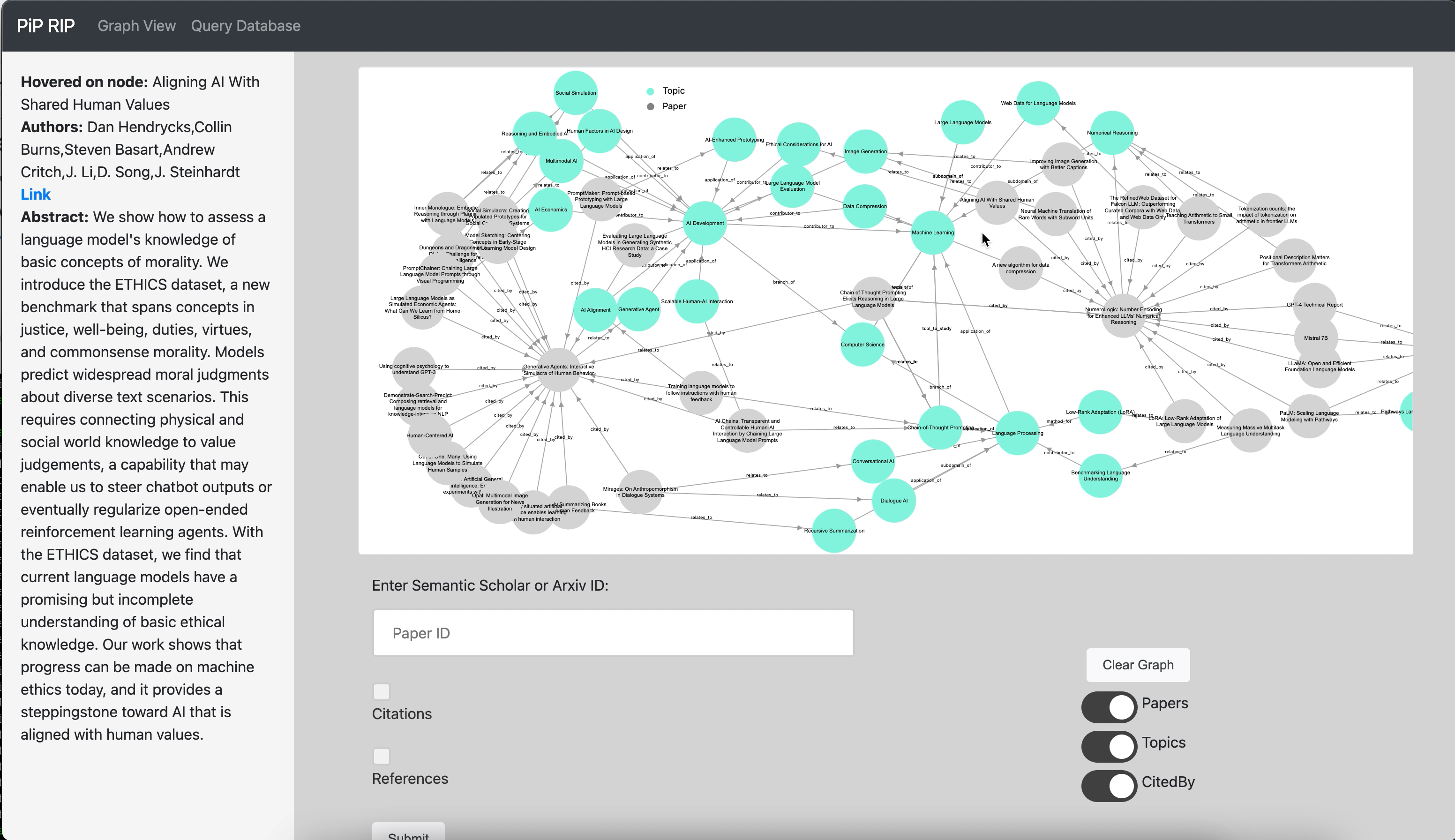
Papers into Perspectives – Research Intelligence Processor (PiPRIP) is a Gemini-powered knowledge graph generator that picks up key topics from the provided research papers and builds connections between those topics.
PiPRIP aims to offer a bird’s eye view of the available literature and help users visualize the connections between papers in an intuitive manner. This facilitates understanding, which often happens when one begins making connections between topics.
PiPRIP's generated knowledge graph enables users to:
- Identify relationships between papers at a glance
- Conveniently discover papers with overlapping topics
- Trace the citations lineage of papers to understand how the research evolves over time
Graph generation process
Upon submitting paper IDs from either Semantic Scholar or ArXiv to our web UI, the papers’ details are retrieved and passed to Gemini, which generates topics capturing the essence of each paper, as well as relationships between the topics.
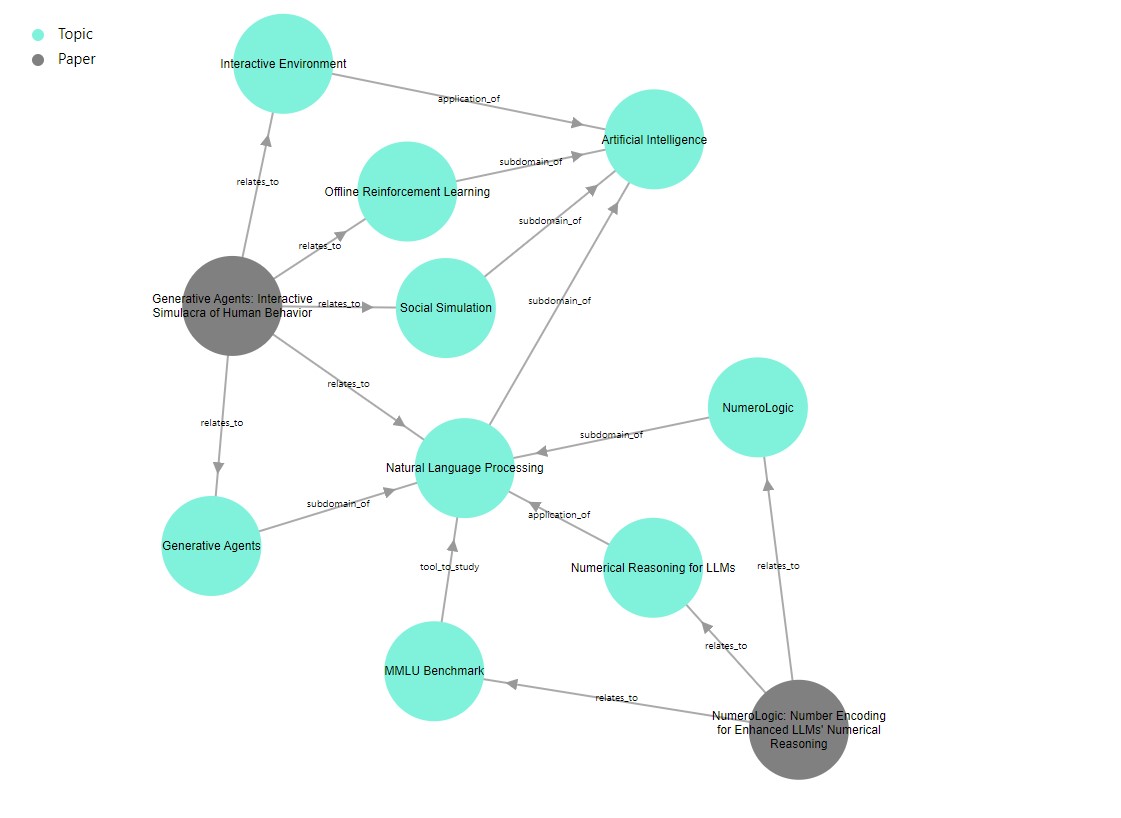
The topic nodes are created by Gemini in two steps. The first step generates specific topics from the paper’s title and abstract. Hovering over a specific topic in the UI shows a Gemini-generated description in the context of the paper used to generate it.
The second step generates broad topics from the specific topics. For instance, the topic Artificial Intelligence may be generated to connect the specific topics Natural Language Processing, Social Simulation, and Offline Reinforcement Learning.
Inspiration and Challenges
Our project was born mainly out of a frustration with navigating unfamiliar research territory. When we come upon a new research paper, it usually references many tools from other papers, which we are likely to be unfamiliar with as well. The manual research process involves laboriously searching for these references and trying to understand them one by one. Even if we were to go through that process, we may still fail to notice connections between the papers, such as one tool comparing itself to another from a different paper.
This inspired us to create a knowledge graph generator that synthesizes research topics, bridging the gaps between scattered pieces of information that would otherwise require painstaking hours to make sense of.
When building the project, one of the main challenges we faced was handling the non-deterministic output of Gemini. As an LLM can produce many variants of outputs from a fixed input, it was difficult to ensure that the output produced would always be a desirable one. We experimented with various prompts to find ones that produced the most consistent high-quality output. Originally complex tasks were also divided into multiple stages to allow Gemini to focus on smaller objectives per API call, which generally resulted in better adherence to instructions.


Log in or sign up for Devpost to join the conversation.