-
-
Executive Summary
-
Architecture Diagram
Inspiration
We’ve experienced event planning from both sides: organizing events and participating as vendors.
Through campus club leadership, our team has helped run workshops, speaker events, and community gatherings. We’ve also organized meetups and pop-up events for a mobile-cart small business. Across both, we kept running into the same work: chasing information, repeating details across forms, and keeping people aligned when plans changed.
A DubHacks organizer reinforced those frustrations, highlighting vendor form filling, license checking, and sponsorship scheduling. We built Gurt to help small teams handle that operational follow-through.
What it does
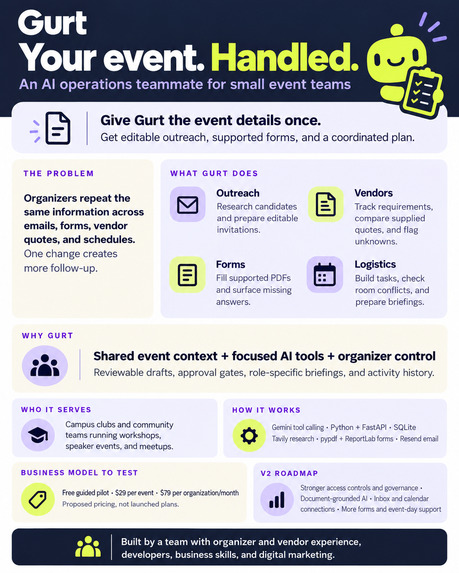
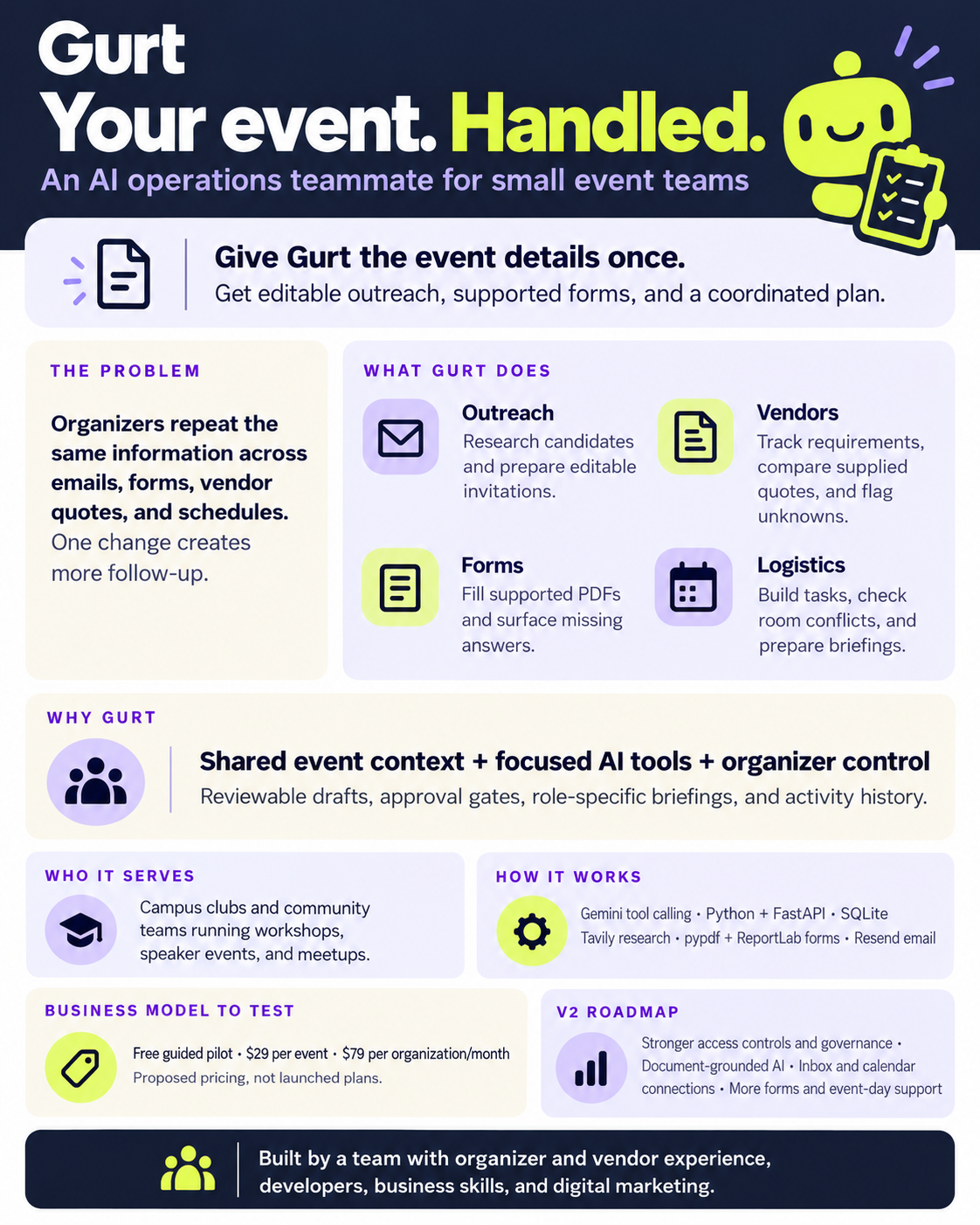
Gurt is an AI event operations teammate. Give it the event context once, then use it across outreach, vendor coordination, paperwork, and logistics.
- Outreach: research speakers and sponsors and prepare personalized, editable drafts.
- Vendors: save requirements, compare supplied quotes, and surface missing costs or information.
- Documents: fill supported PDF fields from saved facts and flag missing answers for review.
- Logistics: build tasks and schedules, detect room and turnover conflicts, and prepare role-specific briefings.
Outputs stay attached to the event as saved records, drafts, and downloadable artifacts. Organizers review consequential external actions before execution.
Our UVP: more capable automation, with organizer control
Our product vision is to combine familiar event-management capabilities with deeper AI automation—and make security, governance, and compliance support central to how that automation works.
We want Gurt to handle more of the work between an event idea and execution: researching options, preparing outreach, completing paperwork, checking constraints, and proposing updates when arrangements change.
We aim to stand out through:
- Broader AI execution: specialized tools that produce usable work across connected event workflows.
- Stronger security controls: scoped access, relevant information for each role, and protection against unintended actions.
- Clear governance: reviewable proposals, explicit approvals, activity history, and clear ownership of decisions.
- Evidence-based compliance support: document checklists, missing-information flags, and human review for signatures, attestations, and ambiguous requirements.
This is the direction we’re building toward, not a claim that the prototype already matches every competitor or has proven superior security. Compliance support helps organizers review requirements; it does not certify legal compliance or vendor safety.
How we’re different
Existing platforms already solve important parts of event management. Our focus is combining connected AI execution with controls that help small teams delegate comfortably.
The table below summarizes selected capabilities from public product descriptions and our prototype report. It is not an independent benchmark.
| Capability | Gurt prototype | Luma | Nowadays | Cvent Vendor Marketplace |
|---|---|---|---|---|
| Vendor sourcing and outreach drafts | ✓ | X | ✓ | ✓ |
| Quote comparison | ✓ | X | ✓ | ✓ |
| Supported PDF form filling | ✓ | X | X | X |
| Room and turnover conflict checks | ✓ | X | X | X |
| Multiple event workspaces | ✓ | ✓ | ✓ | ✓ |
| Registration and ticketing | Outside current scope | ✓ | ✓ | X |
| Live vendor outreach | Partial | X | ✓ | ✓ |
Sources: Luma, Luma API, Nowadays, and Cvent Vendor Marketplace. Public descriptions reviewed October 18, 2026.
Who we’re building for
- Initial users: campus club officers, community hosts, and volunteer coordinators running workshops, speaker events, and meetups.
- Potential buyers: treasurers, department sponsors, student activities offices, and funded recurring-event operators.
- Starting opportunity: repeatable administrative work for teams with limited operational capacity.
Why our startup team
We bring together the skills needed to understand the problem, build the product, and reach users:
- Organizer and vendor experience: we know the paperwork, unclear instructions, and last-minute coordination firsthand.
- Developers: we can turn those workflows into tools and connect them into a usable application.
- Business and pitching: we can shape the offering, explain its value, and build relationships with potential customers.
- Digital marketing: we can create engaging demos, test messaging, generate awareness, and turn interest into product trials.
We want that combination to help us build something people return to, beyond the initial attention of a launch.
Business model
We would test per-event access for occasional organizers and a subscription for recurring teams.
| Proposed option | Price to test | Intended use |
|---|---|---|
| Guided pilot | Free | One event, observed feedback, and workflow testing |
| Per event | $29/event | Occasional organizers with a defined usage allowance |
| Organization | $79/month | Recurring teams with capped active events and AI usage |
These are pricing hypotheses, not launched plans or validated willingness to pay. We would measure model, search, document-processing, and support costs before setting allowances. We would also explore department-funded access for multiple campus clubs.
Getting our first customers
Our first target is 10 pilot teams, recruited through campus organizers, community hosts, and vendor relationships.
- Help each team with one real event.
- Observe completion time, corrections, and unresolved work.
- Use short demos and organizer-focused content to attract similar teams.
- Test repeat usage and paid conversion, not just views or sign-ups.
How we built it
Architecture: one agent, focused tools, shared state
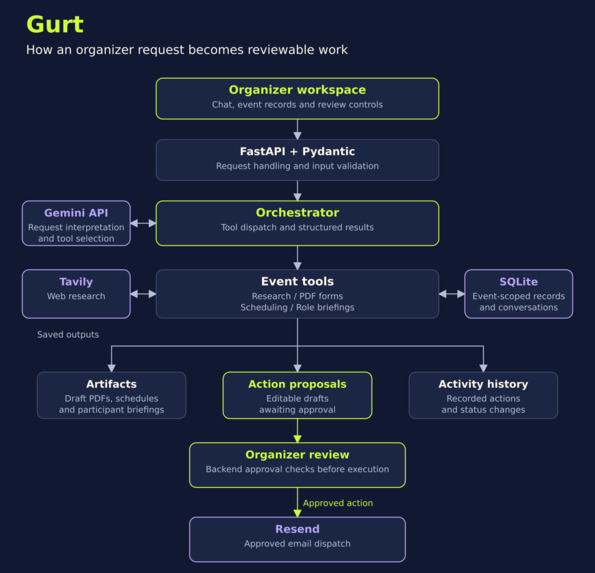
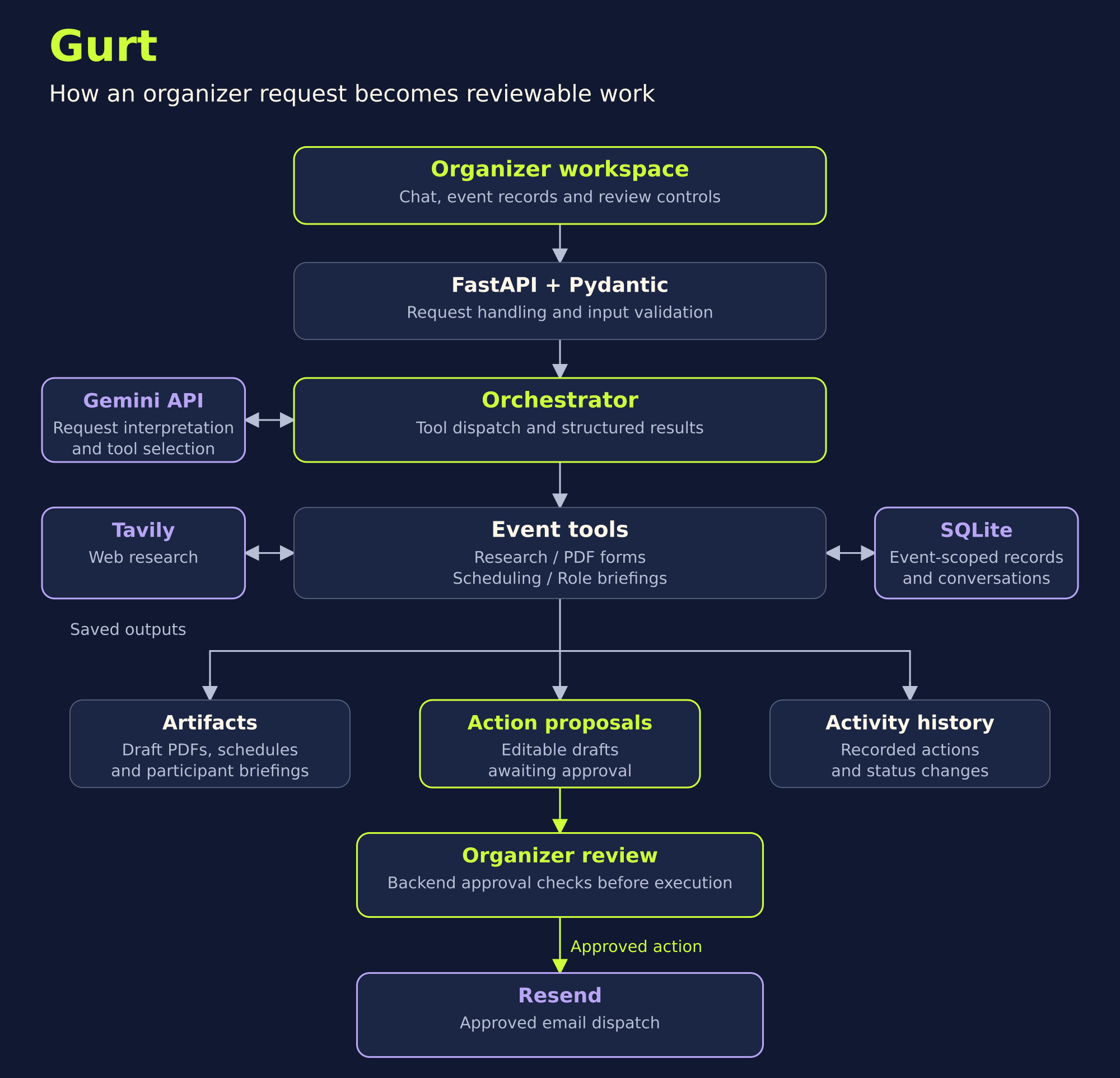
Python 3.12 + FastAPI + Pydantic power the backend. HTML, CSS, and JavaScript provide the browser interface. SQLite stores the shared event state.
The orchestrator calls the Gemini API with tool schemas. It dispatches the selected function, returns the structured result to the model, and saves the relevant output. The model interprets requests; code handles calculations, validation, and state changes.
Shared event context
Event-scoped records hold briefs, contacts, vendor requirements, quotes, tasks, schedules, conversations, documents, and proposed actions. Tools use the active event_id to retrieve relevant facts.
Organizer preferences and constraints supply additional context. Structured database records remain the operational source of truth, so work can continue beyond a single chat response.
Research and outreach tools
Tavily supplies web-search results for speaker, sponsor, and supplier research. The prototype also has labeled synthetic fixtures when live search is unavailable.
Outreach tools save pending_approval proposals that organizers can inspect and edit. Resend supports email dispatch when configured, while existing pending drafts can be updated instead of duplicated. The current reply workflow accepts pasted text and uses heuristics.
PDF completion
ReportLab creates a sample fillable AcroForm, and pypdf inspects and populates supported fields.
The workflow reads saved event/vendor facts, maps known answers, lists unresolved fields, and creates a downloadable draft while preserving the original template. Signatures remain for an authorized person. The prototype supports a known template rather than arbitrary contract layouts.
Logistics and proposed changes
The scheduling tools use integer-minute calculations and half-open time intervals to check room overlaps and turnover gaps. Task dependencies use a directed graph and topological ordering.
A what-if simulation evaluates proposed timing changes against a copy of the saved schedule before committing an update. We integrated a teammate’s logistics work, originally backed by flat-file JSON, into the shared SQLite model.
Security, governance, and responsible execution
The prototype includes specific controls for reviewing delegated work:
| Control | Purpose |
|---|---|
| Action proposals and organizer approval | Separate preparing an external action from authorizing it |
| Draft-only PDF output | Keep filling separate from signing and submission |
| Role-specific field allowlists | Limit which information enters participant briefings |
| Briefing fingerprints | Help detect when relevant event facts have changed |
| Duplicate guards | Reduce repeated pending outreach proposals |
| Event scoping and activity records | Keep operational context separate and record important actions |
These controls are a foundation for stronger governance. Production authentication, organization permissions, and more robust execution handling remain part of V2. Event scoping alone is not user authentication, and a briefing filter is not a universal data-leakage guarantee.
Resilience and verification
A limited rule-based fallback can route selected requests when Gemini is unavailable. It does not reproduce full model behavior or replace live external services.
We added automated checks around logistics, forms, approvals, duplicate prevention, and event scoping, alongside connected walkthroughs. We also adapted permitted high-level skill instructions and concepts from an existing HR-agent project while building Gurt’s event-specific application separately.
Challenges we ran into
- Choosing a manageable scope: each focus area could become a product, so we prioritized connecting selected workflows.
- Keeping state accurate: interest, proposals, approvals, and completed actions need distinct meanings in both code and the interface.
- Handling incomplete inputs: missing fees and unanswered form fields need to remain visible.
- Integrating our work: reconciling different storage assumptions and making backend outputs usable took more than merging files.
Accomplishments that we're proud of
- Connected workflows: shared event records link outreach, vendors, and logistics.
- Usable outputs: saved drafts, scheduling findings, and downloadable forms.
- Organizer control: explicit review points, missing-information handling, and action states.
- A product grounded in experience: we built around coordination problems we’ve encountered ourselves.
What we learned
- An agent needs reliable tools and state, not just a strong prompt.
- Models and code do different jobs: language understanding helps choose an operation; deterministic logic handles calculations and checks.
- The interface is part of the automation: users need to find, inspect, and correct outputs.
- Business assumptions need testing: repeat usage, willingness to pay, and time savings still need evidence.
What's next for Gurt
V2 would deepen AI automation while strengthening security, governance, and compliance support. We would deliver it in stages, guided by pilot feedback.
V2.1: A reliable workspace with stronger access controls
- Authenticated organizations and role-based access: separate leads, staff, and volunteers, with appropriate access to event records and tools.
- Editable records with version checks: reduce conflicting changes and keep the event state consistent.
- Version-bound approvals: require fresh approval when an action’s recipient, content, cost, or other consequential details change.
- Safer retries and provider reconciliation: distinguish failure from uncertain delivery and check before repeating an external action.
V2.2: Deeper AI document and communication workflows
- Event-scoped document retrieval: answer from venue agreements, supplier documents, and policies with supporting passages.
- Requirements-to-task extraction: turn document conditions into proposed tasks and flag contradictions with the saved plan.
- More form templates and OCR: expand supported documents, including scanned inputs, while retaining field review and provenance.
- Structured reply understanding: extract availability, conditions, requests, and deadlines into validated records.
- Authorized inbox connections: turn incoming messages into proposed updates and follow-ups without requiring manual copy-paste.
V2.3: Changes that carry through the event
- Cross-workflow impact analysis: show how attendance, timing, or venue changes affect quantities, tasks, briefings, and communications.
- Calendar and event-platform integrations: keep approved updates consistent across Google Calendar, Outlook, and supported event tools.
- Sponsor obligation tracking: turn promised benefits and delivery requirements into owned tasks.
- Document-expiry and missing-paperwork reminders: surface evidence gaps and relevant deadlines for organizer review.
- Invoice-to-quote reconciliation: flag unexpected charges and prepare a source-backed clarification.
V2.4: Recurring-event and event-day support
- Reusable event templates and controlled preferences: carry useful context into the next event without mixing organizations or exposing private data.
- Incident intake: turn quick floor reports into proposed tasks with severity, location, and suggested ownership.
- Role-specific audio briefings: provide short operational updates for people working on-site.
- An expandable skill library: support additional workflows with defined inputs, permitted tools, outputs, and review boundaries.
How we would measure improvement
We would compare matched manual and Gurt-assisted tasks, including setup, corrections, failures, and human review.
Our key measures would be completion rate, review time, cost per event, repeat usage, and willingness to pay. Those findings would guide feature priorities and pricing.
Our vision: more of the operational work handled by AI, with clearer controls over how that work happens.
Built With
- cursor
- fastapi
- gemini
- pypdf
- python
- react
- tavily
- typescript

Log in or sign up for Devpost to join the conversation.