
Inspiration
The creator economy is changing how consumers discover and purchase products. Millions of people trust influencers and content creators when making purchasing decisions. However, I recognize a critical gap between what a creator endorses and what a consumer ultimately purchases.
A creator may recommend a product at a specific price, but the advertisement or checkout experience may present a different price, product, or merchant. Traditional payment systems process transactions without inherently verifying whether the purchase still matches the creator's original endorsement.
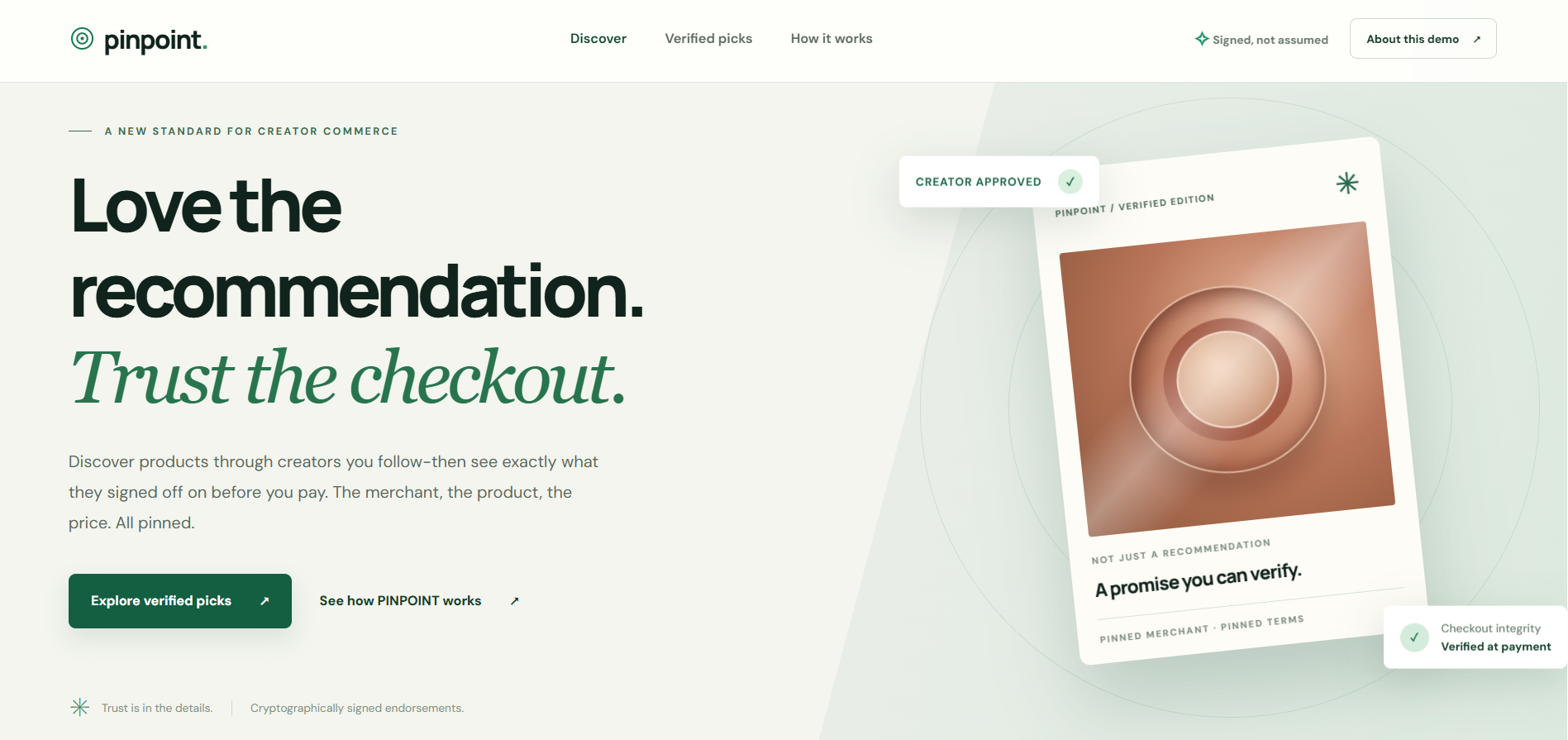
This inspires me to develop PINPOINT: AI Powered Consent Commerce, a system that connects creator approved purchase terms with artificial intelligence, cryptographic verification, and PayPal payment controls.
My goal is to introduce a new layer of trust into creator driven commerce.
A creator's endorsement should not become permission to change the deal.
What it does
PINPOINT is an AI powered consent commerce platform that helps protect consumers and creators by verifying advertisements against cryptographically signed purchase terms before allowing authorized payment operations.
I build PINPOINT around two connected applications.
PINPOINT Market
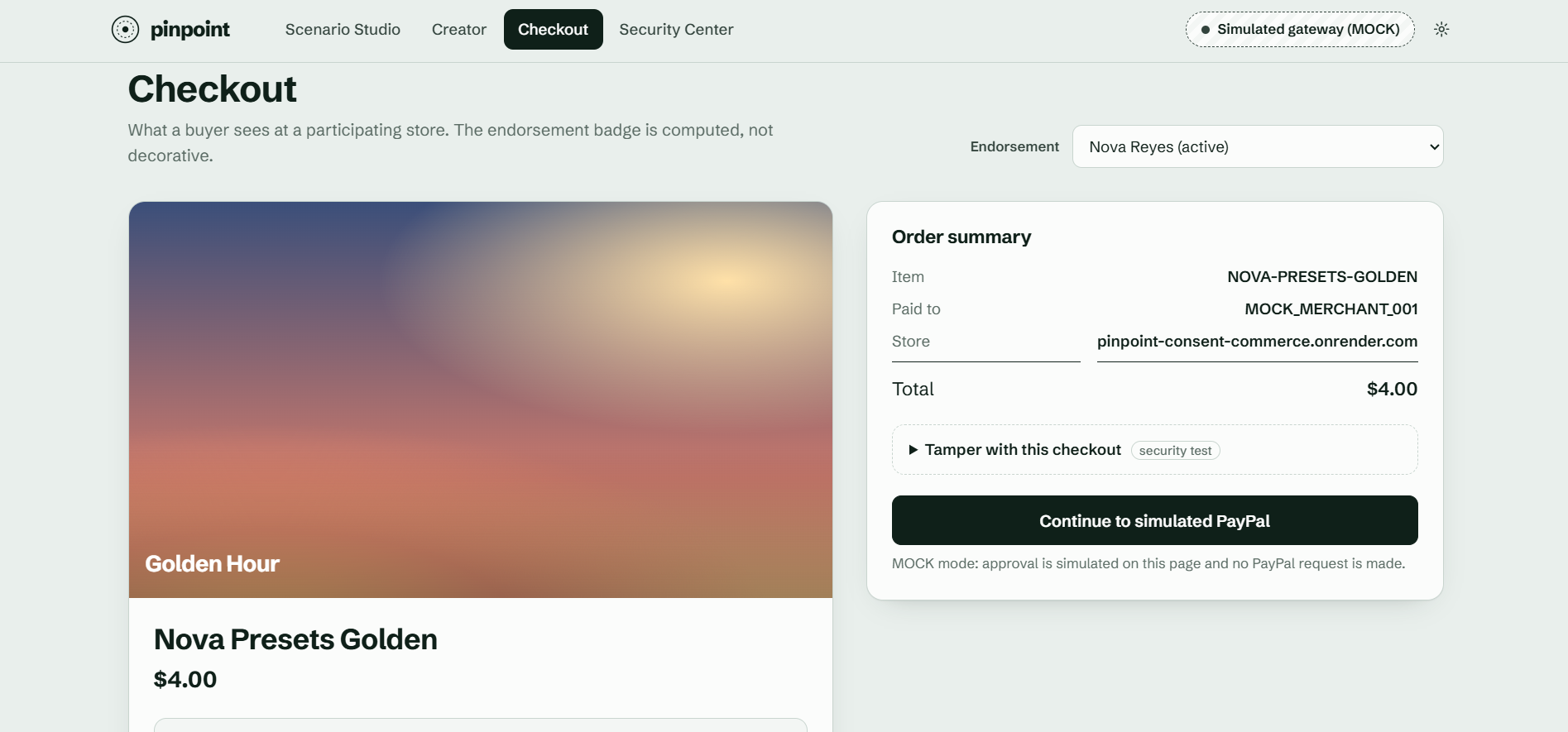
PINPOINT Market provides an interactive shopping experience featuring five product categories.
Consumers can explore products, interact with creator endorsed offers, and experience how purchase terms are checked before payment authorization.
PINPOINT Scenario Studio
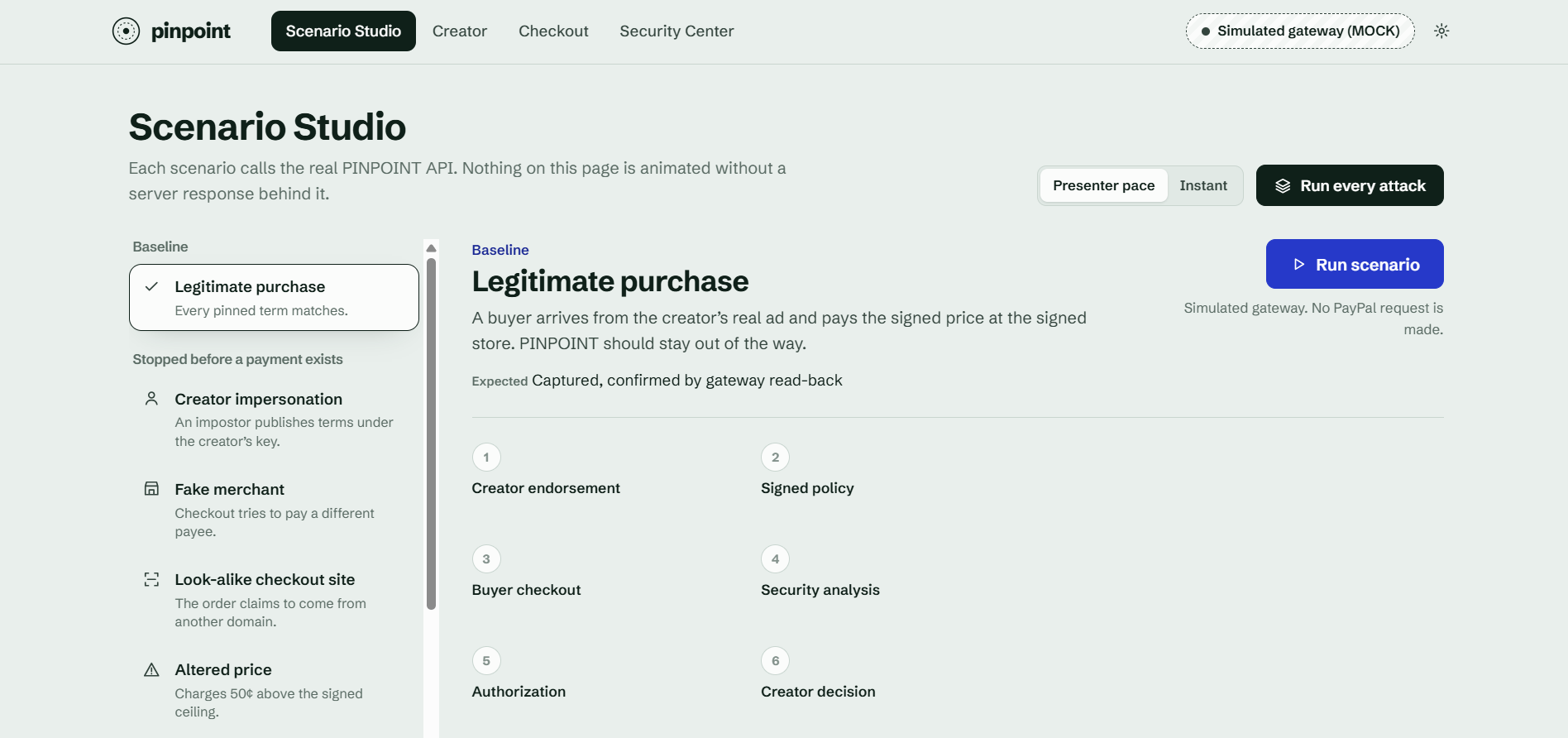
Scenario Studio demonstrates how PINPOINT evaluates creator policies, detects misleading advertisements, and enforces payment decisions.
The interface presents interactive scenarios involving legitimate transactions, mismatched claims, suspicious advertisements, review holds, and payment outcomes.
How PINPOINT works
1. Creator consent
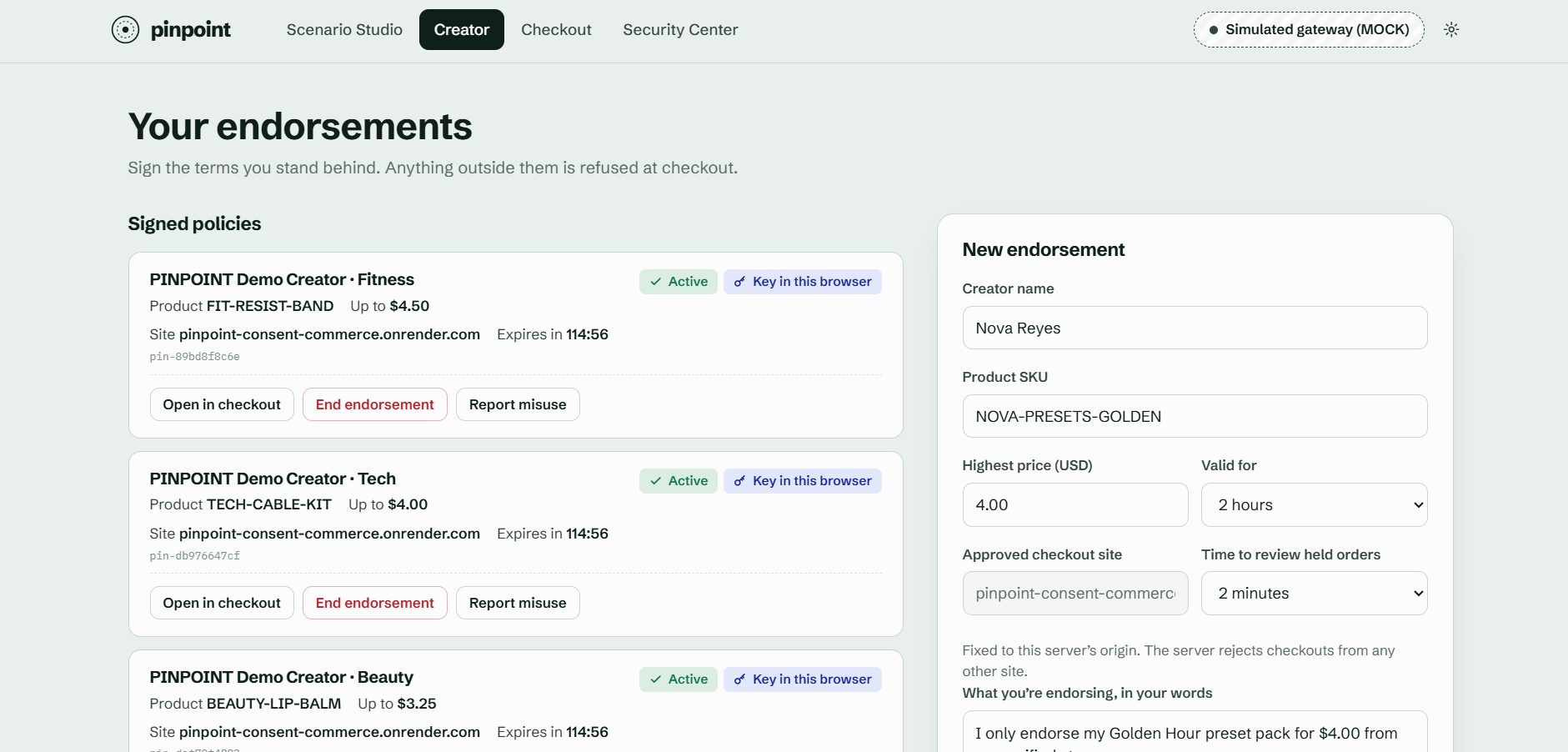
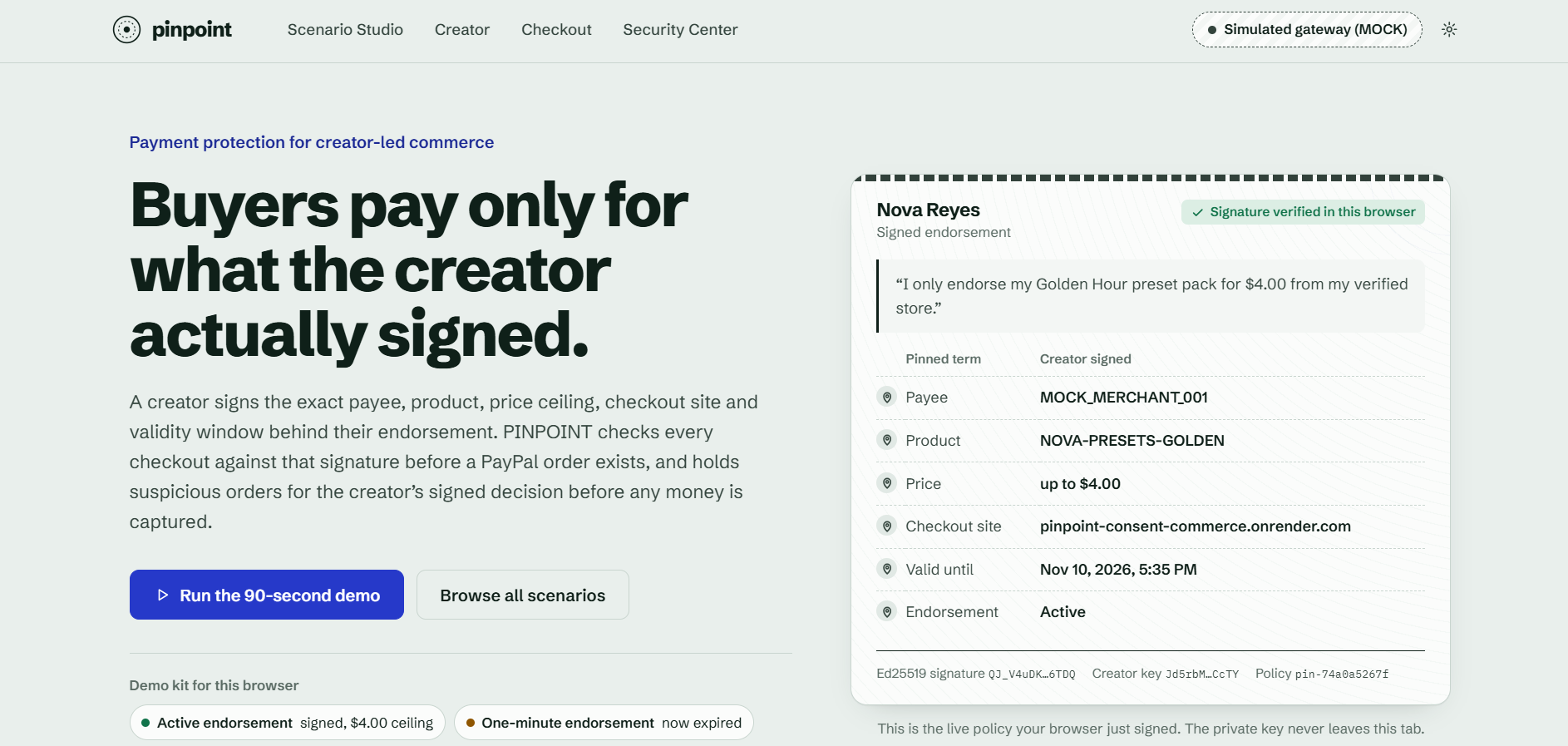
A creator signs an approved commerce policy using Ed25519 digital signatures. The policy specifies the permitted merchant, product identifier, price ceiling, domain, and validity period.
2. AI analysis
I integrate Google Gemini 2.5 Flash to extract commerce claims from advertising content and compare them with the creator's approved terms.
3. Policy verification
The backend verifies the signed policy and checks whether the transaction satisfies the applicable restrictions.
4. Payment authorization
PINPOINT integrates PayPal Sandbox to demonstrate authorization based payment workflows.
5. Payment enforcement
The backend controls whether an eligible authorization can proceed to capture, whether an authorization should be voided, or whether suspicious activity requires review.
6. Explainable evidence
Scenario Studio displays the relevant claim comparisons, policy decisions, transaction states, and supporting evidence.
The most important architectural principle is that AI analyzes claims, but it does not independently control money.
Deterministic backend rules and authorized merchant operations govern payment decisions.
How I built it
I develop PINPOINT using a combination of artificial intelligence, cryptography, payment APIs, backend security controls, and interactive web applications.
Artificial intelligence
I integrate Google Gemini 2.5 Flash through an OpenAI compatible interface.
The AI analyzes advertising claims and identifies differences between the promoted offer and the creator's signed policy.
I design the integration to handle unavailable AI responses and rate limits without inventing verification results or automatically changing payment states.
Cryptographic security
I use Ed25519 digital signatures to demonstrate tamper detection for creator approved commerce policies.
The backend verifies signed policy content before accepting relevant commerce terms.
I also implement server side policy enforcement and merchant binding to reduce the risk of unauthorized changes during the transaction lifecycle.
PayPal integration
I integrate PayPal Sandbox to implement and validate authorization, capture, and void workflows.
I intentionally separate buyer approval from payment capture because approving a transaction is not equivalent to completing settlement.
Backend
I use Python to implement policy validation, AI integration, payment state management, and structured evidence generation.
I keep sensitive payment operations on the backend rather than exposing capture or void controls through the consumer marketplace.
Frontend
I build two connected, responsive browser applications.
PINPOINT Market demonstrates the consumer shopping experience, while Scenario Studio provides interactive security scenarios and transaction evidence.
Deployment and testing
I use GitHub for source control and Render to host the public demonstration.
I maintain separate MOCK and PayPal Sandbox operating modes.
The public deployment uses simulated payment operations, while the PayPal Sandbox integration provides separate evidence of actual sandbox authorization, capture, and void behavior.
I also use automated regression tests and browser based validation to verify important workflows.
Challenges I ran into
Connecting creator consent to payment authorization
One of my biggest challenges is designing a system that preserves the meaning of a creator's endorsement throughout the transaction.
A valid signature alone is insufficient if the merchant, product, or price changes later.
I address this by implementing policy checks and server controlled payment context across important transaction boundaries.
Preventing AI from making financial decisions
AI can extract useful information from advertisements, but its responses are not always reliable.
I design PINPOINT so that model generated analysis remains advisory.
The backend independently enforces policy restrictions and controls authorized payment operations.
Handling PayPal payment states
I need to distinguish between buyer approval, authorization, capture, and void.
I implement explicit transaction state handling and verify final gateway responses rather than assuming an API request represents a completed payment.
Managing AI API limitations
During testing, I encounter HTTP 429 rate limit errors from Gemini.
I improve the error handling so the application communicates the failure without fabricating an AI verdict or silently modifying payment state.
Making cybersecurity understandable
Cryptographic signatures, payment state transitions, and policy enforcement can be difficult to explain visually.
I address this by developing Scenario Studio, where users can explore the decisions and evidence behind different transaction outcomes.
Accomplishments that I'm proud of
Verified PayPal Sandbox integration
I successfully demonstrate two independent payment workflows.
Authorization and Capture
I create a PayPal Sandbox authorization, perform an authorized capture operation, and verify that the final gateway status is CAPTURED.
Authorization and Void
I create another PayPal Sandbox authorization, perform an authorized void operation, and verify that the final gateway status is VOIDED.
I also attempt to capture the voided authorization.
PayPal rejects the operation with HTTP 422 and the error AUTHORIZATION_VOIDED.
This provides concrete evidence that the voided authorization cannot be captured in the tested workflow.
Live AI integration
I successfully integrate Gemini 2.5 Flash and demonstrate live analysis of advertising claims against creator approved terms.
The system identifies pricing discrepancies and presents the corresponding review evidence.
Cryptographically signed consent
I implement Ed25519 signed commerce policies and backend validation to demonstrate how creators can bind an endorsement to specific purchase terms.
Interactive product experience
I create two connected web applications with five shopping product categories and interactive scenarios that demonstrate different transaction outcomes.
Automated verification
I complete extensive development and release validation, including:
- 14 out of 14 local regression tests passing.
- Additional backend security and functional checks.
- Browser based integration tests.
- Public deployment smoke tests.
- Verified PayPal Sandbox capture and void workflows.
- Security hardening for public access and AI request quotas.
Complete product demonstration
I produce a narrated demonstration presenting the PINPOINT architecture, consumer shopping experience, creator policy enforcement, AI analysis, and payment controls.
I am particularly proud that PINPOINT combines an interactive product experience with separately verifiable payment integration evidence.
What I learned
AI needs enforceable security boundaries
I learn that the safest approach is not to give AI unrestricted authority over financial transactions.
Instead, AI can generate evidence while deterministic systems enforce authorization policies.
Payment approval is not payment completion
Working with PayPal Sandbox reinforces the importance of understanding authorization, capture, void, and transaction reconciliation as distinct operations.
Cryptographic integrity and identity are different
Ed25519 signatures help verify the integrity and signing origin of a policy.
However, production deployment also requires trusted creator identity verification, secure key management, and revocation mechanisms.
Security must be explainable
I learn that strong technical controls become more valuable when their decisions are understandable.
Scenario Studio helps translate security enforcement into visible, interactive evidence.
Failure handling matters as much as successful execution
The Gemini rate limit scenario reinforces the importance of preserving correct system behavior when external services become unavailable.
A trustworthy system must never invent successful verification results.
What's next for PINPOINT: AI Powered Consent Commerce
My vision is to evolve PINPOINT into a reusable trust and policy enforcement layer for creator driven commerce.
Verified creator identity
I plan to integrate creator onboarding, identity verification, managed signing keys, policy revocation, and secure key rotation.
Broader ecommerce integration
I aim to connect PINPOINT with creator storefronts, ecommerce platforms, affiliate networks, and additional authorized payment workflows.
Multimodal advertisement verification
I plan to expand AI analysis to video advertisements, product images, and spoken endorsements, enabling comparison of claims across multiple content formats.
Production security architecture
I intend to strengthen the platform with persistent transaction storage, authenticated merchant operations, comprehensive audit logging, replay protection, and automated reconciliation.
Advanced adversarial testing
I plan to evaluate more complex attacks involving advertisement manipulation, unauthorized policy changes, misleading product claims, and attempts to abuse payment transitions.
Real world validation
I want to collaborate with verified creators and participating merchants to measure the effectiveness of policy enforcement, the accuracy of AI claim analysis, and the usability of the consumer experience.
Long term vision
I believe the future of digital commerce requires more than secure payment processing.
It also requires a way to verify that the transaction respects the conditions that originally earned the consumer's trust.
PINPOINT connects AI powered verification, cryptographically signed creator consent, and enforceable payment controls to explore that future.
PINPOINT: Because an endorsement should not become permission to change the deal.
