About the Project
Physics-Informed Neural Networks (PINNs) offer a powerful way to solve differential equations by combining neural networks with the laws of physics. However, useful PINN implementations are often scattered across papers, notebooks, and personal repositories, making them difficult to discover, understand, reuse, and improve.
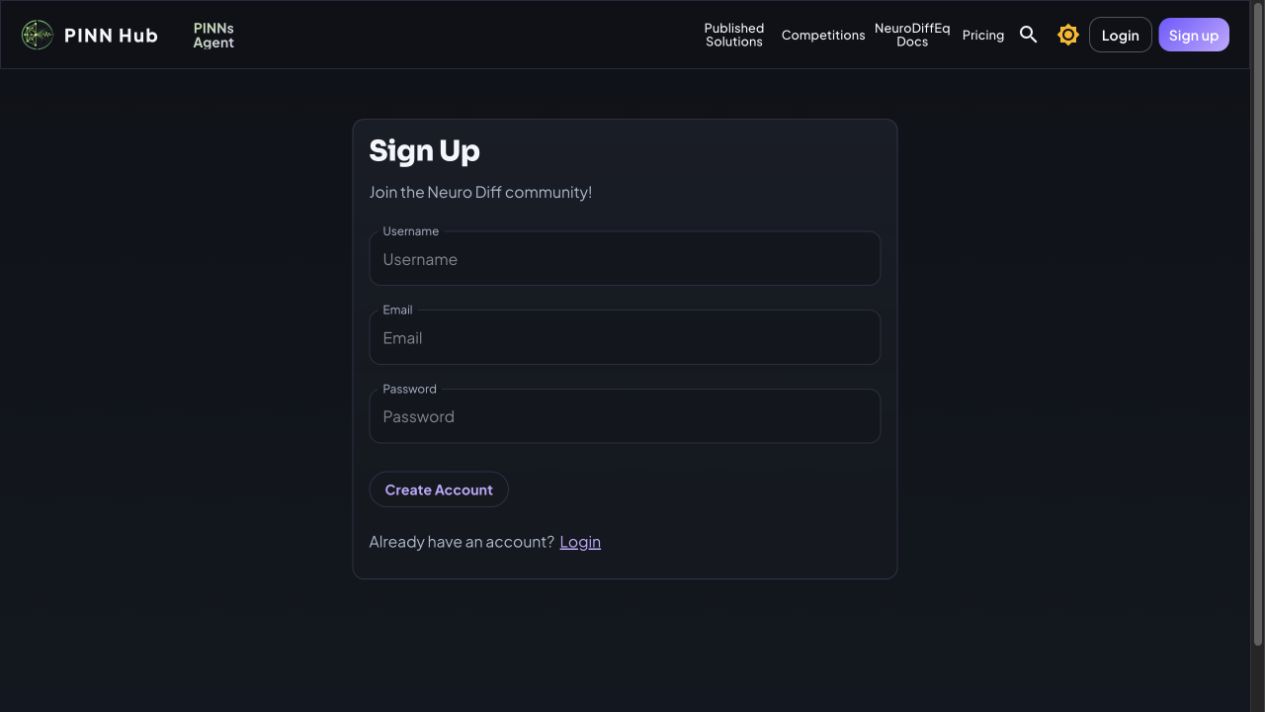
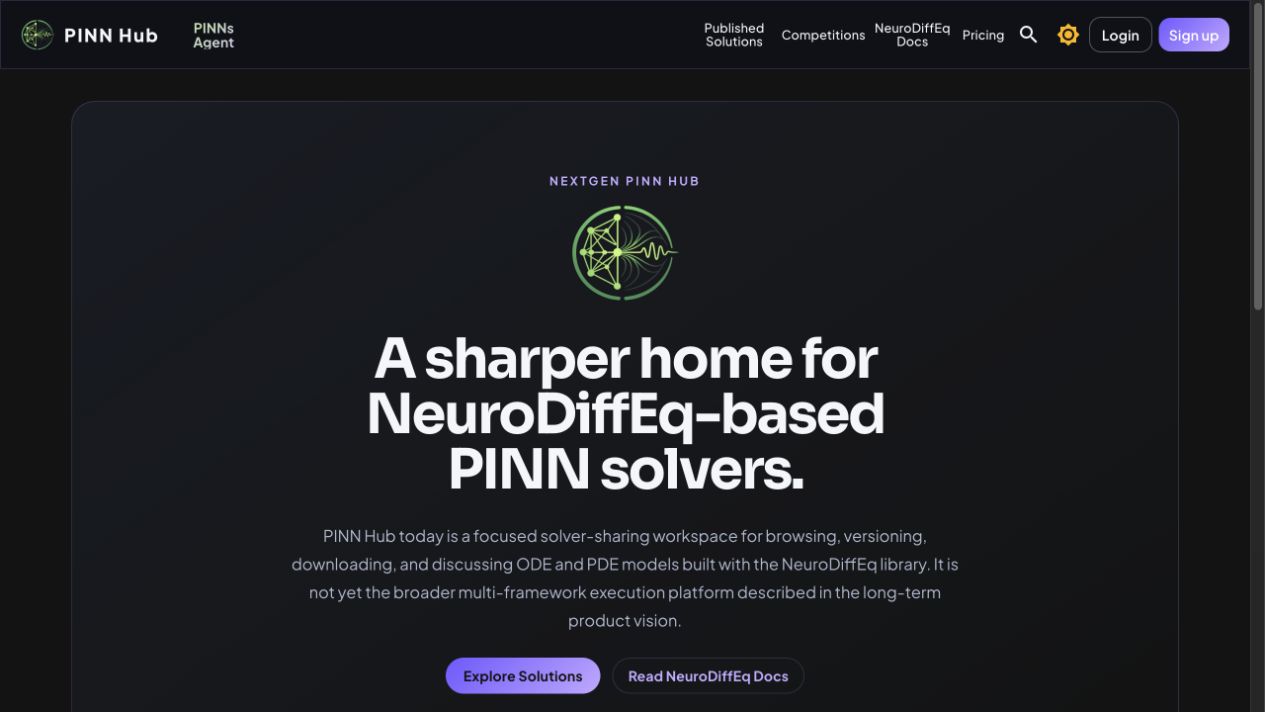
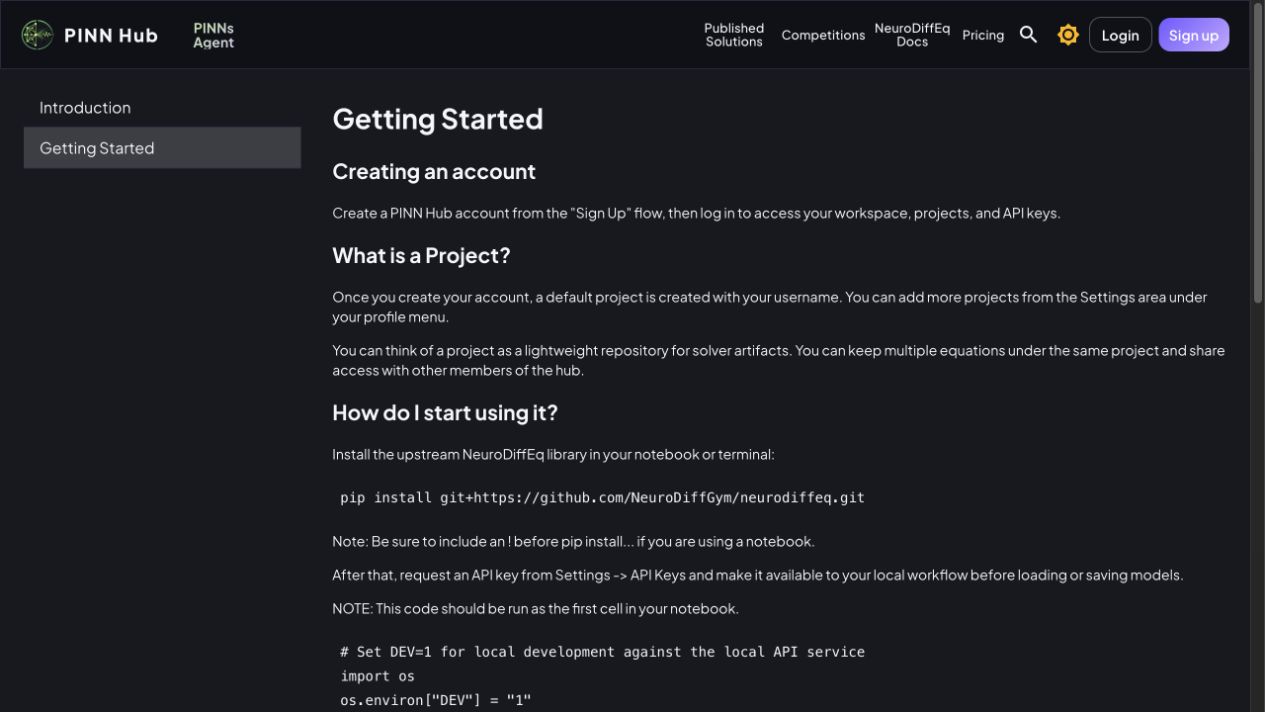
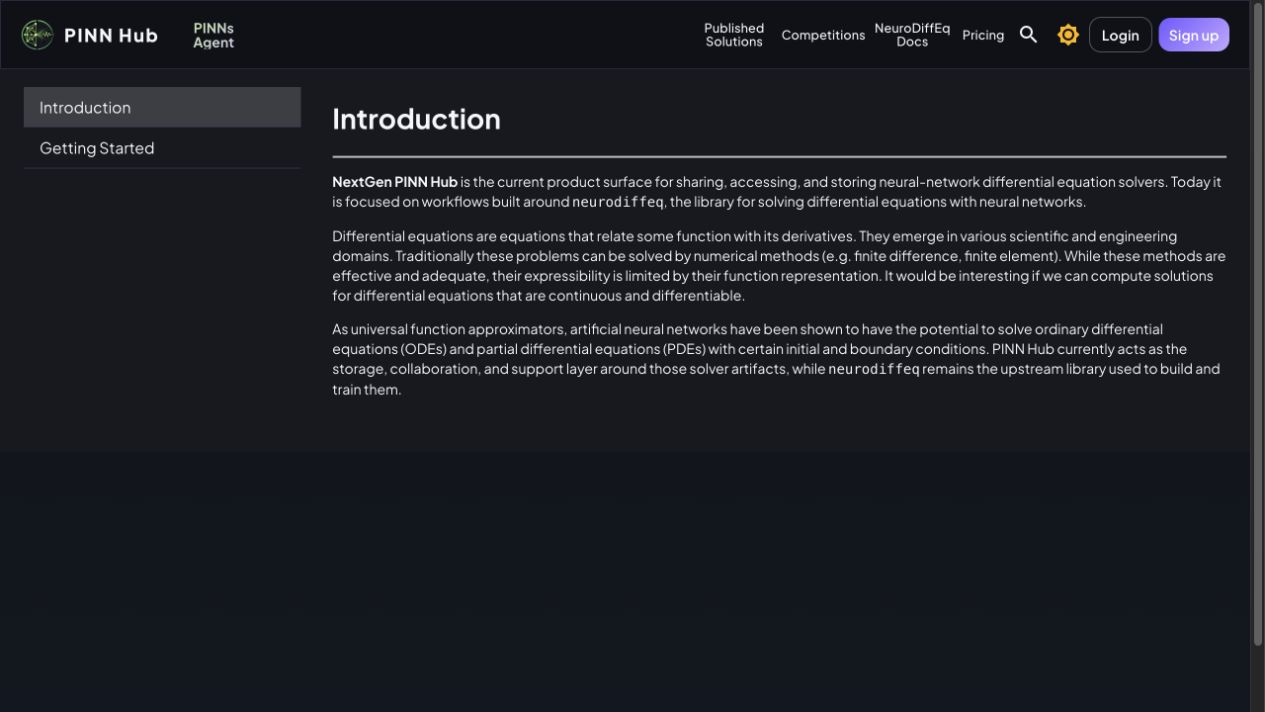
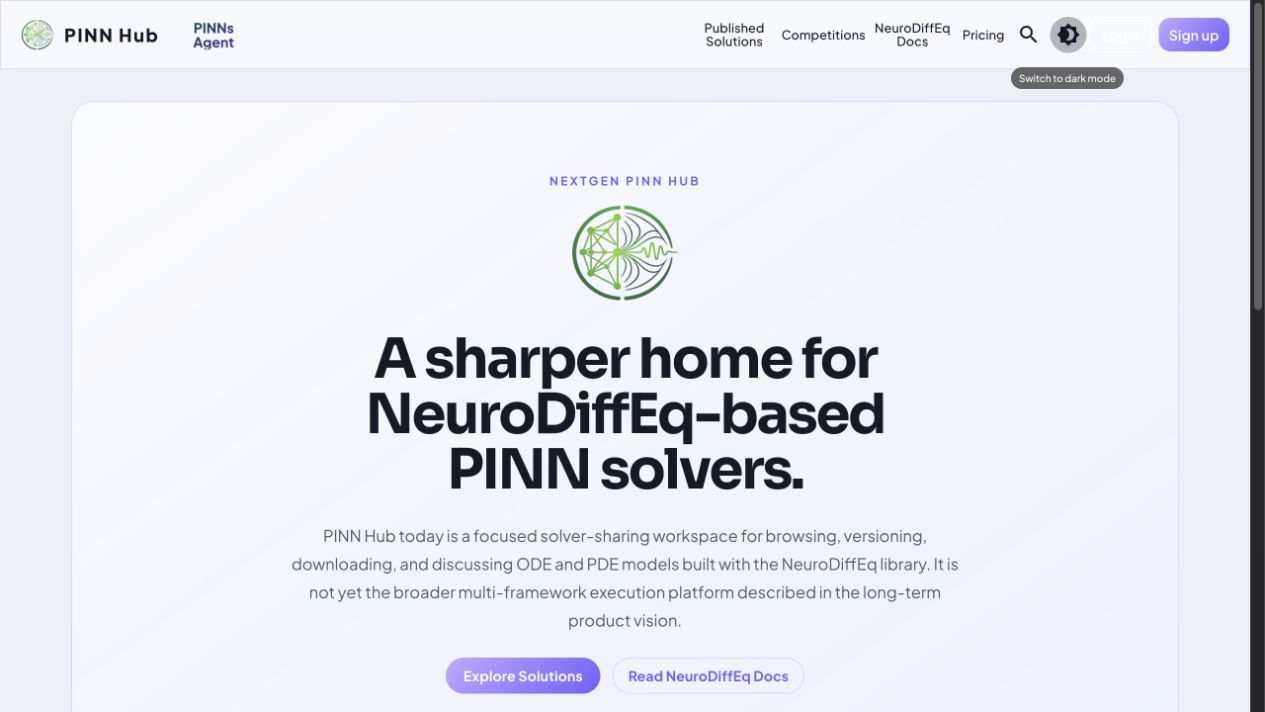
That gap inspired me to build PINN Hub—an open platform for discovering, sharing, versioning, and discussing AI-powered physics-informed solvers. The project currently focuses on ODE and PDE solver artifacts built with NeuroDiffEq, while also providing documentation, project collaboration tools, an AI support agent, and moderation workflows.
A PINN learns an approximation (u_\theta(x,t)) while minimizing both data error and physics error:
$$
\mathcal{L}
\lambda_{\text{data}}\mathcal{L}{\text{data}} + \lambda{\text{physics}}\mathcal{L}_{\text{physics}} $$
The physics loss is calculated from the residual of the governing differential equation, encouraging the model to produce solutions that obey physical laws rather than merely fitting observed data.
I built PINN Hub as a full-stack application using:
- React 18 and Material UI for the frontend
- FastAPI for the backend API
- PostgreSQL and dbmate for data storage and migrations
- Docker Compose for local development and deployment
- NeuroDiffEq for the initial solver ecosystem
Through this project, I learned that building a scientific platform involves more than implementing machine-learning models. Solver metadata, documentation, version history, reproducibility, collaboration, and a clear user experience are equally important. I also gained experience designing APIs, connecting frontend and backend services, managing persistent solver artifacts, and building support tools for technical users.
One of the biggest challenges was making advanced ODE and PDE concepts accessible without hiding the underlying mathematics. Another was creating a flexible system for sharing solver implementations while still keeping projects structured, understandable, and reusable. Building reliable AI-assisted workflows also required careful attention to safety, scope, and predictable behavior.
PINN Hub is a step toward a more open and collaborative ecosystem for scientific machine learning—where researchers, students, and developers can learn from one another, build on existing solvers, and turn physics-based ideas into working computational tools.

Log in or sign up for Devpost to join the conversation.