
Inspiration
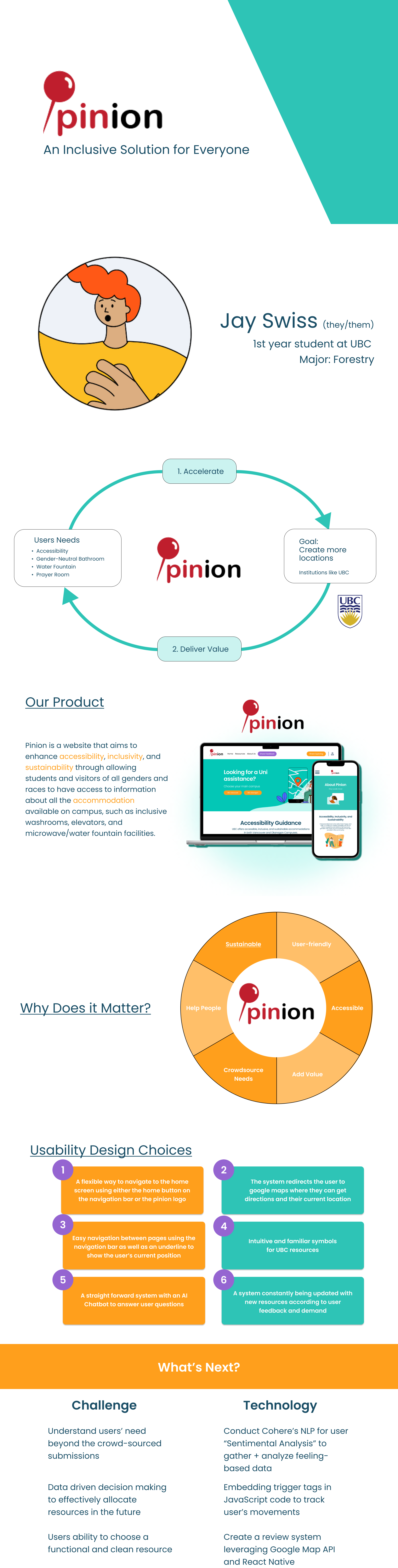
Students and visitors from underrepresented backgrounds struggle to find accommodations on campus like prayer rooms or gender-neutral bathrooms. We wanted to create a resource for them (and us) to easily find such accommodation and access them on a day-to-day basis.
What it does
What does it do: Pinion provides a centralized and user-friendly platform to look up UBC’s accessible and gender-neutral washrooms, the locations of elevators, and the locations of water fountains and microwaves. This will help to make the UBC campus more accessible and inclusive as well as promote sustainability. Pinion also collects user feedback to amplify the voices of underrepresented groups and help UBC to effectively implement future changes to suit the needs of UBC students and visitors
How we built it
Figma, ReactJS, Javascript, restAPI, CSS, coherent AI, HTML
Challenges we ran into
Not being able to implement a rating system using Google Map API
Accomplishments that we're proud of
- Implement a Chat Bot using coherent.
- Implemented a full front-end functional web app in 24 hours.
- Actually bringing value to UBC students
What we learned
- To connect AI tools using an API provided by Coherent
- Design a fully working prototype inside Figma
- To streamline the designing process in Figma using Auto-layout, components and variance, and other tools
- Ask for coaching and feedback from peers and mentors
What's next for Pinion
- Understand users’ needs beyond the crowd-sourced submissions Conduct Cohere’s NLP for user “Sentimental Analysis” to gather + analyze feeling-based data
- Data-driven decision-making to effectively allocate resources in the future Embedding trigger tags in JavaScript code to track user’s movements
- Users' ability to choose a functional and clean resource Create a review system leveraging Google Map API and React Native
Built With
- apis
- coherent
- css
- figma
- html
- javascript
- react


Log in or sign up for Devpost to join the conversation.