
Pinhole
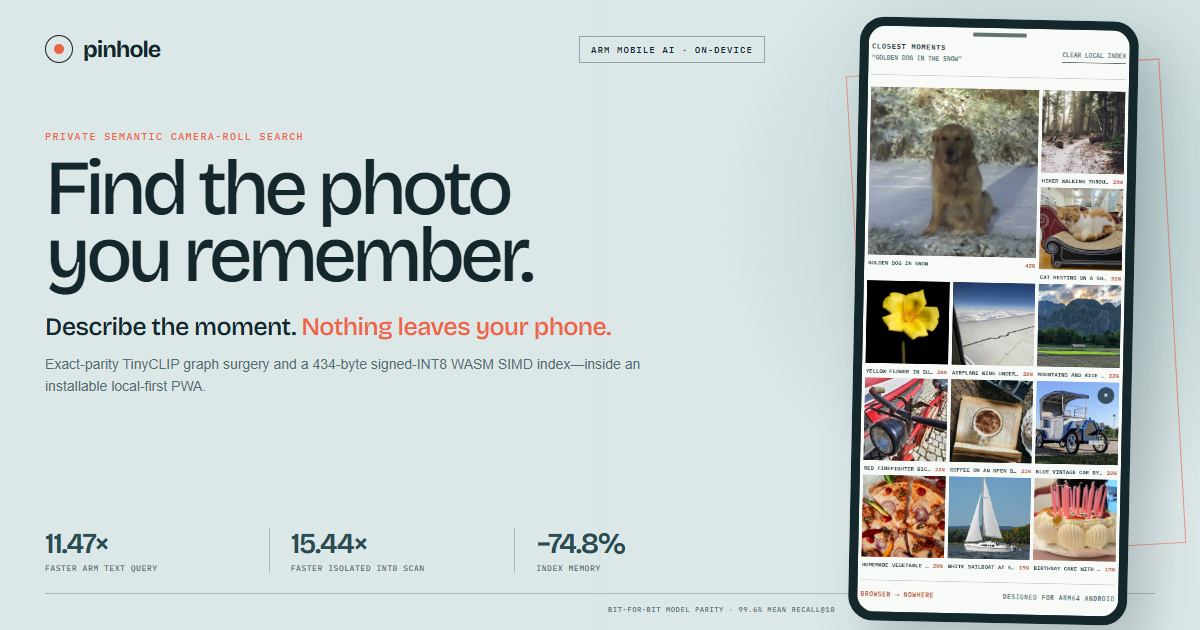
Describe the moment. Find the photo. Nothing leaves your phone.
Try the live PWA · Watch the 63-second demo · Inspect the source · Open the native Arm64 evidence
Inspiration
A camera roll can contain years of memories, yet finding one photo often means remembering a date, filename, or album. Cloud AI can make those photos searchable, but uploading private images and queries is the wrong tradeoff for many people.
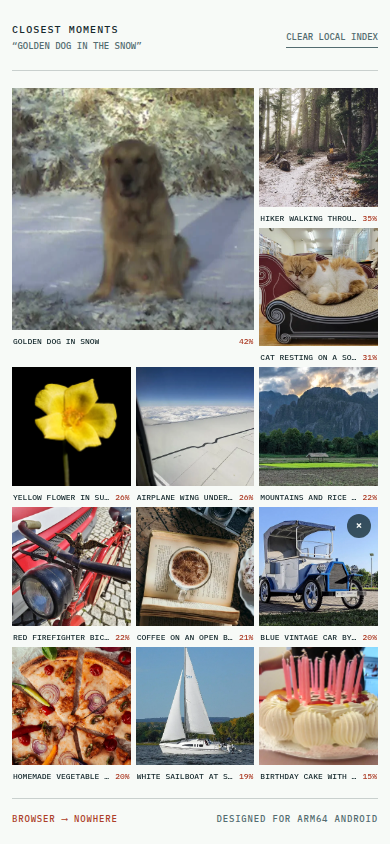
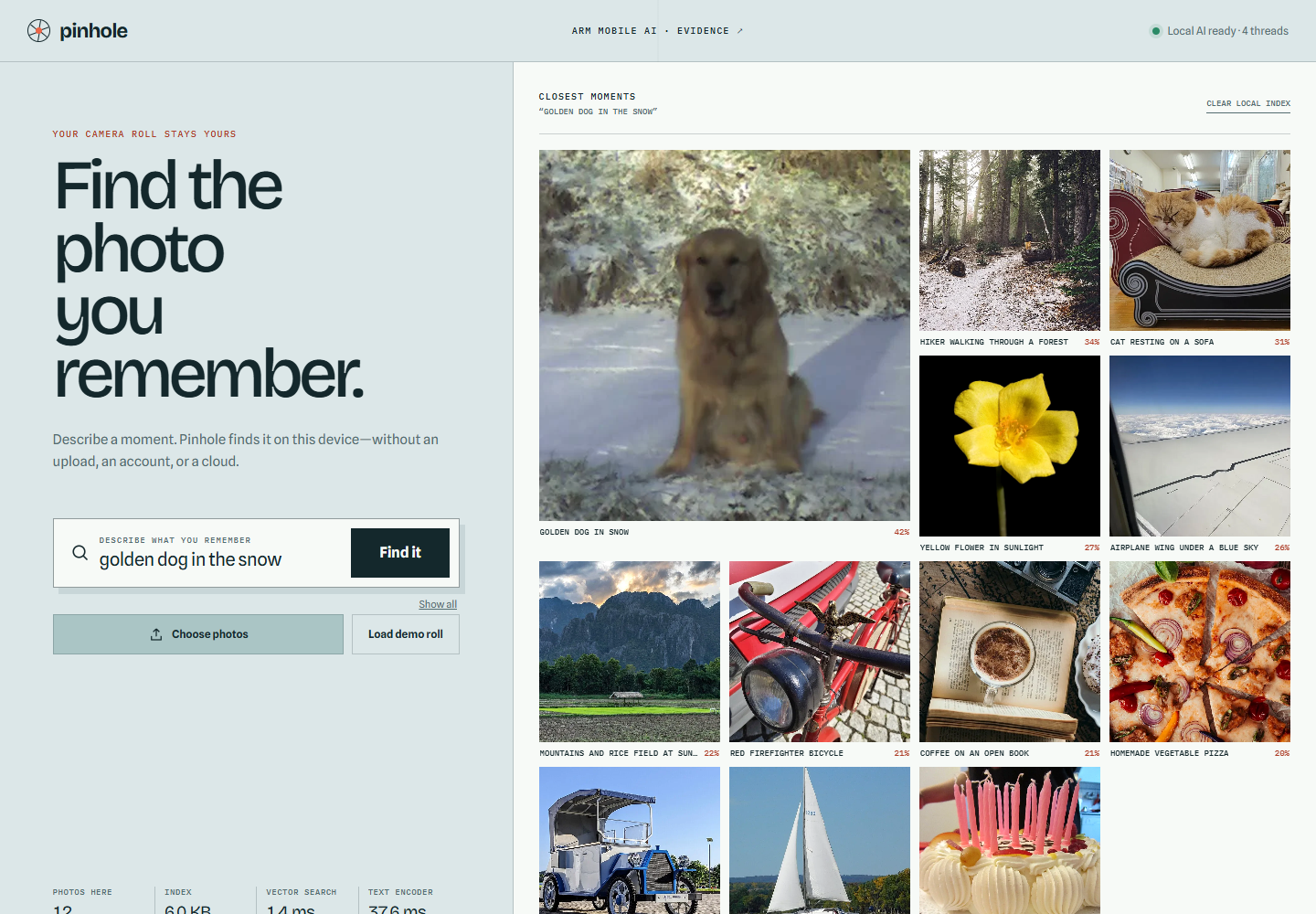
Pinhole asks a different question: what if measurable Arm optimization made the private path the practical path? Type “golden dog in the snow” or “coffee on an open book,” and Pinhole finds the moment locally—without an account, API key, or inference backend.
What it does
Pinhole is an installable semantic camera-roll search PWA for Arm-powered phones, tablets, and laptops.
- Choose personal photos through the normal browser picker, or load the attributed 12-photo demo roll.
- A Web Worker runs the TinyCLIP vision encoder locally. The original image is transient; IndexedDB keeps only a resized WebP thumbnail and a compact 512-dimensional INT8 embedding.
- Describe a remembered moment in natural language.
- An independent text encoder embeds the query without executing or loading the vision graph.
- A custom signed-INT8 WebAssembly SIMD kernel ranks the local index, and the results develop into a photographic contact sheet.
Photos, queries, thumbnails, embeddings, inference, ranking, and persistence stay inside the client browser. The host serves static files only; there is no Pinhole application server or inference endpoint.
Why Mobile AI
The optimization and the user value are the same story. Removing unnecessary vision work lowers query latency. Lazy modality loading and compact vectors lower mobile memory pressure. Local persistence and an offline-capable shell remove the network from steady-state search. Those improvements are what let personal memories remain personal.
With the public demo roll, Pinhole visibly reports 1.3 MB of original photo bytes not sent to an AI API. After the static app and model artifacts are cached, a search sends zero user content and waits on no cloud-inference round trip.
How we built it
The upstream TinyCLIP release provides one combined image-and-text ONNX graph.
Requesting only text_embeds does not prune the image branch in ONNX Runtime, so
Pinhole performs exact dependency-graph extraction and ships separate text and
vision graphs. An automatic parity gate compares both extracted outputs with the
combined model before the build can pass.
The vision graph loads only while importing new photos. Each normalized Float32 embedding is then symmetrically quantized per vector from 2,048 bytes to 516 bytes: 512 signed bytes plus one Float32 scale. Search batches the compact corpus through a 434-byte WAT kernel that sign-extends INT8 lanes, uses WASM SIMD integer dot products, handles non-multiple-of-16 tails, rescales scores, and runs the exact Top-K selection.
The browser runs ONNX Runtime Web with WASM SIMD in a worker. On the hosted PWA, a same-origin service worker adds COOP/COEP to the otherwise headerless GitHub Pages shell, enabling SharedArrayBuffer and threaded WASM. Unsupported browsers retain the same SIMD path with one thread instead of failing. The UI reports the thread count actually in use.
Measured optimization on Arm
The primary public run used native Arm64 Chromium and four Arm Neoverse-N2 cores. Paths were interleaved with rotating order after warm-up; results below are medians, never best runs. Raw JSON records the hardware, runtime, exact hashes, sample counts, p95, min/max, MAD, baselines, and correctness gates.
| Optimization | Strongest baseline | Pinhole | Result |
|---|---|---|---|
| Browser text query, 2 WASM threads | combined graph, text output requested: 121.865 ms | split text graph: 12.493 ms | 9.76× faster |
| Native text query, 1 thread | combined graph: 45.553 ms | split text graph: 3.972 ms | 11.47× faster |
| Isolated 10k-vector signed-INT8 scan | identical INT8 scalar JS: 6.735 ms | WASM SIMD: 0.436 ms | 15.44× faster |
| Full 10k-vector ranking | Float32 JS: 9.531 ms | INT8 WASM SIMD: 3.410 ms | 2.80× faster |
| Full ranking, SIMD contribution only | identical INT8 scalar path: 9.649 ms | INT8 WASM SIMD: 3.410 ms | 2.83× faster |
| 10k-vector index memory | 20,480,000 bytes | 5,160,000 bytes | 74.8% smaller |
The upstream INT8 model conversion is credited rather than presented as our work; relative to its FP32 source, that payload is also 74.2% smaller. Pinhole’s original contributions are graph separation, lazy modality loading, compact per-vector storage, the signed-INT8 batch kernel, product integration, and the measurement and quality system around them.
Correctness before speed
Every optimization has a guard:
- extracted text and vision outputs are bit-for-bit equal to the combined graph
(
max_abs_error = 0.0); - scalar and WASM SIMD paths produce identical integer dot products and exact Top-K results;
- the seeded compact benchmark retains 0.996 mean Recall@10 and 1.0 Top-1 agreement;
- both Float32 and compact INT8 retrieval rank the intended image first for all 12 fixed real-photo queries;
- the production flow passes a dynamic WCAG 2 A/AA audit with zero violations.
The committed evidence is not a screenshot of one favorable timing. It includes the raw browser-model, native-model, index, and real-photo JSON, plus repeat runs and a one-command judge gate.
Offline proof
The 63-second portrait demo was recorded in a 9:16 mobile viewport by native
Arm64 Chromium. It is transparently a responsive browser capture, not claimed as
physical-phone footage. Before the second query, the harness forces the browser
context offline, confirms navigator.onLine === false, verifies that an uncached
network probe is blocked, waits for Pinhole’s Offline · local search active
status, and searches for “coffee on an open book.” The coffee photo ranks first.
The recording fails if the probe succeeds, the result is wrong, or an unexpected
console/request error occurs.
Inspect that public recording run.
What is original and reusable
Pinhole contributes:
- exact ONNX graph surgery with pinned source hashes and an automatic parity gate;
- modality-specific loading so a saved camera roll can be searched without the 8.96 MB vision graph;
- a per-vector symmetric INT8 format with explicit retrieval-quality checks;
- a single-call signed-INT8 WASM SIMD batch scan with scalar fallback and tail tests;
- native-model, browser-model, index, and real-photo benchmark harnesses with strong controls and dispersion statistics;
- an explicit browser privacy boundary and threat model; and
- a porting guide that maps the same optimization pattern to other multimodal retrieval apps.
Pinhole was created on August 12, 2026, inside the challenge period. Its public history records the implementation, optimization, benchmark, native-browser, offline, accessibility, media, and documentation milestones.
Challenges we ran into
The first trap was assuming that requesting only the text output would skip the image branch. A raw-ORT control disproved that assumption: the combined session still scheduled the unused branch. Extracting the actual dependency subgraph was necessary to make the hot path smaller.
The second challenge was signed byte arithmetic. WASM widening operations can silently interpret negative INT8 values as unsigned. The kernel explicitly sign-extends both halves, accumulates i32 lanes, and retains a scalar tail. Tests cover negative values and a 513-dimensional vector.
The third challenge was reconciling browser threading, static hosting, and a strict privacy boundary. Threaded WASM needs cross-origin isolation, while GitHub Pages cannot set those headers. A same-origin service worker supplies them, all runtime assets remain same-origin, and the application reports its real fallback state instead of implying threads that are unavailable.
Accomplishments we are proud of
- A finished, no-login PWA whose optimization is visible as a useful product.
- Strong baselines that isolate graph surgery, compaction, and SIMD rather than combining them into one ambiguous speedup.
- Reproducible native Arm evidence with exact hashes and raw distributions.
- Bit-for-bit model parity, exact kernel parity, retrieval-quality guards, full browser tests, accessibility checks, and genuine forced-offline proof.
- A small reusable optimization kit rather than a benchmark-only prototype.
Try it in 90 seconds
- Open the live PWA in Chrome.
- Wait for Local AI ready, then choose Load demo roll.
- Search
golden dog in the snow,coffee on an open book, or your own phrase. - Use Choose photos to index local files, or Add to Home screen to install the PWA.
The first uncached query includes tokenizer/session warm-up; use a second
different phrase to see the steady-state encoder. Exact repeats are deliberately
shown as cached rather than misreported as encoder speed.
git clone https://github.com/TAUIL-Abd-Elilah/pinhole-ai.git
cd pinhole-ai
npm ci
npm run verify:submission
That command builds the production PWA and exercises model loading, real-photo indexing and ranking, accessibility, query caching, static-host isolation, a blocked uncached network probe, offline reload, and persisted local search. It fails on a wrong result or unexpected browser error.
What’s next
Next we want to validate the same flow across a broader set of physical Arm Android devices and larger personal libraries, add incremental background indexing, and explore hardware-aware execution providers while keeping the exact privacy and correctness gates. The current PWA remains complete and usable without those extensions.
Built with
TypeScript, React, Vite PWA, ONNX Runtime Web, Transformers.js, ONNX, TinyCLIP, IndexedDB, Web Workers, WebAssembly SIMD, WAT, Python, NumPy, Vitest, Playwright, axe-core, GitHub Actions, Arm64, and Microsoft Cobalt 100.
Built With
- arm64
- cobalt100
- github-actions
- indexeddb
- microsoft
- onnx-runtime-web
- playwright
- pwa
- python
- react
- simd
- tinyclip
- typescript
- vite
- web-workers
- webassembly

Log in or sign up for Devpost to join the conversation.