-
-
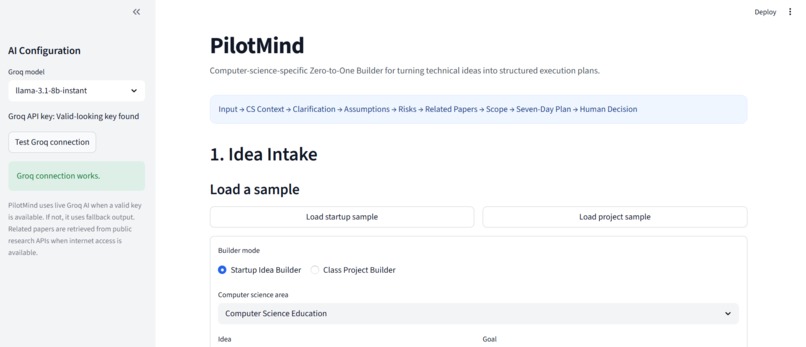
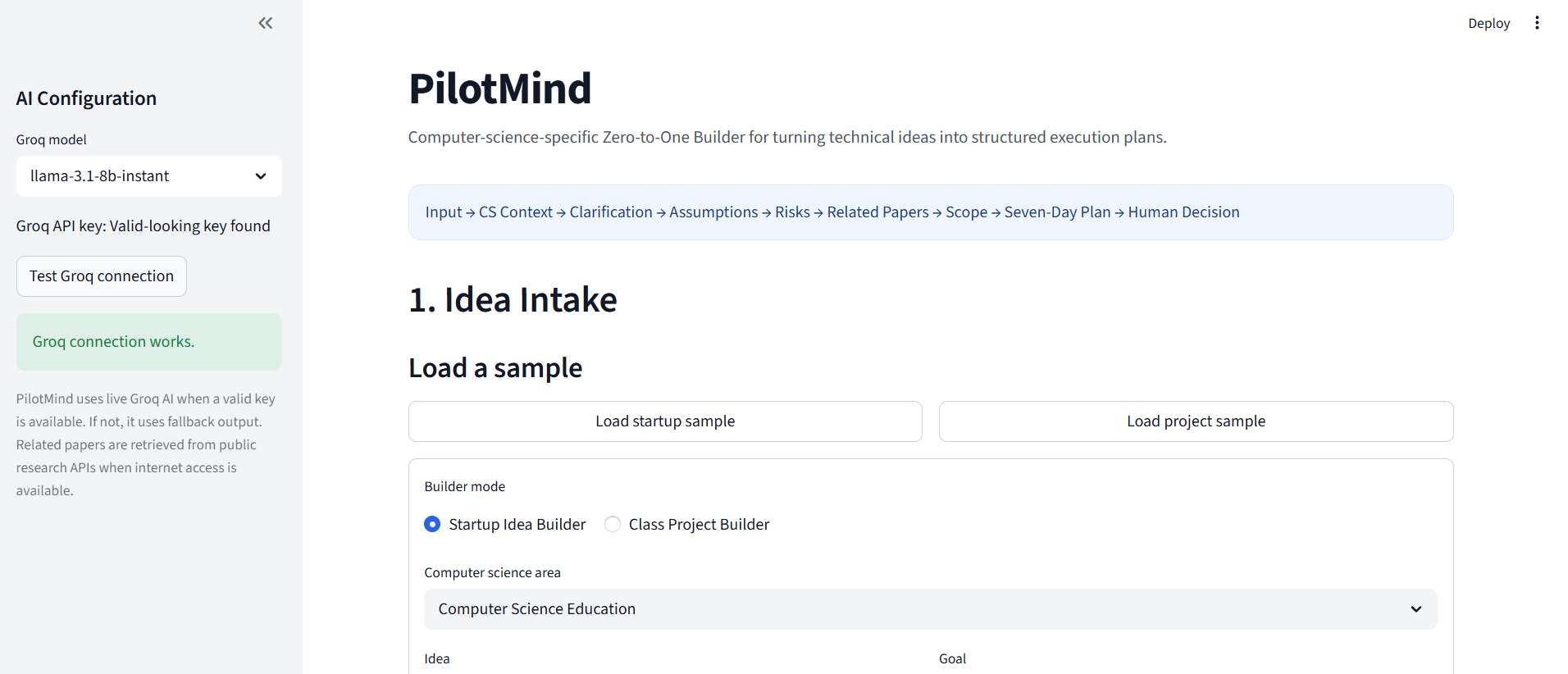
PilotMind homepage introducing an AI-powered Zero-to-One Builder for computer science students.
-
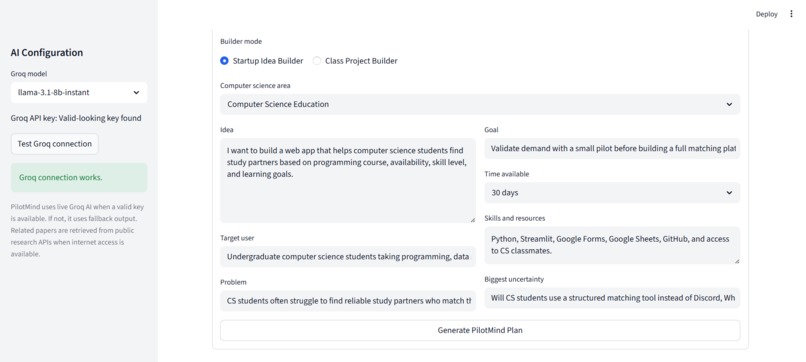
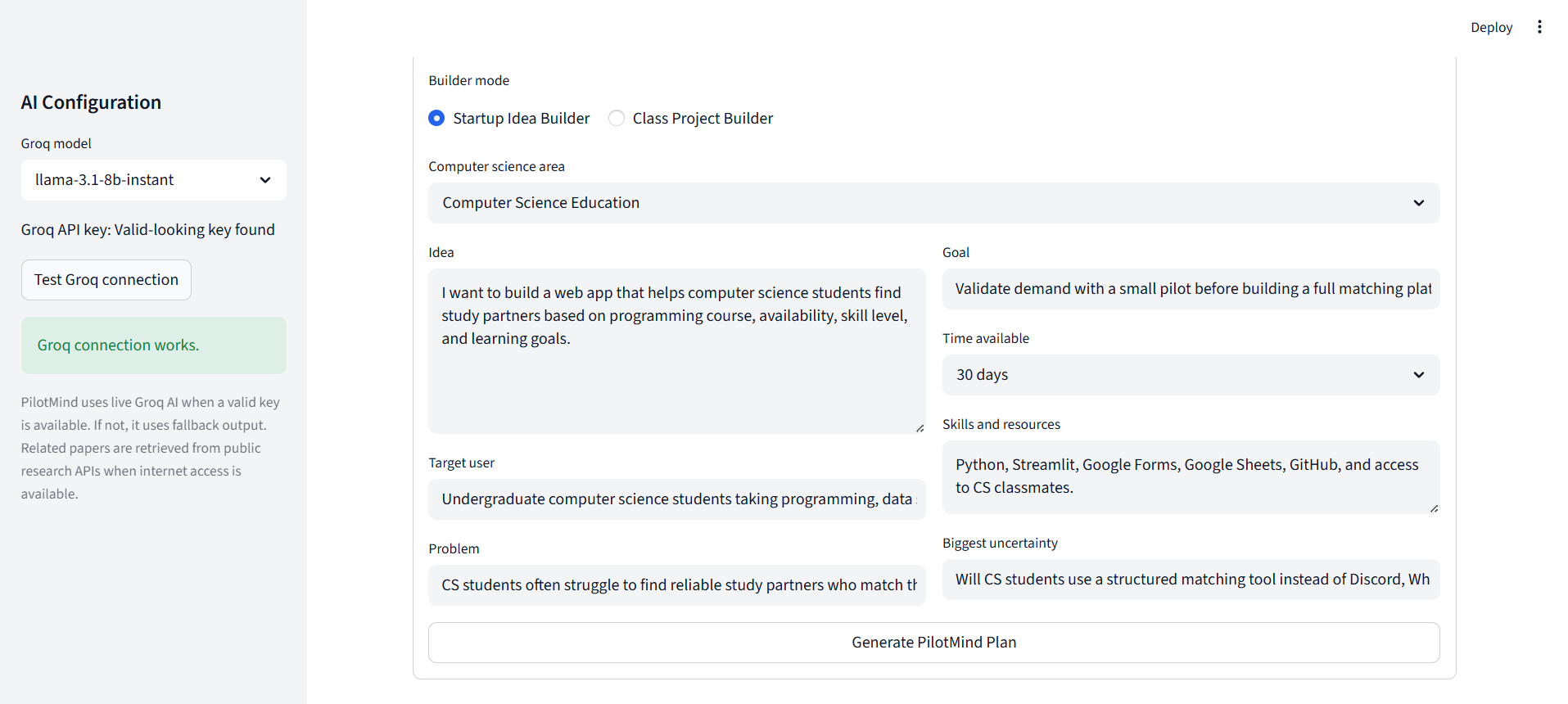
Structured form where students describe their project idea, users, goals, resources, and biggest uncertainty.
-
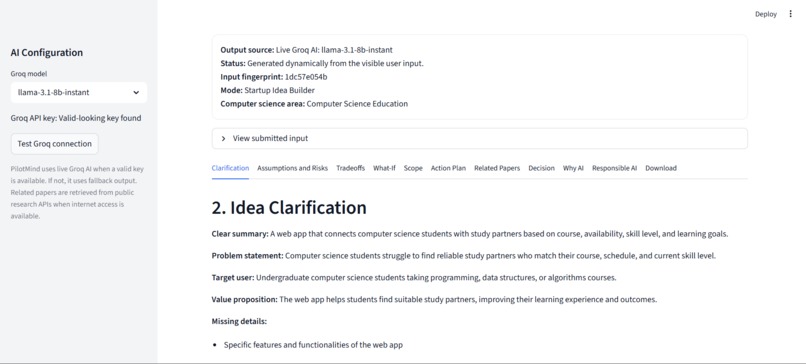
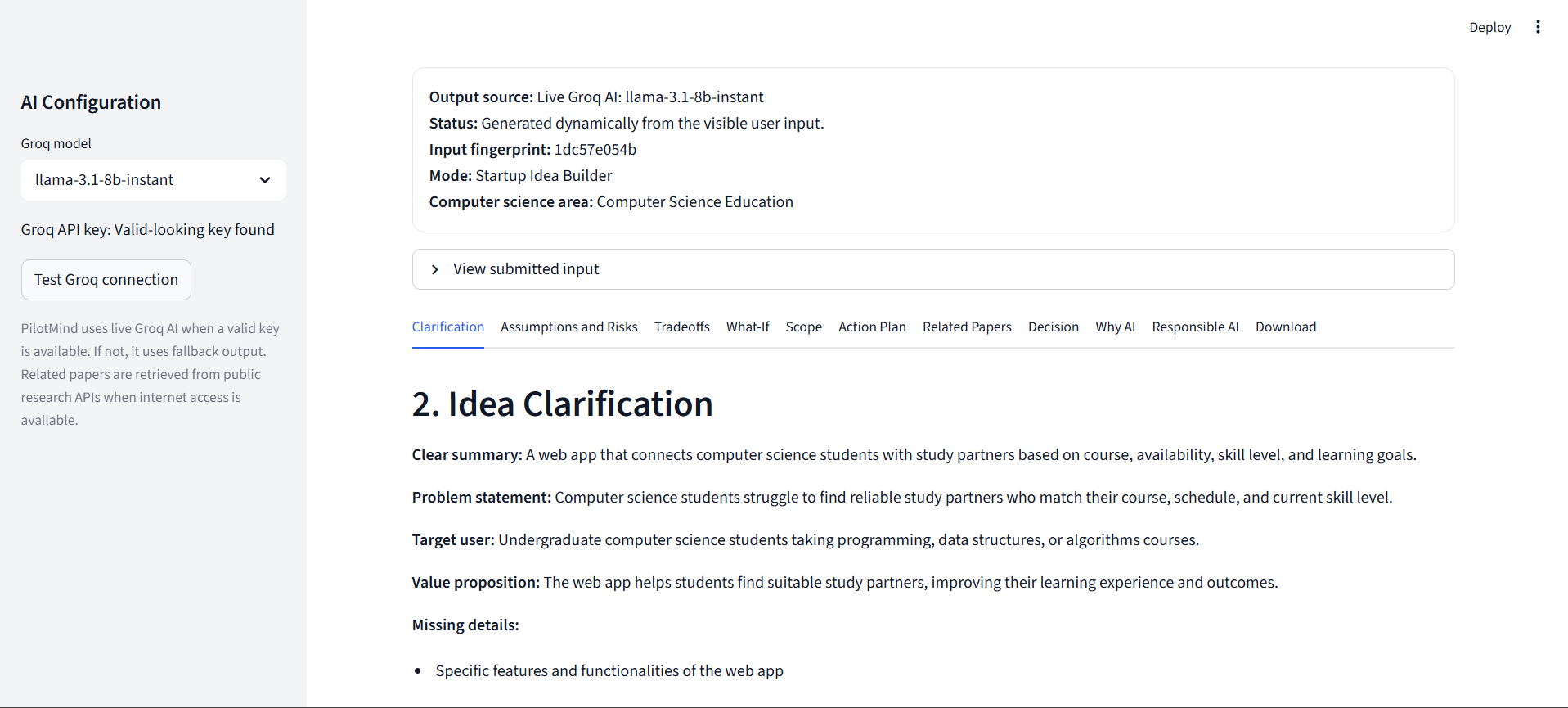
AI results tab showing reasoning, clarifications, risks, tradeoffs, insights, and action plan with Continue/Pivot/Pause controls.
Inspiration
We built Pilot Mind because many computer science students and early technical builders have ideas but struggle to turn them into realistic execution plans. A student may say, “I want to build an AI tool,” “I want to make a class project,” or “I want to solve this problem with software,” but the next step is often unclear.
The challenge is not only generating tasks. The real challenge is reasoning through uncertainty: What is the actual problem? Who is the user? What assumptions are risky? What should be built first? What evidence is needed before continuing?
Pilot Mind was inspired by this gap. We wanted to create a tool that helps users think more clearly and move from a vague computer science idea to a structured, testable plan.
What it does
Pilot Mind is a computer-science-specific Zero-to-One Builder. It helps students, early technical founders, and project teams turn uncertain ideas into structured execution plans.
The user enters:
- A computer science idea
- The CS area, such as AI/ML, software engineering, data science, cybersecurity, HCI, or CS education
- Target user
- Problem
- Goal
- Available time
- Skills and resources
- Biggest uncertainty
Pilot Mind then generates a structured plan with:
- Idea clarification
- Assumptions and risks
- Highest-risk question
- Tradeoff analysis
- What-if scenarios
- MVP or pilot scope
- Seven-day action plan
- Evidence to collect
- Related computer science papers with links and summaries
- Continue/Pivot/Pause decision criteria
- Responsible AI guardrail
- Downloadable Markdown report
The core flow is:
Idea> Assumptions> Risks> Tradeoffs>Scope > Action > Human Decision
Pilot Mind does not make the final decision for the user. Instead, it provides structured evidence and decision criteria so the user can decide whether to continue, pivot, or pause.
How we built it
We built Pilot Mind as a Streamlit web application using Python.
The app uses a structured AI pipeline:
- The user enters a computer science idea and project context.
- Pilot Mind sends the structured input to a Groq-hosted language model when a valid API key is available.
- The model returns a strict JSON response.
- The app validates and displays the response across clear reasoning sections.
- The app retrieves related computer science papers from public research sources when internet access is available.
- The user can review the plan, inspect the structured output, and download a Markdown report.
We used:
- Python
- Streamlit
- Groq API
- Llama models through Groq
- Public research APIs for related papers
- Structured JSON prompting
- Markdown export
We also added fallback behavior. If the Groq API key is missing or live AI fails, the app still works using saved fallback output. This keeps the prototype stable for demonstration.
Challenges we ran into
One major challenge was making Pilot Mind feel like a reasoning system instead of a simple chatbot. We did not want the app to generate a generic task list. To solve this, we designed the output around structured decision-support modules: assumptions, risks, tradeoffs, what-if scenarios, MVP scope, and human decision criteria.
Another challenge was managing reliability. Live AI can fail because of API keys, rate limits, or connection issues. Related paper retrieval can also fail if internet access is unavailable. We handled this by adding fallback output and clear output-source labeling.
We also faced Streamlit state-management issues. At one point, loading sample inputs caused session-state errors because the app tried to modify widget values after the widgets were already created. We fixed this by using Streamlit callbacks and stable session state keys.
A final challenge was responsible AI. Since users may over-rely on AI-generated plans, we had to design the app so it does not present outputs as final answers. Pilot Mind surfaces uncertainty, asks for evidence, and keeps the final Continue/Pivot/Pause decision in human hands.
Accomplishments that we're proud of
We are proud that Pilot Mind became more than a planning chatbot. It is a structured reasoning assistant that helps users think through early-stage computer science ideas.
We are especially proud of:
- Creating a clear input → reasoning → output → action flow
- Making the app specific to computer science projects
- Adding related paper links and summaries to connect ideas with research
- Building a Markdown export so users can save and share their plan
- Adding human-in-the-loop decision criteria
- Designing responsible AI safeguards around over-reliance and high-stakes topics
- Making the prototype stable with fallback behavior
We are also proud that the app supports both startup-style ideas and class project ideas, which makes it useful for different types of undergraduate builders.
What we learned
We learned that useful AI planning is not about producing more content. It is about helping users make better decisions under uncertainty.
We also learned that LLMs are useful when the input is vague, messy, and domain-specific. A fixed template can ask questions, but it cannot easily identify hidden assumptions, domain-specific risks, or practical tradeoffs across different computer science projects.
We learned that responsible AI should be part of the product flow, not only a disclaimer. Pilot Mind includes uncertainty framing, evidence collection, risk identification, and a human-controlled decision checkpoint.
Finally, we learned that a good prototype does not need to solve everything. It needs to demonstrate a clear user problem, a meaningful AI capability, and a responsible path from uncertainty to action.
What's next for Pilot Mind
Next, we want to improve Pilot Mind in several ways:
-Add stronger paper filtering so related research is more accurate -Add a plan quality score that highlights weak areas without predicting success
- Add PDF export in addition to Markdown export
- Add better evaluation metrics for different CS project types
- Add team collaboration features so multiple students can review one idea
- Add more domain-specific templates for AI/ML, cybersecurity, data science, and HCI projects
Long term, Pilot Mind could become a decision-support workspace for students and early builders who need help turning ideas into real, testable projects.


Log in or sign up for Devpost to join the conversation.