-
-
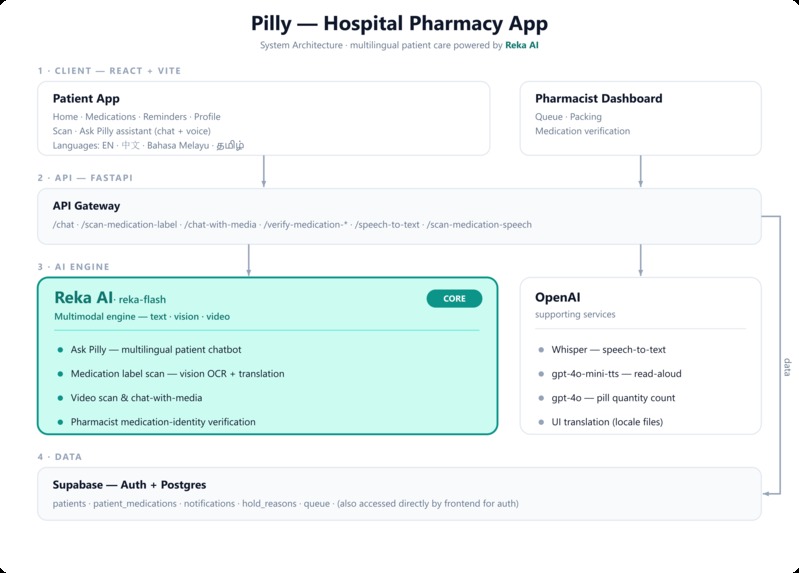
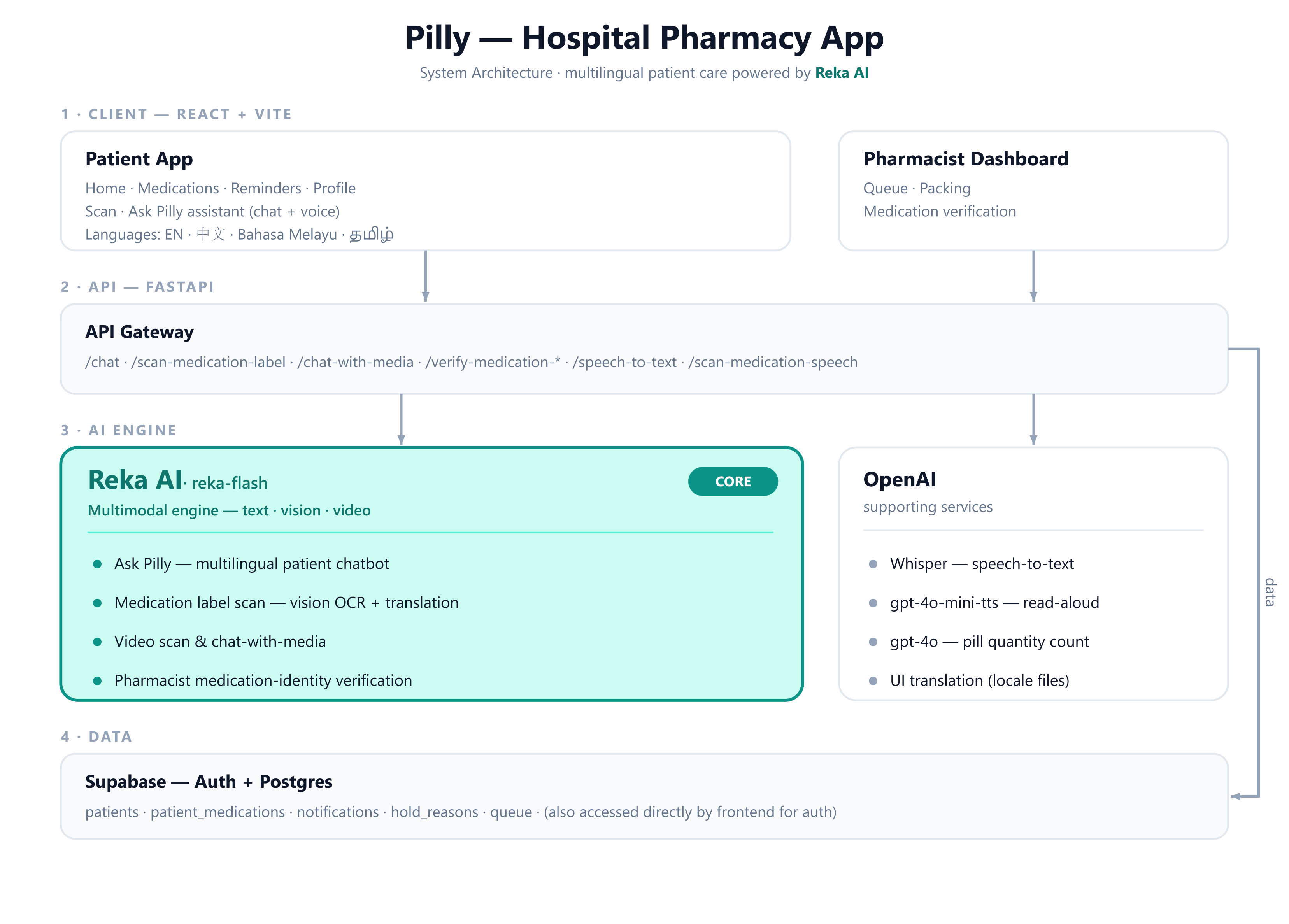
System Architecture Diagram for Pilly
-

Pilly App Logo

Inspiration
Long pharmacy waits left us wondering what happens behind the counter. After some of us experienced the dispensing workflow firsthand, we saw pharmacists juggling verification layers, heavy workloads, and patient frustration which are critical work that's largely invisible. This inspired Pilly, an AI pharmacy assistant built to streamline verification and dispensing while giving patients real-time visibility.
Pain Points it Solves
| No. | Pain Point | Solution |
|---|---|---|
| 1 | Verification Fatigue & Human Error: Repetitive medication/quantity checks increase mistakes from fatigue and lost focus. | AI-powered medication & quantity verification acts as an extra checking layer, reducing errors and boosting confidence. |
| 2 | Poor Visibility of Delays: Patients unaware of delays leads to confusion and frustration directed at pharmacists. | Put On Hold notifications instantly inform patients of delays and reasons via the app, ensuring transparency. |
| 3 | Long Waits & Missed Queue Numbers: Patients stepping away to rest or eat miss their number and must rejoin. | Real-Time Queue Tracking lets patients monitor progress remotely, reducing missed queues and disputes. |
| 4 | Language Barriers & Poor Adherence: Pharmacists struggle to explain instructions, and patients forget dosing later. | Medication Scan Assistant delivers info in plain language; Reminder System keeps patients on track with treatment. |
| 5 | High Enquiry Volume & Limited Staff : Pharmacists are overwhelmed by routine calls, especially during peak dispensing periods. | AI Q&A Assistant gives instant answers on medication and app usage, freeing pharmacists for higher-value clinical work. |
Key Features
For Pharmacists
- Live Queue Dashboard: Real-time view of every patient's status (Pending, On Hold, Ready, Collected), with filtering and search.
- AI Medication Verification: Scan a medication label; the AI reads it and cross-checks it against the prescription, flagging mismatches.
- AI Pill Counting: Count pills directly from a photo for a fast, accurate second check on quantity.
- One-Tap Medication Reminders: Auto-populated from the prescription, controlled by pharmacist and sent to the patient in a single tap.
- On-Hold Reason Capture: Requires a reason when an order is paused, encouraging single-session packing and reducing errors.
For Patients
- QR Code Entry: Patients scan a QR code on arrival at the pharmacy to access Pilly directly in their browser, skipping app store downloads entirely for a frictionless walk-in experience.
- Live Registration & Collection Queue: Real-time position, estimated wait time, and people ahead, with one-tap re-registration if a queue number is missed.
- Real-Time Push Notifications: Patients are notified the moment their queue is called, their order is delayed, or a reminder is due, even while the app is in the background.
- Reschedule Collection: Pick a new date/time slot directly in the app.
- Medications Dashboard: Every prescribed medication with dosage, purpose, instructions, and caution labels, with text-to-speech support.
- Scan Medication Label: Point the camera at any label, bottle, or sticker to get a plain-language breakdown (name, dosage, side effects, storage).
- Personalised Reminders: Pharmacist-initiated, patient-adjustable medication schedules.
- Ask Pilly (Chatbot): Ask about medications, side effects, or pharmacy info via text, voice, photo, or video which is available outside pharmacy hours.
- Profile & Preferences: View patient ID, registered hospital, and visit history; set a persistent language preference; toggle notifications for queue updates, reminders, and delay alerts individually.
- 4-Language Support: English, 中文, Bahasa Melayu, and தமிழ், across the entire patient experience, including scan and chatbot results.
- Accessible, Senior-Friendly UI: Large fonts, high-contrast layouts, and simple navigation designed for elderly patients, fully responsive across laptop and mobile screens.
Challenges We Ran Into
1. Pill Counting with Computer Vision Limitations
Silver foil packaging caused glare that washed out pocket edges and the model defaulted to assuming even-numbered layouts which miscounts odd-sized strips (e.g. a pack of 7). Prompt refinement on Reka AI didn't fix it; switching the counting step to GPT-4.1 vision resolved both the glare and odd-count issues.
2. Real-Time Translation & Reka AI's Language Limitations
Translating the full patient UI at runtime was slow and costly. Reka AI alone couldn't reliably translate Malay or Tamil. We split the pipeline: Reka AI extracts text → GPT-4.1 translates it, giving accurate results across all four supported languages without the runtime cost.
Future Improvements
1. Multilingual & Dialect Voice Translation Support
Expand support to additional languages and local dialects to further improve accessibility and reduce communication barriers for diverse patient groups.
2. GPS-Based Queue Recall & Navigation Guidance
Use location awareness to detect when patients are far from the pharmacy and proactively notify them when their turn is approaching. Navigation assistance can also help patients return to the correct location on time.
3. Robot Interaction for Internal Pharmacy Logistics
Many hospital pharmacies already utilise autonomous robots for medication transportation. A future enhancement would allow pharmacists to summon robots directly to their workstation or dispensing counter, reducing unnecessary movement and improving workflow efficiency.
https://docs.google.com/document/d/1Fw129Su4LN6EbFrOM1mT-VKnD9sTXVZp8NfeivmLFRQ/edit?usp=sharing
Built With
- fastapi
- node.js
- openai
- postgresql
- python
- react
- rekaai
- supabase
- typescript
- vite
- webpushapi


Log in or sign up for Devpost to join the conversation.