Inspiration
At Ng Teng Fong General Hospital, a senior pharmacist described medication reconciliation as “detective work.” A single patient on multiple drugs can take hours to investigate. With 95% of elderly Singaporeans experiencing polypharmacy and over half not literate in English, misidentification is a daily risk. We wanted to create a tool that transforms this detective work into seconds of clarity.
What it does
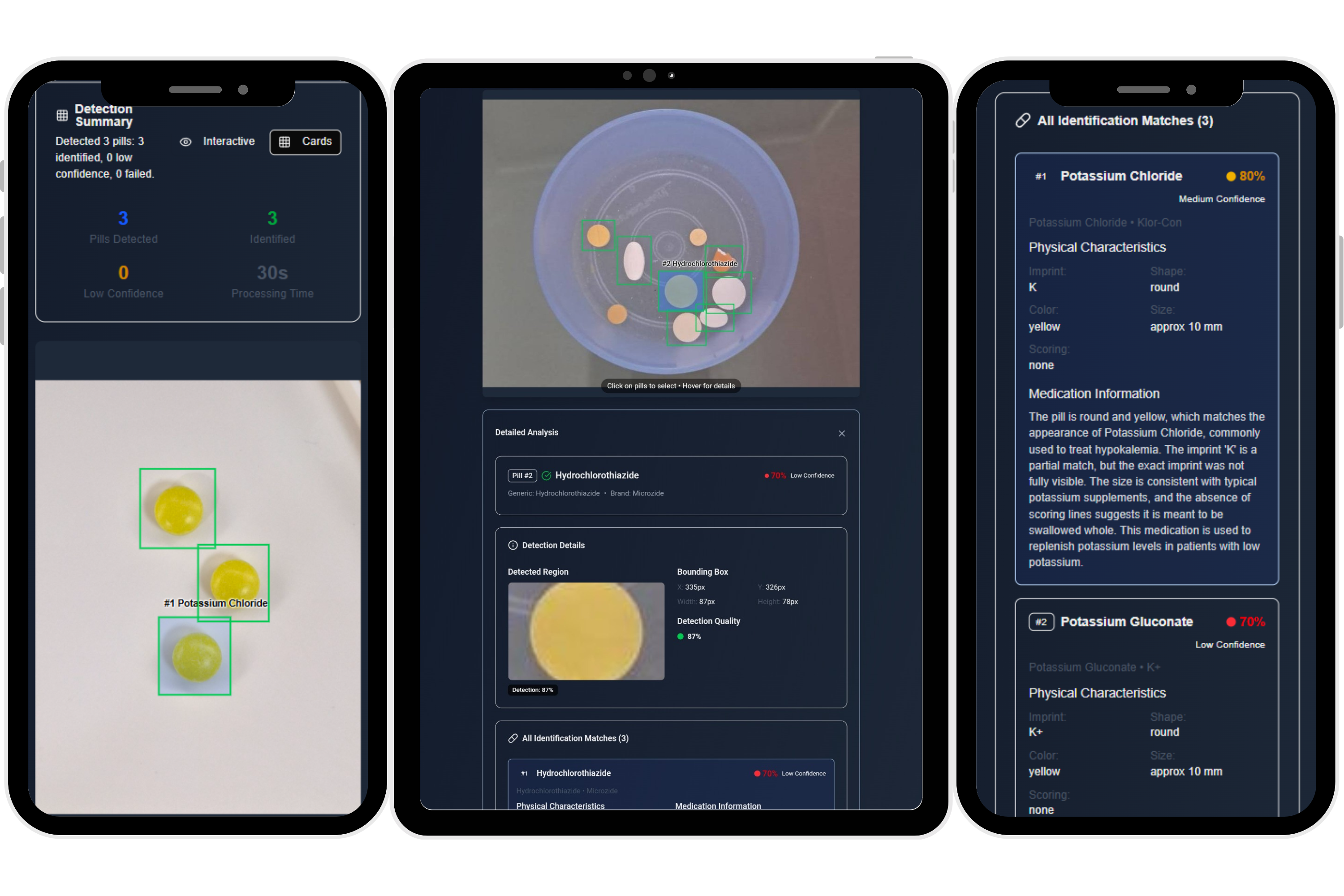
PillSnap lets healthcare professionals snap a photo of loose or unlabelled pills. Using machine learning segmentation and AI-powered identification, the system detects each pill and provides the top 3 confidence matches, with details on imprint, color, size, and typical use cases. It also explains its reasoning, helping clinicians make safe and confident decisions quickly.
How we built it
- YOLOv8 for pill detection and segmentation.
- OpenAI GPT-4o mini for pill identification, reasoning, and generating clear medication descriptions.
- Next.js frontend for the demo platform.
- Vercel for backend hosting.
- v0 for quick prototyping.
Challenges we ran into
- Getting accurate segmentation of cluttered pill images.
- Ensuring the AI provided detailed but clinically relevant reasoning (avoiding hallucinations).
- Time constraints in integrating multiple APIs into a smooth workflow.
Accomplishments we’re proud of
- A working demo where pills are segmented and identified within seconds.
- Strong validation from healthcare professionals.
- A clean, intuitive interface that mirrors real clinical workflows.
What we learned
- How to balance speed and accuracy in computer vision + LLM pipelines.
- The importance of user validation early in healthcare projects.
- That healthcare AI adoption depends on trust and every design choice must inspire confidence.
What’s next for PillSnap
- Integrating drug safety alerts and interaction checks.
- A professional forum with AI-powered case summaries.
- EHR integrations for seamless hospital use.
- Expanding beyond Singapore to Southeast Asia and global healthcare markets.
Built With
- next.js
- openai
- typescript
- v0
- vercel
- yolov8


Log in or sign up for Devpost to join the conversation.