-
-
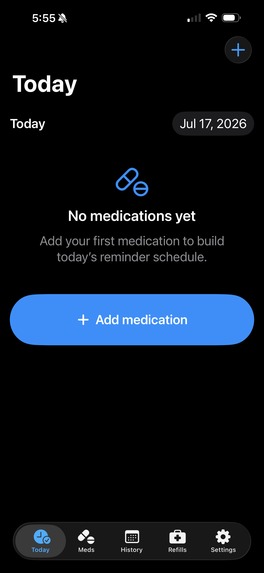
Main Screen
Inspiration
Medication routines involve more than one alarm. People may need different schedules, dose confirmation, refill awareness, history, and a simple way to contact a caregiver. I built PillSignal to bring those pieces together while keeping medication information private on the device.
What it does
PillSignal is a native medication reminder and tracking app for iPhone, iPad, and Android. Users can:
- add medications with dosage, form, notes, dates, and reminder schedules;
- use daily, selected-weekday, interval, or as-needed schedules;
- respond to reminders with Taken, Snooze, or Skip;
- review upcoming, taken, skipped, and missed dose history;
- track pill supply and receive refill reminders;
- store an optional caregiver contact and manually initiate a neutral message;
- export medication and dose history as a PDF; and
- delete all locally stored app data.
PillSignal is a reminder and tracking tool, not a medical device. It does not provide dosage guidance, interaction checking, diagnosis, or treatment recommendations.
How I built it
The repository contains two native clients.
The Apple app uses SwiftUI, SwiftData, UserNotifications, PDFKit/UIKit, and localized resources. The Android app uses Kotlin, Jetpack Compose, Material 3, a local repository/ViewModel layer, Android notification scheduling, and PdfDocument.
Both clients follow the same local-first model: medication data, dose history, caregiver details, and settings remain in app-private device storage. Notifications and PDFs are generated locally. There is no account, developer-controlled backend, subscription, advertising, or analytics SDK.
How I used Codex and GPT-5.6
Codex powered by GPT-5.6 worked as my AI pair programmer during Build Week. It helped translate the medication-reminder concept into native SwiftUI and Jetpack Compose apps, design the medication and schedule models, implement local persistence, build actionable reminders, and create refill tracking, dose history, caregiver contact, and PDF export.
Codex also helped keep the two clients behaviorally aligned while respecting platform conventions, and supported accessibility, localization, dark mode, privacy language, and medical-safety boundaries. During final preparation, Codex inspected the repository for exposed secrets, verified both platform builds, and created the complete setup and acceptance-testing documentation.
I directed the product choices, reviewed the generated code, tested the apps, and iterated with Codex. PillSignal does not call OpenAI APIs at runtime and sends no medication data to OpenAI.
Challenges and decisions
The core design challenge was creating useful reminders without turning a local utility into a cloud health-data service. I chose platform-native local persistence and notifications, plus explicit user actions for exports and caregiver messages. Supporting the same product on two native stacks also required careful alignment of schedule, history, refill, and safety behavior.
Privacy and safety
PillSignal does not collect or upload medication data. There are no analytics or advertising SDKs. Users control notification permissions, exports, caregiver communication, and data deletion. The app repeatedly directs users to follow their doctor or pharmacist and does not attempt clinical decision-making.
Testing
The public repository contains separate setup instructions for Xcode and Android Studio, command-line builds, and a cross-platform acceptance checklist. The final iOS Simulator build and Android debug APK build both completed successfully.
Links
- Source and testing instructions: https://github.com/powerusa/PillSignal
- Demo video: https://youtube.com/shorts/l7gBWqgpSdo

Log in or sign up for Devpost to join the conversation.