-
-
-
Meansure my pulse
-
Inspiration
This problem is in my own home. My little brother has a heart condition and must take a daily medicine that prevents blood clots (thrombosis). Every day he has to take it, and sometimes he forgets. I forget my own medicine too: at night I often fall asleep before I take it. My grandmother and grandfather also take 3 to 4 medicines a day, and sometimes they take them late or skip them completely.
The worst part is not one forgotten pill. A person forgets for two or three days, only then remembers, and by that time the illness can get worse. This matters most for people with long-term conditions like diabetes or heart disease, who must take their medicine on time. And it is not only older people: children and teenagers forget too, because they are busy with school and sleep.
It is also a big topic in medicine. The World Health Organization has reported that in developed countries only about half of patients with long-term illnesses take their medicine as prescribed.
What is the specific problem, and how do I know it's real?
People with daily medicines forget them, take them late, or stop taking them, and nobody notices until the illness gets worse. I know it is real because I see it at home (my brother, my grandparents and me), and because I asked my teacher and my friends about it. They tried the app and told me that they also forget medicine or other daily things. Grandparents already use a paper notebook as a reminder, but they forget to look at the notebook too. So the problem is not the list, it is the reminder.
What it does
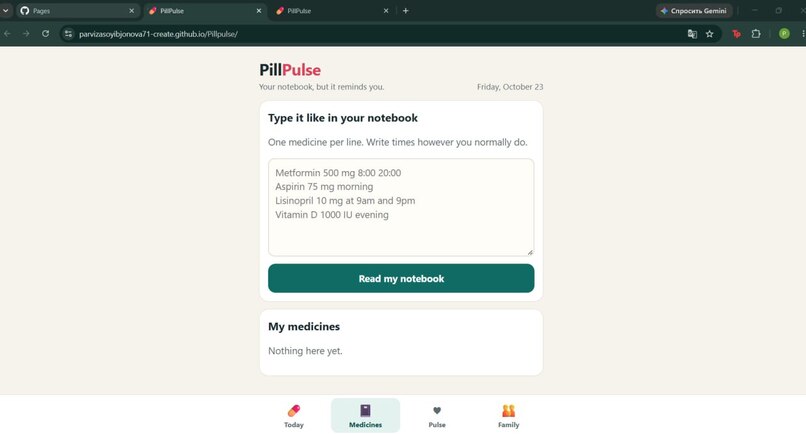
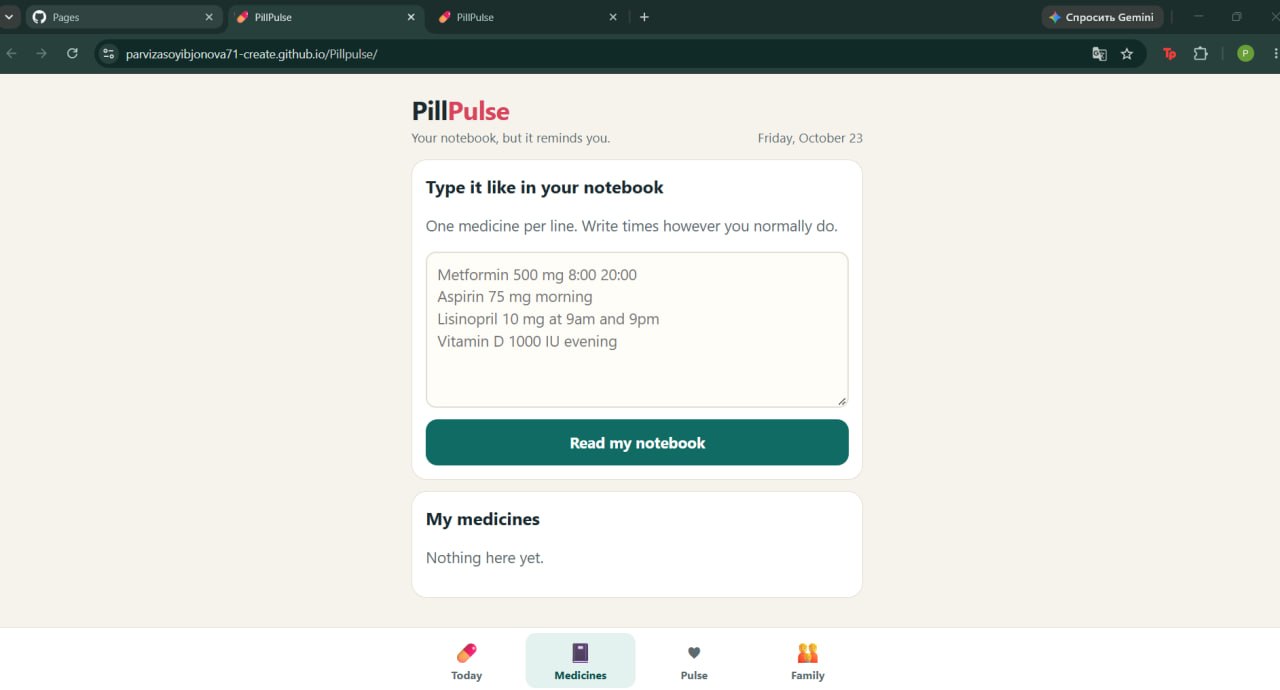
- You type your medicines the way you write them in a notebook, for example "Lisinopril 10 mg at 9am and 9pm". A parser turns this into a daily schedule that you can check and edit.
- The Today screen has big "I took it" buttons, highlights missed doses and shows a 7-day adherence score.
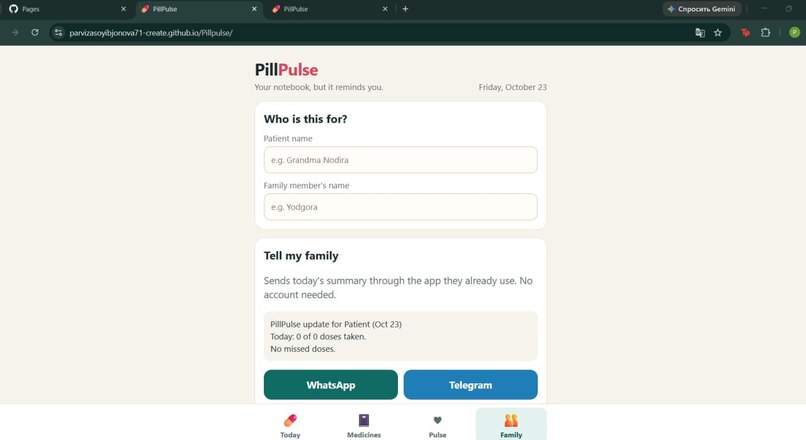
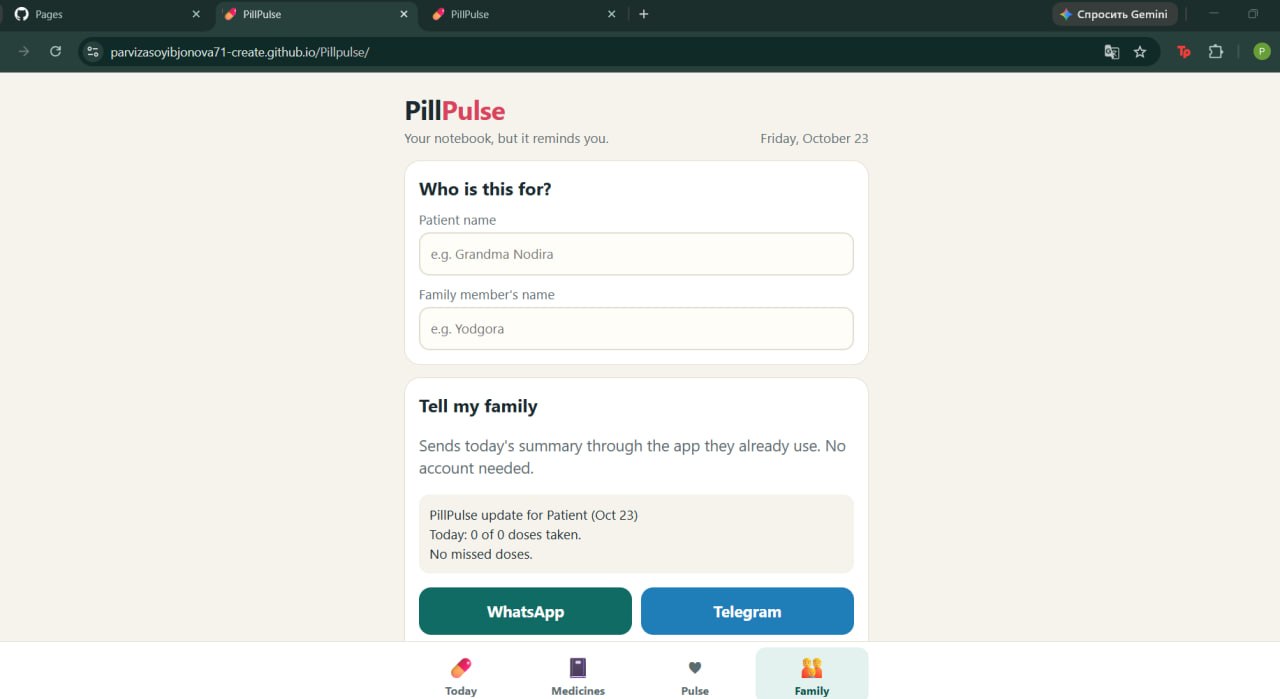
- With one tap, the app sends a summary (what was taken, what was missed, last pulse) to a parent or family member through WhatsApp, Telegram or the phone's share menu. No accounts and no bot are needed.
- A downloadable calendar file creates daily alarms in the phone's own calendar, so reminders still ring at night even when the app is closed.
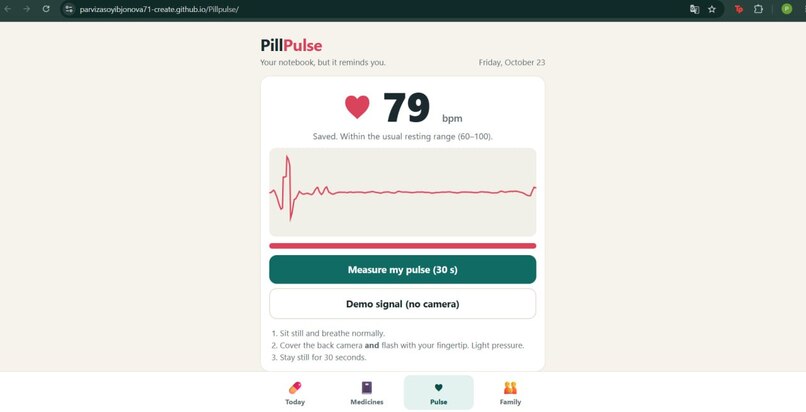
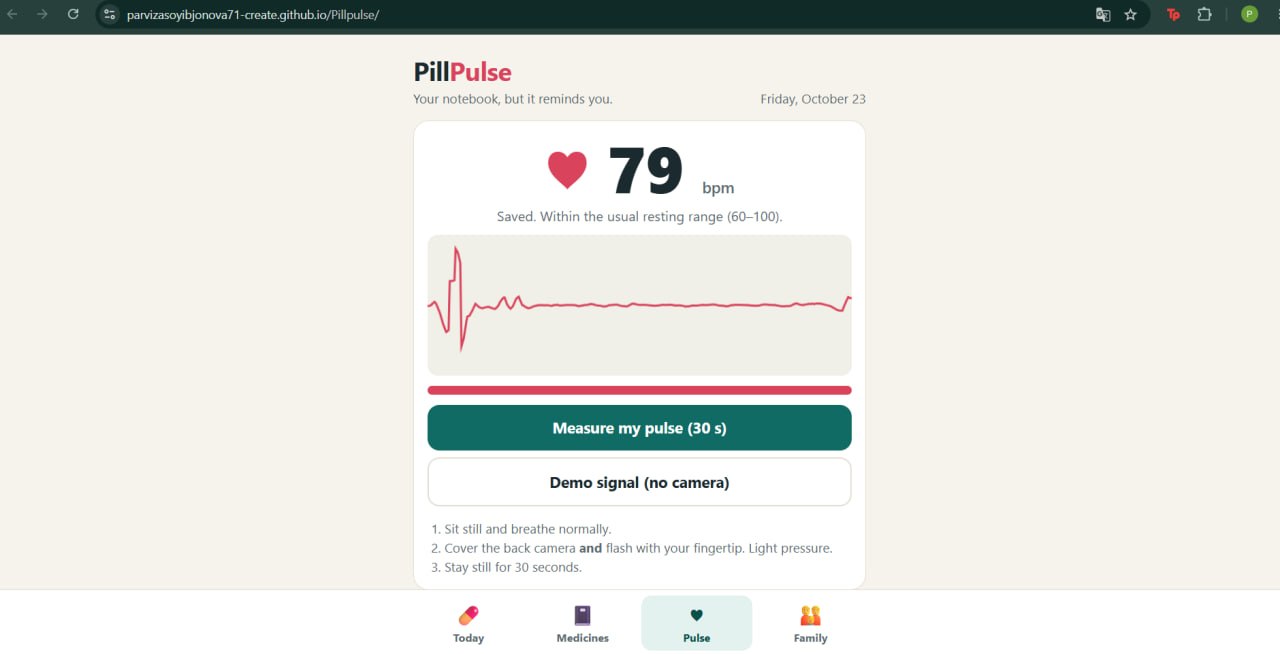
- Pulse check: you cover the phone camera and flash with a fingertip. Each heartbeat slightly changes how much red light passes through the finger (photoplethysmography). The app filters this signal, finds the peaks and calculates beats per minute.
- A printable weekly doctor report shows which doses were taken and the pulse readings, because patients often cannot remember details during a visit.
- Accessibility: extra large text, high-contrast big buttons, read-aloud reminders and a simple interface that works for kids, teens and grandparents.
How I built it
HTML, CSS and vanilla JavaScript, with no external libraries. A rule-based text parser reads notebook-style input. Pulse detection uses the red channel of the camera video, a moving-average filter and peak detection. All data stays in the user's browser (localStorage), so there is no server and no personal data is collected. The site is hosted on GitHub
Challenges I ran into
Writing the code was the hardest part for me, because before this I only worked with websites and bots. I also had to learn for the first time how to create a GitHub repository and publish a site with GitHub Pages.
What I learned
Good health apps do not need to be complicated. The most important thing is a clear reminder, a very big button, and a way for a family member to know when something is missed.
What's next
Let users take a photo of their notebook page and read the handwriting automatically, add voice input, make a shared family dashboard where a parent can see a child's doses, and test the pulse measurement against a medical device with the help of a doctor.
PillPulse is a student project. It is not a medical device and does not give medical advice.
Built With
- css
- github
- html
- javascript
- localstorage

Log in or sign up for Devpost to join the conversation.