Inspiration
Meera is 74, lives alone and takes five medicines, one of them warfarin. Her knee hurts. Can she take Advil? The leaflet print is tiny and her daughter isn't answering, so she guesses.
She isn't unusual:
- About 1 in 6 older Americans is at risk of a potential major drug–drug interaction, and over a third take five or more prescription medicines at once (Qato et al., JAMA Internal Medicine 2016).
- Adults 65+ visit US emergency rooms for adverse drug events more than 600,000 times a year, and blood thinners are the leading cause (CDC).
An AI assistant can answer that question in seconds. The problem is what it needs to hear: her voice, her name, her medicines and her health worries. The people who most need this are also the people with the most reason not to send all of that to a server.
So the question I built around was: what if the cloud only ever saw the drug names?
What it does
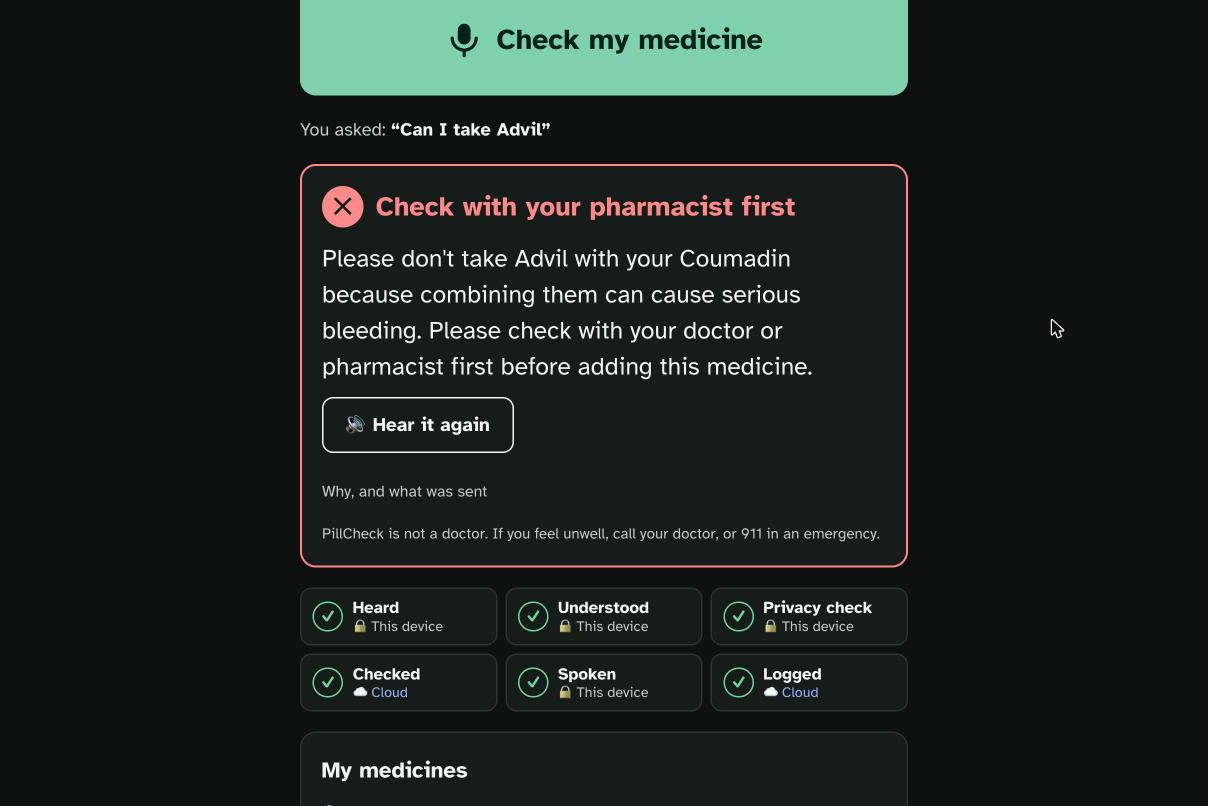
Meera presses one big button and says "Can I take Advil?" A few seconds later she hears "Please don't take Advil with your Coumadin because combining them can cause serious bleeding. Please check with your doctor or pharmacist first before adding this medicine." (the exact answer from the recorded demo run)
Under the hood, each step is pinned to one place on purpose:
| Step | What | Where |
|---|---|---|
| 1 | Hear the question | On device: Chrome speech recognition with processLocally |
| 2 | Pull out the drug names | On device: Gemini Nano via Firebase AI Logic, ONLY_ON_DEVICE |
| Guard | Only known drug names may leave | On device: leak guard |
| 3 | Check the interaction | Cloud: Gemini via Firebase AI Logic, ONLY_IN_CLOUD, grounded in FDA labels |
| 4 | Speak the answer | On device: local voice |
| 5 | Audit log | Cloud: Firestore, with no personal data |
What makes it trustworthy:
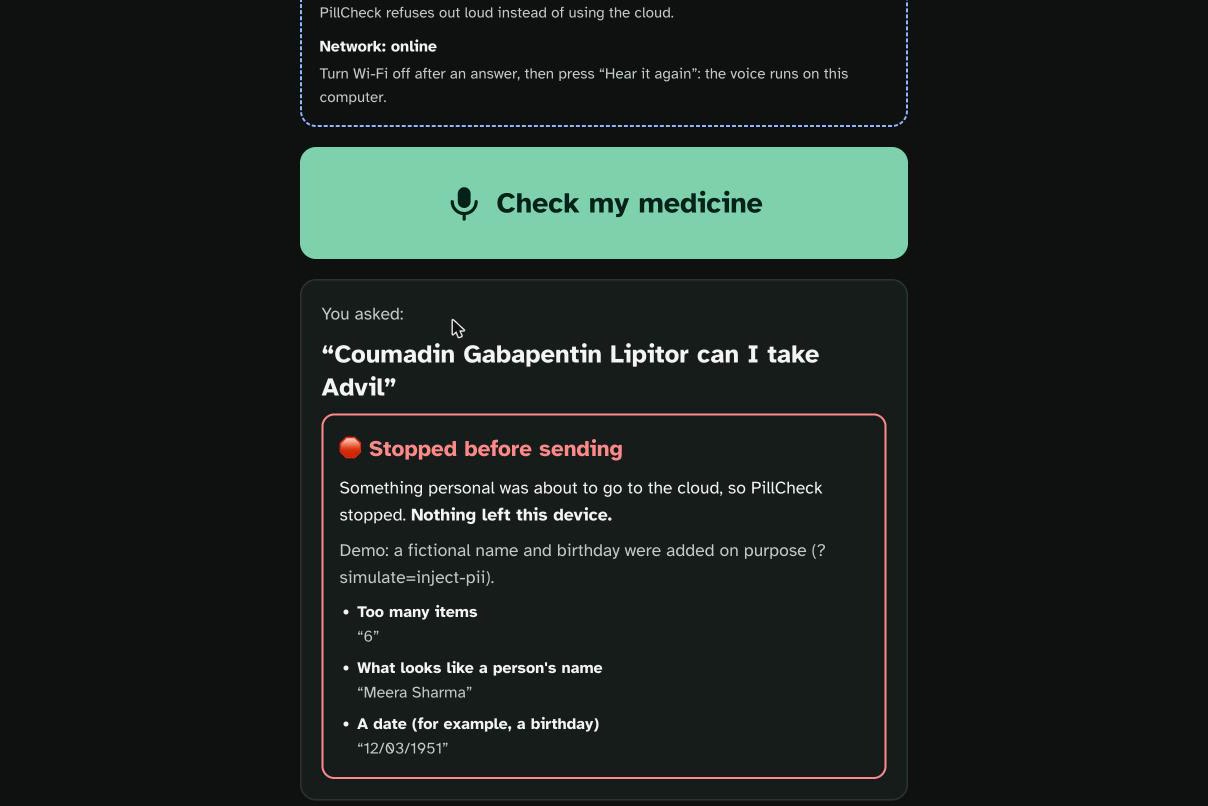
- The leak guard. Whatever Nano extracts, the cloud only gets canonical ingredient names from a closed list built from openFDA. "Advil" becomes
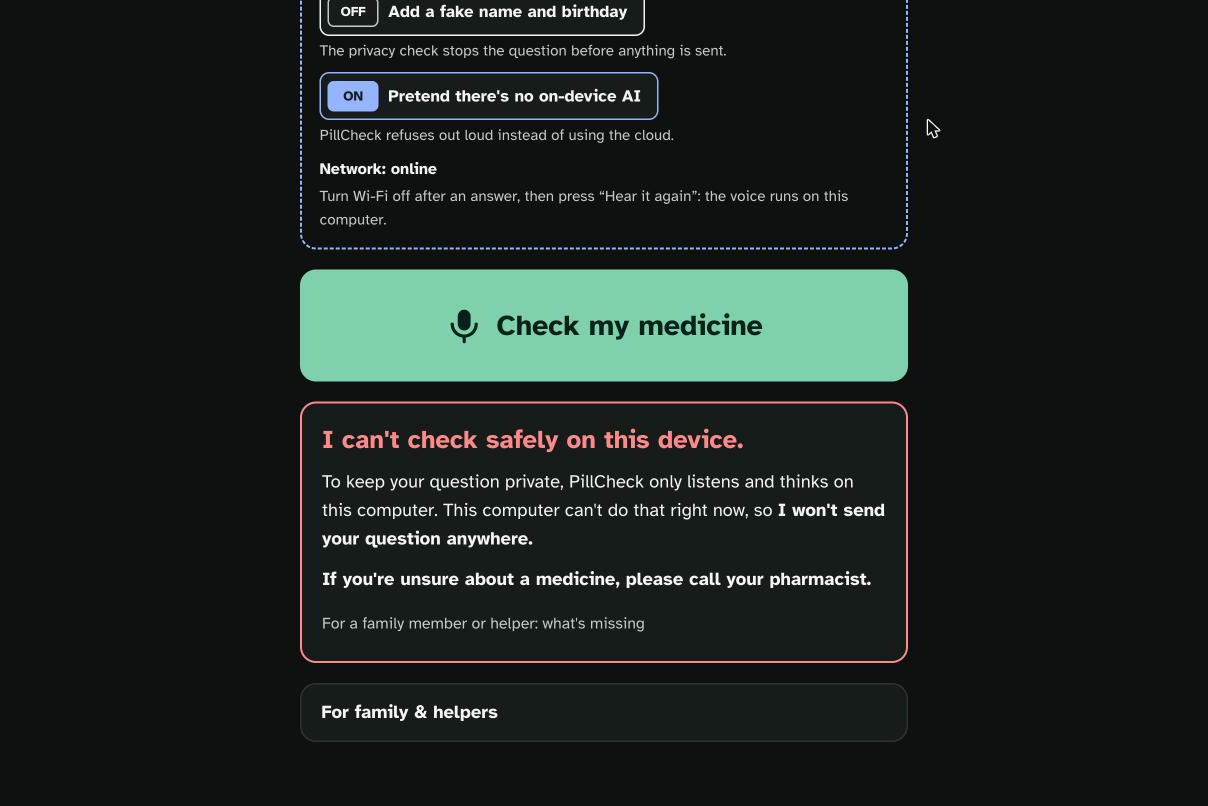
ibuprofenand "Coumadin" becomeswarfarin. A name, a birthday or a dose is blocked, and PillCheck says so out loud: "Stopped before sending. Nothing left this device." - Her names come back on the device. The cloud sees
warfarin, and she hears "Coumadin". - It fails closed. If the computer can't run the private steps locally, PillCheck says "I can't check safely on this device" and sends nothing. It never quietly moves a private step to the cloud.
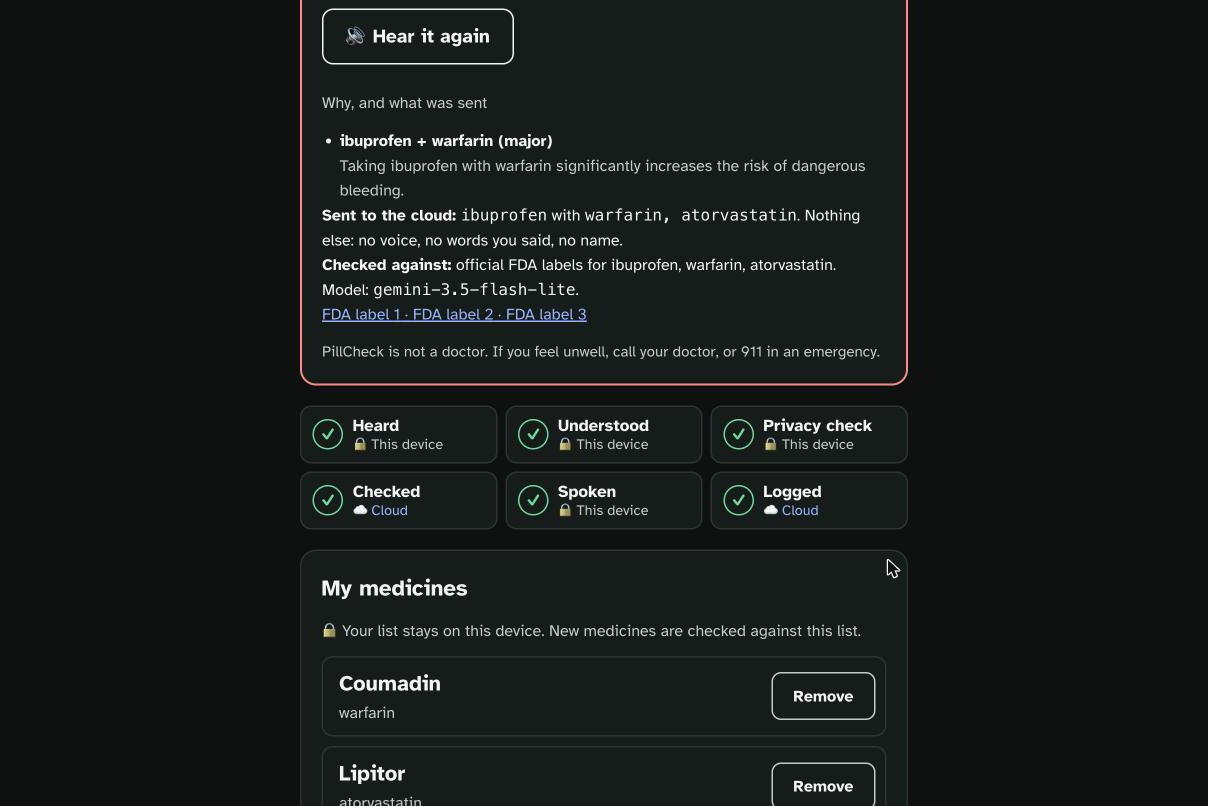
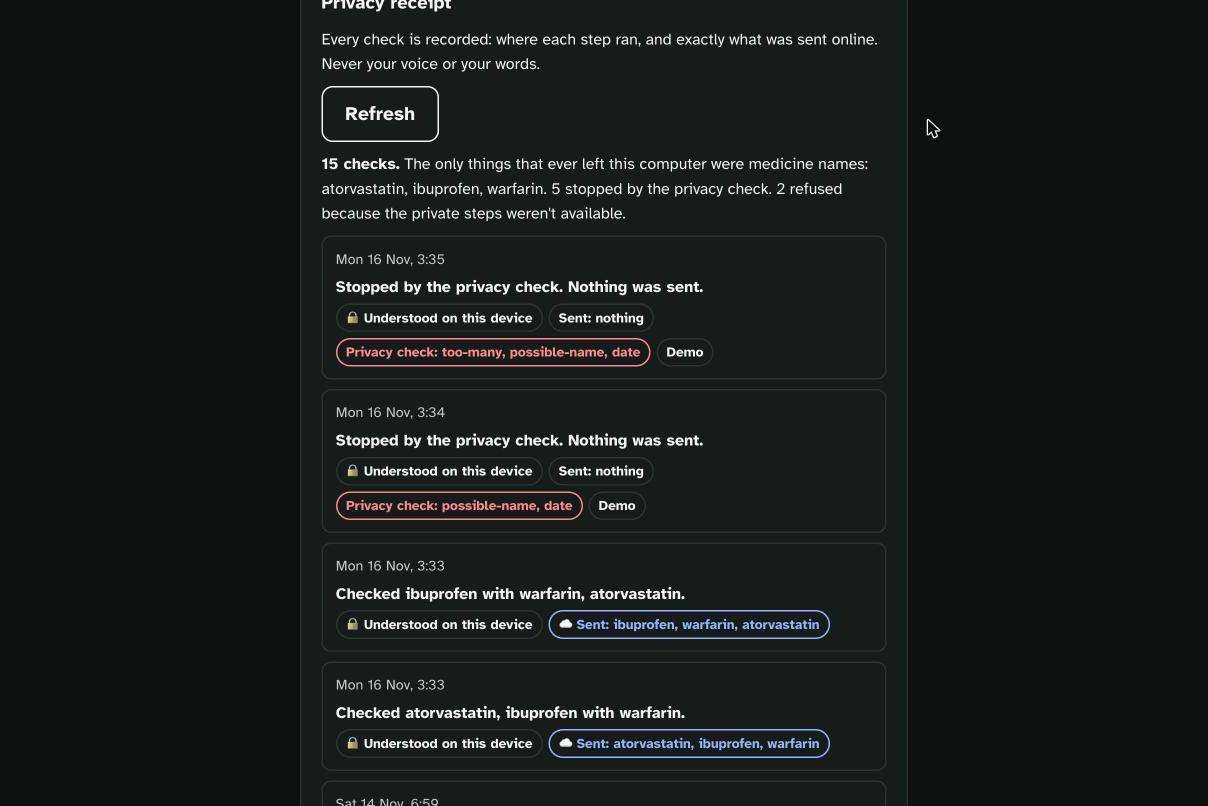
- A live provenance strip shows where each step ran (🔒 This device / ☁️ Cloud). A privacy receipt lists, in plain language, everything that has ever left the computer.
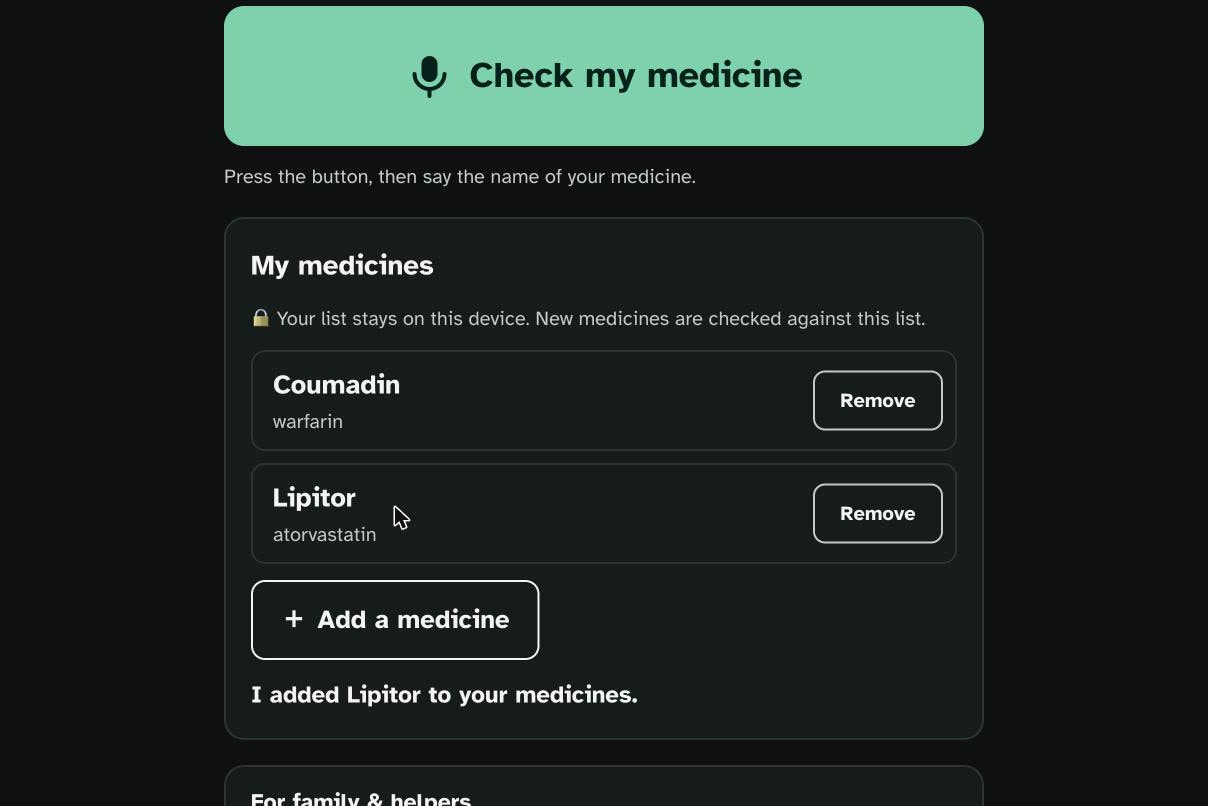
- My medicines are added by voice, stored only in the browser, and included in every check.
- Built for a 74-year-old:
- one 7rem button;
- the Atkinson Hyperlegible typeface;
- WCAG AAA (7:1) contrast, enforced by a test;
- answers of three sentences at most, written to be heard;
- a "Did you mean Coumadin?" button when a name is misheard.
How I built it
- Firebase AI Logic hybrid inference (
[email protected]):InferenceMode.ONLY_ON_DEVICEfor Step 2, with a JSON SchemaresponseConstraintso Nano must return{"medicines": [...]};ONLY_IN_CLOUDfor Step 3, with aresponseSchema(verdict, spoken text, interactions).
- The routing policy is code (
src/pipeline/policy.ts). The UI labels, the audit log and the tests all read from it. - Firebase App Check, enforced. reCAPTCHA Enterprise protects AI Logic and Firestore, and AI Logic uses limited-use tokens. I verified it on the live site: a Gemini request with a missing or forged token gets
401. - Firestore audit log. It holds only fixed status words, finding types, and the drug names that were actually sent. Security rules make it owner-only, append-only and schema-checked. They even refuse a record claiming Step 2 ran in the cloud. 12 emulator tests cover the rules.
- Remote Config tunes the cloud models, the answer length, the listening time and a kill switch. By design, no key can move a step between device and cloud, disable a guard, or widen what is sent.
- Grounding: Step 3 fetches the interaction, boxed-warning and older-adult sections of the official FDA label (openFDA) for each drug. Gemini answers from those first.
- Hosting: Firebase Hosting with a strict Content Security Policy. The page can only contact Firebase and openFDA, and the browser refuses everything else.
- Stack: React + TypeScript + Vite, with 231 Vitest unit tests.
Challenges I ran into
ONLY_ON_DEVICEisn't a guarantee. Reading the SDK source, I found that when Chrome'sLanguageModelAPI is missing, the request quietly goes to the cloud even inONLY_ON_DEVICEmode. I wrote a test against the real SDK that proves it: a transcript with a patient's name reaches the cloud endpoint. PillCheck therefore checks Nano is ready before every on-device call and checksinferenceSourceafter it. Anything uncertain means refusal.- On-device audio isn't supported by the Firebase hybrid SDK. So Step 1 uses Chrome's on-device speech recognition. PillCheck verifies that
processLocallyreally is on, and treats any network error as a refusal instead of a retry. - "Can I take Behind Patel?" That's what the local recogniser first heard for "Advil". I fixed it with Chrome's contextual-biasing phrases: her own medicines get the strongest boost, then common ones. The "Did you mean…?" button is a backstop. It has a test that ~30 common first names and surnames are never "corrected" into a drug.
- Store brands. "Equate" and "CVS" sell dozens of different drugs under one name. The lexicon builder keeps a brand only if every product under it has the same ingredients.
- I found a secret in my own bundle before I shipped it. A config default had been inlining every
VITE_*value into the production bundle, including the App Check debug token. I caught it before the first deploy, and a test now fails on the old code. - A 110-second hang. My safety evaluation found that Step 3 had no timeout. Now each cloud model gets 15 seconds and each label request 6. After that comes the backup model, then "ask your pharmacist".
Accomplishments that I'm proud of
- Safety evaluation: 30 of 30. I ran 20 dangerous pairs (warfarin + ibuprofen, sildenafil + nitroglycerin, oxycodone + alprazolam…) and 10 safe ones through the full live pipeline. There were 0 missed dangers and 0 over-warnings, at 2.5–4.5 s per answer.
- The privacy promise is checked in four independent places:
- the leak guard;
- a second guard inside Step 3, right before the network;
- the audit builder, which only accepts a closed vocabulary;
- Firestore security rules.
- The demo can't be faked into leaking. Its switches (
?simulate=…) can only take capabilities away, never add one. - Lighthouse accessibility 100, and AAA contrast in light and dark mode.
What I learned
- Hybrid AI isn't "on device when you can, cloud when you must". For sensitive data, the useful version is "this step on device, always, or not at all", and you have to enforce that yourself.
- The cheapest privacy technique was not sending the data at all. The cloud model works just as well on
["ibuprofen", "warfarin"]as on the sentence Meera said. - Designing for an older user changed my engineering choices, not just the CSS. Examples: answers that fit in three spoken sentences, two taps to remove a blood thinner, and spoken refusals so she always knows why nothing happened.
What's next for PillCheck
- More languages for speech and voice, starting with Hindi.
- A pharmacist-reviewed evaluation set, much larger than 30 pairs.
- A Chrome extension so a family member can set it up once on Meera's computer.
- Reminders from the on-device medicine list, which never leaves the device.
PillCheck is not medical advice. It always tells people to check with their pharmacist or doctor.
Built With
- chrome-built-in-ai
- cloud-firestore
- firebase-ai-logic
- firebase-app-check
- firebase-authentication
- firebase-hosting
- firebase-remote-config
- gemini
- gemini-nano
- openfda
- prompt-api
- react
- recaptcha-enterprise
- typescript
- vite
- vitest
- web-speech-api
