-
-
This image is currently processing. Please be patient...

Every Sunday I photograph the grid on my dad's fridge and text it to myself. Eleven prescriptions, four doctors, his handwriting. He is 78 and I live in another city. When a fifth doctor added ciprofloxacin last week, nobody checked it against the warfarin. The interaction checker I found online said "moderate." That was the entire explanation.
Pillbox is my answer to "moderate."
One list, two links. I open the medication list with my link and get 12 WebMCP tools. His pharmacist opens the same list with a different link and gets 9. Same page, same origin. add_medication, accept_change, print_round_card and the side-effect form only exist in my window. propose_change and add_counsel_note only exist in the pharmacist's. If you open DevTools, Application, WebMCP in each window the lists disagree, and that disagreement is the product.
The label, verbatim. I tell my agent "he started ciprofloxacin yesterday." It calls check_interactions with add: "ciprofloxacin", so the new drug is checked against the list before it is added. Two rows go red. Each flag shows the exact sentence from the FDA label that triggered it, the label's set_id, the openFDA URL, and a severity taken from which section the sentence lives in (boxed warning, contraindication, warning, interaction). Nothing is rephrased. Click the set_id and read the label yourself.
That rule cost me most of the data work. openFDA hands you combination products first, so the label for "Amlodipine and Atorvastatin" would have stood in for atorvastatin and given it no pharmacologic class at all. The index now aggregates brands, classes and section text across every prescription label for a generic instead of trusting the first hit. 64 drugs, 1,012 interaction sentences, 497 geriatric-use sentences, each tied to its set_id. The seed set is printed on the page; it is not the whole formulary.
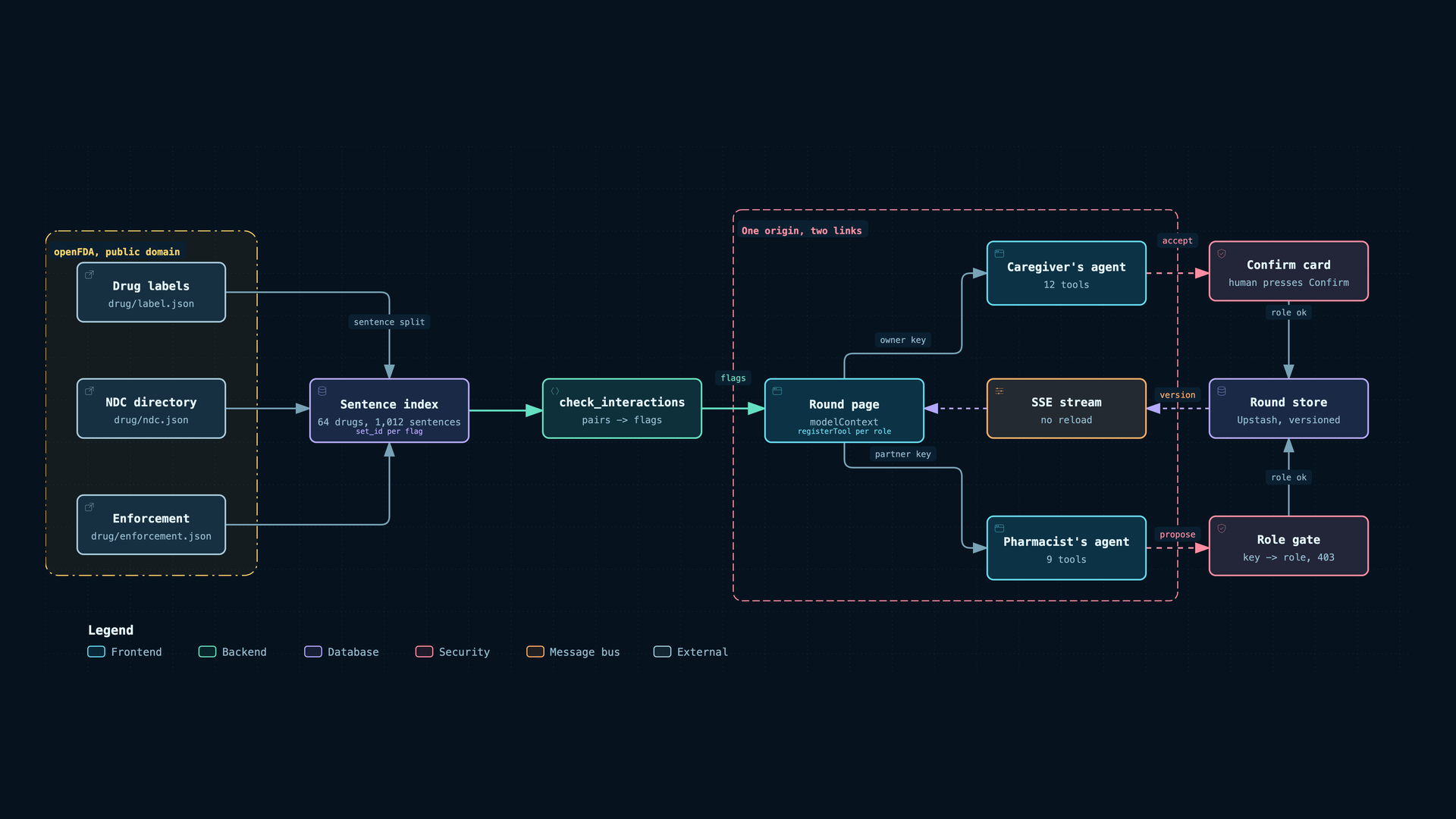
openFDA labels become a sentence index keyed by every drug each sentence names; check_interactions returns the sentence, the set_id and a severity; the page registers tools per link and the server re-checks every write.
Who gets to say yes. The pharmacist's agent calls propose_change, hold warfarin until the INR is rechecked. It pauses in a confirmation card until the pharmacist clicks Confirm, then shows up in my window over a live stream, no reload, with Accept and Reject buttons the pharmacist never sees. My agent calls accept_change; I press Confirm; warfarin flips to held and the flags recompute against what is actually active. If the pharmacist's agent tries to accept its own proposal, the server answers 403: "Only the caregiver can accept change. You are the pharmacist: propose a change instead and the caregiver confirms it." The role comes from the capability key in the URL, re-derived on every write. Hiding a tool is not the boundary; the server is.
Two things only a person can do. The side-effect report is a real <form toolname="report_side_effect"> with toolparamdescription on each field and no toolautosubmit; the agent fills it, a human presses Send. print_round_card snapshots the list into a grid by time of day, which is the thing that actually replaces the photo on the fridge.
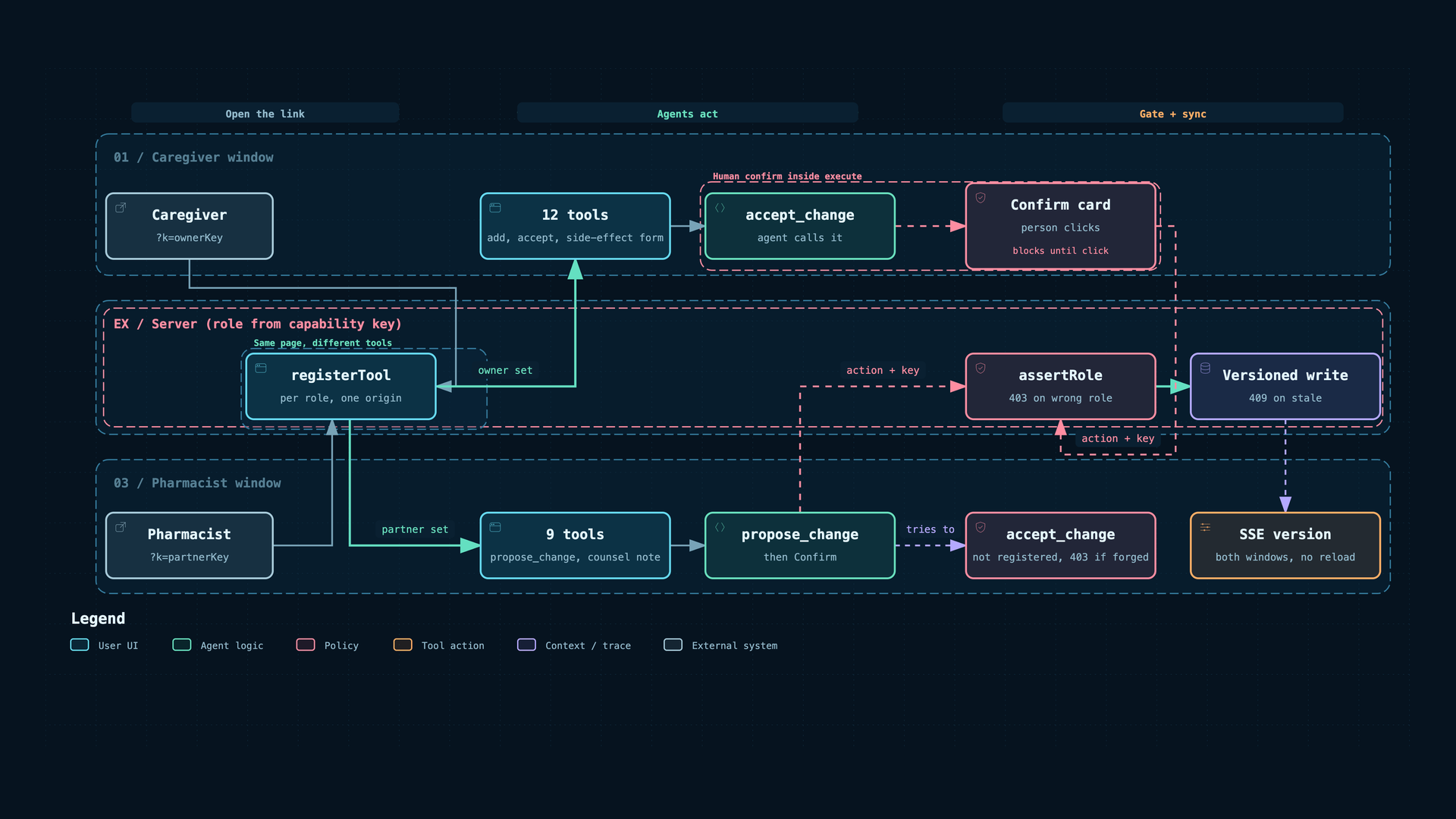
The caregiver's window and the pharmacist's window on the same list. The pharmacist can propose; only the caregiver can accept, and the server enforces it.
Under the hood. document.modelContext.registerTool, native first, @mcp-b/webmcp-polyfill behind it, a badge on the page saying which is live. Fourteen tools with strict schemas and readOnlyHint. untrustedContentHint is true on lookup_label_section and check_geriatric_warnings because label prose is third-party text; it is wrapped in <untrusted-user-text> on the tool, REST and SSE paths alike. Descriptions change with state: accept_change says how many proposals are pending. Confirm gates live inside each mutating tool's execute. Seventeen eval fixtures, the negative ones asserting the denied tool is absent from that session's toolsForRole; 132 tests. Versioned writes (409 after four losing retries) and a rate limit of 60 per minute per IP and per list (429 with Retry-After), which I burst-tested against the live deploy with 70 concurrent requests.
What I got wrong. The first deploy passed reportForm={false} to the tools panel, so the side-effect form never registered. Five of the seven review passes I ran caught it. It is mounted now.
The footer carries openFDA's disclaimer. This is label text for discussion with a pharmacist, not a diagnosis, and nothing on the page says otherwise.
Everything here was written on 4 September 2026 with Next.js 16, TypeScript, Tailwind 4, Upstash Redis, Vitest and openFDA. The build script, every openFDA query URL and the eval fixtures are in the repo.
Built With
- next.js
- tailwind
- typescript
- upstash
- vercel
- vitest
- webmcp


Log in or sign up for Devpost to join the conversation.