-
-
-
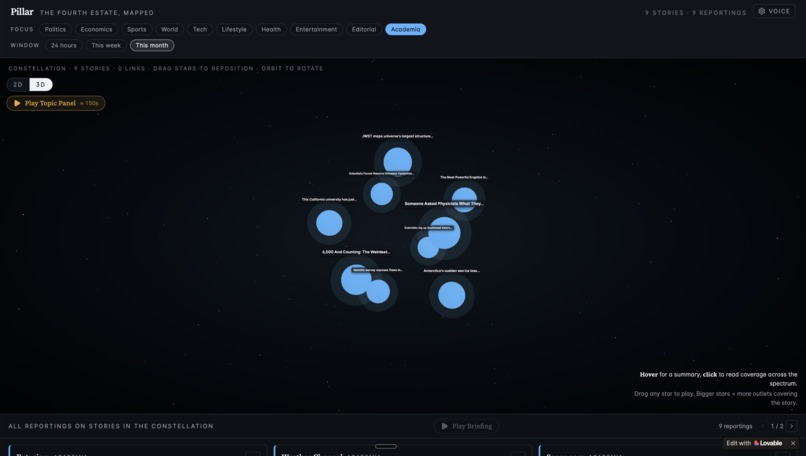
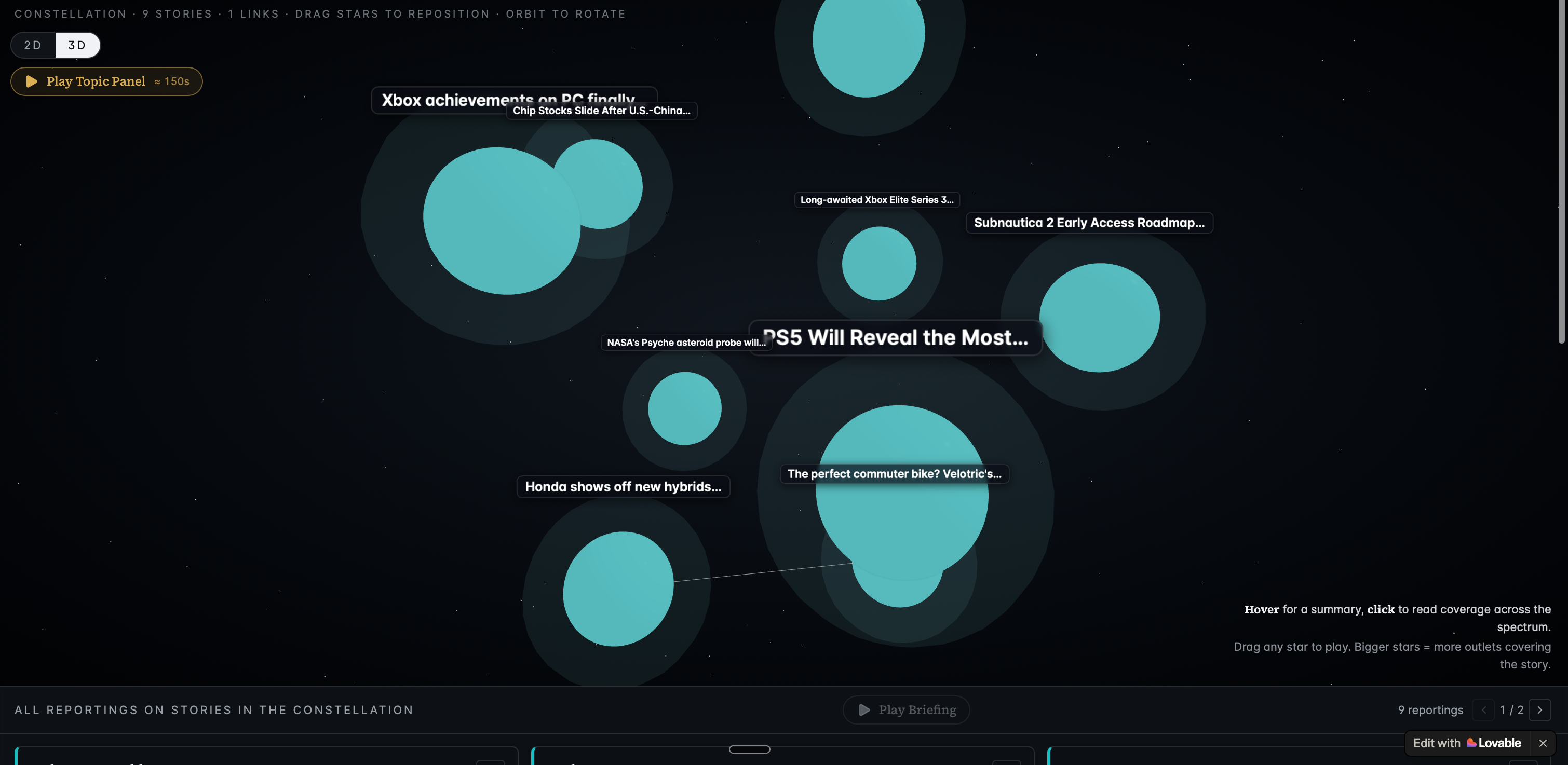
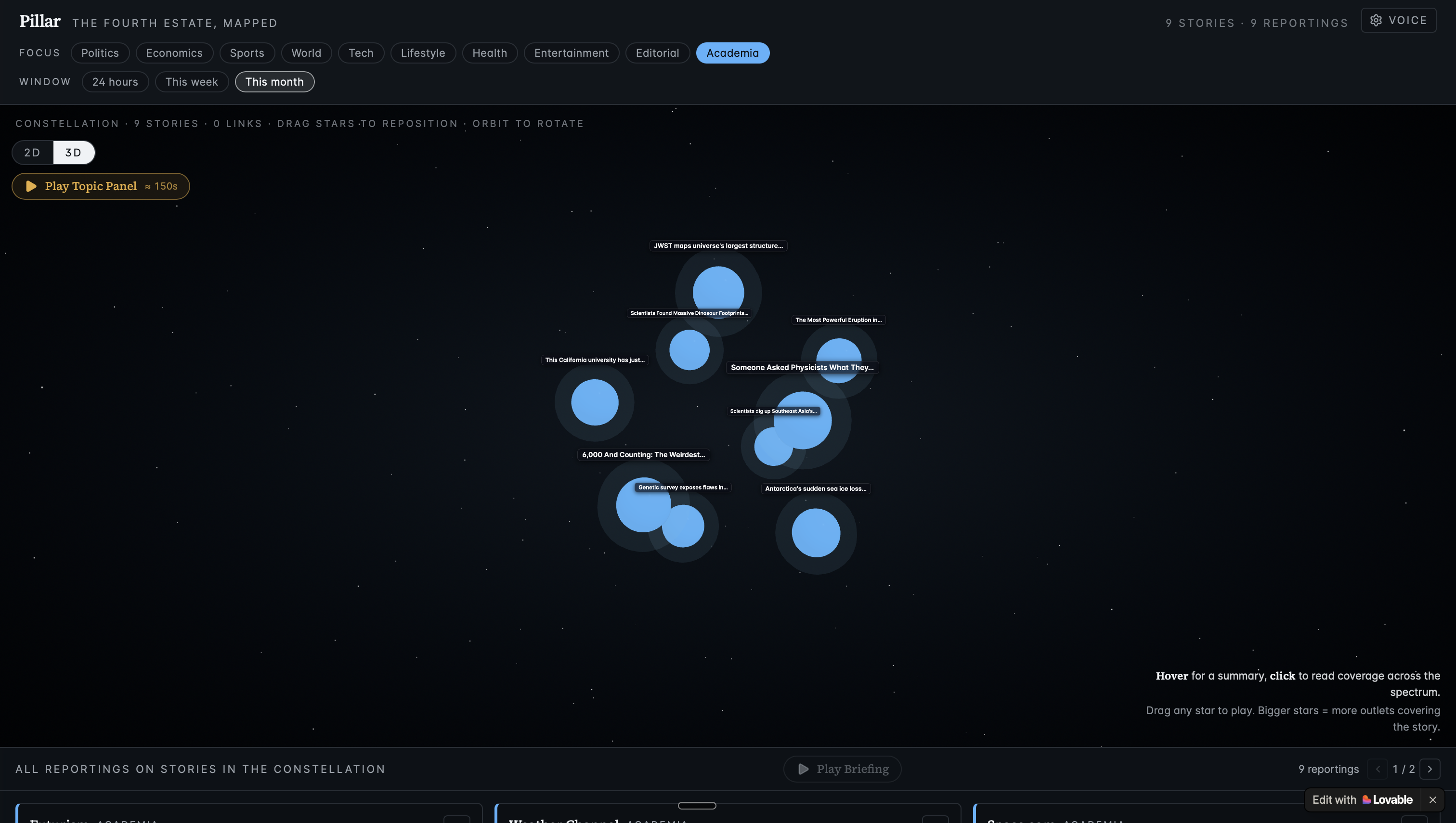
3d mode that is more interactive and prettiers
-
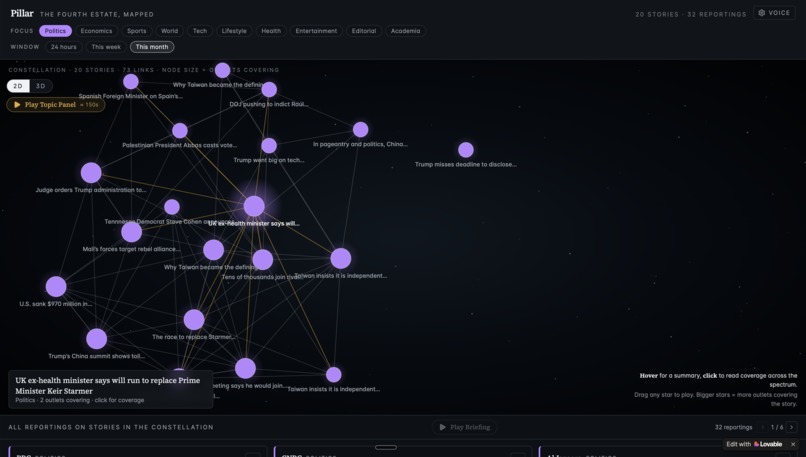
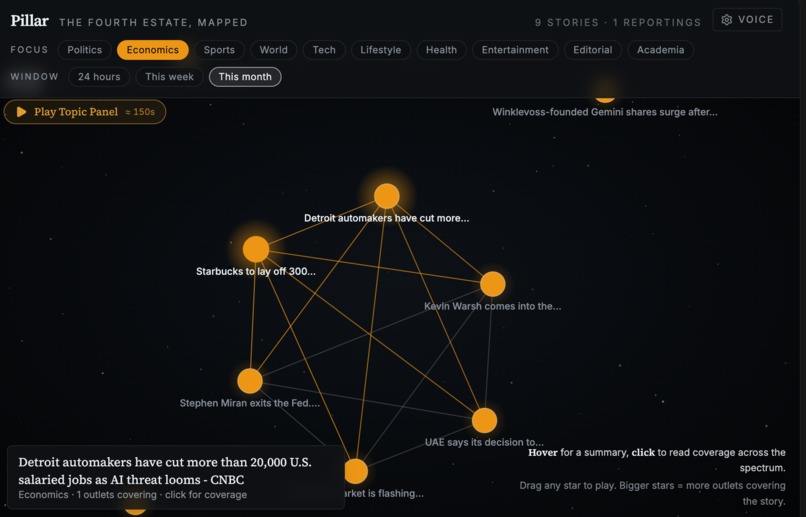
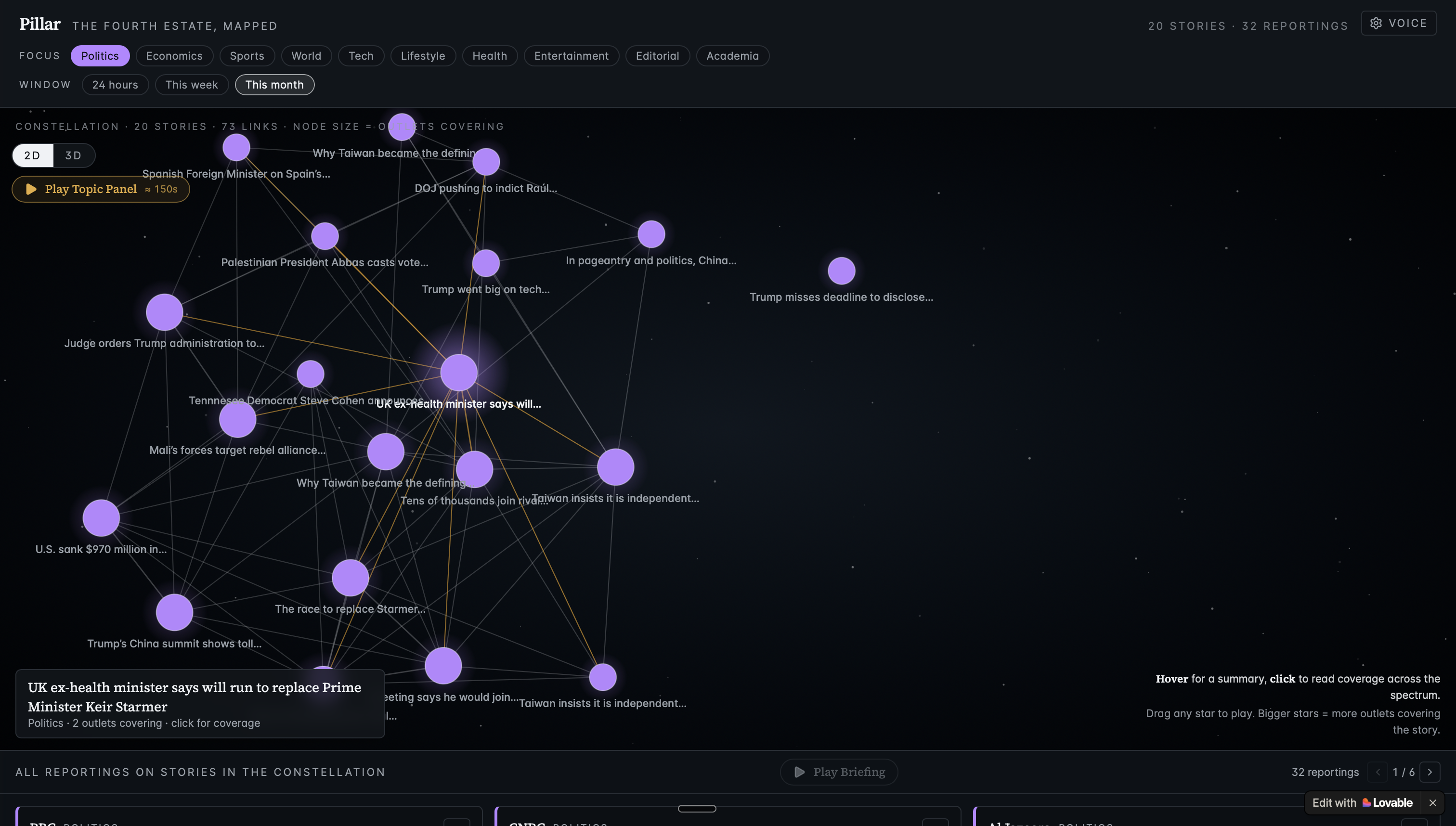
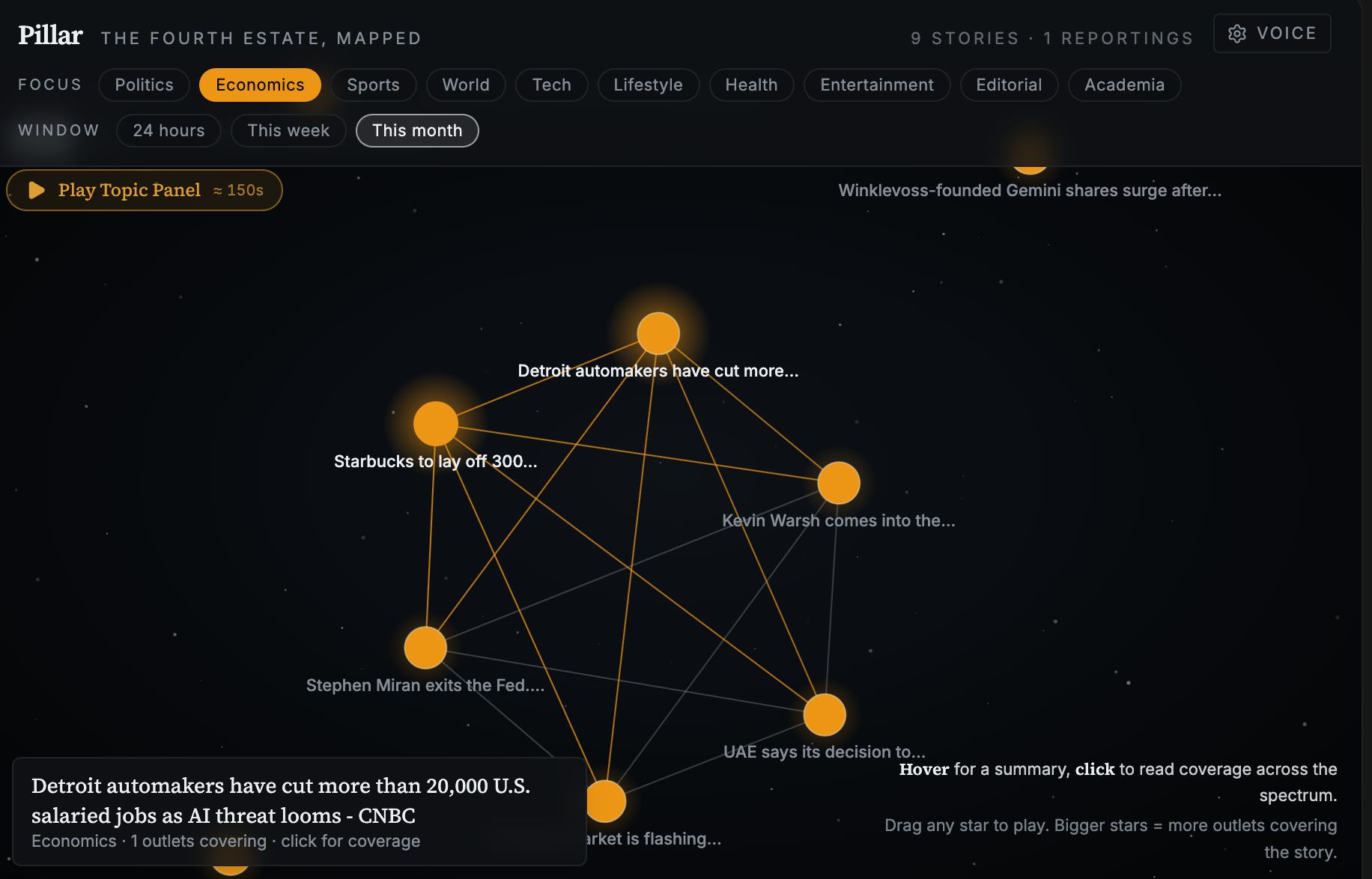
Playful graphing of different stories and how the connect to each other
-

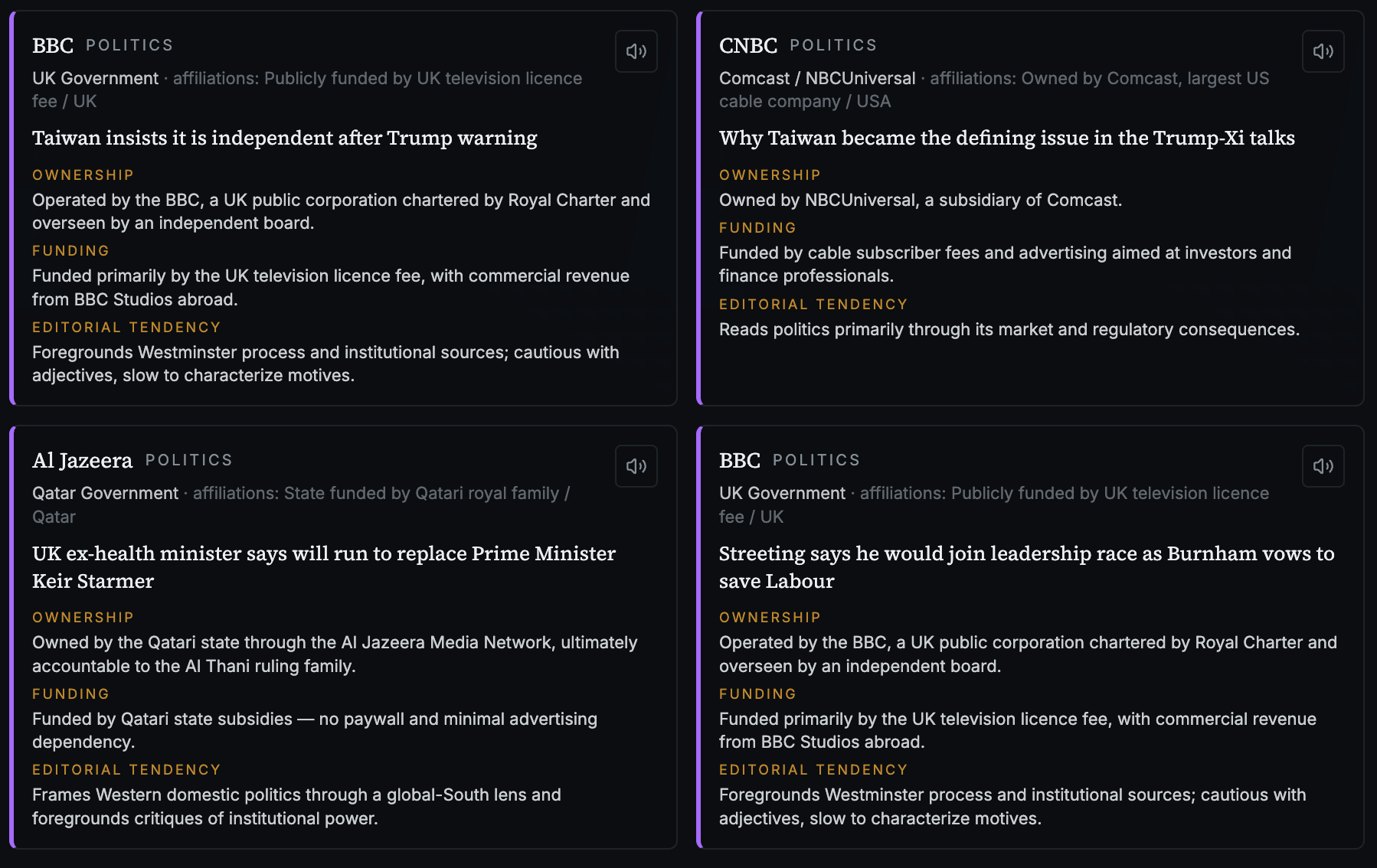
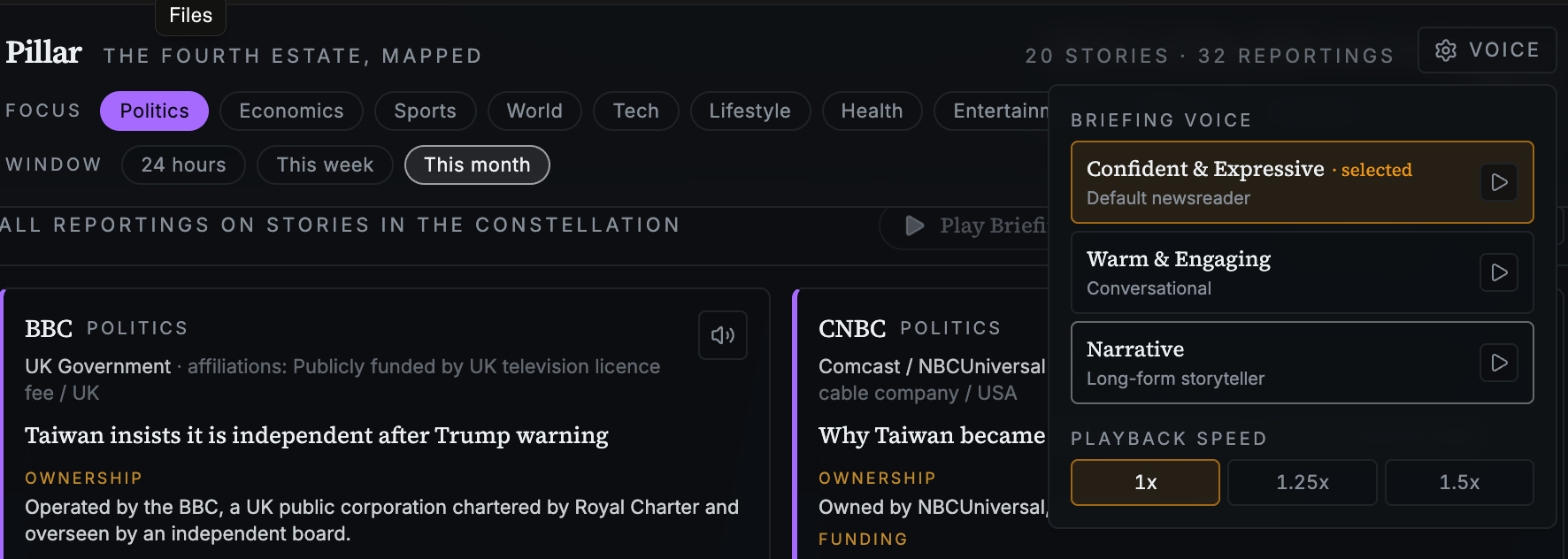
Break down of reported affiliations and the implications.
-
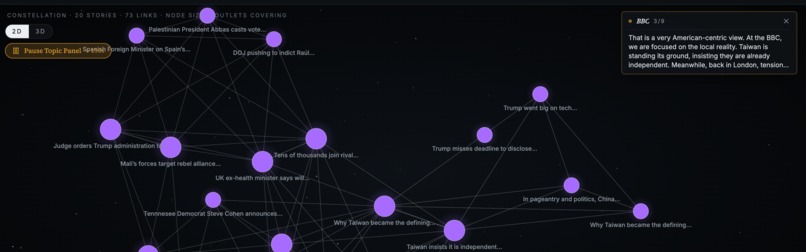
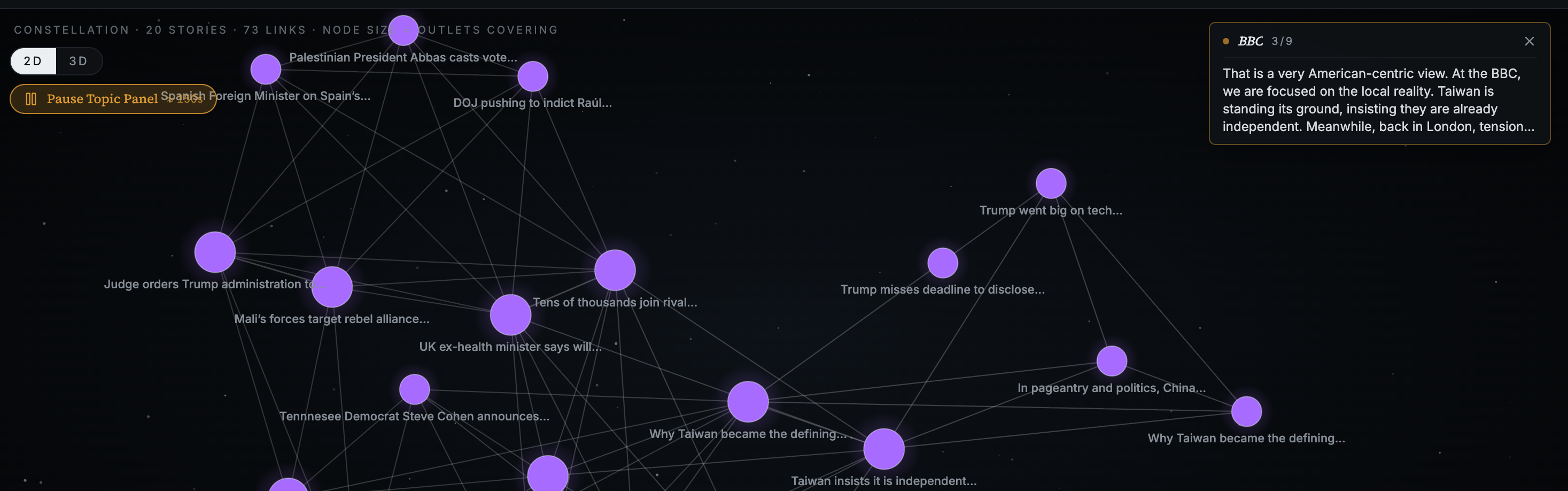
Podcast feature. Different news networks Covering the same topic in different ways and exchanging ideas/conversations to give you a big pic.
-
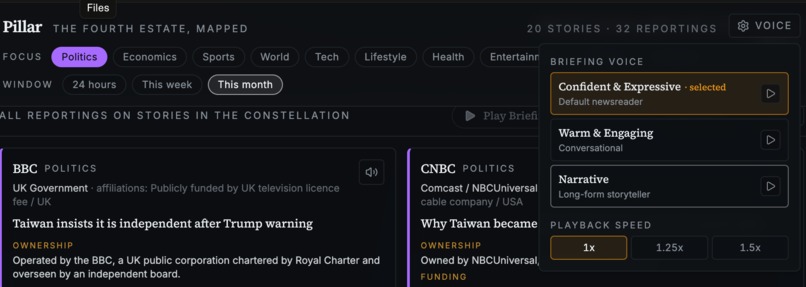
Different voice modes for briefing.
-
-
What is Pillar?
Six billionaires own 90% of American media. Every article you read was written inside that ownership structure. Most news apps give you the news. Pillar gives you the news, who's paying for it, and what the real story is from telling you potential bias and how the story is being reported differently. The only intelligent and most in-depth news aggregrator.
Pillar is a real-time news transparency platform that visualizes how the same story gets framed differently across outlets with different ownership structures. You see a living constellation of today's stories. You click one. You hear how Bezos's Washington Post, Murdoch's Fox News, the Qatar-funded Al Jazeera, and the UK government's BBC each chose to cover the same event, and why their ownership might explain the difference.
What inspired us
The moment that sparked this: reading a Washington Post article about Amazon's AI regulation policy without knowing Bezos owns WaPo and has a direct financial stake in that outcome. That gap between what we read and who's telling it to us felt like the most important transparency problem nobody was solving.
How we built it
Data pipeline: A dual-source ingestion layer combining RSS feeds and a News API, pulling from multiple outlets across ownership spectrums, government funded, nonprofit, state funded, corporate, and independent. Articles are cleaned, deduplicated, and stored in Snowflake, with a flexible VARIANT enrichment column that allows new data fields without requiring schema changes.
Snowflake as the intelligence layer: This is where Pillar's real power lives. We used Snowflake Cortex to run all LLM workloads natively inside the warehouse, no external API calls, no data leaving Snowflake. Every article goes through three Cortex pipelines:
SNOWFLAKE.CORTEX.COMPLETE('llama3.1-70b', prompt)for per-outlet framing summaries, generating how each outlet specifically chose to frame a story given their ownership context- Named entity extraction, identifying people, organizations, and locations mentioned in each article to compute relationships between stories
- Category classification, automatically tagging each story as Politics, Economics, World, Tech, Health, Sports, Entertainment, Academia, or Lifestyle
The result: 206 articles fully processed with AI-generated ownership-aware summaries, all computed inside Snowflake without a single external LLM API call. This is the architectural decision that makes Pillar scalable, the intelligence lives where the data lives.
Voice layer: ElevenLabs generates distinct voice personas for each outlet, each with a character that reflects their ownership culture. Same story, multiple different voices, multiple different realities.
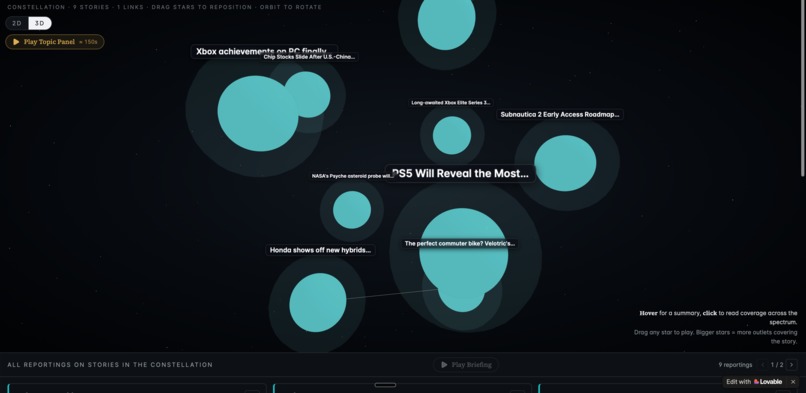
Constellation UI: A physics-simulated force-directed graph where story nodes are connected by shared entities. Node size = number of outlets covering that story. Built with React and canvas.
Podcast mode: Play Topic Panel generates a multi-voice debate about the day's top stories, different outlet personas arguing the same event from their ownership perspective.
Challenges
- Snowflake MFA blocked programmatic access for hours. Solved with TOTP authentication and Cortex running natively inside Snowflake notebooks.
- JSON quoting issues in Snowflake VARIANT columns required parameterized queries with
?placeholders instead of f-string interpolation. - ElevenLabs credit limits required careful voice generation prioritization for the demo.
- Story clustering across outlets required semantic similarity, we used named entity overlap from Cortex extraction to compute edges between stories sharing the same people, organizations, or locations.
What we learned
Snowflake Cortex is genuinely powerful for running LLM workloads natively on your data. The key insight: when your intelligence layer lives inside your data warehouse, you eliminate latency, reduce costs, and keep everything in one place. We ran summarization, entity extraction, and classification on 206 articles without a single OpenAI or Anthropic API call.
The ownership transparency angle hits differently than left/right political bias framing, it's harder to dismiss and more structurally accurate. Nobody can argue with "here's who owns this outlet and what their financial interests are."
What's next
- Live FastAPI backend connecting directly to Snowflake
- Snowflake Streams and Tasks for automated real-time pipeline, new articles trigger Cortex automatically
- Expanding to 50+ outlets globally
- Podcast debate mode as a standalone product, AI-generated cross-ownership news debates. Nobody has that yet.
Built With
- elevenlabs
- fastapi
- feedparser
- lovable
- python
- react
- rss
- snowflake
- snowflake-cortex
- tailwind
- typescript

Log in or sign up for Devpost to join the conversation.