-
-
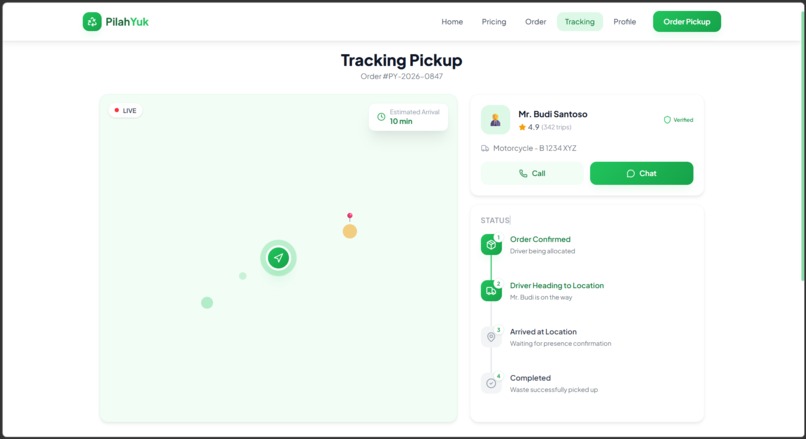
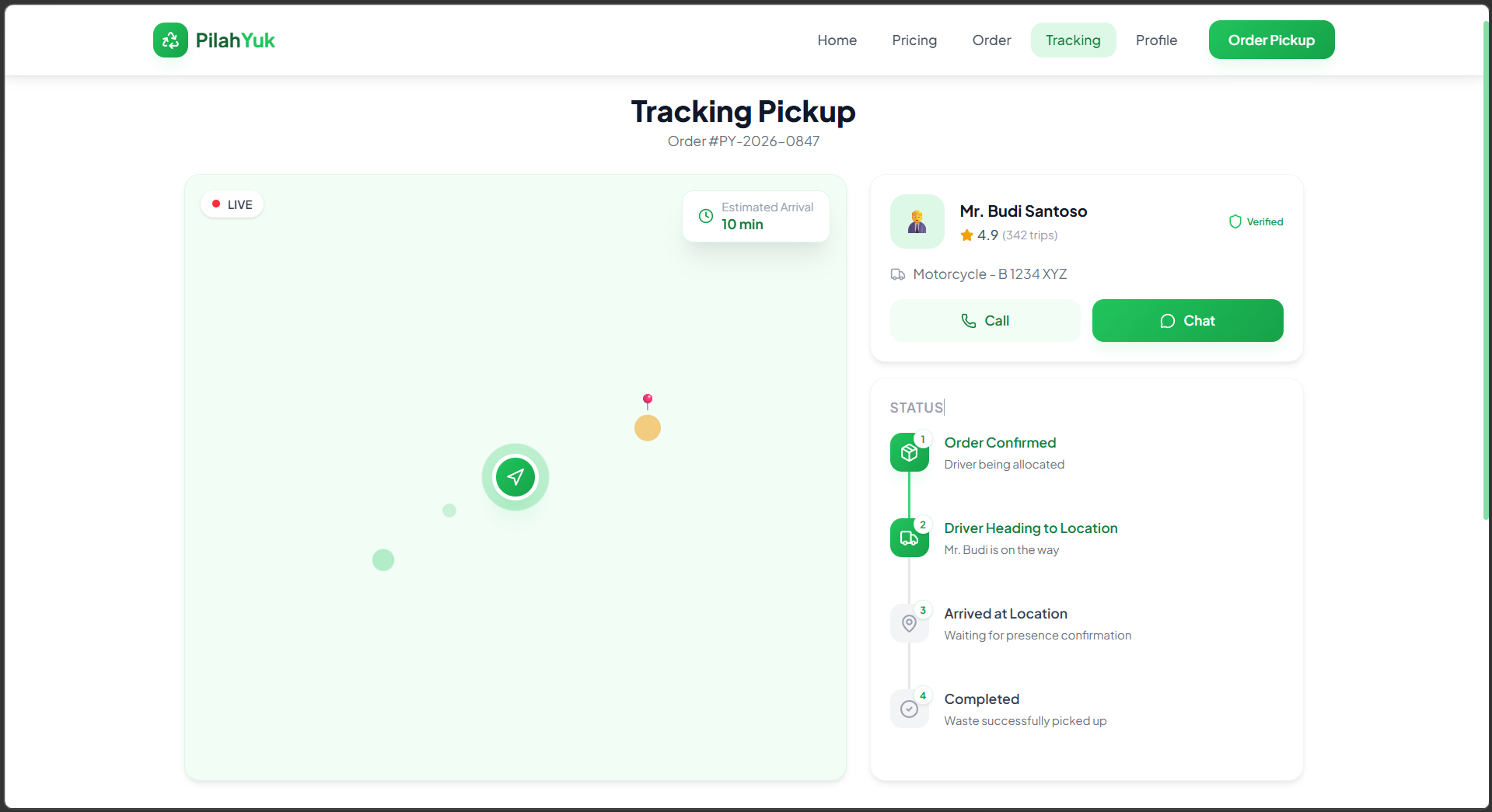
Tracking Page
-
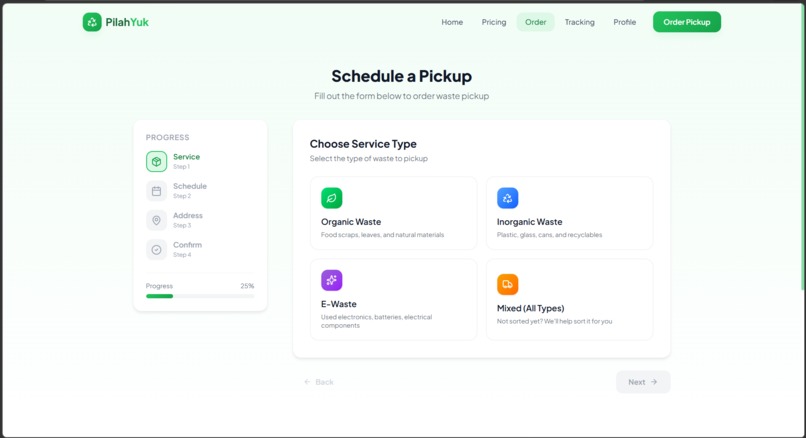
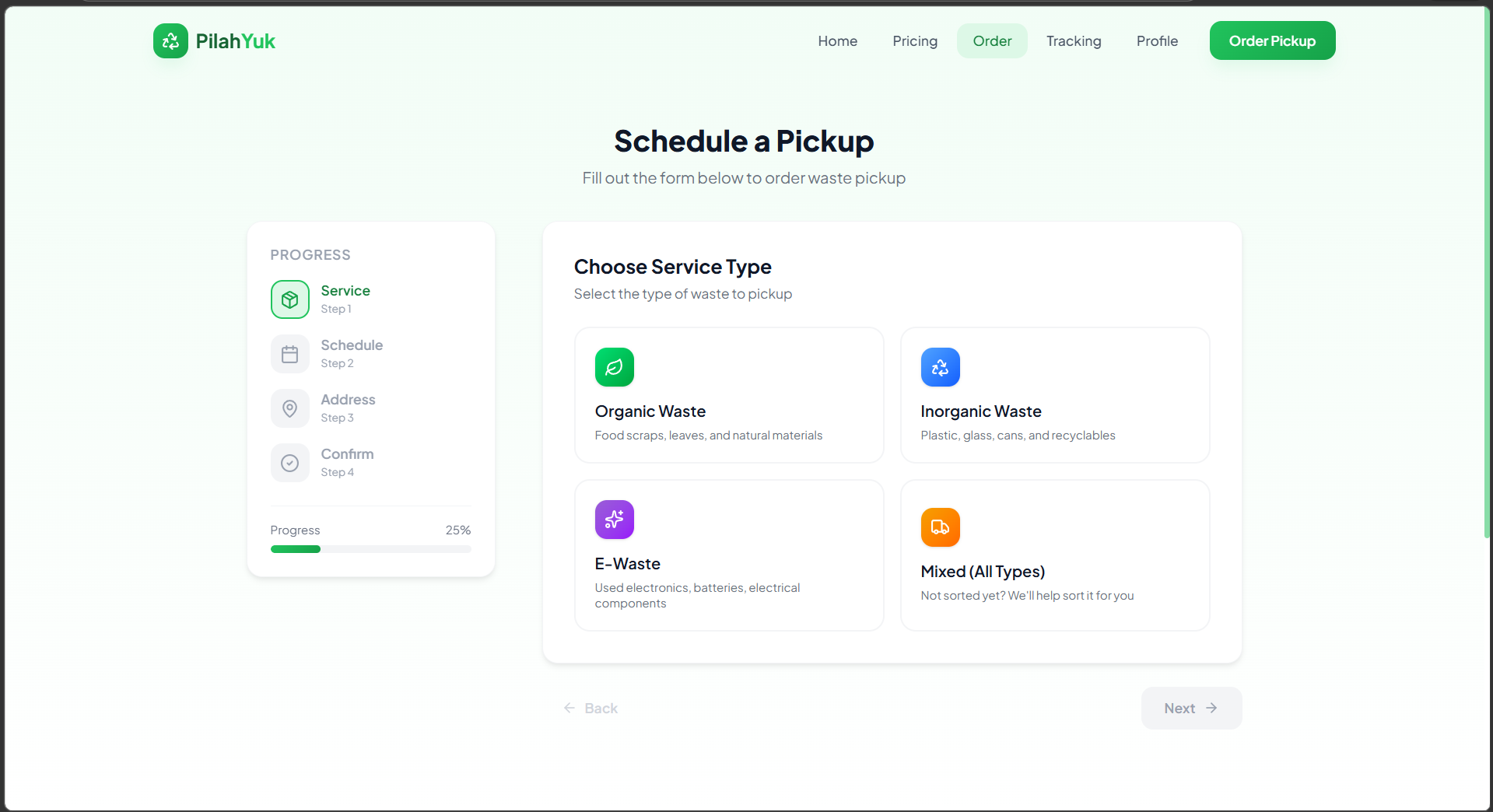
Order Page
-
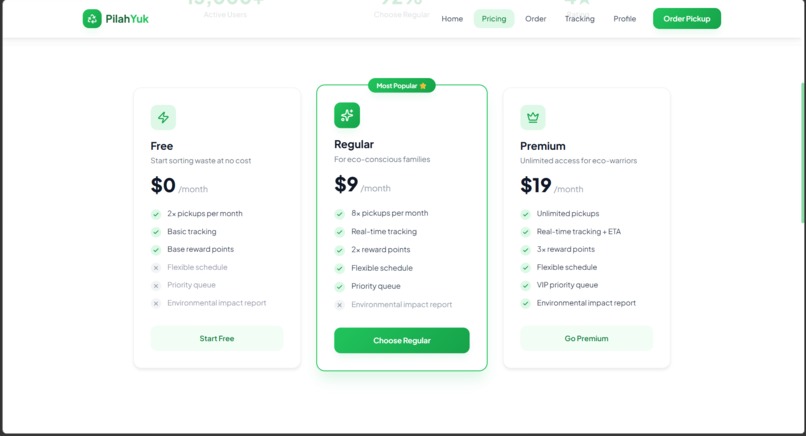
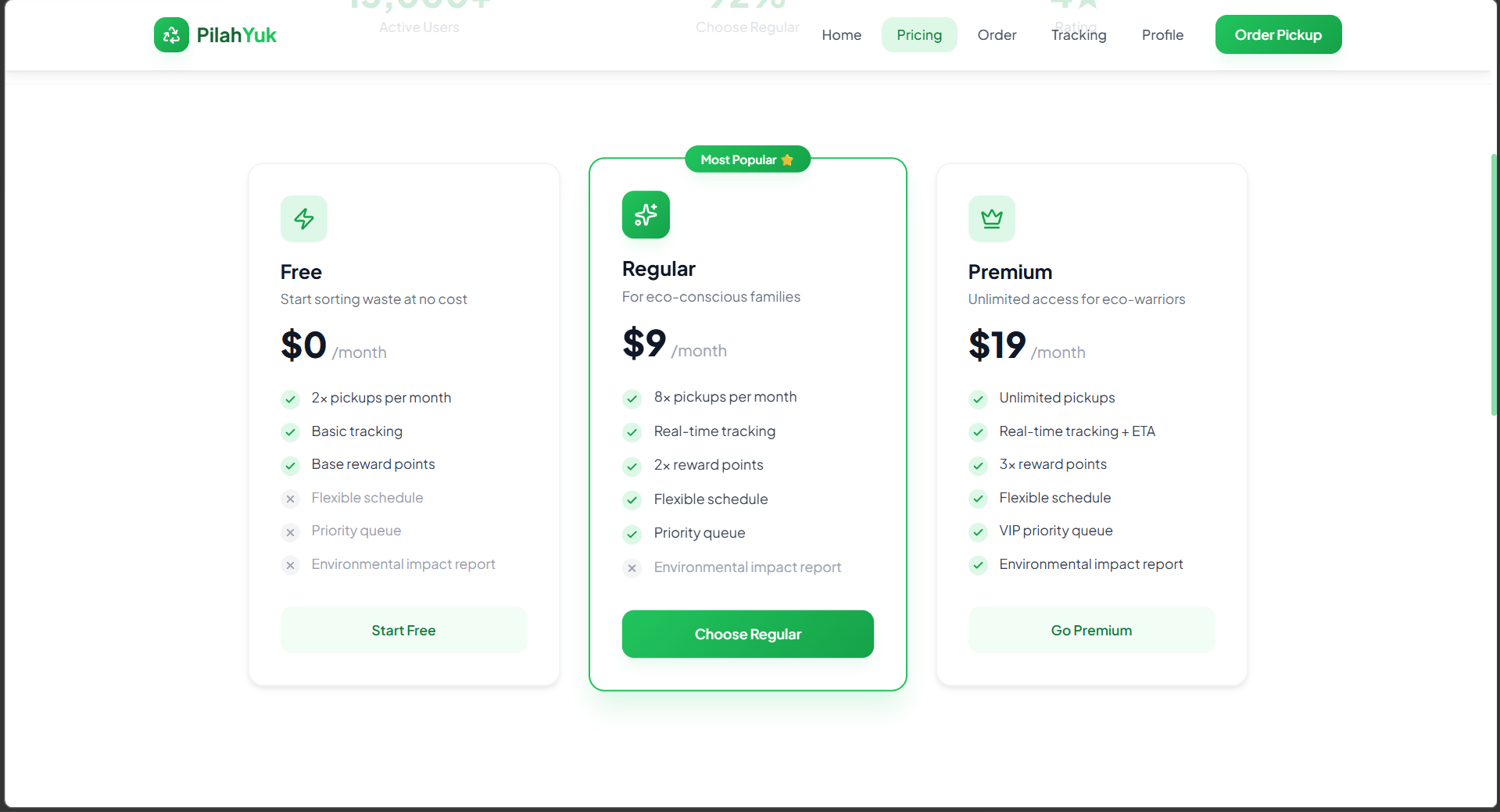
Pricing Page
-
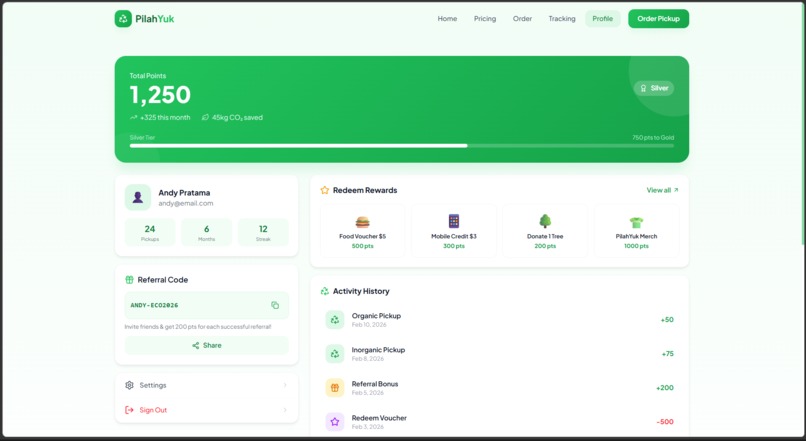
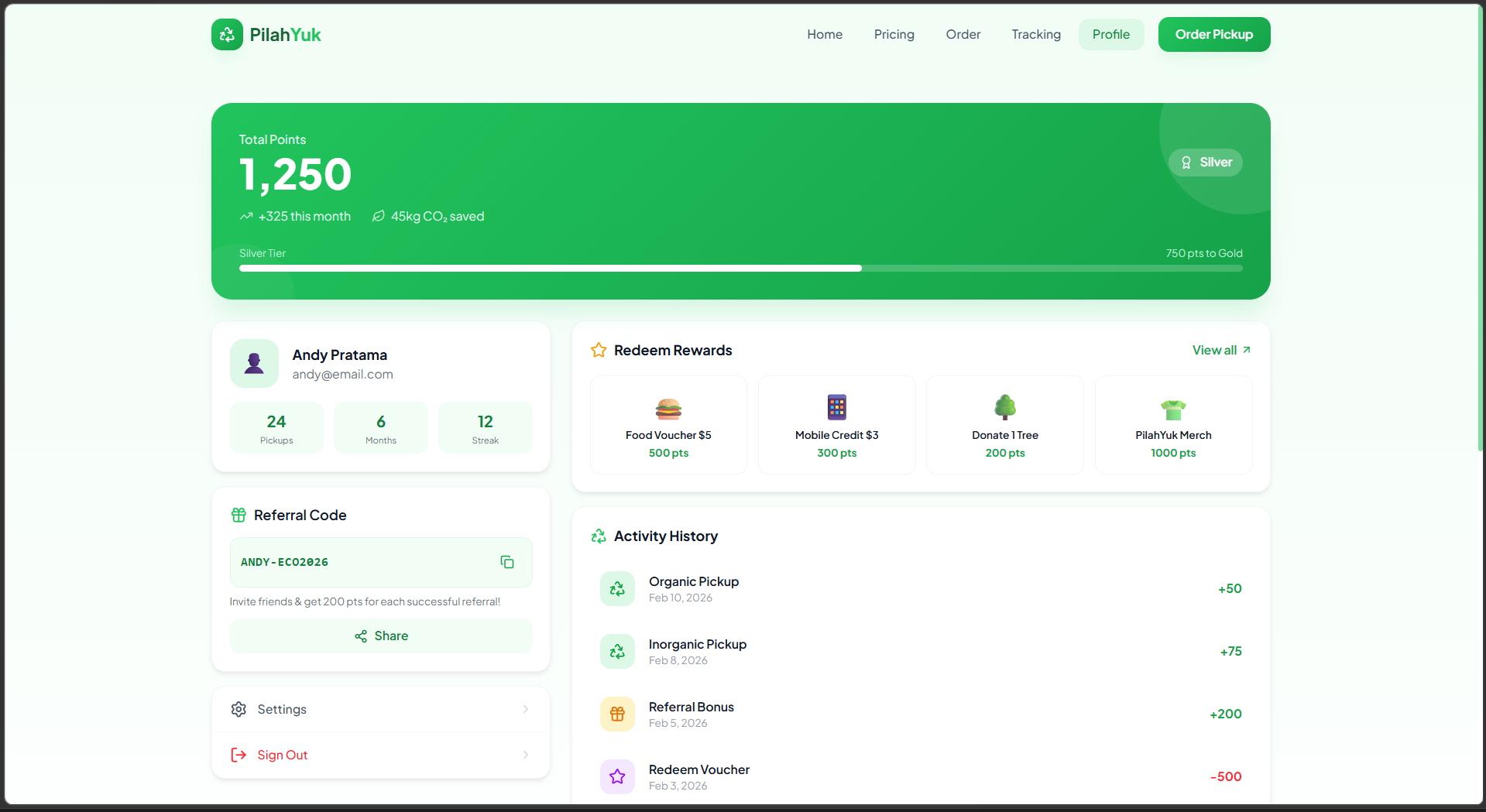
Profile Dashboard Page
-
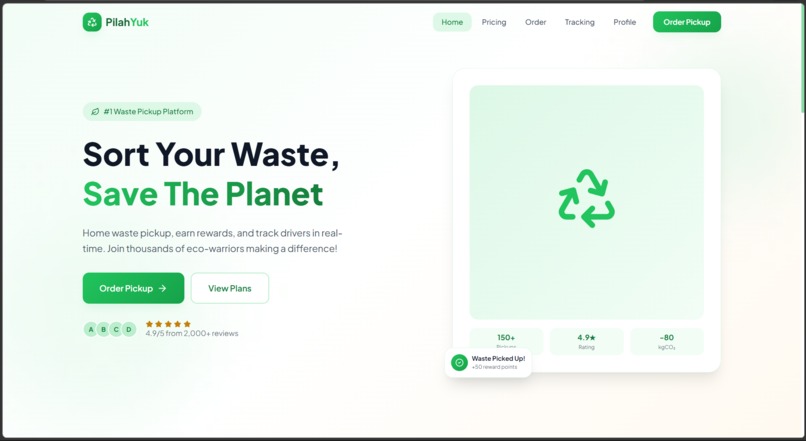
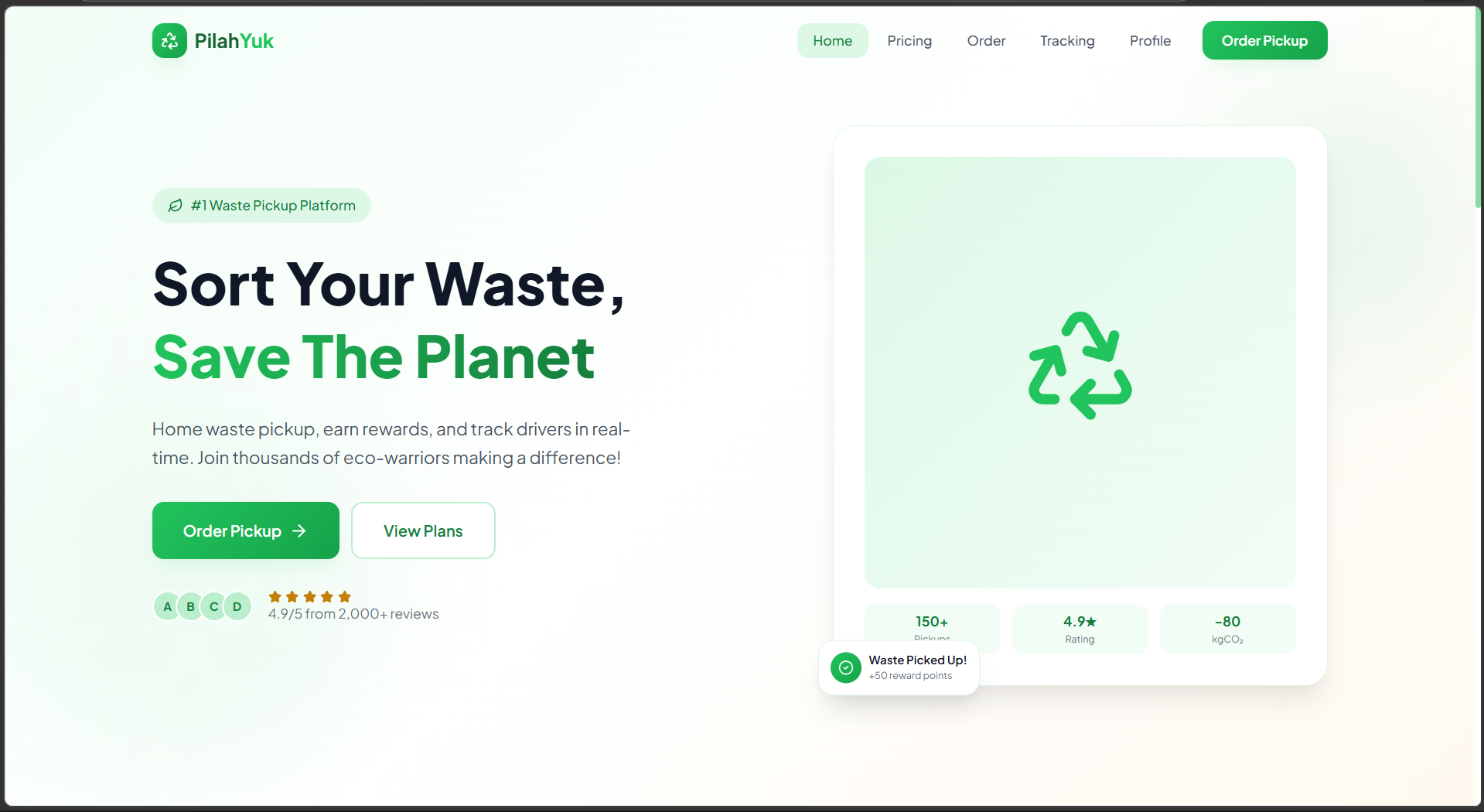
Home Page
Inspiration
Growing up in Surabaya, I saw families wanting to recycle but failing because the infrastructure failed them. Waste banks were too far. No pickup service existed. Rewards were too small to bother.
Indonesia generates 68 million tons of waste annually. Only 12% is properly recycled. 25-30 million urban households are affected by this broken system.
I kept asking: why is it so hard to do the right thing?
The answer was clear: the system was broken, not the people. That infrastructure gap became my opportunity. That's why I built PilahYuk.
What It Does
PilahYuk is a subscription platform that picks up sorted recyclable waste from homes on a fixed schedule, paying users instant rewards for their recyclables.
How it works:
- Book pickup through web app
- Sort waste at home (plastic, paper, metal, glass)
- Driver picks up on scheduled day
- Rewards transferred to GoPay within 24 hours
- Track impact: CO2 saved, trees equivalent
Subscription tiers:
- Free: $0/month (2 pickups, basic rewards)
- Regular: $9/month (8 pickups, 2x rewards, live tracking)
- Premium: $19/month (unlimited pickups, 3x rewards, priority)
Verified prices we pay users (Feb 2026 Surabaya market research):
- PET Plastic (clear): Rp 4,500 - 6,000/kg
- PP Cups: Rp 8,000 - 9,500/kg
- Aluminum cans: Rp 13,000 - 15,000/kg
- HVS Paper: Rp 4,450 - 8,200/kg
Our competitive advantage: direct factory partnerships eliminate middlemen, giving us 45-65% material margins vs industry standard 20-40%. This means we can pay users significantly more than competitors.
How I Built It
Solo student founder. I handled everything independently from concept to deployment.
Market Research
Verified pricing from 50+ sources including recycling factories, online marketplaces, and competitor apps. Conducted competitive analysis of Waste4Change (~Rp 165,000/month, zero user payment), Rekosistem (~Rp 1,000/kg blended reward), and Bank Sampah Induk Surabaya (60-70% factory price, self drop-off required).
Data sources (Feb 2026):
- Material pricing: siu-bijiplastik.com, anekajayamakmur.com, tokopedia.com, direct factory inquiry
- Competitors: waste4change.com, rekosistem.co.id, Bank Sampah Induk Surabaya
- Operational costs: Official UMK data (bappeda.jatimprov.go.id), olx.co.id, rumah123.com
- Environmental impact: LCA studies (mdpi.com, e3s-conferences.org)
Tech Stack
- Frontend: Next.js 16.1 (App Router), TypeScript 5.0
- Styling: Tailwind CSS 4.0
- Animations: Framer Motion 12.34.0
- Icons: Lucide React
- Deployment: Vercel (automatic CI/CD)
Features Built
- 5-page complete user flow (Homepage, Pricing, Order, Tracking, Profile)
- Multi-step booking form with progress tracker
- Live driver tracking simulation with real-time map
- Gamified rewards dashboard with tier progression (Silver, Gold, Platinum)
- Environmental impact calculator (CO2 saved, trees equivalent)
- Mobile-first responsive design
Challenges I Ran Into
1. Finding accurate market data Online pricing was inconsistent across sources. I cross-referenced 50+ verified sources including direct inquiry to pengepul (waste collectors) and recycling factories in Surabaya to get accurate February 2026 rates.
2. Competitive positioning The market has extremes: premium services (Waste4Change, high convenience but zero user payment) vs traditional (Bank Sampah, pays users but requires self drop-off). I found the unoccupied position: doorstep convenience + fair market compensation simultaneously.
3. Solo development scope Building everything alone meant prioritizing ruthlessly. I focused on complete user flow prototype over backend complexity, proving the concept visually and functionally first.
4. Making margins work Initially assumed low margins were inevitable. Research revealed direct factory partnerships in Rungkut/Sidoarjo industrial zones + quality sorting at facility = premium pricing that competitors using middlemen cannot match.
Accomplishments That I'm Proud Of
- Live prototype: pilahyuk.vercel.app fully functional, complete user journey
- Verified market data: 50+ sources, February 2026 Surabaya-specific pricing
- Solo execution: Research, UI/UX design, development all done independently as SMK student
- Sustainable unit economics: ARPU $12, cost to serve $8, contribution margin $4 (33%)
- Realistic break-even: 288 users, achievable in Phase 2
- Strong LTV/CAC: 19:1 ratio indicates healthy subscription business
- Quantified environmental impact: At 5,000 users, platform diverts 300 tons waste/year, saves 366 tons CO2, equivalent to planting 17,400 trees annually (verified: 1kg PET recycled = 1.5kg CO2 saved)
What I Learned
Business:
- Waste management profitability lives in logistics efficiency and margin optimization
- Direct factory partnerships eliminate 3-4 middlemen in traditional chain, enabling better user rewards
- Quality sorting commands premium factory pricing (PET clear Rp 6,000/kg vs mixed Rp 1,500/kg = 4x difference)
- Subscription model provides revenue stability vs pure transaction fees
Technical:
- Next.js App Router provides scalable architecture for future backend integration
- Smooth animations (Framer Motion) build user trust and perceived quality
- Mobile-first design is non-negotiable for Indonesian market
Market:
- Surabaya has strong recycling infrastructure but broken last-mile connectivity
- Users need both environmental motivation AND financial incentive to change behavior
- Instant 24hr rewards (GoPay transfer) vs delayed rewards = massive retention difference
What's Next for PilahYuk
Phase 1 (Month 1-2): MVP Pilot - $25K budget
- Launch 3-5 neighborhoods in Surabaya
- 2-3 driver partners (Rp 2.5M base + Rp 500/kg incentive)
- 50m² warehouse Lakarsantri (~$150/month)
- Target: 50 active users, validate unit economics
Phase 2 (Month 3-6): Validation
- Expand to 10 neighborhoods
- Add backend: Firebase + Midtrans payment integration
- Mobile app (React Native)
- Target: 300 users, break-even achieved
Phase 3 (Month 7-12): City Launch
- Full Surabaya coverage
- Launch B2B (offices, schools: $300-500/month contracts)
- 100m² sorting facility
- Target: 2,000 users, $100K monthly revenue
Phase 4 (Year 2+): Regional Expansion
- Expand to Jakarta, Bandung, Medan
- Franchise model for tier-2 cities
- Seek Series A: $2-5M
- Target: 2.5M middle-class household market nationally
As a solo founder, Phase 1 is fully manageable with contract drivers. Building the right team for operations and business development is part of my growth plan as the model gets validated.
Built With
- framer-motion
- lucide-react
- next.js
- node.js
- npm
- react
- tailwind-css
- typescript
- vercel

Log in or sign up for Devpost to join the conversation.