-
-
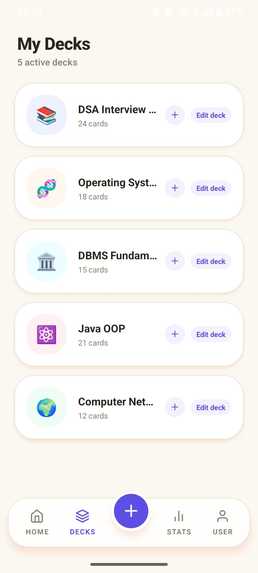
Decks
-
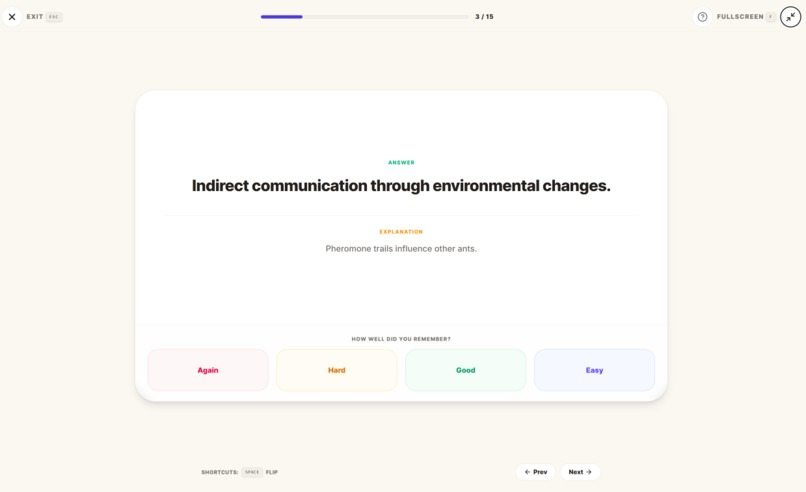
Reviews
-
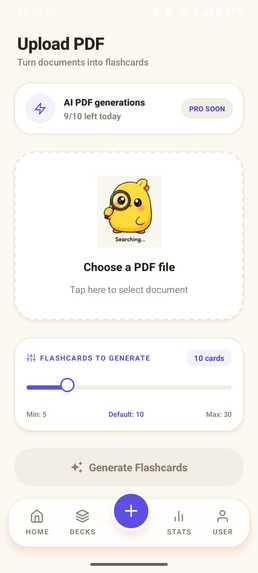
PDF Processing
-
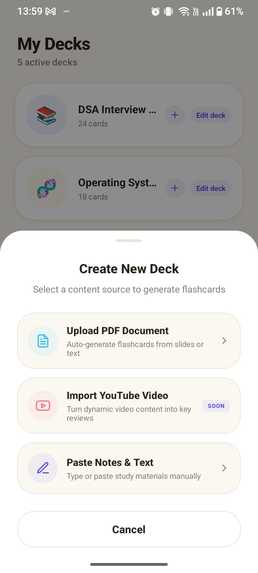
Core Functionalities
-
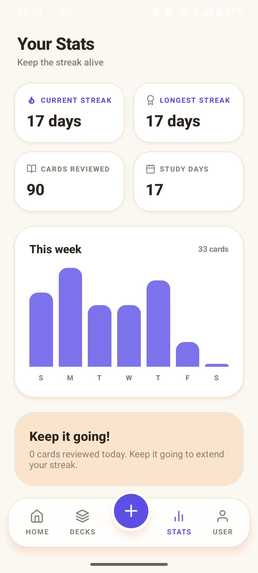
Stats
-
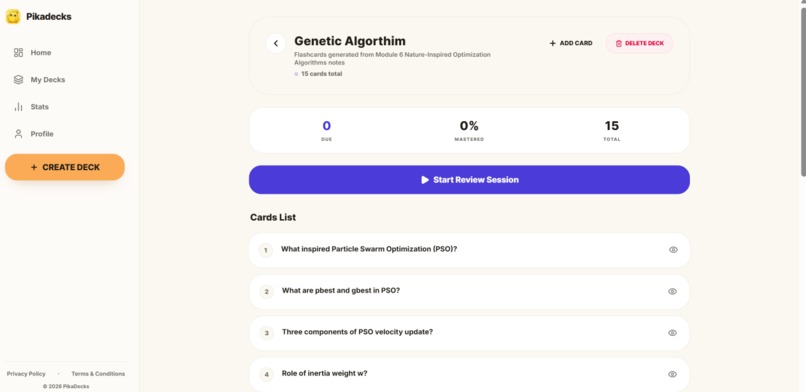
SRS and Deck Review System
-
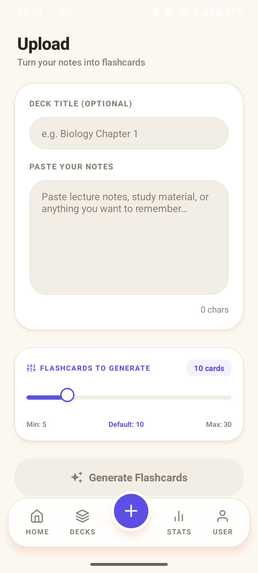
Notes
-
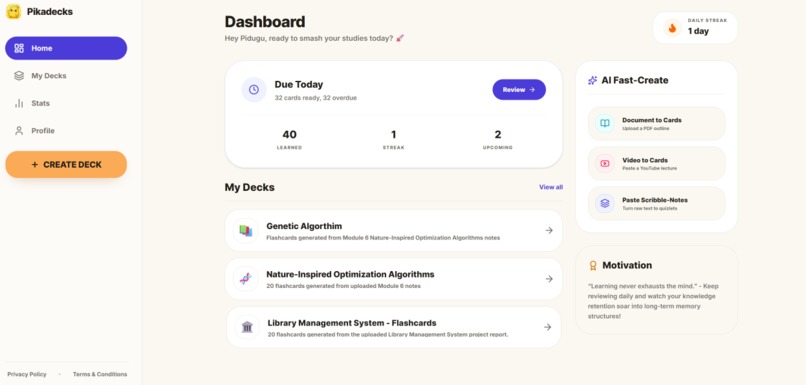
-
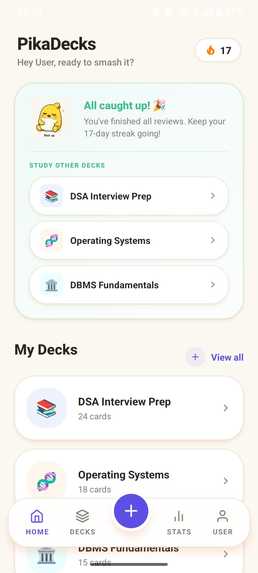
Dashboard App UI
-
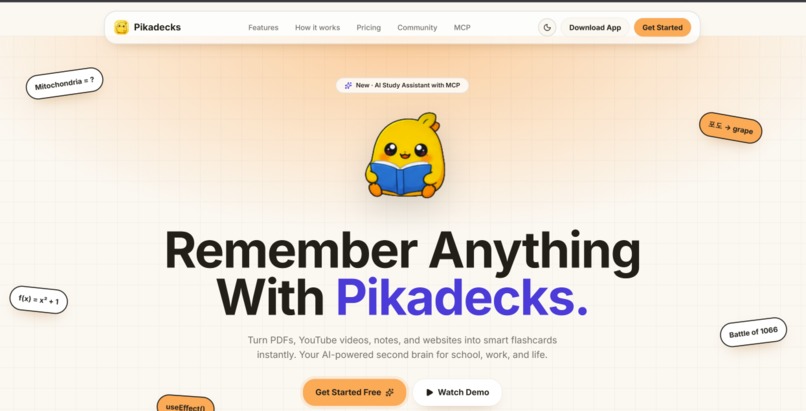
OnBoarding
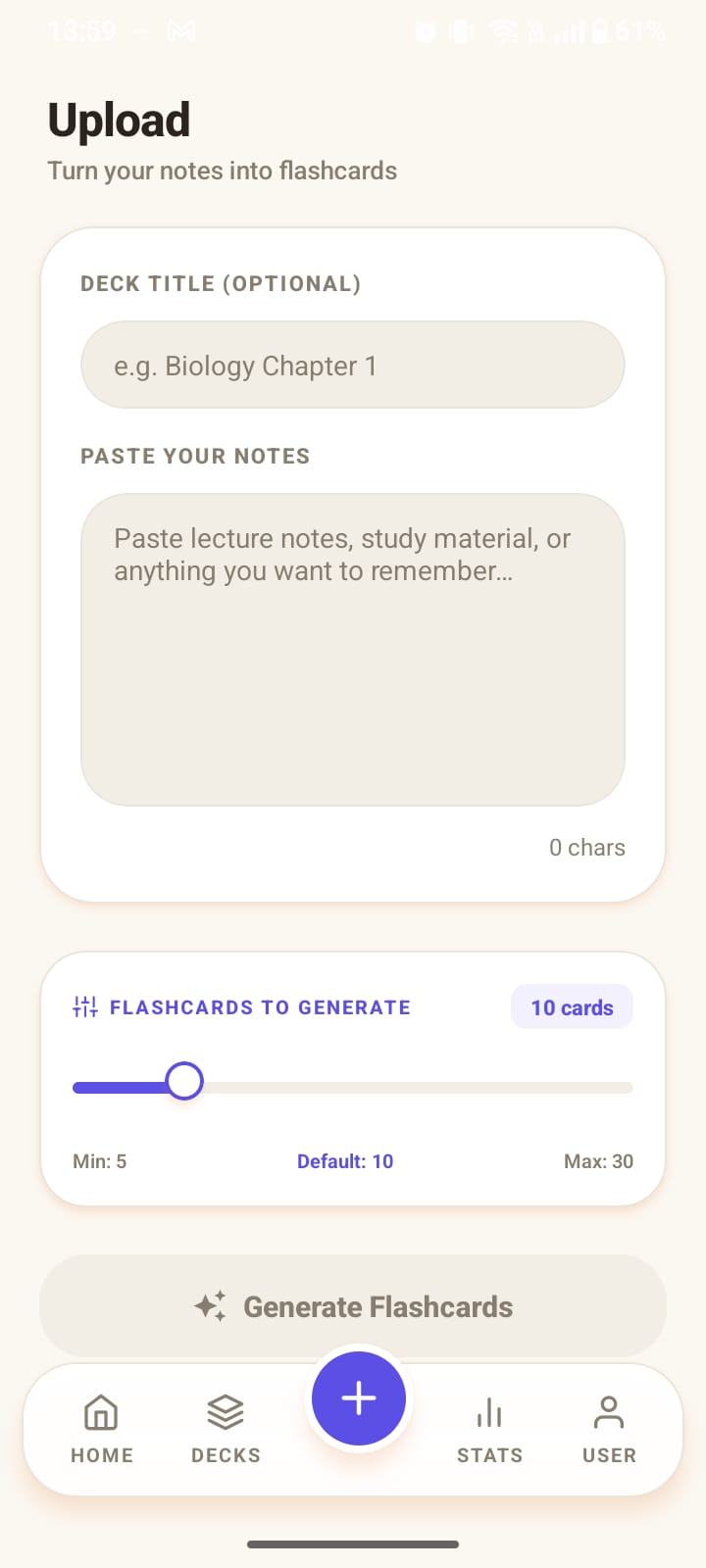
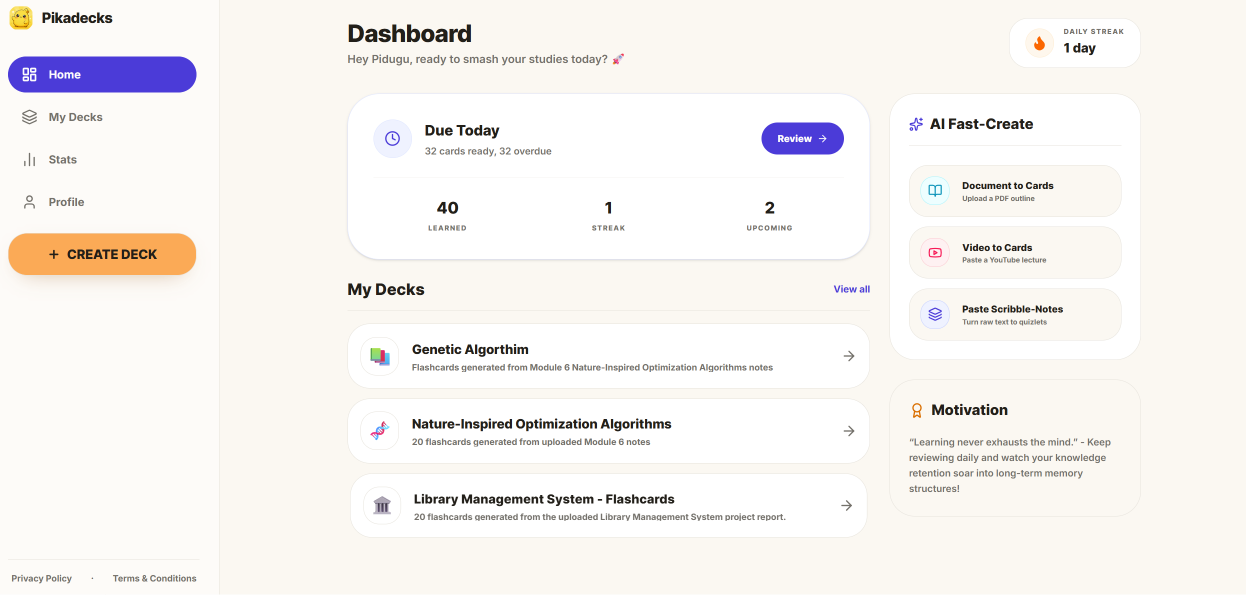
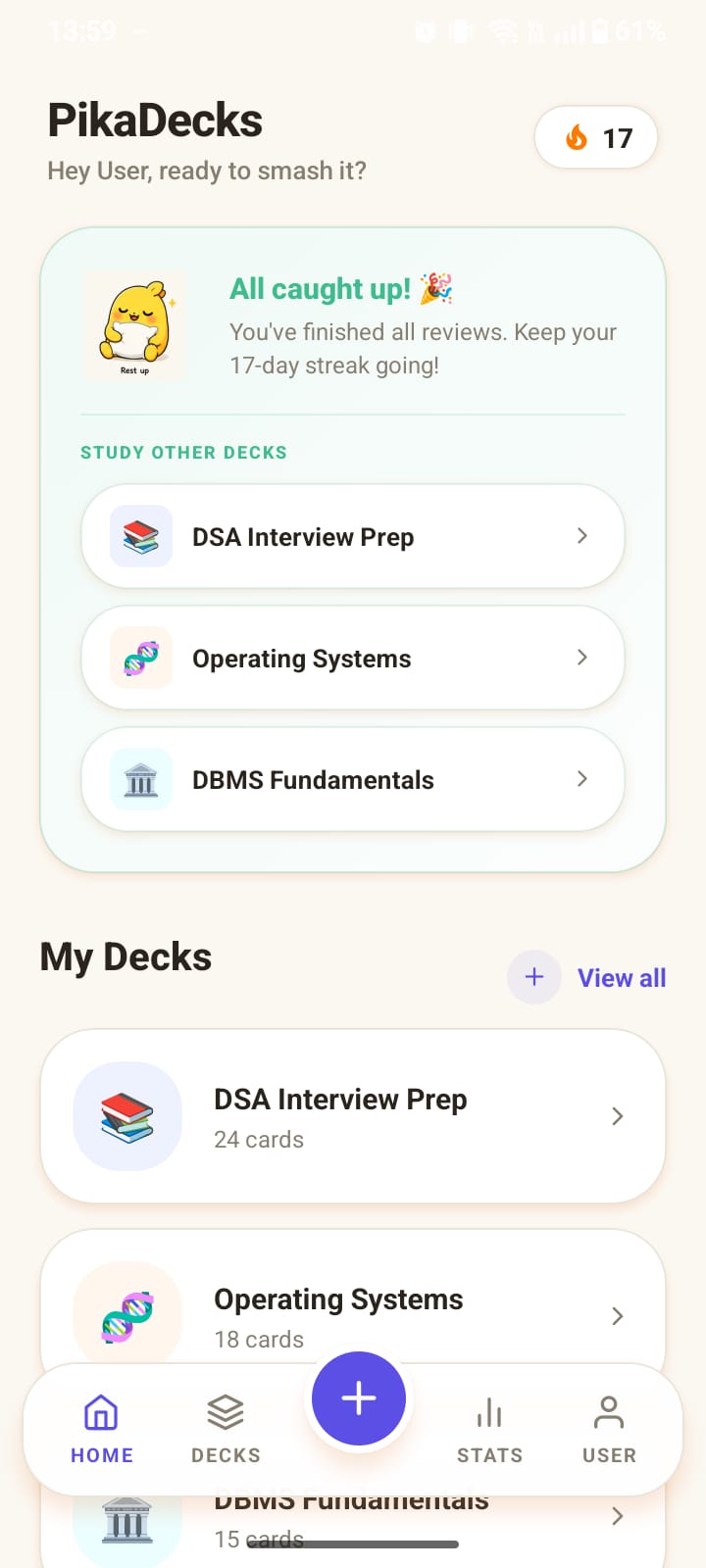
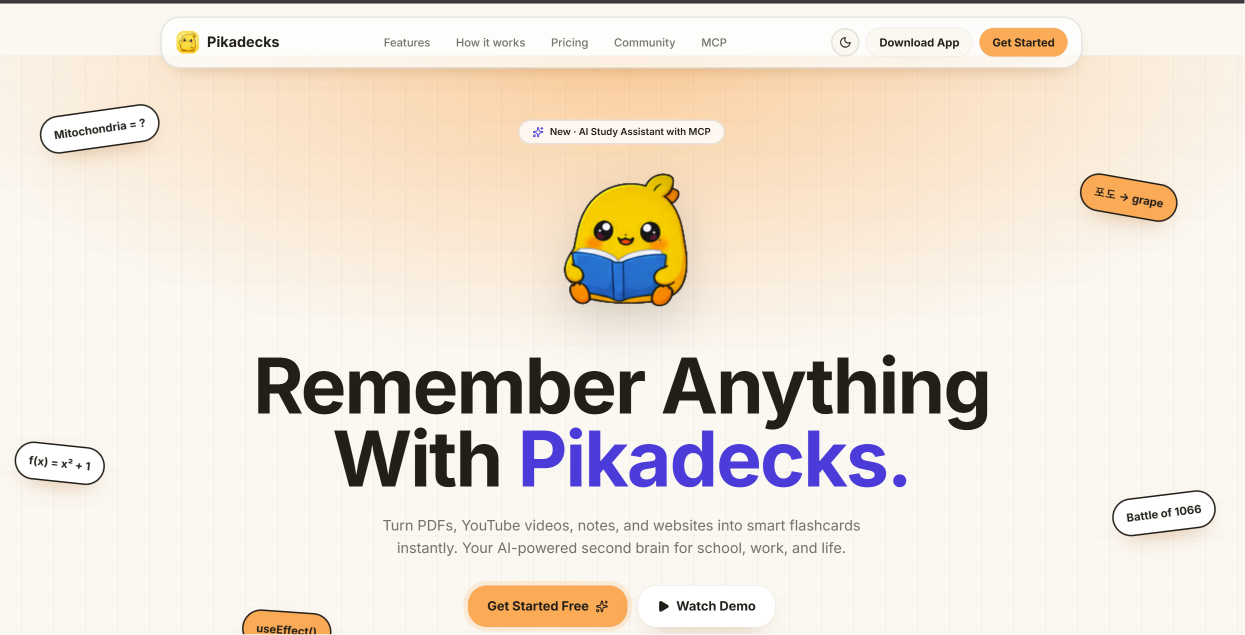
PikaDecks: AI-Powered Learning Platform
Transforming Content into Knowledge
The Story Behind PikaDecks
Every student has experienced the same problem.
You attend lectures. Download dozens of PDFs. Watch YouTube tutorials. Read documentation. Highlight important paragraphs.
But when it's finally time to study...
You realize you've spent more time organizing information than actually learning it.
Creating flashcards manually takes hours.
Writing notes is repetitive.
By the time you're done preparing, you're already exhausted.
And even after all that effort, most of the information is forgotten within days.
This isn't because students don't work hard.
It's because modern education still relies on passive learning.
The Problem
Today's students face four major challenges.
1. Manual Knowledge Extraction
Educational content exists everywhere.
- PDF books
- Lecture slides
- Research papers
- YouTube videos
- Documentation
- Websites
Yet converting this information into effective study material is almost entirely manual.
2. Passive Learning
Reading.
Highlighting.
Watching videos.
Re-reading notes.
These activities feel productive, but they don't actively strengthen memory.
Students recognize information rather than recalling it.
3. Inefficient Revision
Most learners revise randomly.
Some topics receive too much attention.
Others are forgotten completely.
Without an intelligent review schedule, knowledge decays rapidly.
4. AI Cannot Interact With Learning Systems
Modern AI assistants can answer questions.
But they cannot naturally interact with learning platforms.
Imagine asking:
"Generate flashcards from this PDF."
or
"Save these cards to my Genetics deck."
Most learning applications cannot communicate with AI agents.
We wanted to change that.
Inspiration
One question inspired PikaDecks.
"What if studying required only understanding—not preparing?"
Instead of spending hours creating flashcards,
students should simply upload their learning material.
Artificial Intelligence should perform the repetitive work.
Students should spend their time learning.
Not organizing.
Our Vision
Our vision is to build an intelligent learning ecosystem where
every educational resource
becomes personalized study material within seconds.
AI should never replace learning.
AI should remove the friction around learning.
Introducing PikaDecks
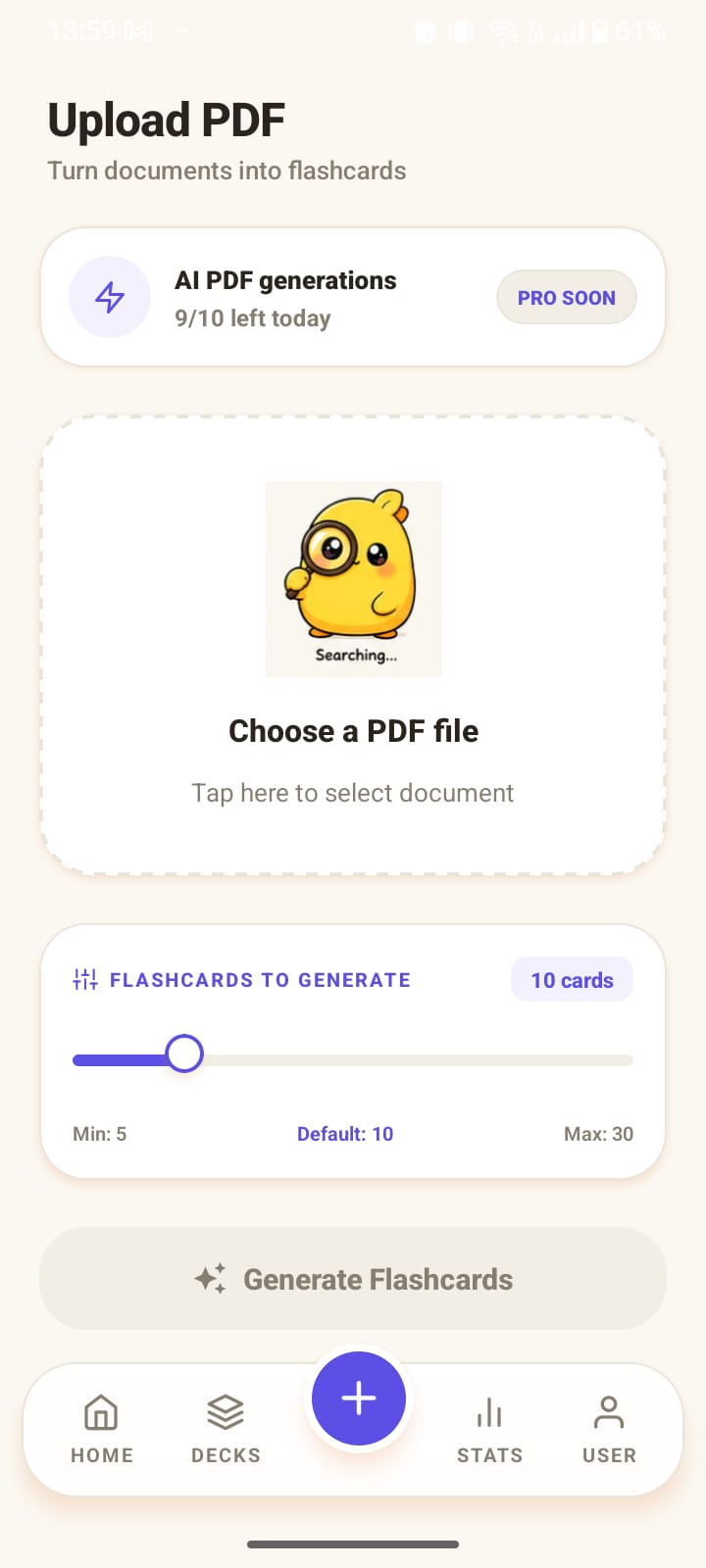
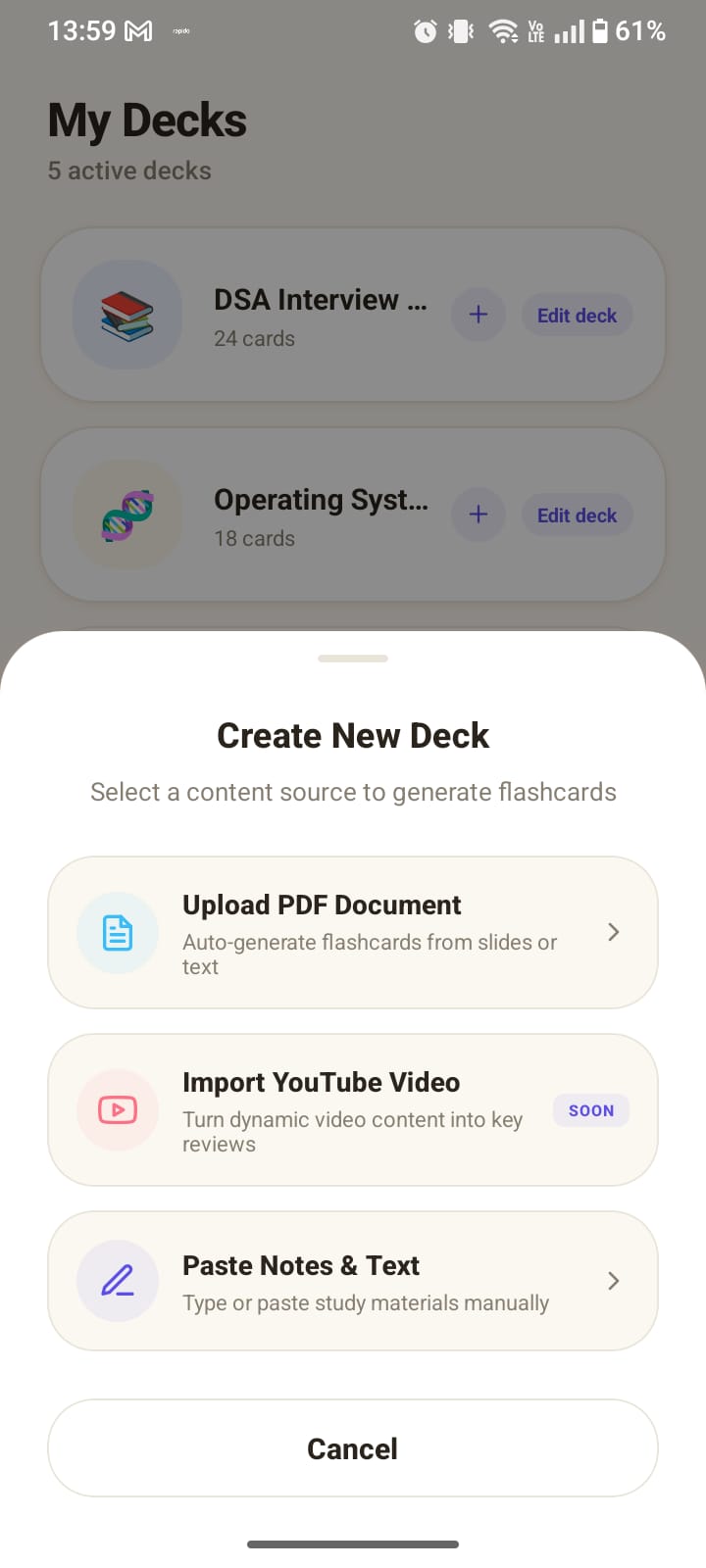
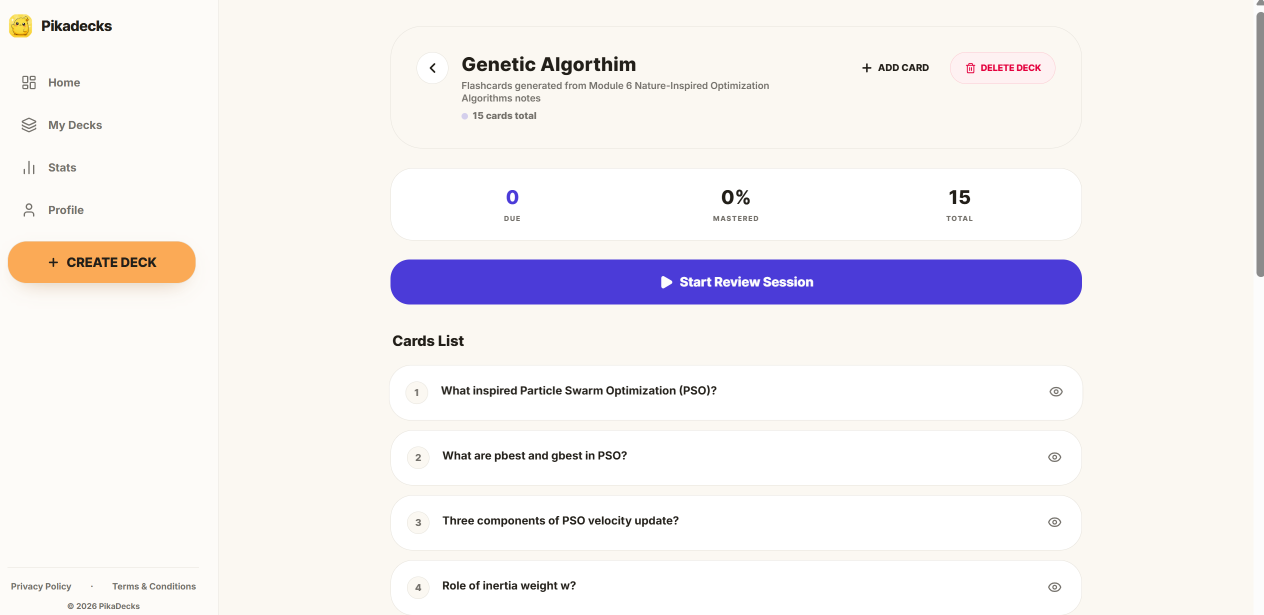
PikaDecks is an AI-powered learning platform that automatically converts educational content into intelligent flashcards.
The platform consists of three integrated components:
- Web Platform
- Mobile Application
- MCP Server for AI Assistants
Students can study anywhere while AI automates content generation.
⚙ Technology Stack
Frontend
- React 19
- TanStack Start
- TypeScript
- Vite
Mobile
- React Native
- Expo
Backend
- FastAPI
- Python
Database
- PostgreSQL
- Supabase
Storage
- AWS S3
AI
- Groq LLM
- OCR
- PDF Processing
- NLP
Authentication
- Clerk
Payments
- Razorpay
- Stripe
AI Integrations
- Model Context Protocol (MCP)
AI Flashcard Generation Pipeline
The generation process is fully automated.
Upload PDF / Video
        │
        ▼
Extract Text
        │
        ▼
Clean & Chunk Content
        │
        ▼
Groq LLM
        │
        ▼
Identify

• Concepts
• Definitions
• Examples
• Comparisons
• Algorithms
• Formulae

        │
        ▼
Generate Flashcards
        │
        ▼
Store in Database
        │
        ▼
Sync to Web + Mobile + MCP
No manual copy-paste required.
Spaced Repetition Engine
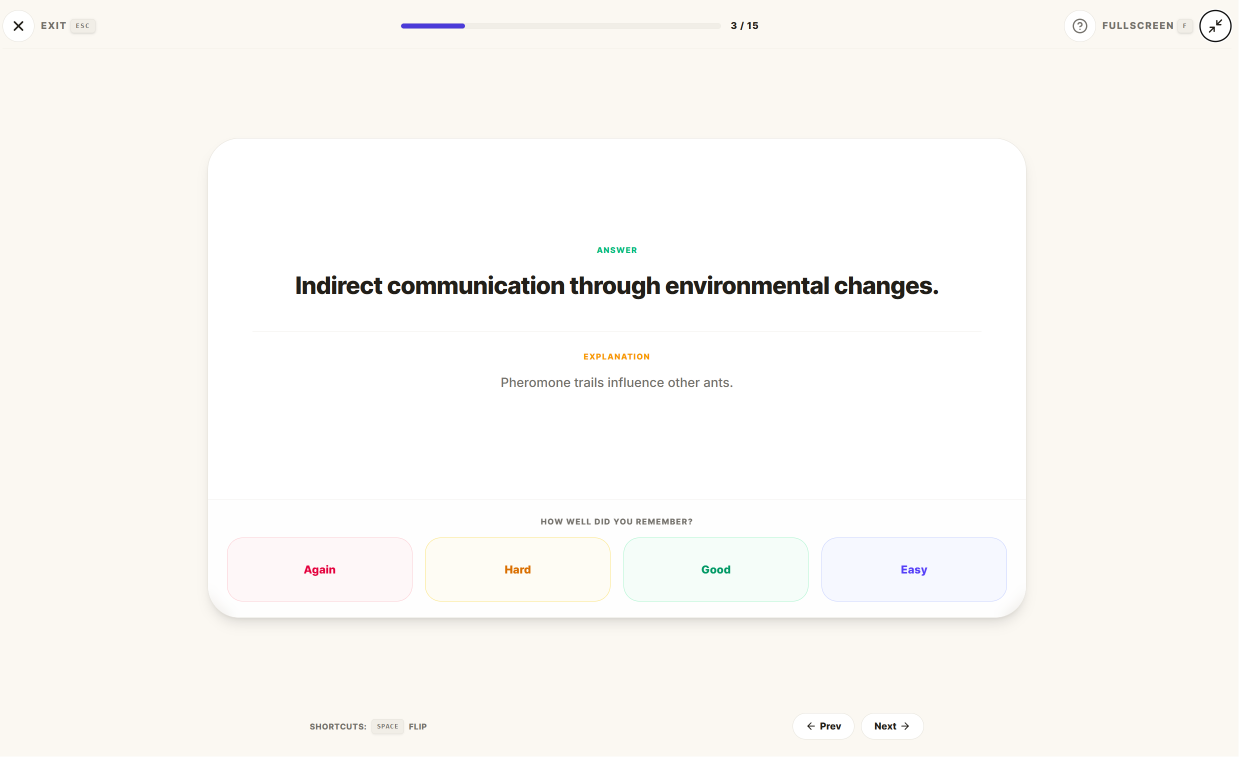
PikaDecks uses a modified SuperMemo-2 (SM-2) scheduling algorithm.
Unlike traditional flashcard systems,
our scheduler adapts according to the learner's performance.
Each review updates:
- Easiness Factor
- Review Interval
- Learning State
- Due Date
Mathematical Model
Easiness Factor
The Easiness Factor determines how quickly review intervals expand.
\begin{cases} \max(1.3,EF_{old}-0.20) & Again\ \max(1.3,EF_{old}-0.15) & Hard\ EF_{old} & Good\ \min(3.0,EF_{old}+0.15) & Easy \end{cases}
Review Interval
For review cards,
\begin{cases} \max(1,\lceil I_{old}\times1.2\rceil) & Hard\ \max(1,\lceil I_{old}\times EF\rceil) & Good\ \max(3,\lceil I_{old}\times EF\times1.5\rceil) & Easy \end{cases}
Learning State
For newly learned cards,
\begin{cases} 5\text{ min} & Again\ 10\text{ min} & Hard\ 20\text{ min} & Good\ 4\text{ Days} & Easy \end{cases}
Once promoted,
the card enters the Review state.
Why This Works
PikaDecks combines two scientifically proven learning principles.
Active Recall
Instead of recognizing information,
students retrieve knowledge from memory.
Memory retrieval strengthens neural connections.
Spaced Repetition
Cards appear exactly before the learner is predicted to forget them.
This minimizes study time while maximizing retention.
Web Platform
The Web Application enables users to
- Upload study material
- Generate flashcards
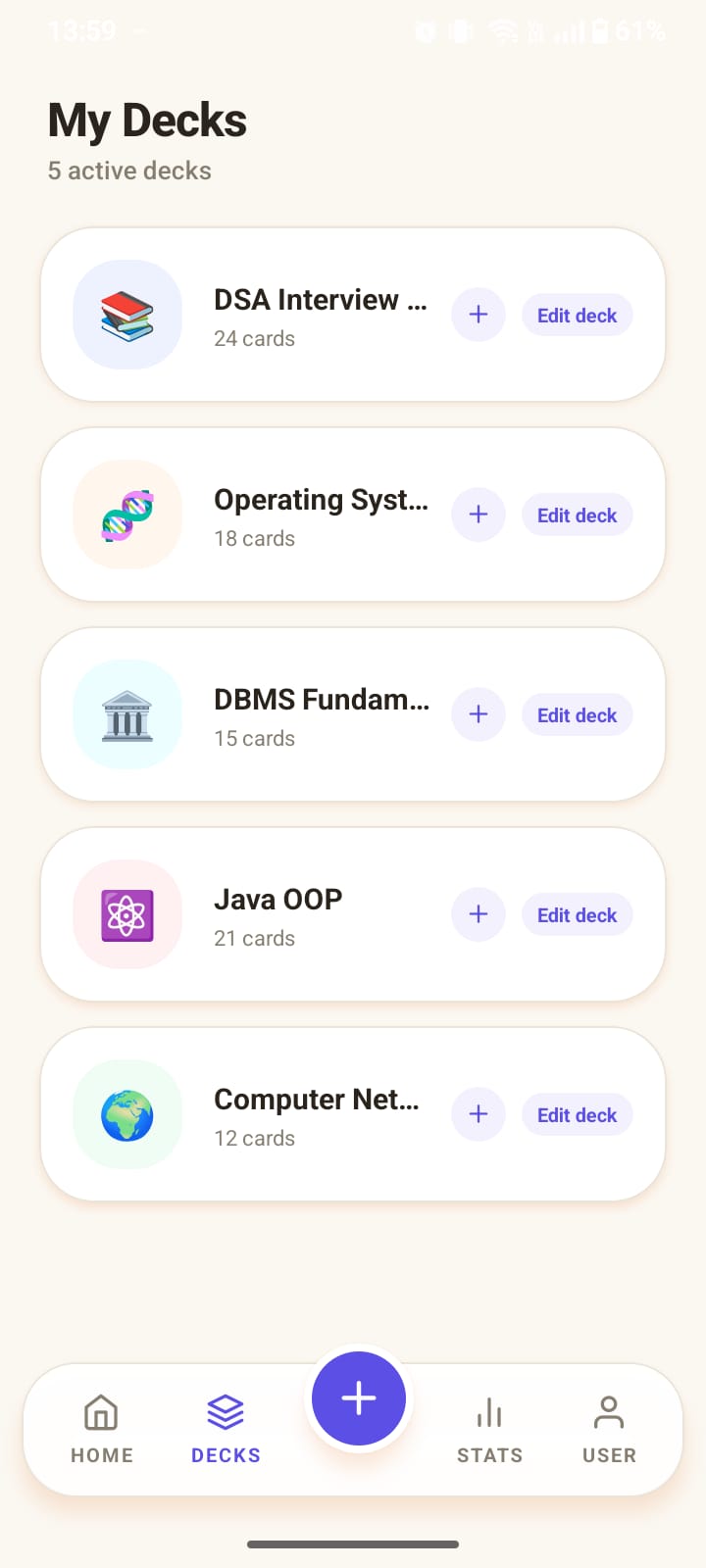
- Manage decks
- Study with SRS
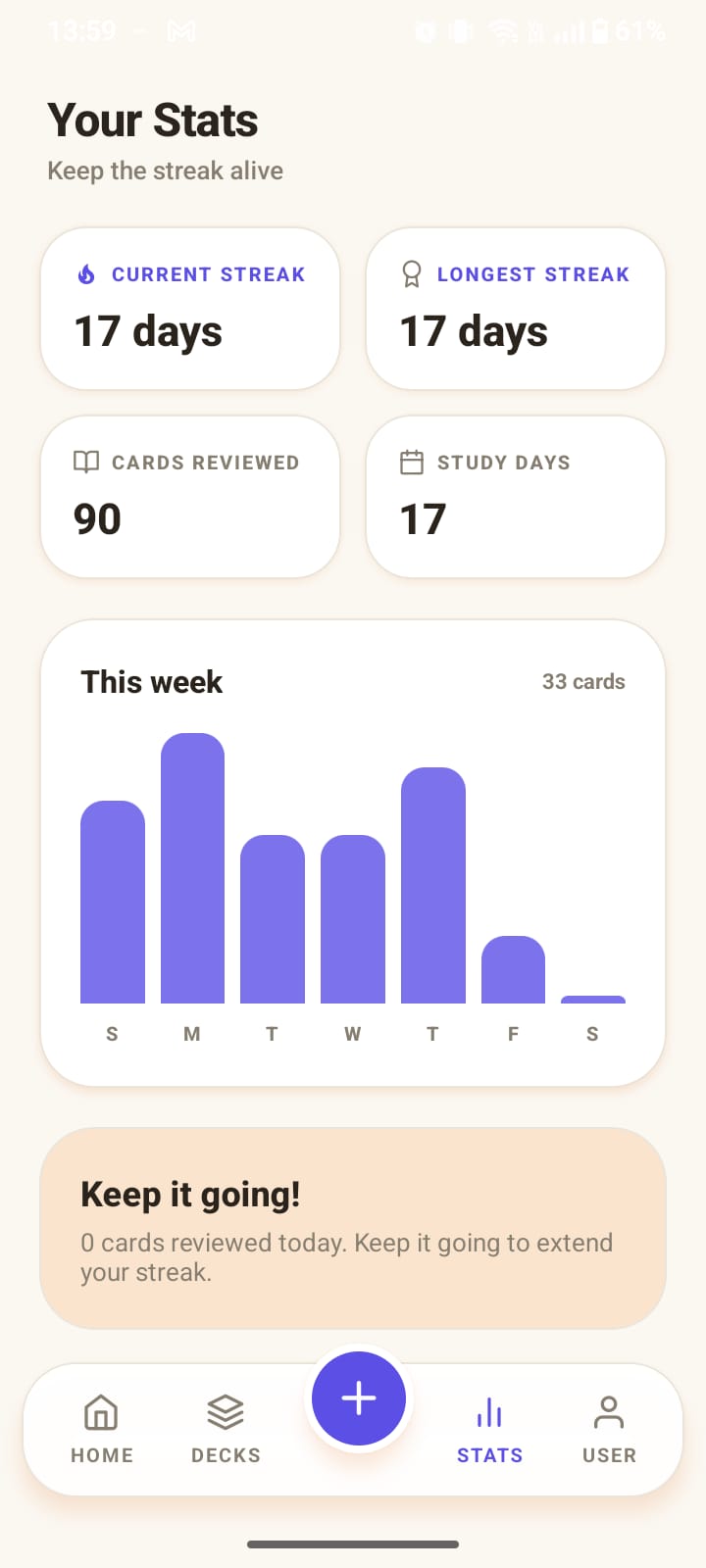
- Track learning progress
- View analytics
Mobile Application
The React Native application provides
- Offline studying
- Daily reminders
- Sync with cloud
- Review queues
- Cross-device learning
Students can continue learning without internet connectivity.
MCP Server
One of PikaDecks' most innovative features is its Model Context Protocol (MCP) Server.
The MCP Server exposes learning capabilities directly to AI assistants.
Instead of manually interacting with the application,
users can simply ask:
"Generate flashcards from this lecture."
"Create a Biology deck."
"Save these cards."
"Show my learning statistics."
The MCP Server securely communicates with the backend and performs these operations automatically.
This allows AI assistants like ChatGPT, Claude, and other MCP-compatible clients to become intelligent study companions.
Challenges We Solved
AI Processing
Large PDFs require
- OCR
- Parsing
- Chunking
- AI Processing
We implemented asynchronous background processing with status tracking.
Offline Synchronization
Students often study without internet.
We designed an offline-first synchronization model where review history is replayed sequentially once connectivity is restored.
Multi-Platform Deployment
The project spans multiple platforms:
- FastAPI Backend
- React Web
- React Native Mobile
- MCP Server
Ensuring secure authentication and synchronized state across all services required careful architectural planning.
What We Learned
Developing PikaDecks demonstrated that AI is most powerful when integrated into the learning process rather than replacing it.
We also learned the importance of:
- Modular system architecture
- Asynchronous AI pipelines
- Offline-first design
- Cross-platform synchronization
- Open standards like MCP for AI interoperability
Future Roadmap
Upcoming features include:
- AI-generated quizzes
- Voice learning
- Image-based flashcards
- Collaborative study groups
- Classroom dashboards
- LMS integrations
- Multi-language support
- AI tutoring
- Advanced learning analytics
- Additional MCP tools and integrations
Impact
Instead of spending hours preparing to study,
students can begin learning immediately.
Instead of memorizing temporarily,
they retain knowledge for the long term.
Instead of isolated learning,
they gain an AI-powered learning companion available across the web, mobile devices, and intelligent AI assistants.
Mission
PikaDecks exists to make learning effortless by combining Artificial Intelligence, scientifically proven memory techniques, and open AI integrations into one seamless learning platform.
One-Line Pitch
PikaDecks is an AI-powered learning ecosystem that transforms PDFs, videos, and notes into intelligent flashcards, delivers personalized spaced repetition across web and mobile, and enables seamless AI workflows through its Model Context Protocol (MCP) Server.
Built With
- codex
- fastapi
- mcp
- python
- react
- react-native

Log in or sign up for Devpost to join the conversation.