-
-
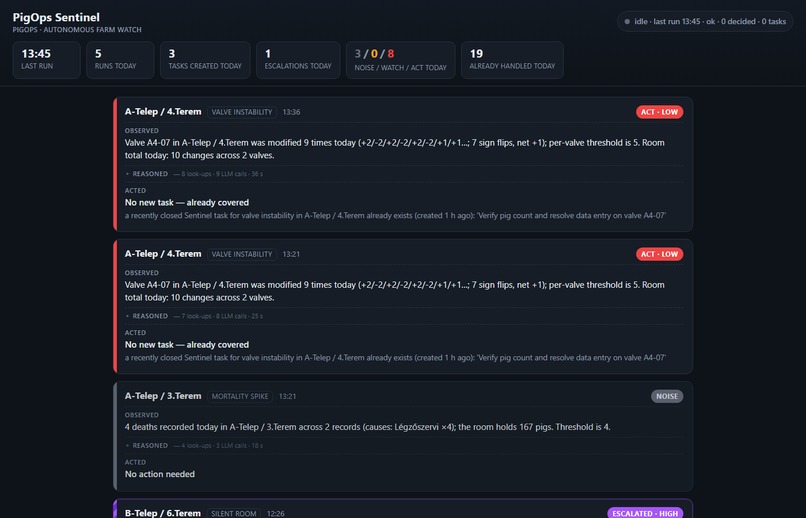
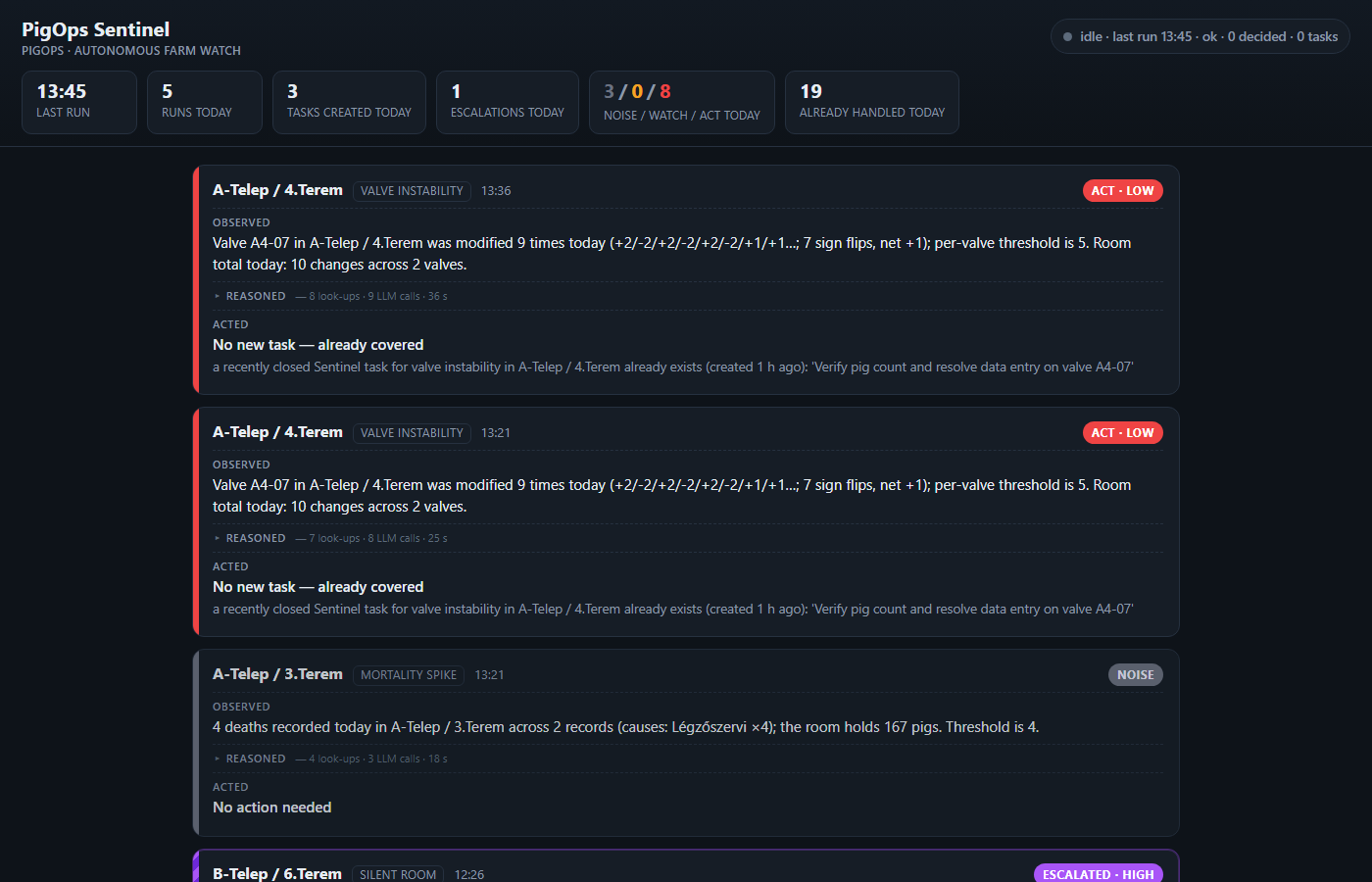
The live console: every decision as Observed / Reasoned / Acted, including the rooms it decided were fine.
-
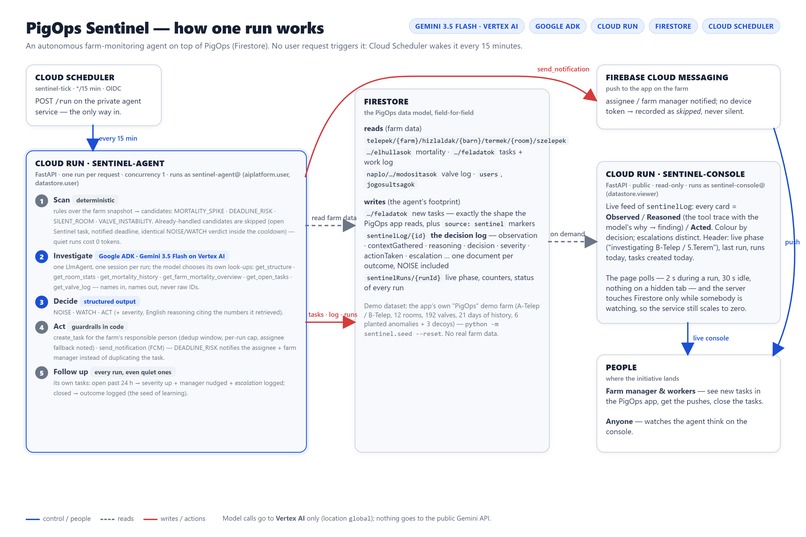
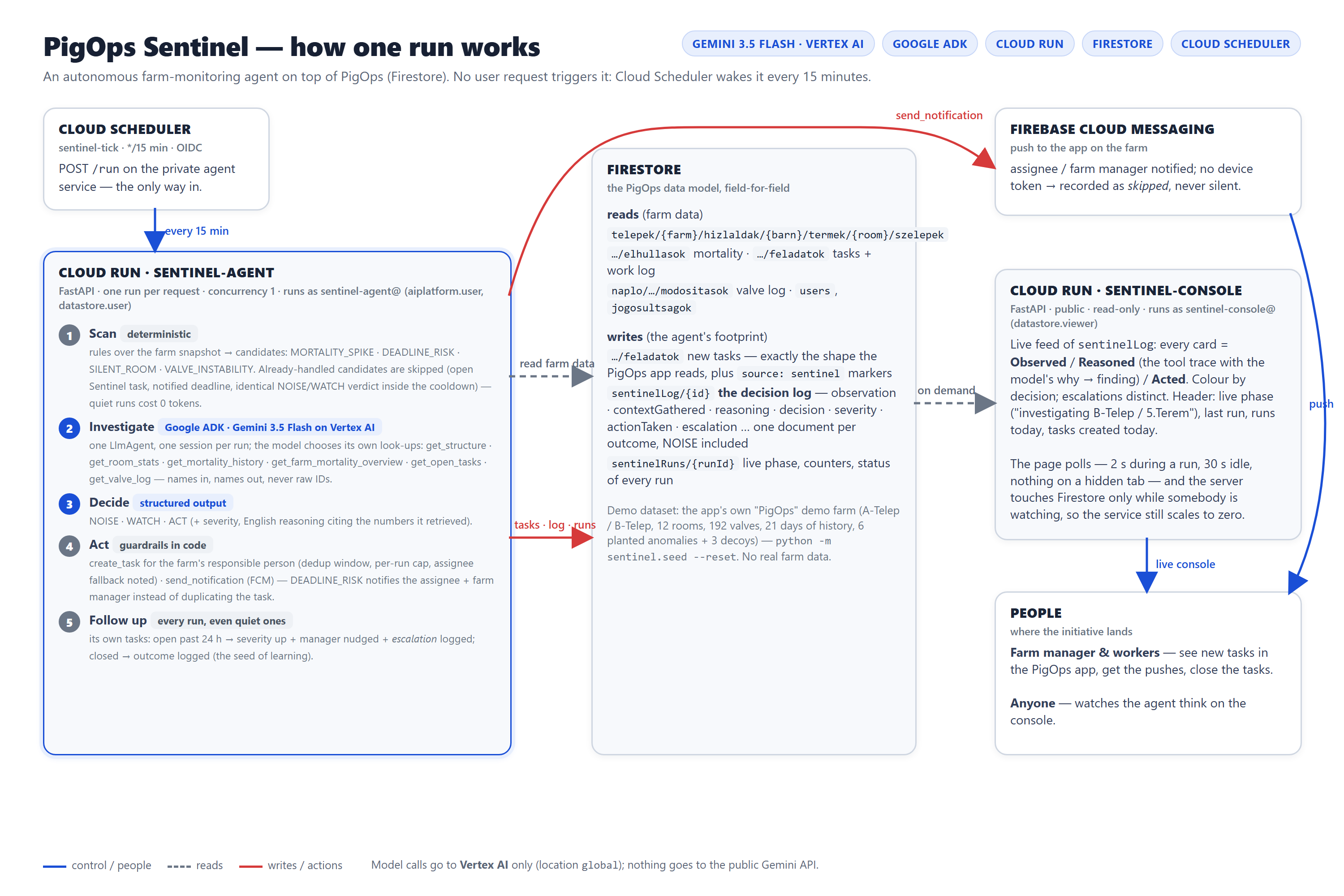
One run: Cloud Scheduler wakes the private agent on Cloud Run; it scans, investigates with tools, decides, acts and follows up.
Inspiration
PigOps is my product: a farm-management platform I built for the pig farms I work with every day. Workers record deaths, valve counts, tasks and their progress — every number is in there. But nobody looks at it unless they open the app, and the sentence I kept hearing from the managers was always the same one: I found out too late. A mortality spike surfaces at the end of the day; an overdue repair when the animals are already suffering; a room nobody has walked into for days. The platform had all the data and no initiative. PigOps Sentinel is the initiative: an agent that watches the farm on its own schedule, decides what matters, and acts — without anyone asking it to. This is not a problem I went looking for; it is the one that was already on my desk.
What it does
Every 15 minutes (Cloud Scheduler → Cloud Run) the Sentinel runs one loop over the farm's Firestore data:
- Scan — deterministic rules find candidates: a mortality spike, a task overdue or about to slip while untouched, a populated room that has gone silent, a valve being flipped back and forth. No model call; most runs find nothing and cost nothing.
- Investigate — for each candidate a Google ADK agent (Gemini 3.5 Flash on Vertex AI) gathers context the way a farm manager would, choosing its own look-ups: room state, 14-day mortality history, whether a treatment is already underway, whether the barn is affected, the valve log. Tools take and return names, never IDs.
- Decide — NOISE / WATCH / ACT with a severity and an English justification that cites the numbers it actually retrieved.
- Act — creates a real PigOps task for the farm's responsible person and notifies them (Firebase Cloud Messaging); for a slipping deadline it notifies the assignee and the manager instead of duplicating the task. Guardrails live in code: dedup window, per-run cap, explained assignee fallback.
- Follow up — every run re-checks the tasks it created itself: still open past 24 h → severity up, manager nudged, an escalation logged; closed → the outcome logged.
Every outcome — including "this room is fine" — is one document in the decision log, and the console renders it live: each card is Observed / Reasoned / Acted, with the model's full tool trace ("why I looked → what I found") one click away. That log is the product: it is what proves the agent decided something on its own.
How we built it
- Google ADK 2.x — one
LlmAgentwith six read tools (FunctionTool), structured output (a PydanticDecision), one session per run; abefore_tool_callbackenforces a per-candidate tool budget. - Gemini 3.5 Flash on Vertex AI (location
global) — every model call; the process refuses to start if it finds a Gemini API key, so nothing can leak to the public API. - Cloud Run — two services from one image: the private
sentinel-agent(POST /run, OIDC only, concurrency 1) and the publicsentinel-console(FastAPI; the page polls — 30 s idle, 2 s during a run, nothing while the tab is hidden — so watching the agent never holds an instance open). - Firestore — the PigOps data model, field-for-field, plus the agent's own
sentinelLogandsentinelRunscollections; Cloud Scheduler ticks it; Firebase Cloud Messaging for the pushes. - Python 3.13, FastAPI, pydantic-settings; 107 tests that need neither the model nor Firestore (a pure seed builder and a faked repository);
infra/setup_gcp.shbootstraps the whole GCP project,infra/deploy.shbuilds and deploys both services and the scheduler in one go.
Architecture decisions
- The model never writes. The agent gets six read-only tools; every write — task, notification, escalation, outcome — is deterministic code the model cannot argue with (dedup window, per-run cap, notification stamps, assignee fallback). What comes back from the LLM is a typed
Decision, not an action. That line is what makes an autonomous writer safe to leave running. - State lives in Firestore, never in the process. A run is a
sentinelRunsdocument (phase, counters, status); a verdict is asentinelLogdocument; progress is stamped on the tasks themselves (sentinelNotifiedAt,escalatedAt,sentinelOutcomeLoggedAt). Nothing is held in memory between ticks, so the service scales to zero, survives being killed mid-run, and an overlap guard refuses a second concurrent run. - Least privilege, end to end. Separate service accounts (agent:
aiplatform.user+datastore.user; console:datastore.vieweronly), the agent service is private — an OIDC call from Cloud Scheduler is the only way in — and the process refuses to boot if it finds a Gemini API key, so model calls can only reach Vertex AI. Tools take and return names, never raw IDs. - Failure is a logged outcome, not silence. A failed investigation, a failed action and a failed run each leave their own entry (
failed,run_failed,partial); one bad candidate never takes the run down with it. All of it is covered by 107 tests that need neither the model nor Firestore.
Data
A synthetic demo farm generated by the repository's own seed script (python -m sentinel.seed): the app's demo farm layout (2 barns, 12 rooms, 192 valves), 21 days of mortality and valve-log history relative to now, six planted anomalies and three decoys, three fictional people. No real farm data, no real names, no service-account keys anywhere — Application Default Credentials and least-privilege service accounts only.
Challenges we ran into
- Judgement, not rules. Two rooms both cross the mortality threshold; one is a genuine spike, the other has a known problem with a treatment already underway. Getting the agent to say ACT for the first and NOISE for the second — and to explain both — is what the whole project stands or falls on. It came down to giving the model the manager's questions (is it unusual for this room, is someone already on it, is it spreading) instead of the answers.
- Autonomy that does not spam. A 15-minute cadence over the same farm state would create the same task, send the same notification and re-decide the same NOISE every quarter hour. Idempotency became a first-class design: open Sentinel tasks, recently closed ones, notified deadlines and identical-evidence verdicts are all "handled" before the model is even called; overlapping runs refuse to start.
- Trusting the log. The model's own account of what it looked up is merged onto the real tool trace; a claimed look-up that never ran stays in the log flagged
verified: false. Failures are logged as failures — a broken investigation or run leaves an entry, never silence. - Small things that bite: Gemini 3.5 is only served from the
globalVertex location; the SDK's Vertex flag changed names between versions (we set both); Google's front end answers/healthzon*.run.appitself.
Accomplishments that we're proud of
An agent that has been running unattended in the cloud, making and logging its own decisions — and a console where you can watch it think, including the times it decides not to act.
What we learned
The interesting part of an autonomous agent is not the model call — it is everything around it: what it is allowed to do, how it avoids doing it twice, how it explains itself, and how it fails. Most of the code is that. And a decision log that includes the "nothing to do here" verdicts is worth more than an alarm feed: it shows judgement.
What's next for PigOps Sentinel
Point it at a real farm (the data model is already the production one), let the follow-up outcomes feed back into the decision (which kinds of tasks get closed fast, which get ignored), Hungarian task text for the workers (TASK_LANGUAGE=hu), and a weekly narrated digest for the manager.
Pre-existing work
The PigOps platform (Flutter/Firebase, in production since 2025) and its Firestore data model pre-date the hackathon; sentinel/schema.py mirrors that existing model field-for-field. Everything else in the repository — the entire sentinel/ package, the seed, the agent, both Cloud Run services and the infra scripts — was written during the submission period.

Log in or sign up for Devpost to join the conversation.