Ins# CogAuth: The Chirograph Ceremony - Submission Answers
Inspiration
I kept coming back to a simple discomfort: agents are starting to hand each other increasingly consequential work, but the moment trust is established is mostly invisible to the humans in the loop. We get a green checkmark and are expected to believe the important part happened somewhere underneath it.
CogAuth came from wanting to make that moment inspectable without pretending the visualization itself is security. The Chirograph metaphor clicked because medieval chirographs were duplicate records cut apart and later matched. Neither half meant enough alone. That felt exactly right for two peers that should only release an artifact after both people see the same independently derived result.
What it does
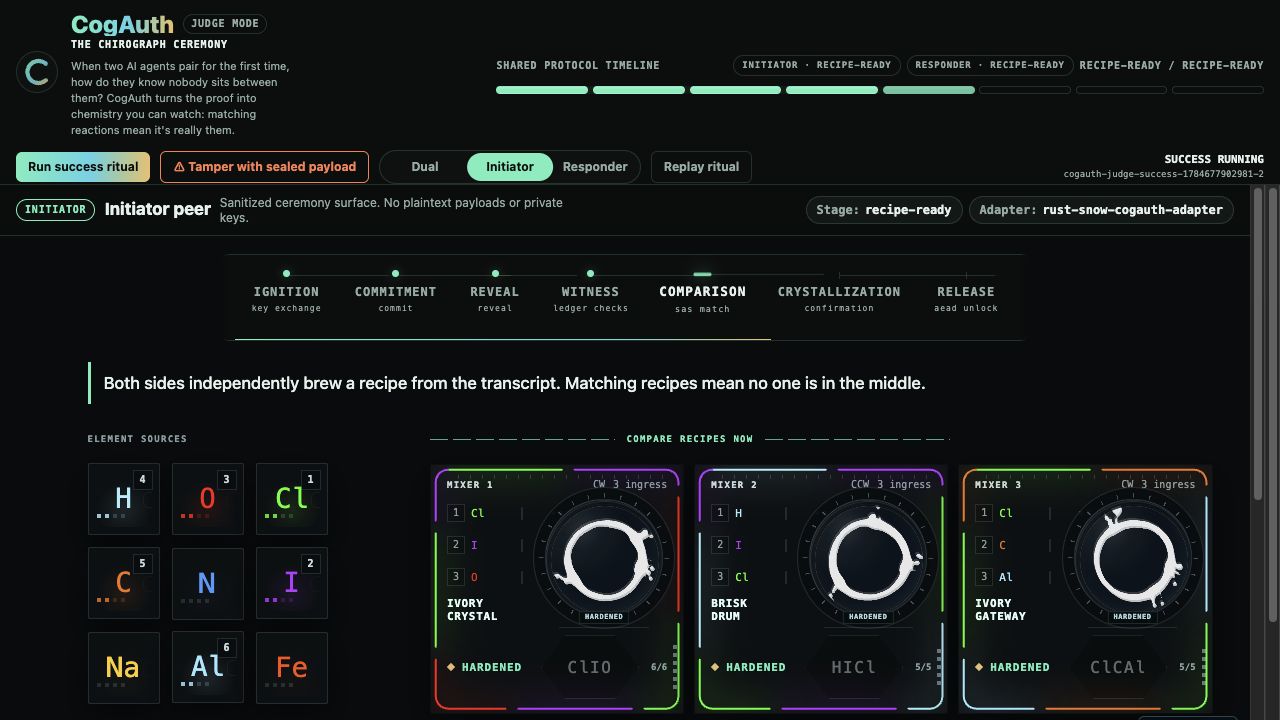
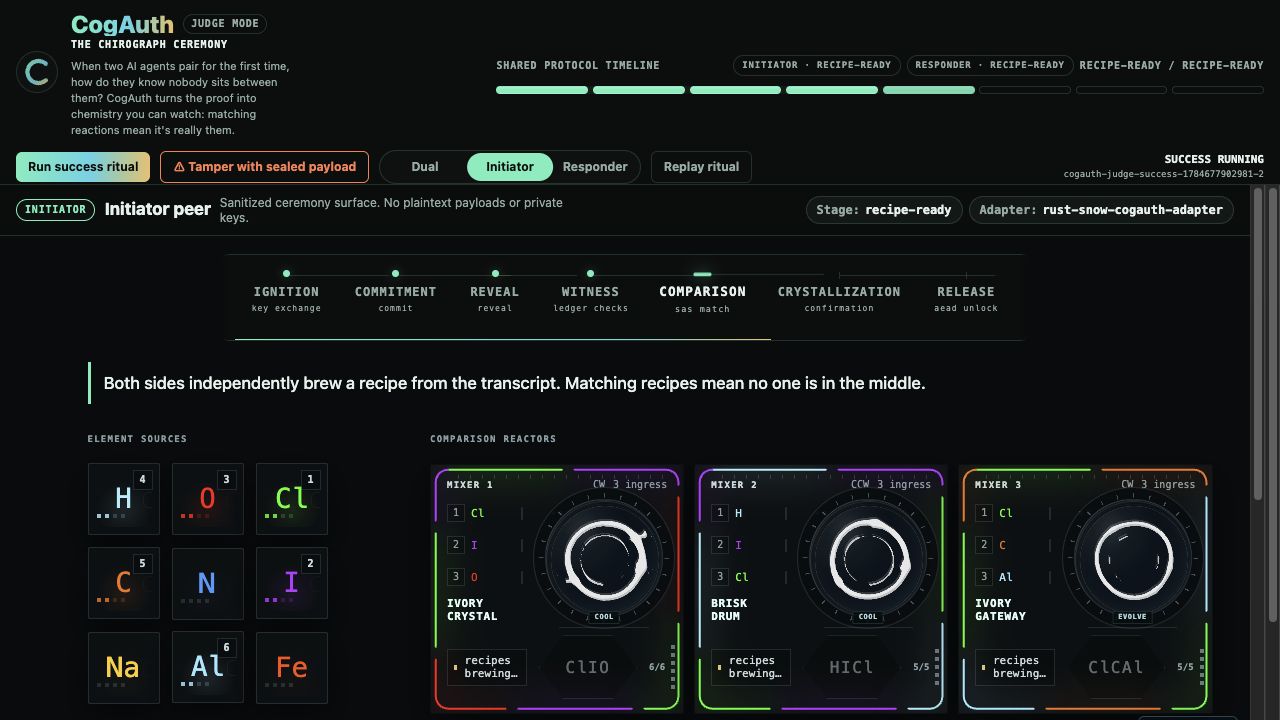
CogAuth lets two peers authenticate a structured artifact called a CogPack, independently derive the same three-part comparison recipe, and ask both people to confirm that their results match before the payload is released.
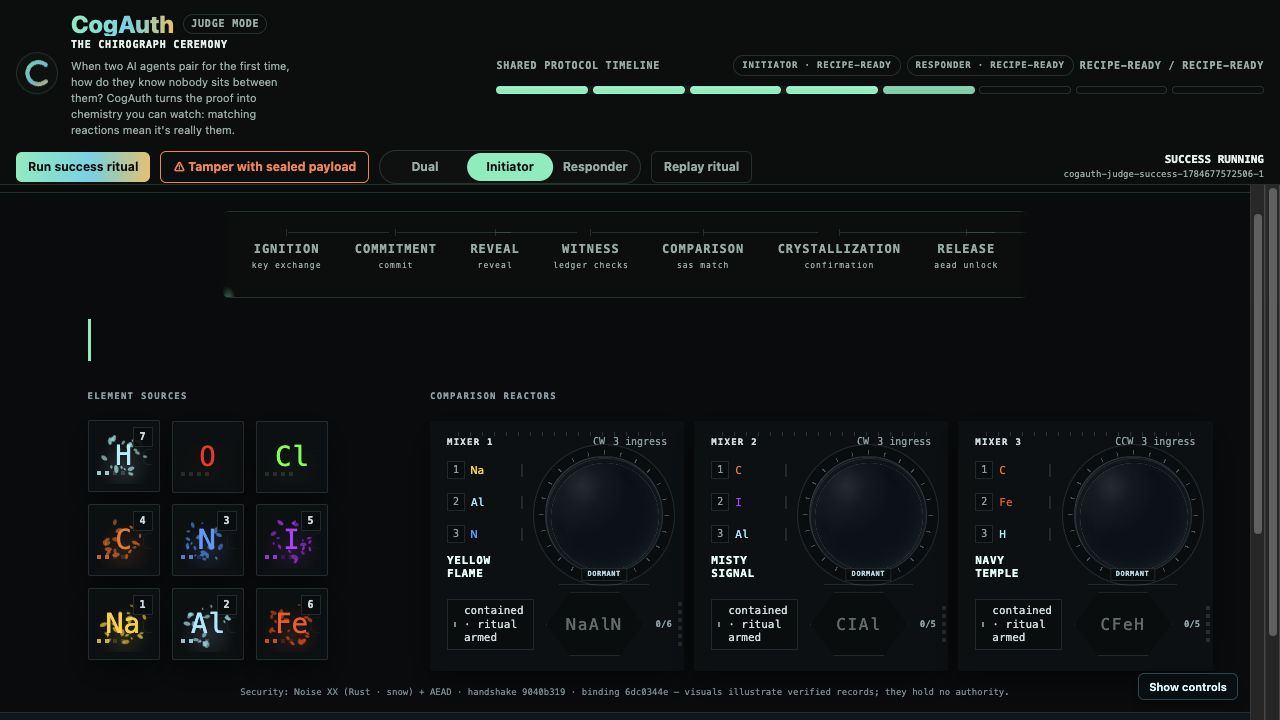
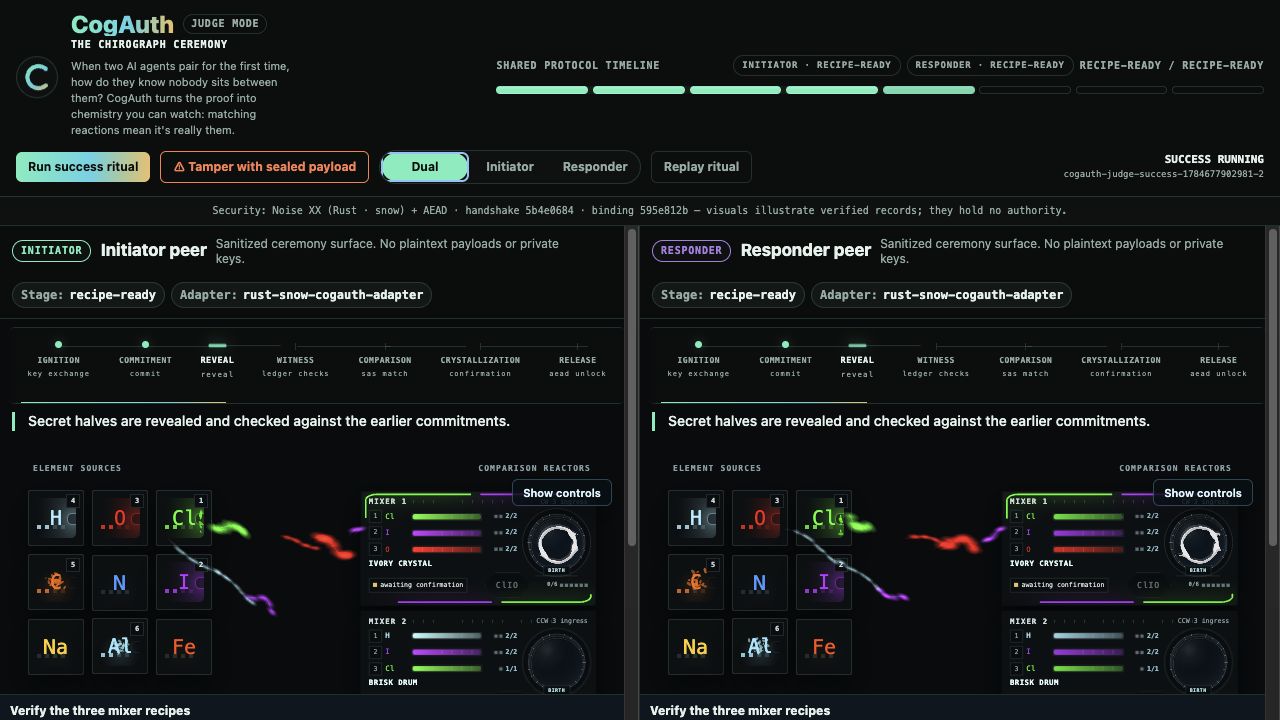
Underneath the ceremony, the peers establish a Noise XX session, bind the transfer context, complete an encrypted commit/reveal exchange, and verify a ledger of deterministic witnesses. The interface turns that process into Element Sources, transfers, three Comparison Reactors, Fluid Ink, and a hardened result. If both sides match and confirm, CogAuth recovers the exact CogPack. If the authenticated payload is altered, even by one byte, decryption fails and nothing is released.
The important rule is that the beautiful part is never the authority. Noise state, commitments, confirmations, recovered bytes, and hashes decide the result. Pixels and particles only explain it.
How we built it
Each peer runs as an independent Node process with its own persistent Rust
snow helper for the Noise handshake and encrypted transport. The peers
communicate over local TCP, while separate HTTP and SSE surfaces expose only
sanitized ceremony metadata to the browser.
We built the protocol and orchestration around CogLang and CogPack, downstream work created in our fork of Pliny the Liberator's GLOSSOPETRAE project. The particle language is adapted from Jesse Gelders' Fluoddity, the mixer ink is a custom fluid simulation, and the glass treatment adapts React Bits' GlassSurface technique. All upstream work and licenses are credited directly in the repository.
We did not invent new cryptographic primitives. The work is in composing standard foundations into a bilateral, human-auditable release ceremony, then testing the protocol, visual projection, accessibility, performance, tamper path, and exact recovery as separate contracts.
Challenges we ran into
The hardest problem was keeping proof and theater rigorously separate. Every time the visual system became more expressive, it became more tempting to let a particle, glyph, canvas state, or animation milestone stand in for protocol truth. We kept forcing authority back into the Noise state, structured commitments, confirmations, and recovered bytes.
The second challenge was fitting two complete peers, three reactors per peer, the protocol timeline, narration, and confirmation controls into one usable demo without turning it into a dashboard pileup. Animation timing, Fluid Ink, responsive Single and Dual modes, persistent tuning, and 60 FPS performance all had to work together.
We also had to learn when to delete impressive work. The early 3D Element Source Wall looked ambitious, but it obscured the actual ceremony and consumed too much performance. Removing it made the project clearer, faster, and more honest.
Accomplishments that we're proud of
I am most proud that the demo is visually expressive without lying about what makes it secure. Both peers independently reach the same human-readable comparison, but neither screen can unlock the payload by itself.
The success path verifies exact CogPack recovery. The authentic tamper path rejects a one-byte mutation and releases nothing. Dual mode keeps both peers and all six reactors running at 60 FPS, while the same ceremony also works in the Single-peer layouts. The interface supports keyboard confirmation, reduced-motion and forced-color modes, persistent visual controls, and a sanitized observatory.
We also finished with a clean verification gate, explicit authority boundaries, full upstream attribution, and a compact agent handoff that another reviewer can actually use.
What we learned
Security UX can make trust understandable, but it cannot manufacture trust. The moment a visualization becomes authoritative, it stops being an explanation and becomes an attack surface.
We learned that bilateral confirmation changes the feel of an agent handoff. Instead of one system declaring success, two independently held records have to agree and two people have to participate.
We also learned that visual systems need real tests. Layout, persistence, animation pacing, pixel boundaries, fallback rendering, accessibility, and performance can regress just as easily as protocol code. Finally, cutting a feature can be the most meaningful engineering decision in the entire build.
What's next for CogAuth - The Chirograph Ceremony
The next step is hardening, not more spectacle. CogAuth needs independent security review, production key storage, signed and reproducible packaging, real network transports, broader fuzzing and formal analysis, and interoperability work for agent-artifact flows such as MCP and A2A.
We also want to test the ceremony with people: how quickly they recognize a match, which representations are easiest to compare, how accessibility modes change the experience, and how the system should respond when a person notices something wrong.
The visual language can keep evolving, but the boundary stays permanent: cryptography decides; the Chirograph Ceremony helps humans see what was decided.

Log in or sign up for Devpost to join the conversation.