-
-
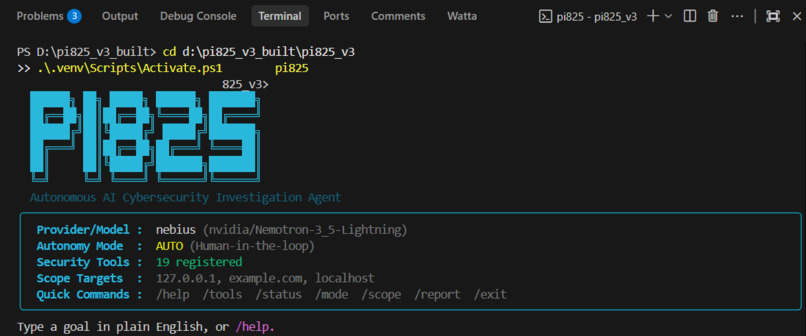
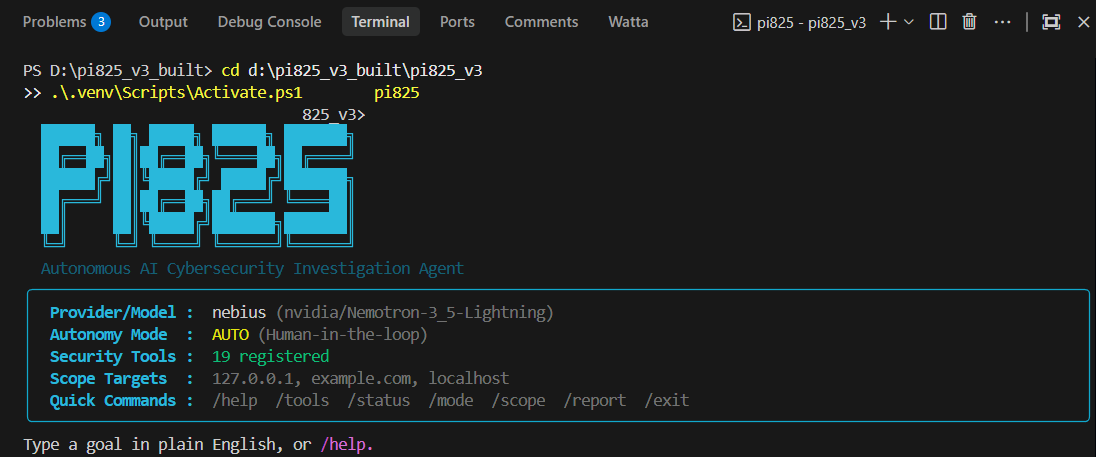
This screenshot showcases the PI825 command-line interface.
-
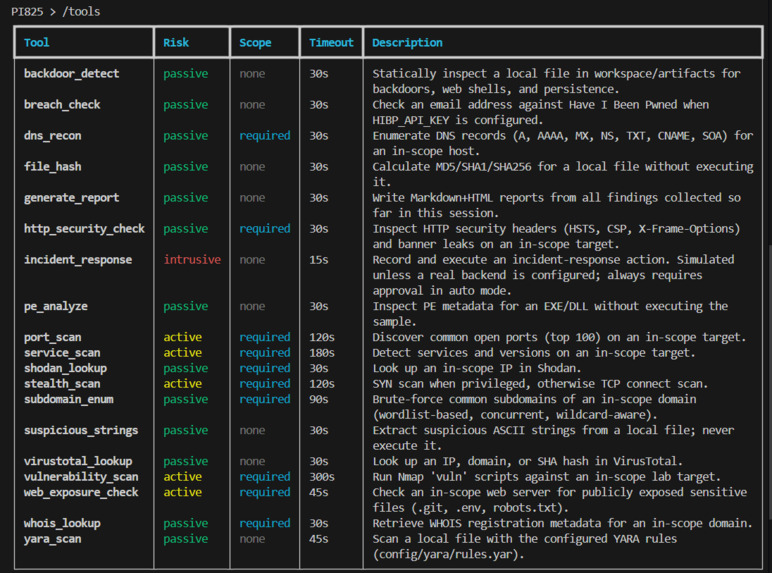
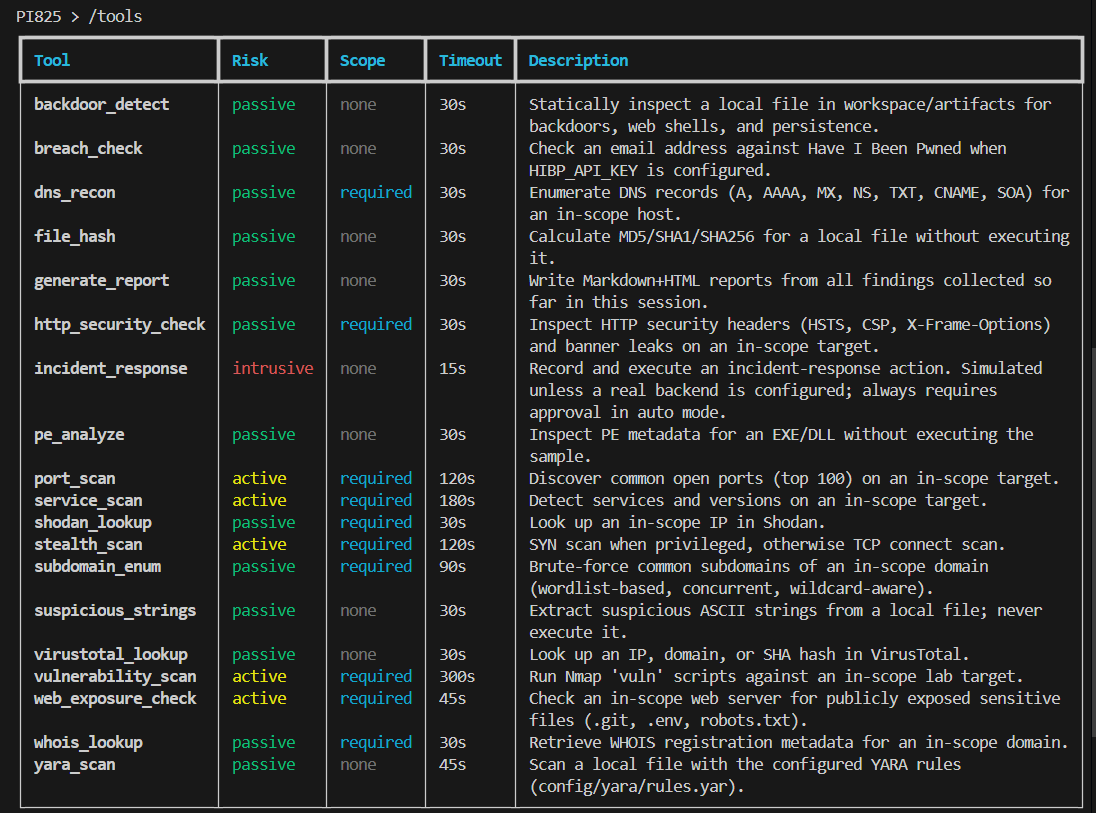
This screenshot displays the PI825 security tool registry, accessible through the /tools command.
-
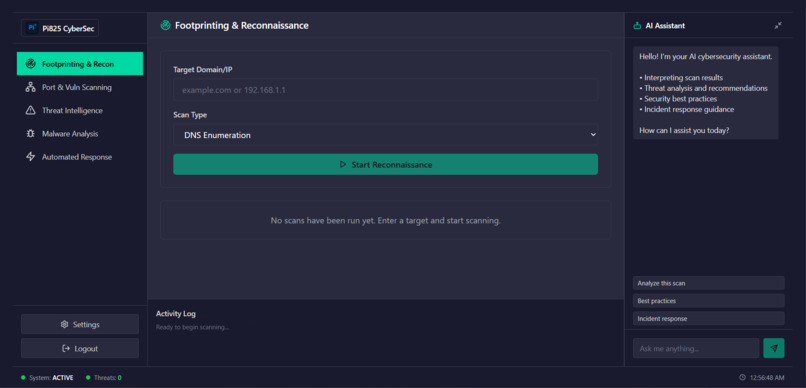
The registry includes capabilities
-
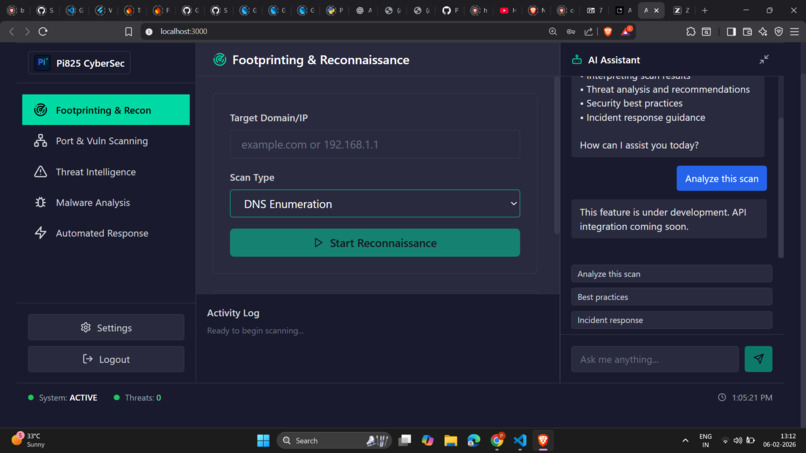
Each tool includes execution metadata and a description.
Cybersecurity is becoming increasingly complex as organizations face growing numbers of vulnerabilities, suspicious activities, malware threats, and network attacks. Security professionals often need to switch between multiple tools and manually correlate information to investigate a single security incident.
We identified an opportunity to make these workflows more intelligent and accessible through AI.
Our inspiration was simple: What if cybersecurity professionals could communicate with an AI agent that understands their security requirements, selects the appropriate tools, performs controlled investigations, and presents meaningful results?
This idea led to PI825 – an AI-powered cybersecurity agent designed to connect artificial intelligence with practical cybersecurity operations.
What it does
PI825 is an AI-powered cybersecurity agent that combines natural-language interaction with multiple cybersecurity tools through a unified platform.
Its major capabilities include:
Footprinting and Reconnaissance: Gathers information about authorized targets, domains, and network infrastructure.
Port and Vulnerability Scanning: Uses network scanning capabilities to identify open ports, exposed services, and potential security weaknesses.
Threat Intelligence Integration: Enriches investigations using external intelligence sources and suspicious indicators.
Malware and File Analysis: Supports the inspection of suspicious files and identification of potentially malicious indicators.
Automated Incident Response: Supports structured incident creation, investigation tracking, and controlled response workflows.
AI Chat Interface: Allows users to interact with cybersecurity capabilities through natural-language instructions.
PI825 connects these capabilities through an AI agent architecture, helping users move from a security request to a structured investigation workflow.
How we built it
We developed PI825 using a modular architecture that connects an AI reasoning layer with specialized cybersecurity tools.
AI Agent Layer: We integrated the Google Gemini API with function calling so the AI can interpret user requests and select appropriate backend operations.
Backend: Python and Flask power the backend services, with dedicated API endpoints for reconnaissance, vulnerability scanning, threat intelligence, malware analysis, incident creation, and AI chat.
Cybersecurity Tool Integration: We integrated tools and libraries such as Nmap, WHOIS, DNS utilities, Shodan, and VirusTotal to support different investigation workflows.
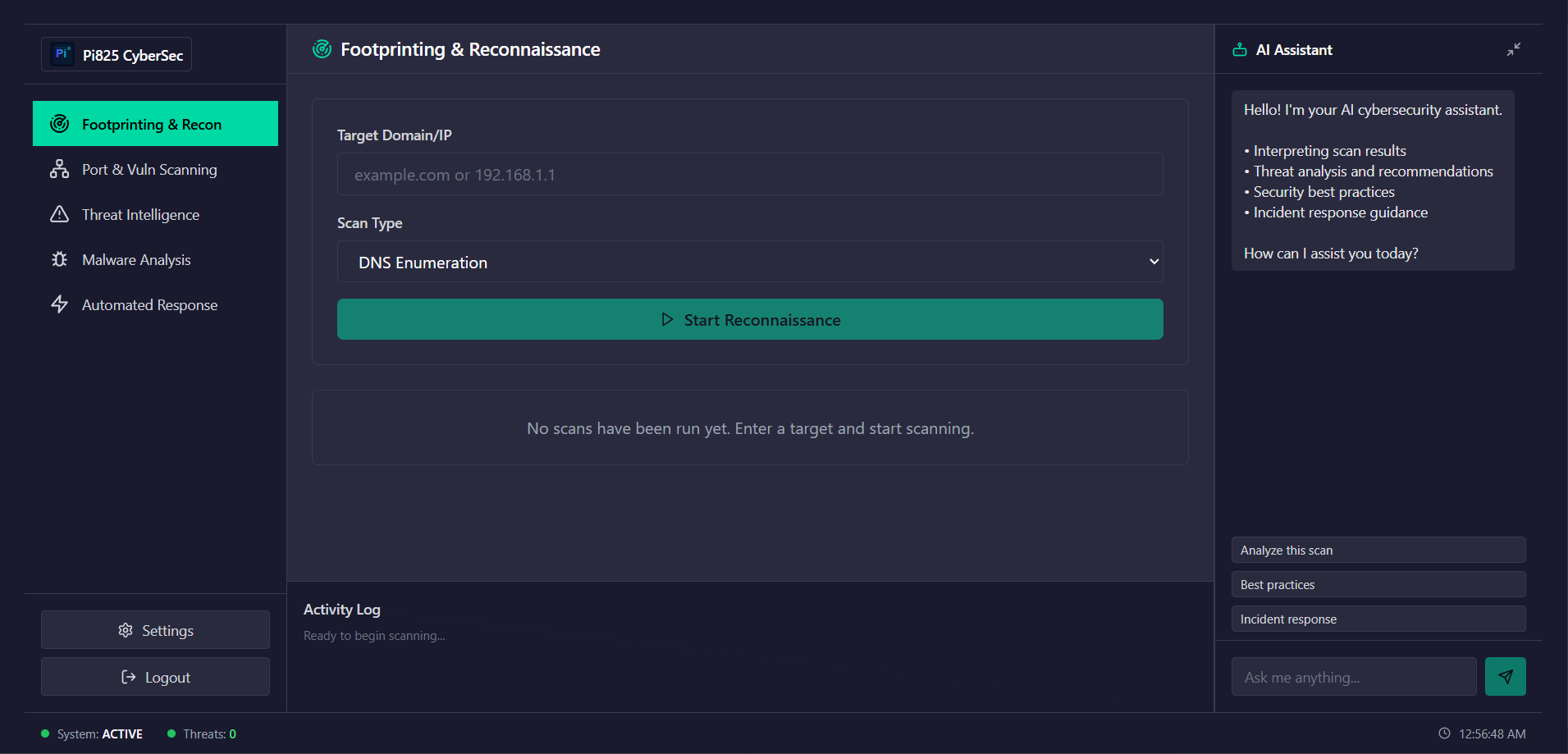
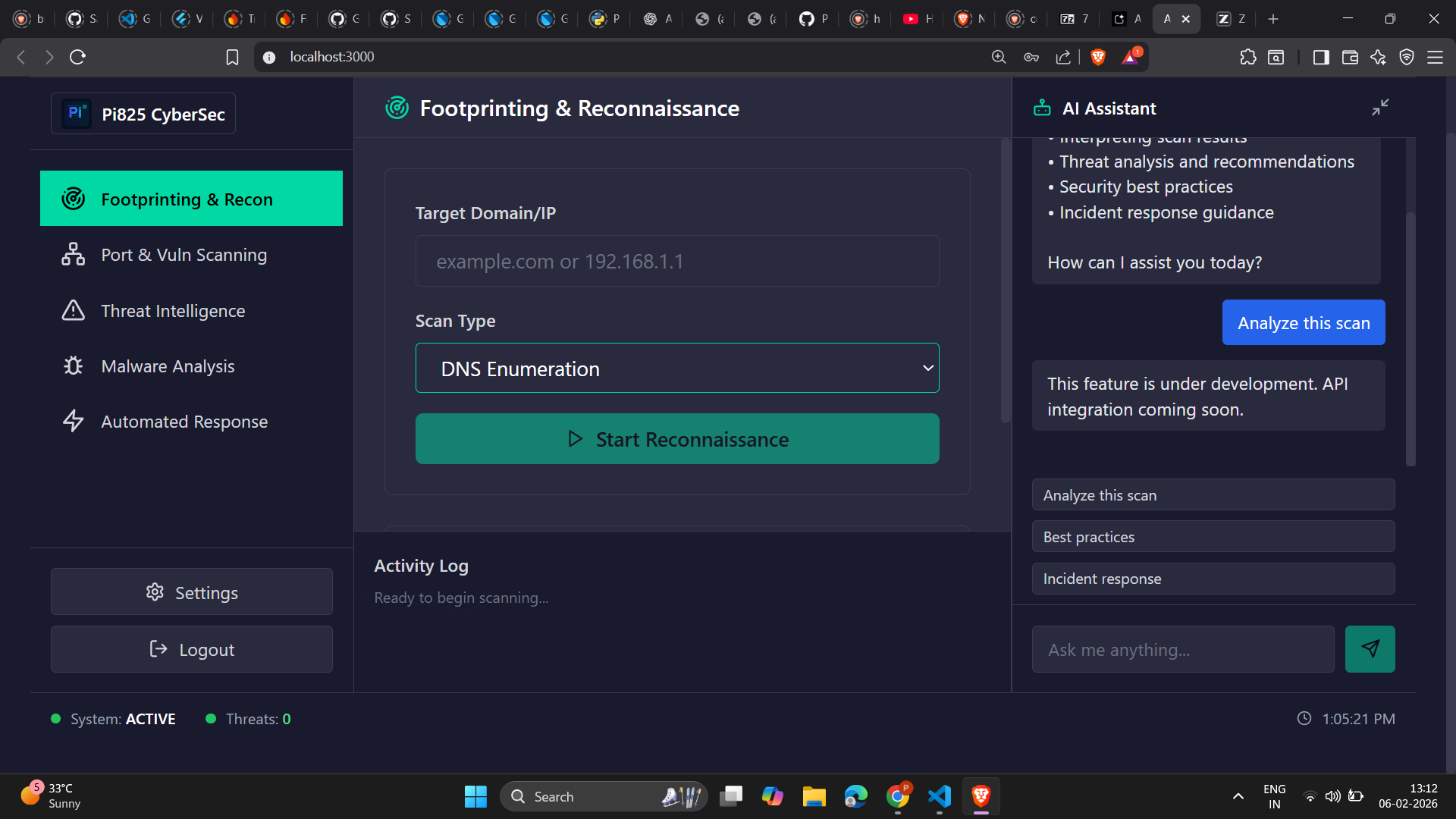
User Interface: We developed a PyQt-based interface with an AI chat area, module-specific forms, terminal output, and an activity log.
Security and Control: We incorporated scope validation, controlled tool execution, and audit logging into the architecture to support responsible cybersecurity automation.
The overall architecture follows a modular approach, allowing individual cybersecurity capabilities to operate as specialized components coordinated through the AI agent.
Challenges we ran into
Building an AI-powered cybersecurity agent involved several technical and architectural challenges.
AI and Tool Orchestration: Connecting natural-language instructions to actual cybersecurity tools required careful implementation of function calling and backend routing.
Tool Integration: Different cybersecurity tools produce different output formats. Normalizing and presenting these results through a unified interface required additional development.
Safe Execution: Cybersecurity operations must remain within authorized boundaries. Designing scope validation and controlled execution was an important challenge.
External API Dependencies: Integrating services such as Shodan and VirusTotal introduced challenges involving API keys, rate limits, connectivity, and error handling.
Backend and Interface Coordination: Maintaining reliable communication between Flask services and the PyQt interface required debugging and testing.
AI Reliability: Ensuring that AI-generated tool selections and investigation workflows are handled through validated backend operations rather than unrestricted command execution was another important consideration.
These challenges helped us improve the architecture and understand the importance of reliability, safety, and structured execution in AI-driven cybersecurity systems.
Accomplishments that we're proud of
We are proud to have developed a working foundation for an AI-driven cybersecurity platform that brings multiple security operations into a unified environment.
Our key accomplishments include:
Building an AI agent architecture using Gemini function calling.
Connecting AI interactions with specialized cybersecurity backend operations.
Integrating multiple cybersecurity tools into one platform.
Developing dedicated workflows for reconnaissance, vulnerability scanning, threat intelligence, and malware analysis.
Creating a unified PyQt interface with AI chat, terminal output, and activity monitoring.
Designing controlled tool execution with scope validation and audit logging.
Exploring how AI can simplify complex cybersecurity workflows for students, developers, and security professionals.
Most importantly, we transformed an idea into a modular platform that demonstrates how AI reasoning can work alongside practical cybersecurity tools.
What we learned
Developing PI825 taught us that building a useful AI agent involves much more than connecting an application to a language model.
We gained practical experience in:
AI agent architecture and function calling.
Connecting LLMs with external tools and backend services.
Python backend development using Flask.
Network reconnaissance and vulnerability assessment.
Threat intelligence and malware analysis workflows.
API integration and error handling.
Scope validation and responsible cybersecurity automation.
Designing interfaces for complex technical operations.
We also learned that AI-generated decisions need validation, tool execution needs boundaries, and investigation results need to be structured and understandable.
This project strengthened our understanding of the intersection between artificial intelligence, automation, and cybersecurity.
What's next for PI825 – AI Cybersecurity Agent
PI825 is a foundation that we aim to evolve into a more intelligent, reliable, and scalable cybersecurity platform.
Our future roadmap includes:
Advanced AI Agent Orchestration: Improve multi-step reasoning, tool selection, and coordination between cybersecurity modules.
Real-Time Network Monitoring: Explore continuous network monitoring and live threat detection capabilities.
Enhanced Threat Intelligence: Integrate additional intelligence sources and improve threat correlation.
Advanced Malware Analysis: Expand file inspection, behavioral analysis, and suspicious activity detection.
Intelligent Incident Response: Develop more advanced incident workflows with human approval and controlled response actions.
Report Generation: Generate comprehensive security reports with findings, risk classifications, and remediation recommendations.
Cloud and Scalable Deployment: Explore containerization and cloud deployment to make PI825 easier to install and operate.
Improved User Experience: Develop a more intuitive interface with interactive dashboards and real-time investigation visibility.
Our long-term vision is to build PI825 into an AI-driven cybersecurity assistant that helps make security investigations faster, more understandable, and accessible to a wider range of users.
PI825 – Intelligent. Accessible. Efficient.
Bringing AI reasoning and cybersecurity operations together.
Built With
- ai-agents
- artificial-intelligence
- automation
- cybersecurity
- flask
- gemini-api
- machine-learning
- malware
- natural-language-processing
- nebius
- network-security
- nmap
- nvidia
- python
- threat-intelligence
