Inspiration
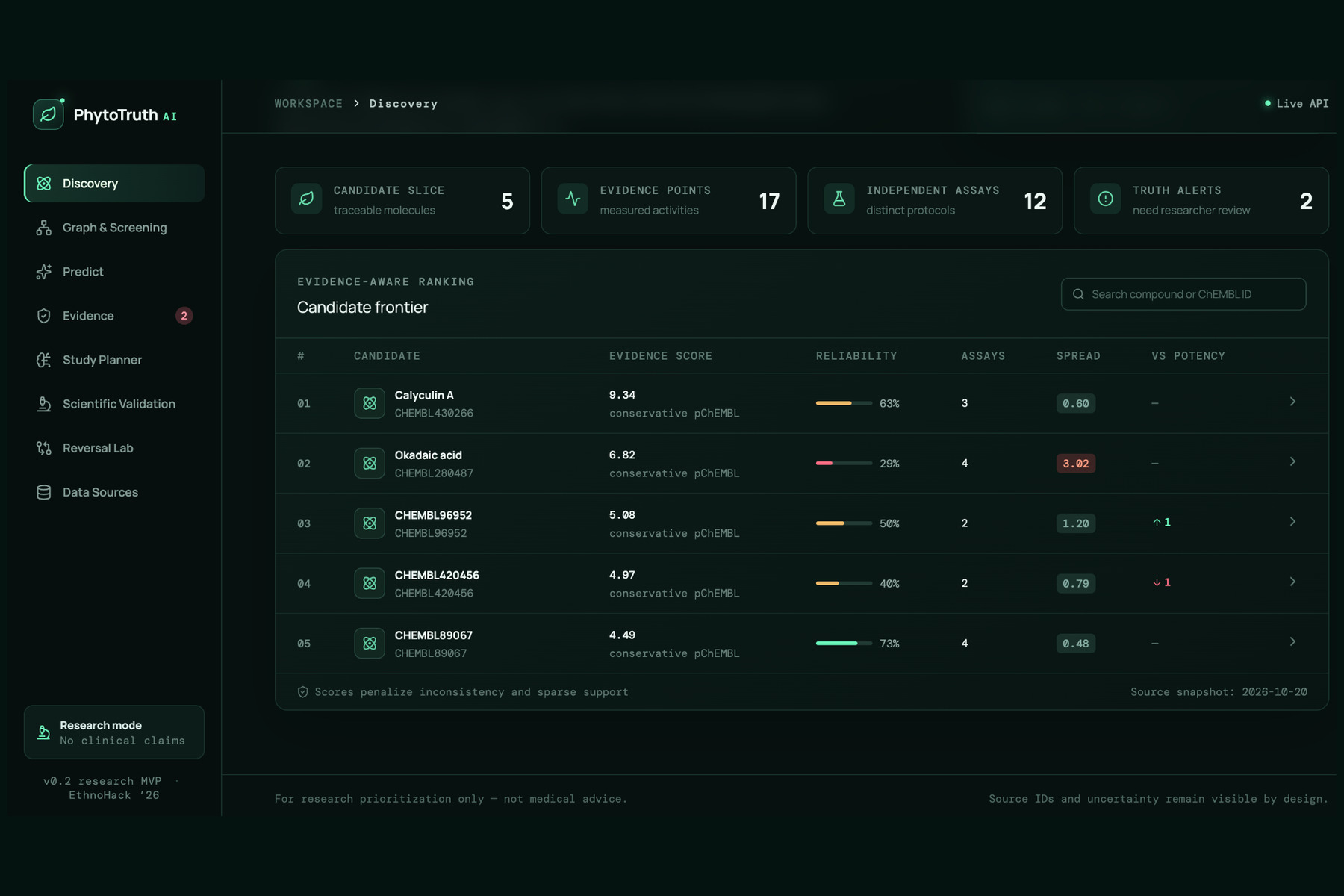
Natural-product research has an evidence problem: the same compound can produce very different results across laboratory tests. A strong measurement can look promising while hiding disagreement, missing context, or limited supporting evidence.
We built PhytoTruth AI around a question: which candidate deserves the next experiment, and what should a researcher verify first?
Our goal was to make chemical screening easier to inspect, with source evidence and uncertainty visible alongside predictions.
What it does
PhytoTruth AI is a research workspace for exploring natural compounds, comparing experimental evidence, and prioritizing laboratory follow-up.
Researchers can:
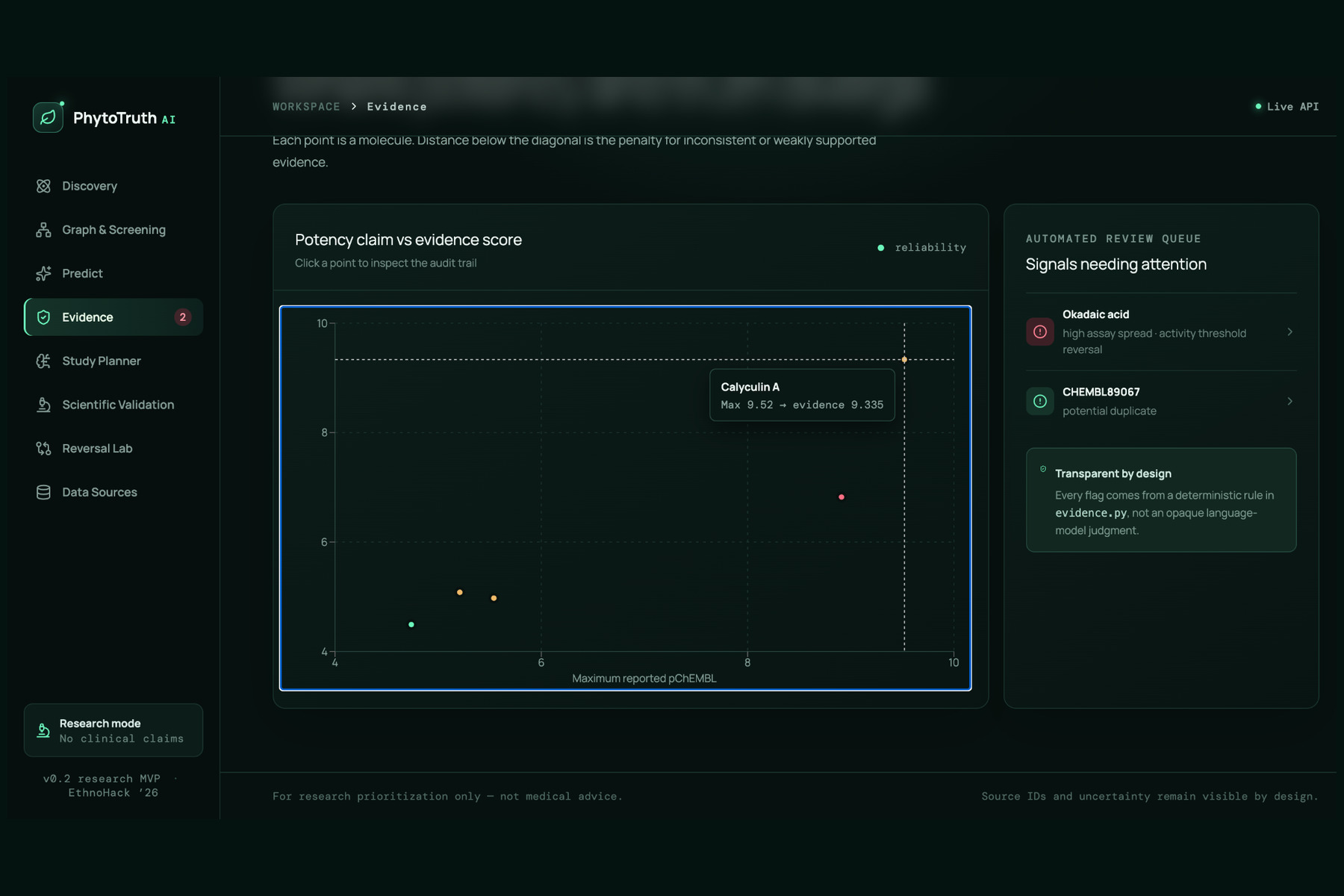
- Inspect measured activity and trace it to source assays and publications.
- Identify conflicting measurements, potential duplicates, and provenance gaps.
- Submit a molecular structure and receive a prediction of activity against PTP1B, a protein studied in diabetes research.
- View uncertainty intervals and warnings when a molecule falls outside the model’s familiar chemistry.
- Explore a saved screening run of 100,000 NPASS structures, with 100 candidates retained for review.
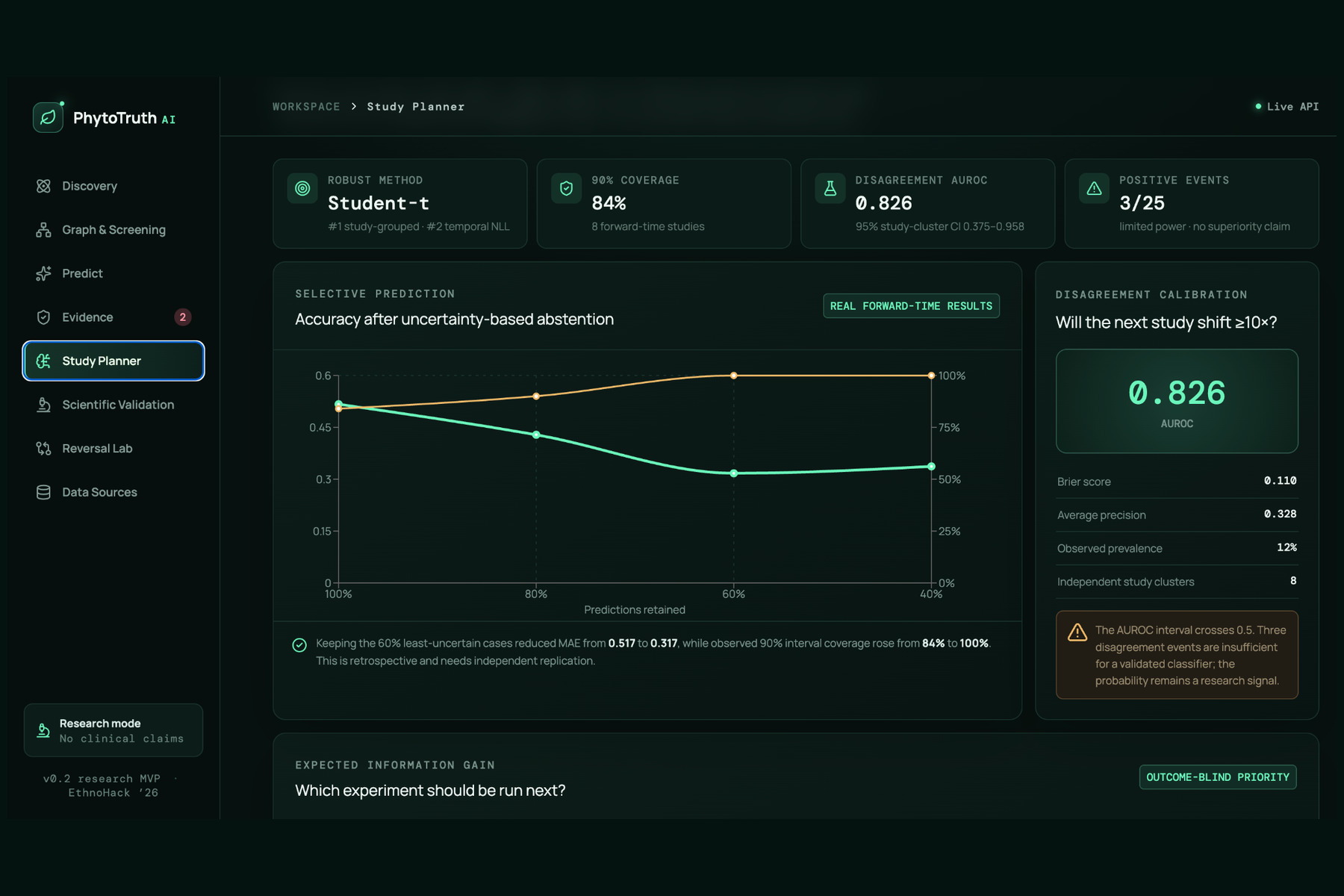
- Examine follow-up experiment hypotheses through the Study Planner.
- Explore traditional plant-use records alongside model predictions in the Scientific Validation workspace.
Measured evidence and model predictions remain clearly separated. The platform supports research prioritization and makes no claims of clinical efficacy or safety.
How we built it
We built the frontend with React, TypeScript, and Tailwind CSS, backed by a Python FastAPI service.
Our data pipeline integrates ChEMBL bioactivity records with NPASS and COCONUT natural-product data. RDKit standardizes molecular structures and generates fingerprints and descriptors. An XGBoost model uses these features to predict PTP1B activity.
We evaluated the model using scaffold-based cross-validation, which separates groups of related chemical structures between training and evaluation. On 2,444 structures, the selected model achieved MAE 0.432 pChEMBL and R² 0.612.
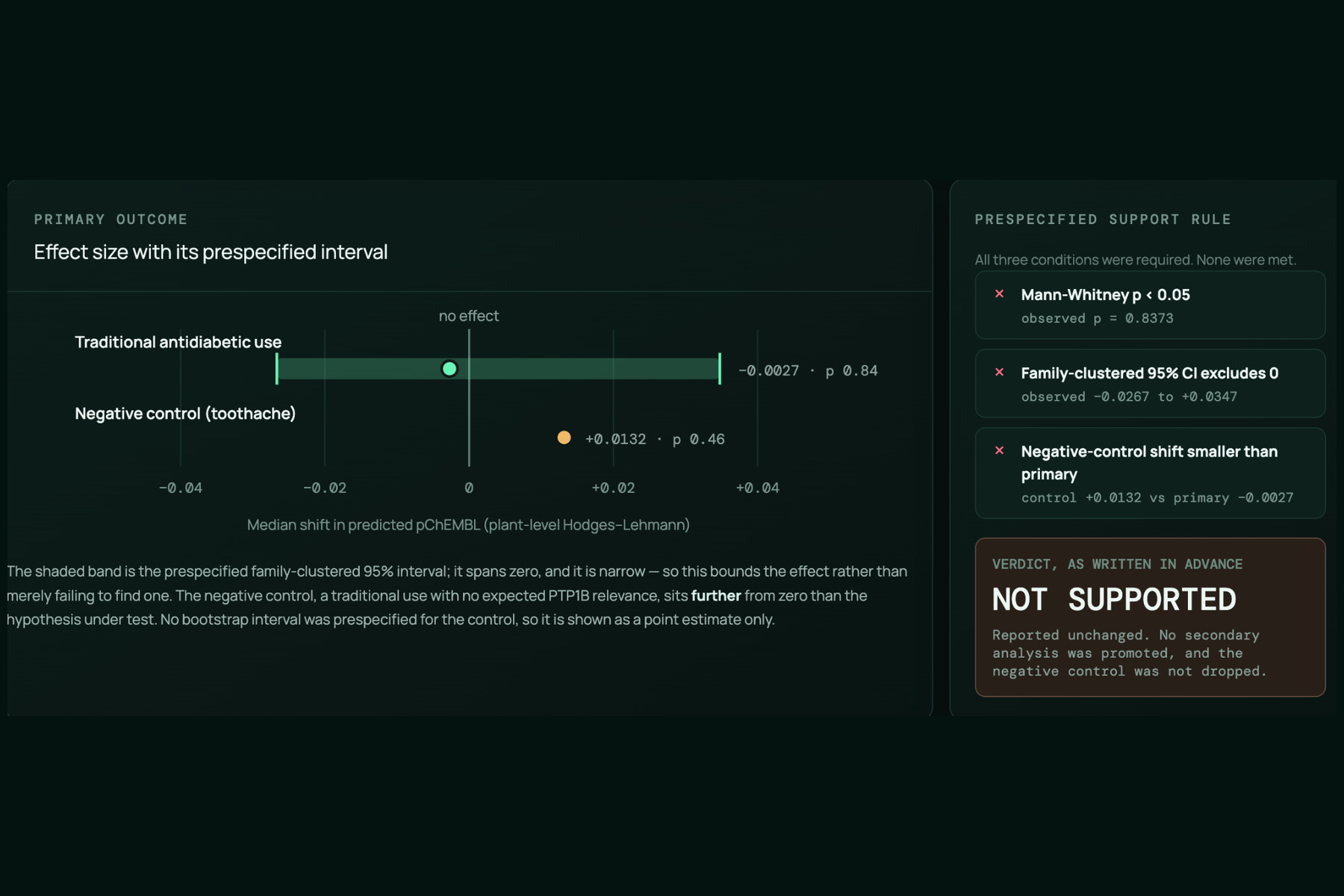
The Scientific Validation workspace connects reported NPASS source organisms with Duke traditional-use records. Its analysis compares plants with documented traditional antidiabetic use against Duke-covered controls, using a protocol committed before the primary outcomes were computed.
Challenges we faced
The hardest challenge was deciding what the evidence justified.
Chemical structures need consistent representations. Measurements from different assays need context before comparison. Predictions need uncertainty estimates and checks of whether the molecules resemble the training data.
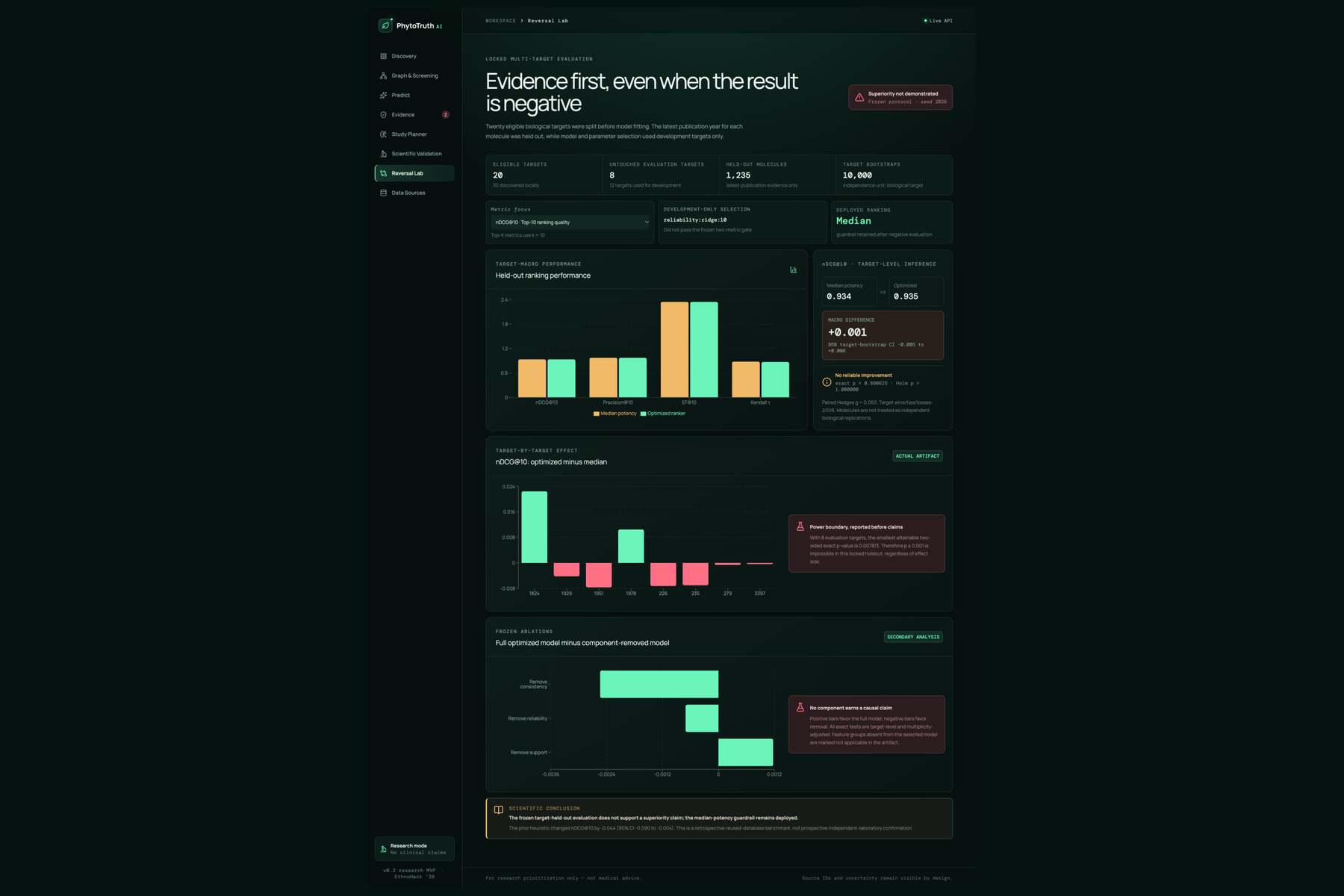
Some proposed improvements did not demonstrate a benefit. Our reliability-aware ranking did not establish superiority over median potency, so we retained the simpler ranking rule.
Our traditional-use analysis covered 3,870 plant species and did not support higher model-predicted PTP1B activity in the traditional-use group. However, 70.6% of the scored chemistry falls outside the model’s applicability domain. This result therefore cannot determine whether traditional remedies work.
Accomplishments we’re proud of
We connected data ingestion, molecular processing, model inference, batch screening, and evidence inspection in a working application.
We also made our research decisions auditable through source identifiers, saved artifacts, input checksums, and documented evaluation protocols. When a proposed method did not meet its acceptance criteria, we reported the result and kept the baseline.
What we learned
We learned that a useful research tool must communicate its limits as clearly as its results.
Source traceability, appropriate evaluation, and clear distinctions between predictions and measurements matter as much as model accuracy. Reporting an unsupported hypothesis can be valuable when it prevents an unjustified conclusion.
What’s next for PhytoTruth AI
Our next milestones are external PTP1B validation and a researcher pilot to evaluate whether the workspace improves prioritization decisions or saves time.
We also want to improve chemical coverage and extend the approach to additional biological targets.
Built With
- docker
- fastapi
- numpy
- pandas
- pydantic
- python
- rdkit
- react
- recharts
- rest
- scikit-learn
- scipy
- sqlite
- tailwind-css
- typescript
- uvicorn
- vite
- xgboost
