-
-
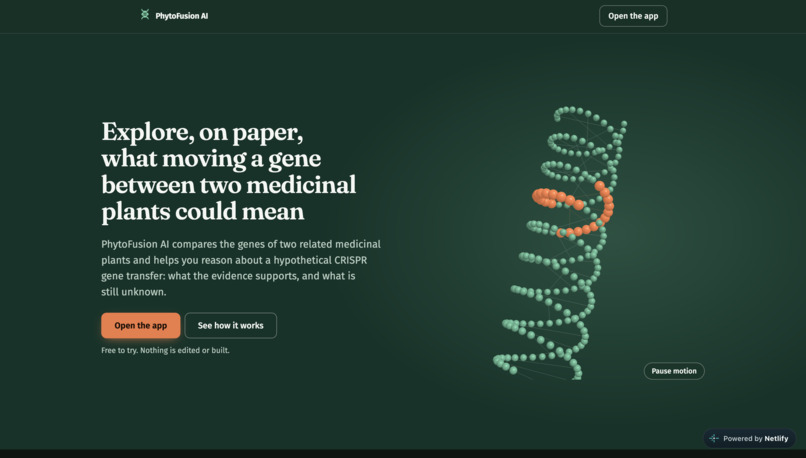
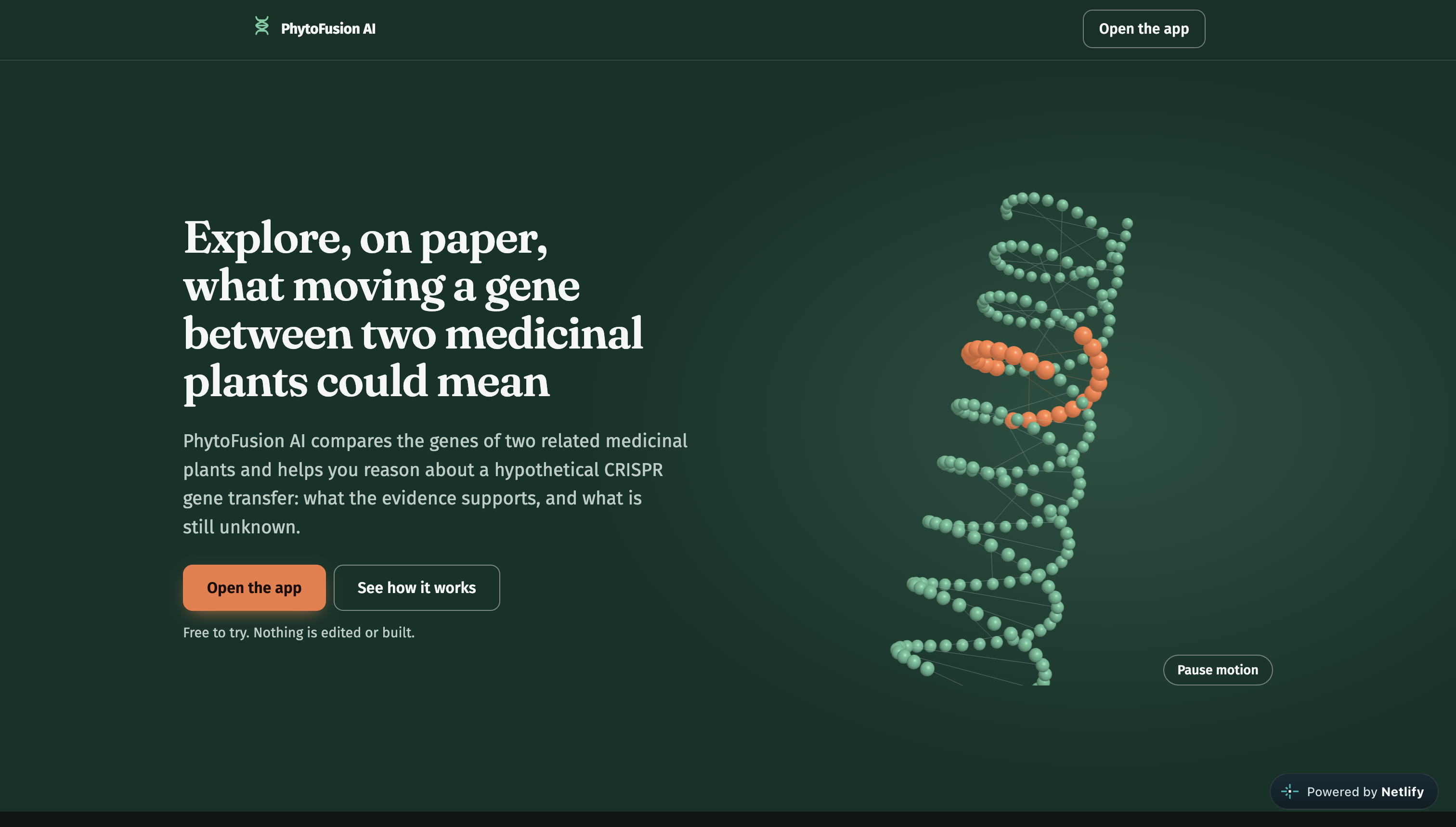
How the website looks like
Devpost "Project details": paste these
Three parts of the form: the Project Story (Markdown), the "Built with" tags, and the "Try it out" links.
1. Project Story (paste everything between the two lines)
Inspiration
Medicinal plants make remarkable compounds, but the genes behind them are scattered across huge genomes, papers and databases. One of us is a pharmacy student, the other a DevOps engineer. We kept asking the same question: could a gene from one medicinal plant, in theory, add a missing step in another? And a second one: how would anyone know how well the evidence supports that idea, and what is still missing?
We picked two skullcaps from the same genus. Scutellaria baicalensis is known for flavonoids such as baicalein, baicalin and wogonin. Scutellaria barbata is known for clerodane diterpenoids. Both are used in traditional Chinese medicine (Zhao et al. 2019, PMID 31236960; Wang et al. 2020, PMID 31577937). A 2023 paper (Qiu et al., PMID 37395679) characterised the KPS enzymes that start clerodane diterpenoid biosynthesis in both plants. That gave us a precise, testable question for a hypothetical CRISPR gene transfer, studied on paper only.
What it does
PhytoFusion AI is a computational platform for reasoning about that question. Nothing is edited or built.
- Genomes: both published genomes (30,313 and 34,909 genes) as chromosome maps drawn to scale, with a 3D view.
- Compare genes: BLAST finds the closest host gene for a donor gene, then a reciprocal check confirms it.
- Pathways: how genes, enzymes and compounds connect, with a source and an evidence level on every step.
- Evidence: a strong, moderate or limited class for each finding. Never a score or a probability.
- Scenario and report: a hypothetical gene transfer, with what it could mean, what we don't know, and the limits.
An optional AI model can explain a result in plain words, but only from facts the app already computed. It is labelled as AI-written and never sets an evidence level.
How we built it
- Backend: Python, FastAPI and pydantic, with BLAST+ for the sequence search, in a Docker container on Render.
- Frontend: React and TypeScript with Vite, Cytoscape for the pathway graph and three.js for the 3D views, on Netlify.
- Data: Supabase (Postgres with pgvector, row-level security, versioned SQL migrations).
- Quality: 221 backend tests at 98% coverage, 74 frontend tests, and GitHub Actions CI with seven checks. The pipeline also fails the build if the code ever contains a numeric success claim or says a plant "has been engineered".
- Documentation: a README plus 14 documents, including a sources file where every claim traces to a PMID or DOI.
Challenges we ran into
- The gene names did not match the paper. Our annotation uses IDs like
Sbar9A9T61, not "SbarKPS2". We downloaded the paper's protein sequences and BLASTed them against both genomes. One matched at 100% identity. The other two are best matches from sequence similarity, so we label them that way, not as proven identical. - A search that took hours. Comparing whole proteomes against each other was far too slow for a web app. Searching only the candidate genes, then checking their best hits back, gives the same answer for these genes in seconds.
- Not overclaiming. It is easy to turn "similar sequence" into "it would work". We built the opposite: evidence classes, explicit "unknown", and guardrails in the code and in CI.
Accomplishments that we're proud of
- A working, deployed prototype on real published genomes, not a mock-up.
- Validation we can show. The paper's own protein finds its gene at 100%. The best host hit for both KPS proteins
(
Sbai8C203T0, 84% and 89%) stands about 28 to 31 points above the runner-up (about 57%). - An honest limit, published. 86% of 300 random donor genes would also count as "related", because the plants share a genus. So the label alone is not the signal. The mutual best match and the margin are. We say so in our validation document.
- Every finding is traced to a source, and the AWS architecture is generated as code and kept in the repository.
What we learned
- Sequence similarity is not function. Two close genes can do different jobs, which is why the app shows what is known, what conflicts and what is missing, not a single number.
- Uncertainty is a feature. A tool that says "unknown" and lists the gap is more useful to a researcher than one that always answers.
- Combining pharmacy and DevOps worked: pharmacy gave the meaning of the data, and automation, tests and pipelines made it reproducible.
What's next for PhytoFusion AI
- Build a small benchmark of known orthologs and report precision and recall.
- Add gene expression data and more pathways, such as the full flavonoid route.
- Show the best-versus-runner-up margin in the comparison table.
- Add sign-in and rate limits before opening the API publicly, then move to AWS as planned.
- Test the most promising hypotheses with laboratory partners. Traditional use and computation are reasons to study a plant, not proof that it works.
2. Built with (paste each as a tag; up to 25)
python, fastapi, pydantic, pandas, networkx, blast, typescript, react, vite, three.js,
cytoscape.js, postgresql, pgvector, supabase, docker, github-actions, netlify, render, pytest,
vitest, groq
3. "Try it out" links
| What | URL |
|---|---|
| Live demo | https://photofusionai.netlify.app |
| Source code | https://github.com/lerthy/PhytoFusion-AI |
The GitHub repository is private. Judges cannot open the second link until you make it public (GitHub: Settings, then Danger Zone, then Change visibility) or add them as collaborators. If you would rather keep it private, remove that link and say so in the story.
Before you submit
- Open the demo link a minute before submitting (the free server sleeps and the first request can take a minute).
- The story does not claim any saved evidence or pathways, because your database has none yet.
If you add them first (see
docs/DEMO.md), the live site looks more finished. - Check the AI claim: the explain buttons need
AI_API_KEYset in Render. Without it they say AI is not switched on, which the story already allows for ("optional").
Built With
- blast
- cytoscape.js
- docker
- fastapi
- github-actions
- groq
- netlify
- networkx
- pandas
- pgvector
- postgresql
- pydantic
- pytest
- python
- react
- render
- supabase
- three.js
- typescript
- vite
- vitest
