-
-
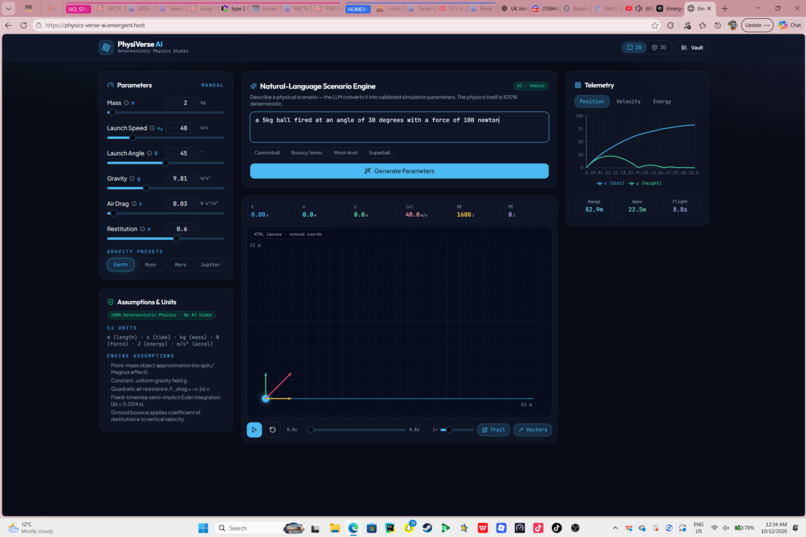
Photo evidence, more on the youtube video link, couldnt send vid due to space
-

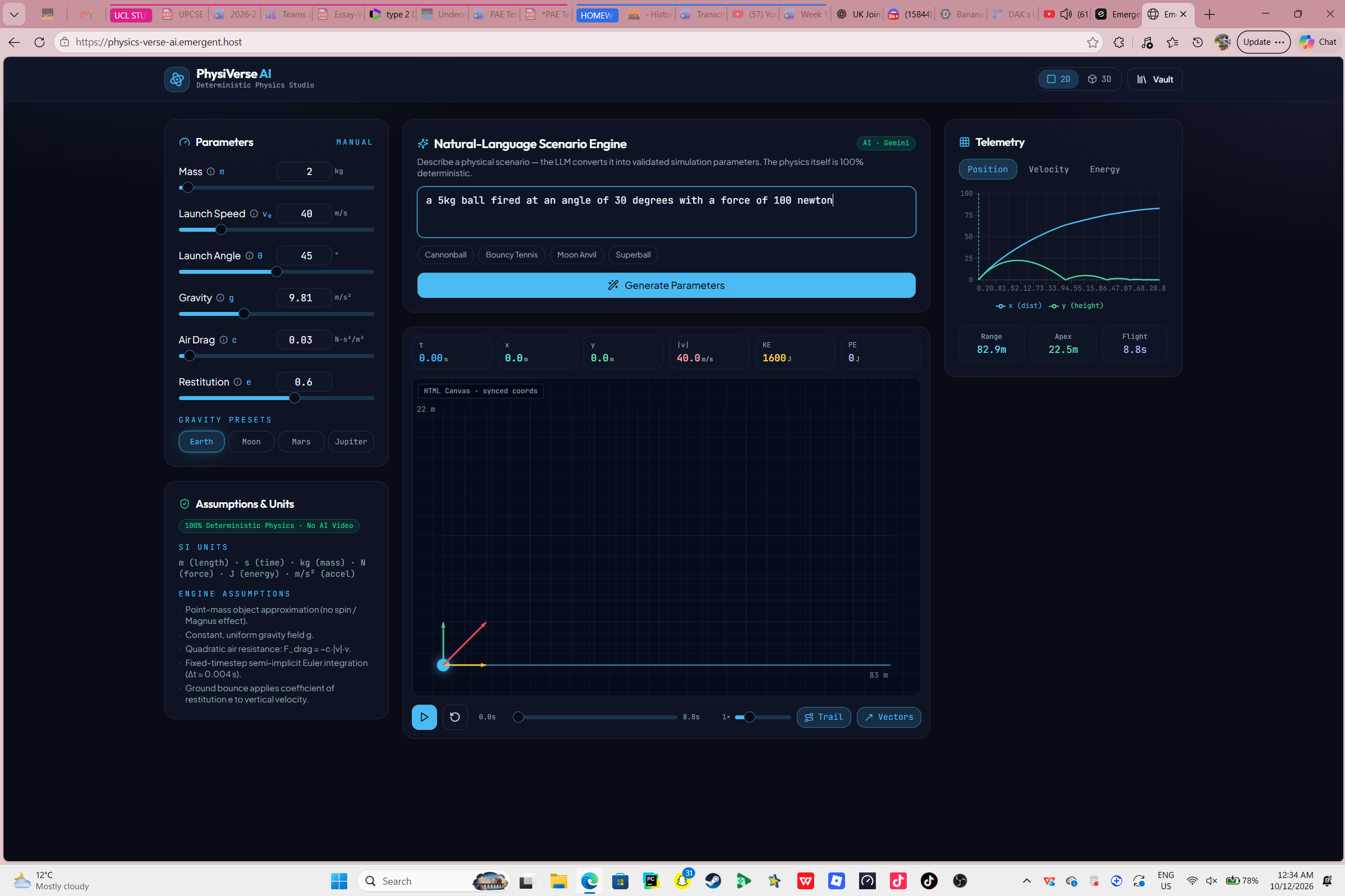
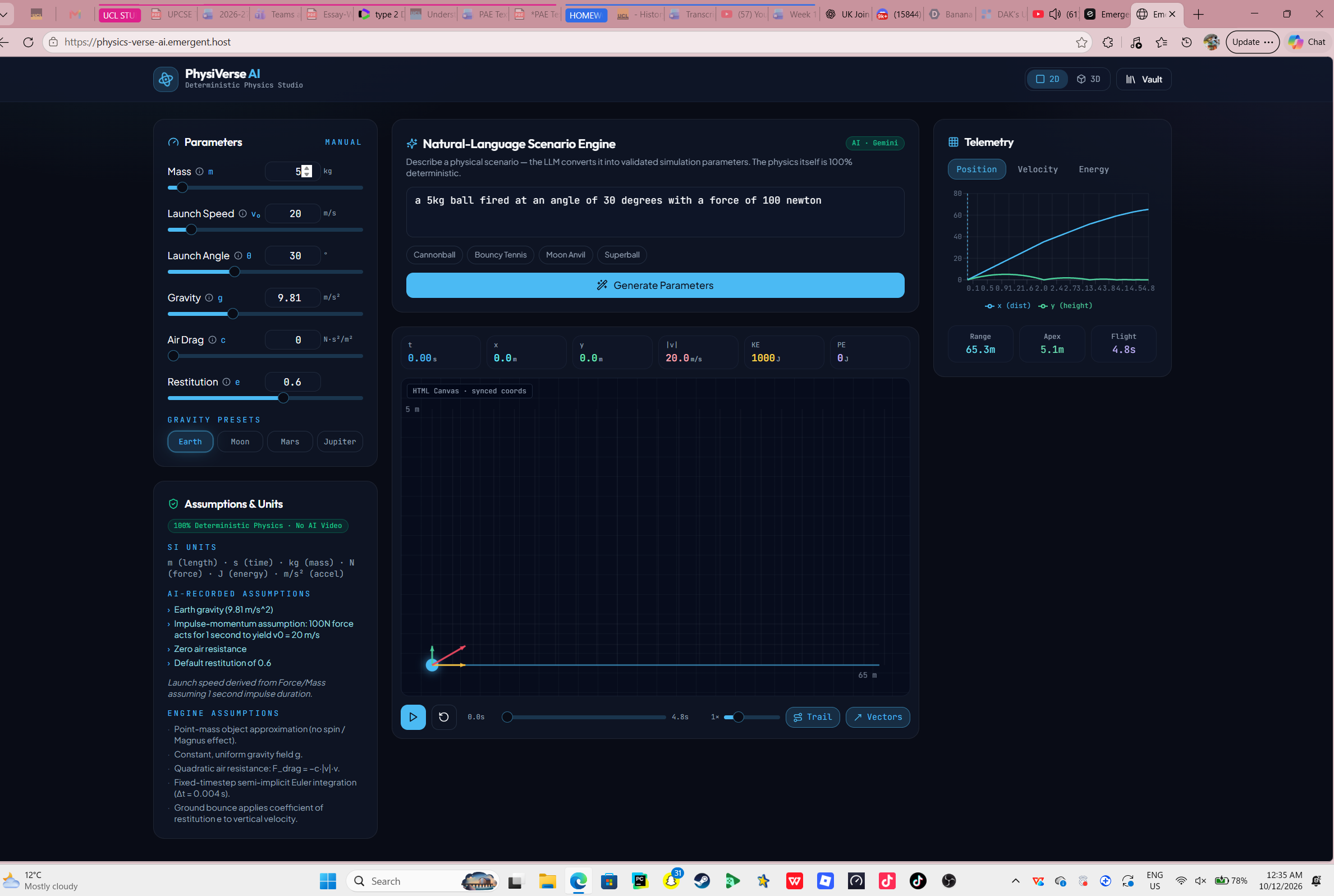
Photo evidence, there are way way way more features in the video on the youtube link
Inspiration
My inspiration for PhysiVerse AI came from my experience learning physics. Sometimes, physics lessons can feel too boring and focused on equations and calculations without showing what is actually happening or how it will lokk like in real life I wanted to see the motion behind the equations, understand how different forces affect objects, and experiment with changing values to see the results immediately that will be way more fun and learning I thought that if students could visualize physical situations instead of only solving them on paper, physics could become easier to understand and much more interesting. This inspired me to create PhysiVerse AI, a platform that aims to make physics more interactive, visual, and accessible and more fun to learn
What it does
PhysiVerse AI is an interactive physics simulation platform that allows users to explore physical scenarios through 2D and 3D visualizations. Users can describe a physical situation in natural language, such as launching a ball at a particular angle with a specified force. Users can also manually adjust: 1.Mass and initial velocity 2.Launch angle 3.Gravity 3.Air resistance 4.Coefficient of restitution The platform visualizes the resulting motion and displays scientific data, including position, velocity, kinetic energy, potential energy, trajectory, and flight time. It also includes gravity presets for Earth, the Moon, Mars, and Jupiter. Rather than relying on AI-generated videos to represent physical behaviour, PhysiVerse AI uses a numerical physics engine to calculate the motion.
How we built it
I developed PhysiVerse AI using Emergent, an AI-assisted application development platform. I used vibe coding to describe the functionality I wanted, generate the application, and refine its features through testing and feedback. The application uses: Generative AI: Natural-language interpretation of physical scenarios using Gemini JavaScript and React: Interactive web application interface HTML Canvas: 2D physics visualization Three.js and WebGL: 3D physics visualization Nuerical physics calculations Emergent: AI-assisted development and deployment The physics engine calculates object motion using gravity, air resistance, and collision behaviour. Its results are then displayed through interactive visualizations and graphs.
Challenges we ran into
Sometimes the 3d didn't work at all, due to bad Wi-Fi it lags sometimes, and it crashed many times and due to time zones, I couldn't go for any workshops and the recordings aren't available to me, so it was hard finding information on what to do
Accomplishments that we're proud of
I am proud of the fact that its actually working because there were so many times it crashed or didn't load or didn't just work at all
What we learned
I learnt that it's possible to achieve your goal with the right resources and as easy at it is to find a problem you can find a solution to a problem too

Log in or sign up for Devpost to join the conversation.