Inspiration
Medicine is brilliant at discovery and primitive at delivery. We've sequenced the genome and mapped proteins with AI — yet treatment still means broadcasting a chemical through the entire bloodstream with no address and no way to call it back.
Every computing revolution was really an abstraction layer: the compiler abstracted machine code, the OS abstracted hardware. Biology has never had one. So we asked: what if it did?
What it does
PhysioOS is a software architecture — and a working simulation of it — for coordinating nanoscale agents inside the human body the way an OS coordinates hardware. Four layers: a Hardware Abstraction Layer (move, sense, signal, actuate), a Swarm Kernel (distributed consensus via quorum sensing), a PhysioAPI (deploy(), target(), recall()), and a BioApp Layer (Cancer.app, Clot.app).
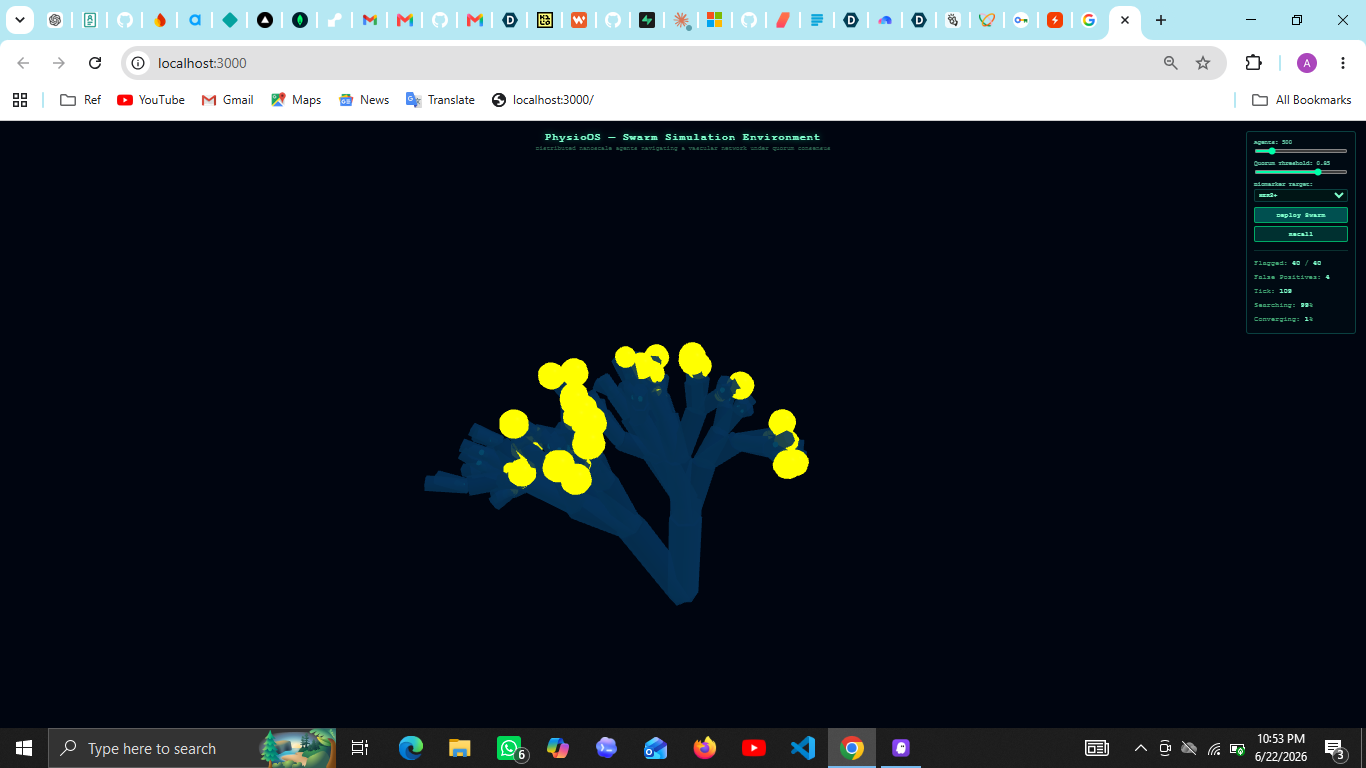
The prototype simulates a nanobot swarm navigating a 3D vascular network, locating tumor cells, and reaching quorum consensus before flagging one — preventing false positives before any "treatment" triggers. A live system log streams every kernel decision in real time, so you can watch the OS actually reason.
How we built it
We wrote the architecture as a full paper before writing any simulation code, so engineering followed the idea rather than the reverse. The vascular network is procedurally generated using Murray's Law branching. Swarm rendering uses Three.js InstancedMesh for up to 2,000 agents in one draw call. The quorum protocol only flags a cell once positiveVotes / visits crosses a tunable threshold and a minimum visit count — directly modeled on bacterial quorum sensing and Raft consensus.
Challenges we ran into
Making an invisible process visible. Agents that are individually meaningless but collectively intelligent are hard to render legibly — too small to see, or a flooded unreadable log at scale. We fixed this with rate-limiting and tiered event sampling rather than simplifying the underlying simulation.
What we learned
Nanobots, when they exist, will need exactly what every computing revolution needed first: an abstraction layer that makes the chaos usable. That's the real contribution here, more than any single line of code.
What's next for PhysioOS
- Validate HAL primitives against real DNA-nanotechnology actuators with synthetic biology labs
- Model adversarial conditions: immune response to the swarm, agent dropout
- Open-source the kernel as a research testbed for swarm-based drug delivery


Log in or sign up for Devpost to join the conversation.