-
-
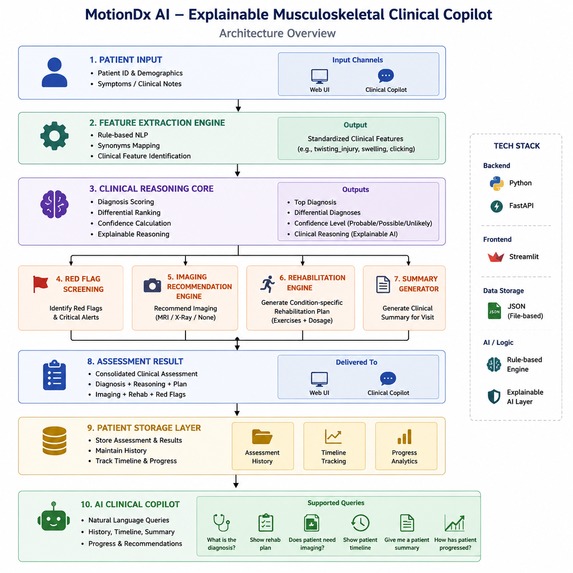
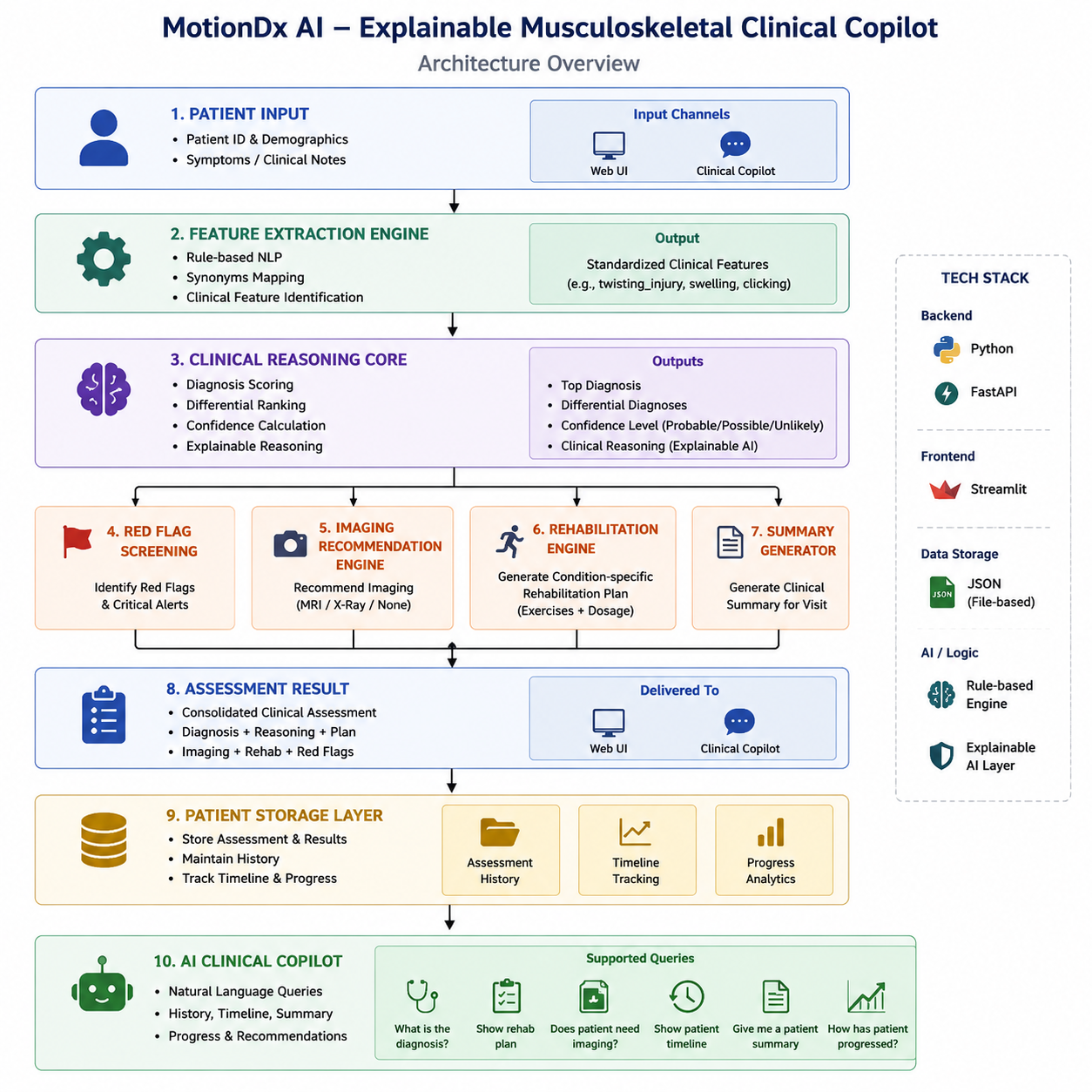
ARCHITECTURE
-
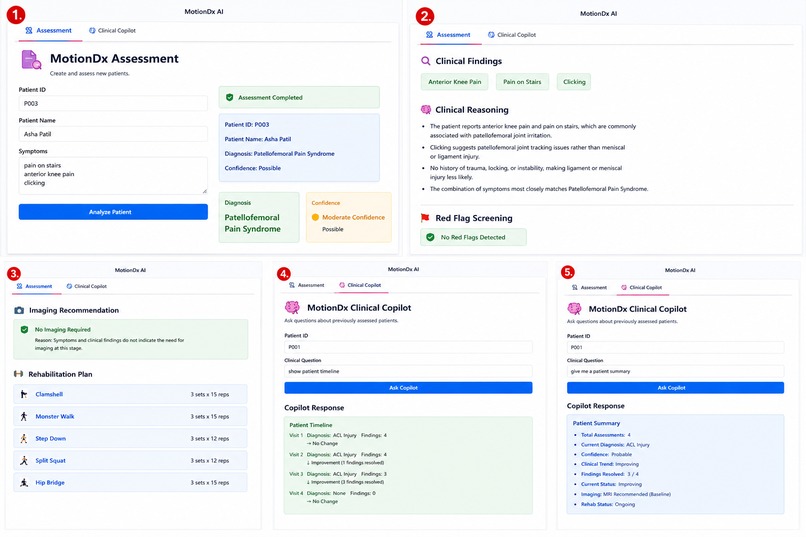
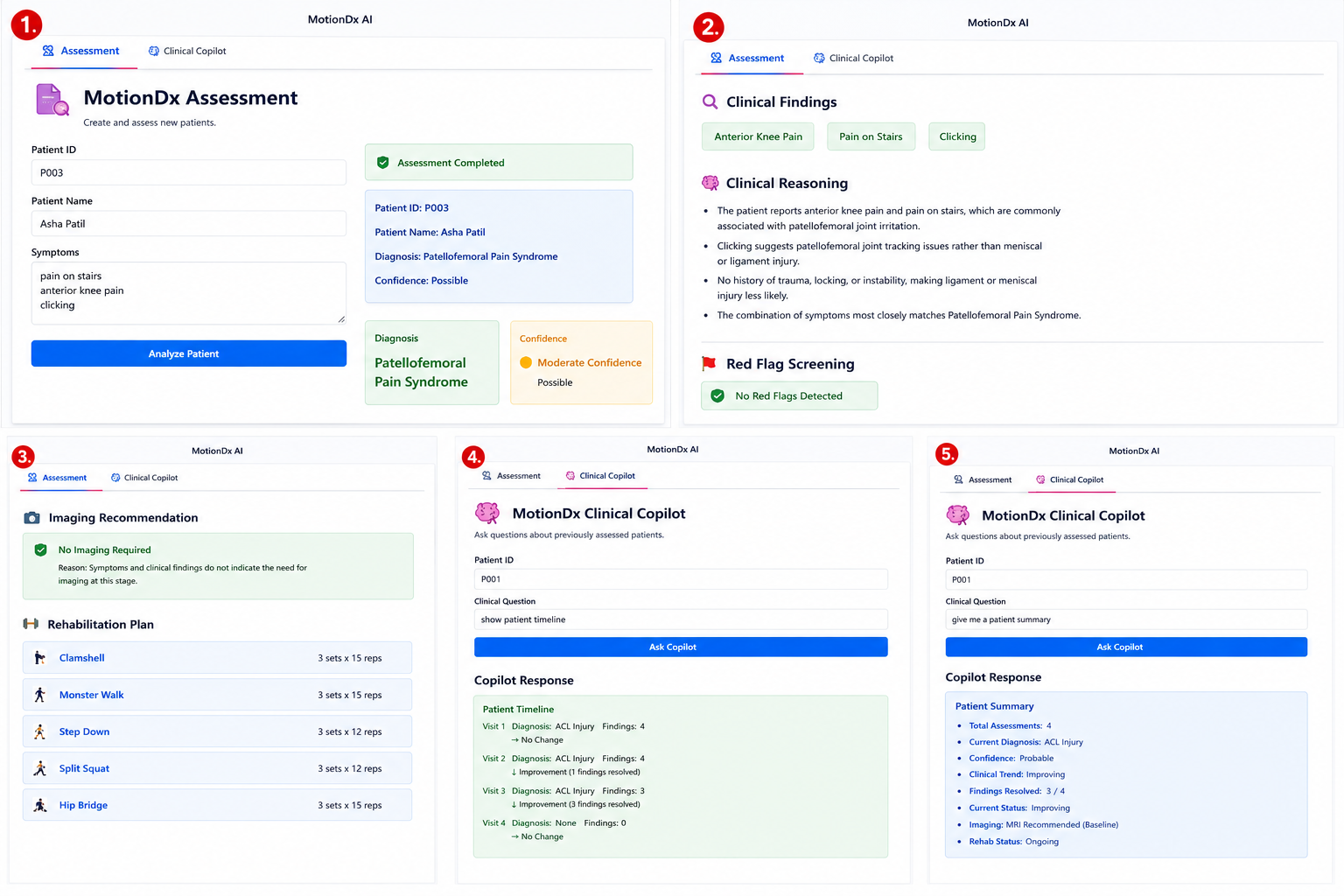
SCREENSHOTS
MotionDx AI – Explainable Musculoskeletal Clinical Copilot
Inspiration
Musculoskeletal disorders are one of the most common reasons patients seek healthcare, yet clinical assessment often relies heavily on experience, manual reasoning, and fragmented documentation systems. As a physiotherapist, I have experienced firsthand the challenge of balancing patient assessment, clinical decision-making, rehabilitation planning, and progress tracking within limited consultation time.
We wanted to explore how AI could support clinicians without becoming a black box. Rather than simply predicting a diagnosis, our goal was to build a system that could explain its reasoning, justify its recommendations, and help clinicians make informed decisions while maintaining trust and transparency.
This led to the creation of MotionDx AI—an explainable musculoskeletal clinical copilot designed to assist with assessment, diagnosis, rehabilitation planning, and longitudinal patient management.
What It Does
MotionDx AI helps clinicians:
- Analyze patient symptoms and clinical findings
- Generate differential diagnoses with confidence scoring
- Provide explainable clinical reasoning
- Screen for red flags
- Recommend appropriate imaging
- Generate rehabilitation plans
- Track patient progress across multiple visits
- Query patient records through an AI Clinical Copilot
The platform combines assessment, decision support, and patient tracking into a single workflow.
How We Built It
The project was built using a modular architecture consisting of:
Clinical Assessment Engine
A rule-based feature extraction system identifies clinically relevant findings from patient symptom descriptions.
Clinical Reasoning Engine
Extracted features are matched against a musculoskeletal clinical ontology to generate diagnostic scores and differential diagnoses.
Explainable AI Layer
Instead of acting as a black box, MotionDx AI displays the clinical findings and reasoning behind each diagnosis, helping clinicians understand why a recommendation was made.
Imaging Recommendation Engine
Evidence-based logic determines whether imaging is required and suggests the most appropriate modality.
Rehabilitation Recommendation Engine
Condition-specific rehabilitation plans are generated automatically based on the identified diagnosis.
Patient Management Layer
Assessments are stored and organized into patient histories and timelines, allowing clinicians to monitor progress over time.
AI Clinical Copilot
A conversational agent enables clinicians to ask natural language questions such as:
- What is the diagnosis?
- Show patient history
- Show patient timeline
- Give me a patient summary
- How has the patient progressed?
The frontend was developed using Streamlit, while the backend clinical reasoning and API services were built with FastAPI and Python.
Challenges We Ran Into
One of the biggest challenges was designing a system that remained clinically transparent. Many AI systems focus on prediction accuracy, but in healthcare, explainability and trust are equally important.
Additional challenges included:
- Creating meaningful clinical feature extraction from free-text symptom descriptions
- Building a scalable clinical ontology and scoring framework
- Designing patient timeline and progress-tracking functionality
- Integrating assessment workflows with conversational AI interactions
- Balancing clinical relevance, usability, and development speed within the hackathon timeframe
What We Learned
This project reinforced the importance of explainable AI in healthcare. We learned that clinicians are far more likely to trust and adopt AI systems when they can understand the reasoning behind recommendations.
We also gained experience in:
- Clinical knowledge engineering
- Explainable decision-support systems
- Healthcare-focused AI workflows
- FastAPI and Streamlit integration
- Building conversational agents on top of structured clinical data
Accomplishments That We're Proud Of
- Built an end-to-end musculoskeletal assessment workflow
- Developed an explainable diagnostic reasoning engine
- Implemented imaging and rehabilitation recommendation systems
- Created patient history, timeline, and progress-tracking capabilities
- Built an AI Clinical Copilot for natural language interaction with patient records
- Delivered a fully functional healthcare AI prototype within the hackathon timeframe
What's Next for MotionDx AI
Future plans include:
- Expanding support to additional joints and conditions
- Integrating with Electronic Medical Records (EMR)
- Adding outcome prediction and risk stratification models
- Incorporating Large Language Models for richer clinical conversations
- Developing clinician dashboards and analytics
- Supporting multidisciplinary rehabilitation workflows
MotionDx AI demonstrates how explainable AI can augment clinical decision-making, improve consistency, and enhance patient management while keeping clinicians in control of the care process.
Built With
- agent
- ai
- api
- architecture
- clinical
- decision
- explainable
- fastapi
- git
- github
- healthcare
- json
- language
- natural
- ontology
- processing
- pydantic
- python
- rehabilitation
- rest
- rule-based
- streamlit
- support
- systems
- uvicorn


Log in or sign up for Devpost to join the conversation.