Inspiration
As financial services become increasingly digital, many people still rely on cash, paper receipts, and manual expense records to manage their money. Moving toward digital finance can feel overwhelming when people lack the knowledge or confidence to navigate financial tools safely.
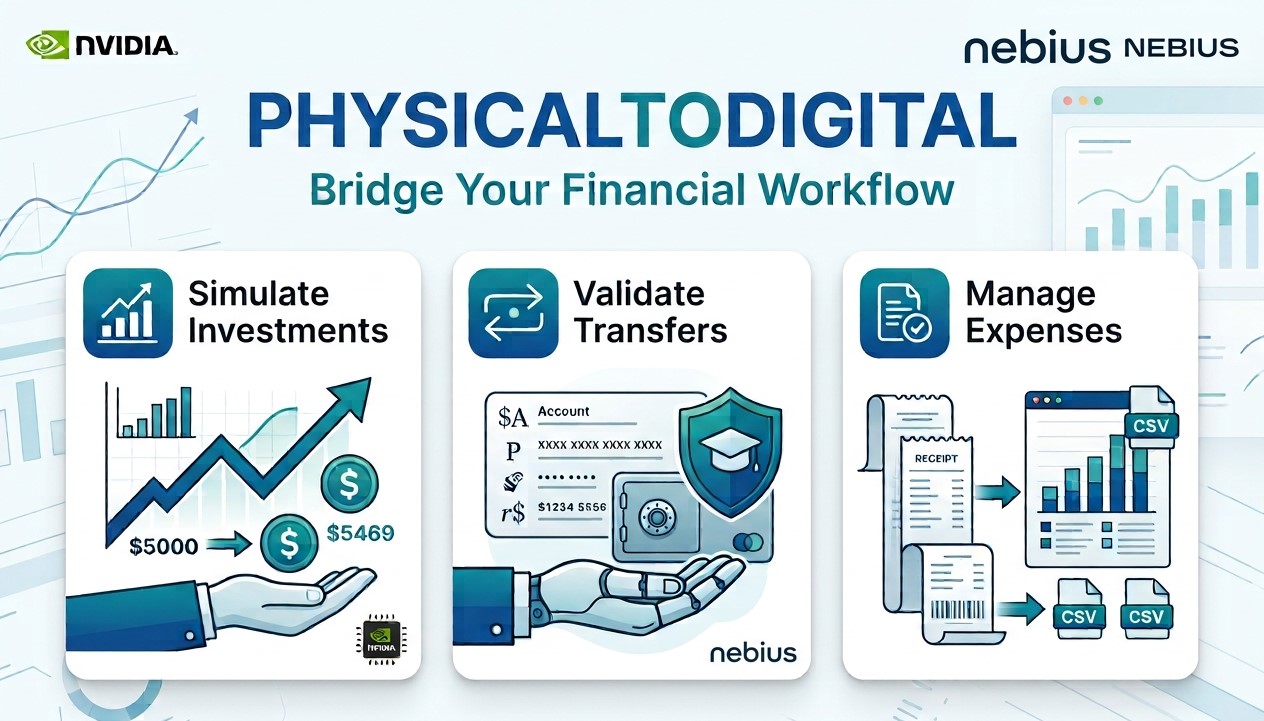
PhysicalToDigital was inspired by the opportunity to make financial technology more approachable. The goal is to bridge everyday financial activities with digital financial literacy through an AI-powered co-pilot that helps users understand their expenses, explore investment scenarios, validate transfer information, and recognize potential financial scams.
We wanted to create more than a chatbot: an interactive tool that combines financial calculations, specialized utilities, and conversational AI to help people make more informed financial decisions.
What it does
PhysicalToDigital is an AI-powered digital finance and investment co-pilot that brings several practical financial tools together in one interactive application.
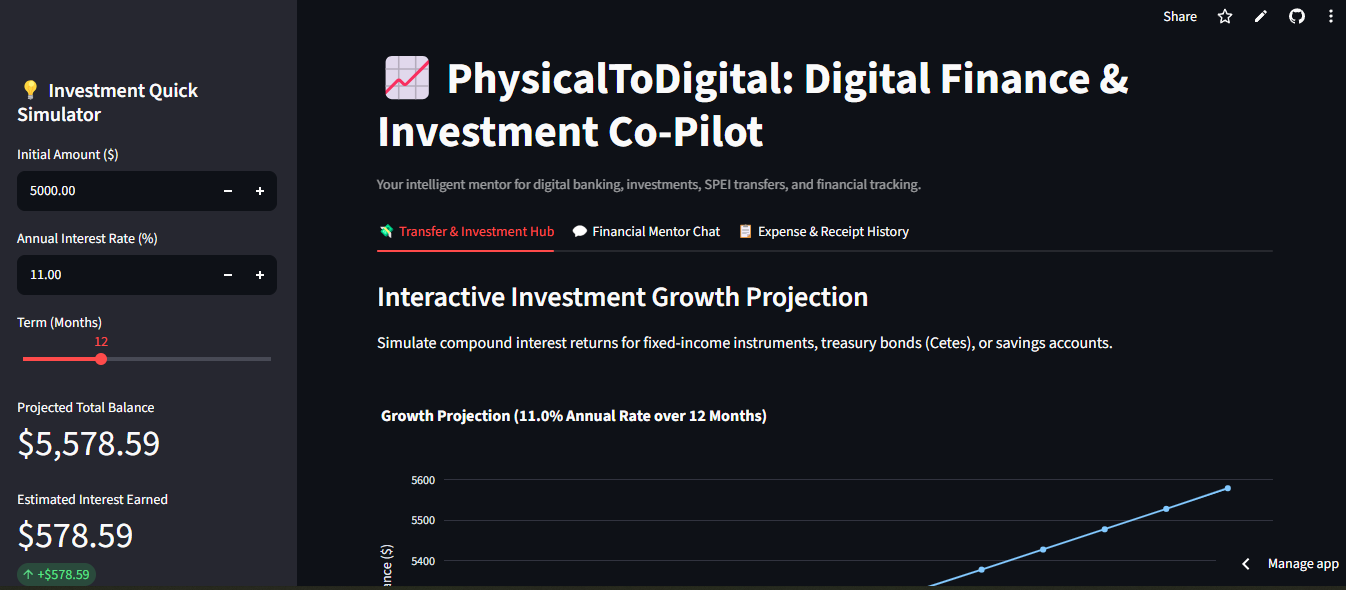
- Investment Simulations: Estimates compound growth, accumulated interest, and potential investment balances over time, with interactive charts to illustrate different scenarios.
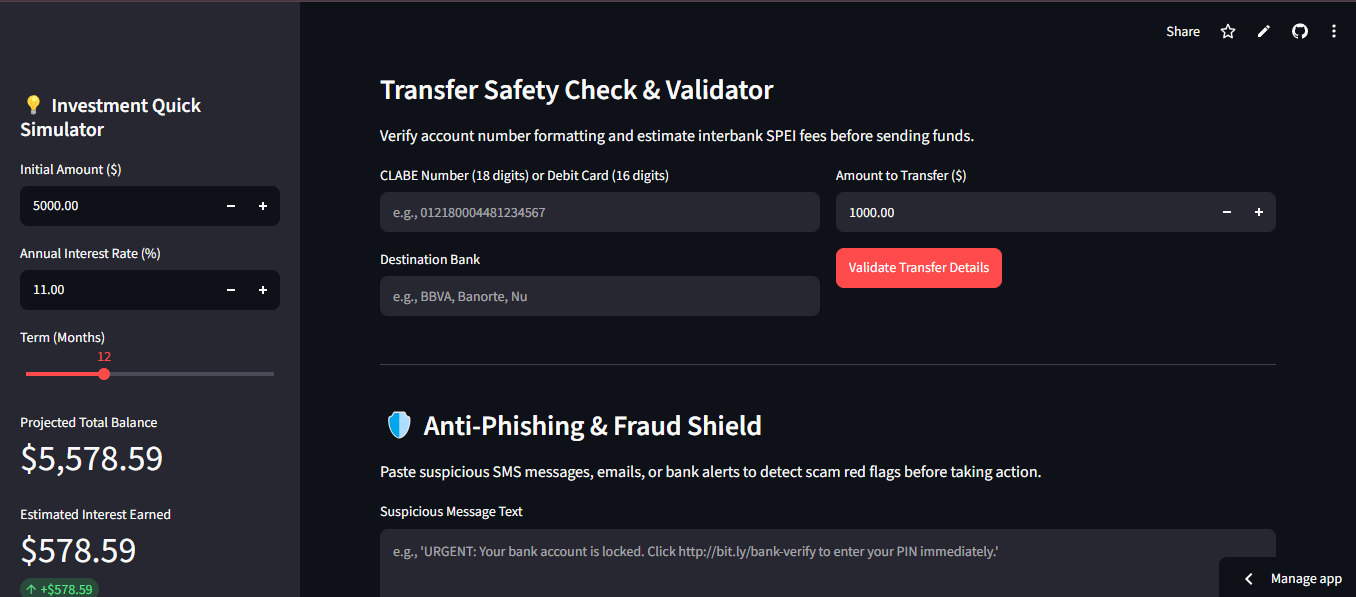
- Transfer Validation: Checks the format of financial information, such as account identifiers and card numbers, and provides educational guidance for safer transfers.
- Anti-Phishing and Fraud Awareness: Analyzes suspicious messages for potential warning signs, assigns risk levels, and offers safety recommendations.
- Receipt and Expense Tracking: Extracts structured information from receipt data, organizes expenses by category, and presents spending patterns through interactive charts.
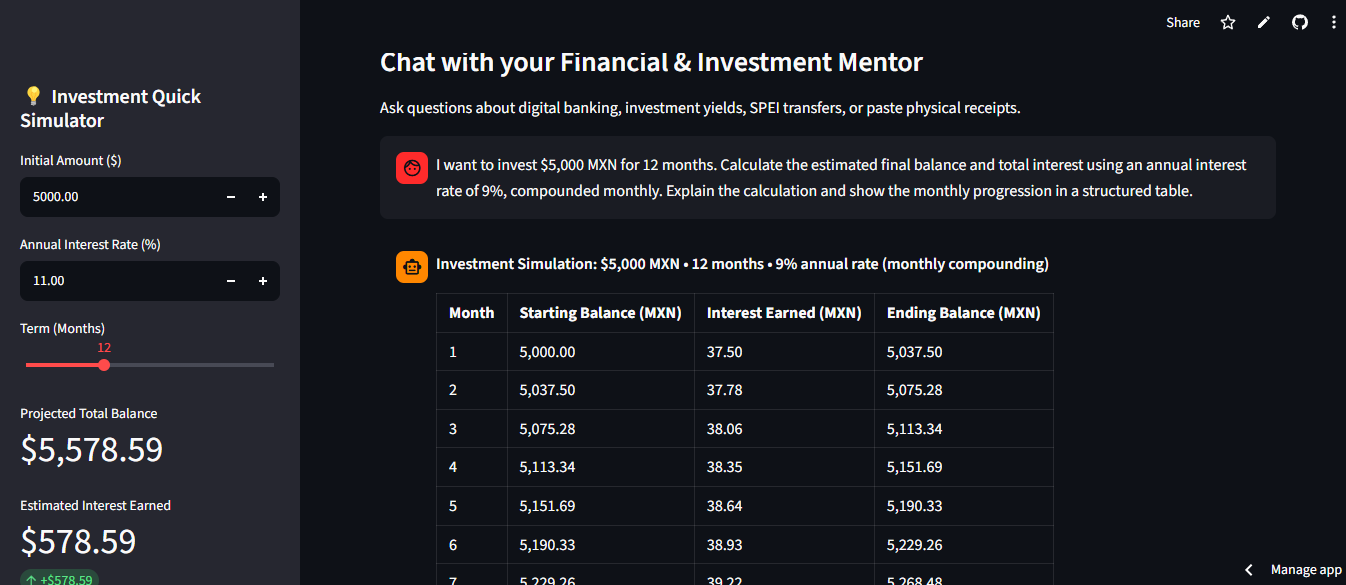
- Financial Mentor Chat: Provides conversational financial guidance in English and Spanish and can invoke specialized tools to answer supported questions.
- Data Export: Allows users to export expense records to CSV for further analysis in spreadsheet applications.
For investment simulations, the application uses the compound interest formula:
$$A=P\left(1+\frac{r}{n}\right)^{nt}$$
Where $P$ is the initial investment, $r$ is the annual nominal interest rate, $n$ is the number of compounding periods per year, and $t$ is the investment duration in years. The resulting balance is an estimate based on the assumptions provided.
How we built it
We developed PhysicalToDigital as an interactive web application using Python and Streamlit, combining a language model with specialized financial tools and data visualization.
- AI Model and Infrastructure: Integrated the open NVIDIA Nemotron model (
nvidia/Nemotron-3_5-Lightning) through Nebius Token Factory. - Agent Orchestration: Used LangChain to connect the conversational assistant with specialized tools for investment simulations, transfer validation, fraud analysis, and receipt data extraction.
- Financial Logic: Implemented dedicated Python functions to perform investment calculations and validate financial data formats.
- Data Processing and Visualization: Used Pandas and Plotly to organize expense records and display financial information through interactive charts.
- User Interface and Deployment: Built an interactive web application with Streamlit and successfully deployed it to Streamlit Community Cloud, making PhysicalToDigital accessible online for demonstration and testing.
- Configuration and Secrets: Used environment-based configuration to keep API credentials separate from application source code.
The project combines conversational AI with practical, task-oriented tools so users can explore financial information through both natural-language questions and interactive controls.
Challenges we ran into
- Reliable Financial Calculations: Connecting natural-language requests with consistent calculations required separating the mathematical logic from the language model's explanations.
- Tool Integration: Coordinating the AI assistant with specialized functions required careful tool descriptions, input handling, and output formatting.
- Financial Safety: We needed to distinguish between checking the format of transfer information and actually verifying or executing a transaction. The application provides educational checks, not bank-level verification.
- Making Financial Information Understandable: Presenting investment projections, expense patterns, and fraud warnings in a clear and approachable way was an important design challenge.
- API Configuration: Integrating an externally hosted model required configuring API credentials and managing them separately from the public source code.
Accomplishments that we're proud of
- An Integrated Financial Co-Pilot: Combined investment simulations, transfer data validation, fraud-awareness analysis, receipt data processing, and conversational assistance in one application.
- Working Cloud Deployment: Successfully deployed a functional version of PhysicalToDigital that integrates its financial tools and AI-powered assistance into an accessible online experience.
- Practical AI Tool Use: Connected NVIDIA Nemotron through Nebius Token Factory to specialized financial functions using LangChain.
- Interactive Financial Visualization: Built charts and financial projections that help users explore results rather than relying only on text responses.
- A More Accessible Experience: Designed the application to support English and Spanish, making its financial tools approachable to a broader audience.
- An Open-Source Project: Organized the project in a public GitHub repository with an MIT license so others can inspect the implementation and build upon it.
What we learned
Building PhysicalToDigital strengthened our understanding of how to integrate language models into practical applications. We learned that a useful AI assistant needs more than natural-language generation: it also needs reliable tools, clearly defined inputs, consistent outputs, and safeguards around the actions it can perform.
We also gained hands-on experience with NVIDIA Nemotron, Nebius Token Factory, LangChain, Python-based financial calculations, interactive data visualization, and the configuration required to connect these components.
One of our main takeaways was the importance of transparency in financial applications. Investment projections should clearly state their assumptions, and validating financial data should never be confused with confirming that a real transaction has occurred.
What's next for PhysicalToDigital
- Improved Document Digitization: Expand receipt processing with more direct image and document uploads and more robust extraction of financial information.
- Personalized Budget Insights: Develop recurring expense analysis, spending summaries, and configurable budget alerts.
- Expanded Investment Scenarios: Add more investment products and clearer comparisons between potential returns, time horizons, and assumptions.
- Broader Financial Accessibility: Improve multilingual support and make the interface easier to use for people with limited experience with digital financial tools.
- Enhanced Safety Features: Continue improving fraud-warning explanations and educational guidance for safer digital financial activities.
Our long-term vision is to make the transition from physical financial records to digital financial understanding simpler, safer, and more accessible.

Log in or sign up for Devpost to join the conversation.