The Problem:
In the midst of our first period physics class, we hear the sighs of the students in the back who cannot grasp and visualize the important concepts in physics. The sighs never reach the teacher, let alone those who make educational tools, but they’ve reached us. Our teacher, although wonderful, is stuck with using some unrealistic and overly-simplified online models. As I browsed different simulation websites online, we noticed that it’s all impractical 2D with basic shapes and, more importantly, with minimal student interaction.
The Solution:
After considering all the issues and potential improvements for an interactive resource, we present an all-in-one system to improve the instructional area.
It comprises of:
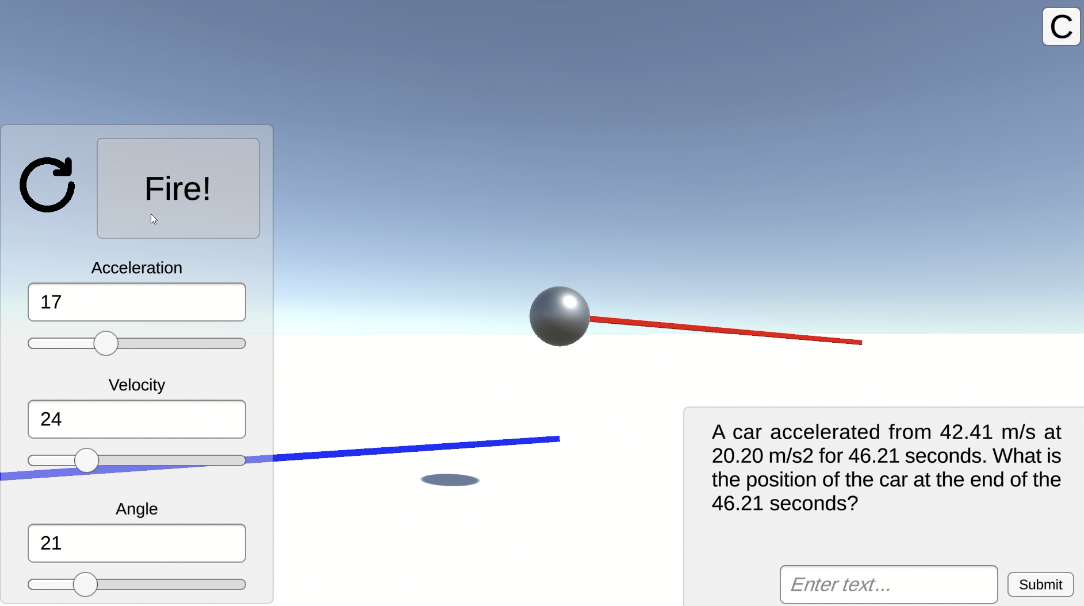
Realistic 3D simulations for uniform motion, uniform acceleration, projectile motion, momentum, spring, electric fields, magnetic fields, sound waves, optics, vector addition, friction and gravitational fields and orbits.
A webpage so that educators and students can collaborate simultaneously, complete assignments and explore in a realistic 3D setting. It features a login and registration system for both educators and students. The students can join a class on our website with a custom code for each teacher’s class.
How we built it:
On our main website page, we have options for teacher login/registration and student login/registration. An educator can register and generate a random class code, which their students can join after registering. Educators can assign questions/assignments for their students to complete. The students can complete the assignments traditionally, but now, they can play around with realistic simulations in 3D space. We know we would have loved to actually visualize what happens in 3D rather than struggling to learn about our 3D world on a 2D page. More information about us can be found on our website!
Challenges we ran into:
The main challenge for our team was creating a working registration/login system for both educators and students. We had trouble implementing the databases, but we figured it out overnight. Also, we had to implement the realistic physics in Unity.
Accomplishments we’re proud of:
The accomplishment we’re most proud of is implementing a class-join system using relational databases (PostgreSQL). It was challenging at first to implement the system in an efficient manner, but through lot’s of trial and error we came up with a database design that generally follows good practice and functions well.
Another accomplishment we’re proud of is the physics simulations. We implemented an intuitive camera system in 3D that allows you to navigate a 3D world as you watch physics simulations. In addition, we implemented kinematics models with various formulas, and even experimented with simulating charged particle interactions.
Lastly, we used bcrypt, which is an industry-standard hashing algorithm that uses salting to create very secure passwords. These passwords are never stored as text, and are stored in the database as hashed passwords.
What we learned:
Databases (PostgreSQL)
EJS
Express.js
Node.js
C# and different Unity modules
Video Editing
What’s next for PhysEd:
The next steps for PhysEd include adding more types of physics simulations, including gravity, momentum, collisions, etc.. We could also make it so that our answer verification mechanism can also recognize significant digits. Currently, students would enter an unrounded value.


Log in or sign up for Devpost to join the conversation.