-
-
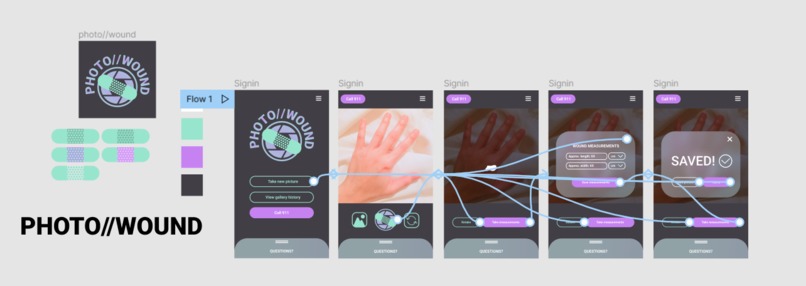
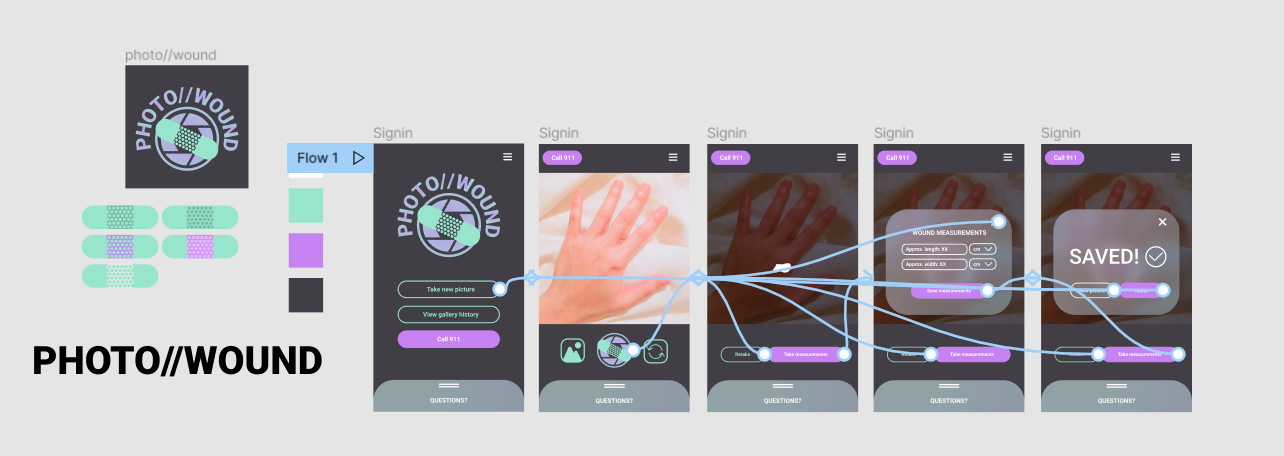
Caption: Our prototyping and branding design work in the software Figma.
Inspiration
We were inspired to create this project when we saw the inadequacies in the current wound detection and measurement process. With one of the members of our team being involved in a home-health care company, we had first hand experience with these shortcomings and knew the impacts that these mistakes can have on the treatments process.
What it does
Our algorithm is a pixel-wise semantic segmentation of the initial image that points out the exact shape of the "objects of interest", in this case, wounds.
How we built it
We trained a UNET based structure built on the Keras framework on the MICCAI Ulcer Detection Database, which included thousands of annotated images of wounds and their proper masks. We used a 80%/20% split between our training and testing databases. No major data preprocessing was involved (other than size standardization) as the images were already mostly processed in the database.
Challenges we ran into
Although we were able to successfully develop our code, we were unable to connect our backend to our front end interface. We hope to do this in the next coming days so that we can truly have a fully functional application that is capable of revolutionizing the way in which we diagnose and measure wounds.
Accomplishments that we're proud of
We are proud of the fact that, despite being a 3-person team consisting of members that (prior to Metrohacks) did not know each other, we were able to unite our talents and work towards the common vision of creating PhotoWound. Beyond this, we were also pleasantly surprised by our teams ability to rapidly prototype a solution to our problem and create an effective backend UNET model.
What we learned
Through this project, we learned quite a bit about the wound detection and measurements process, as well as rapid prototyping in Figma and other such softwares, as well as the development of more advanced machine learning structures.
What's next for PhotoWound
We hope to soon add a depth measurement tool using a bi-camera and color/edge detection system. We also hope to create a singular server less architecture in which hospitals, providers, nurses, and patients can all easily access the wound scans recorded by our app.
Built With
- keras
- pillow
- python
- tensorflow

Log in or sign up for Devpost to join the conversation.