Inspiration
Photon Warden started with a simple idea: what if a tower-defense game treated light itself as the weapon system?
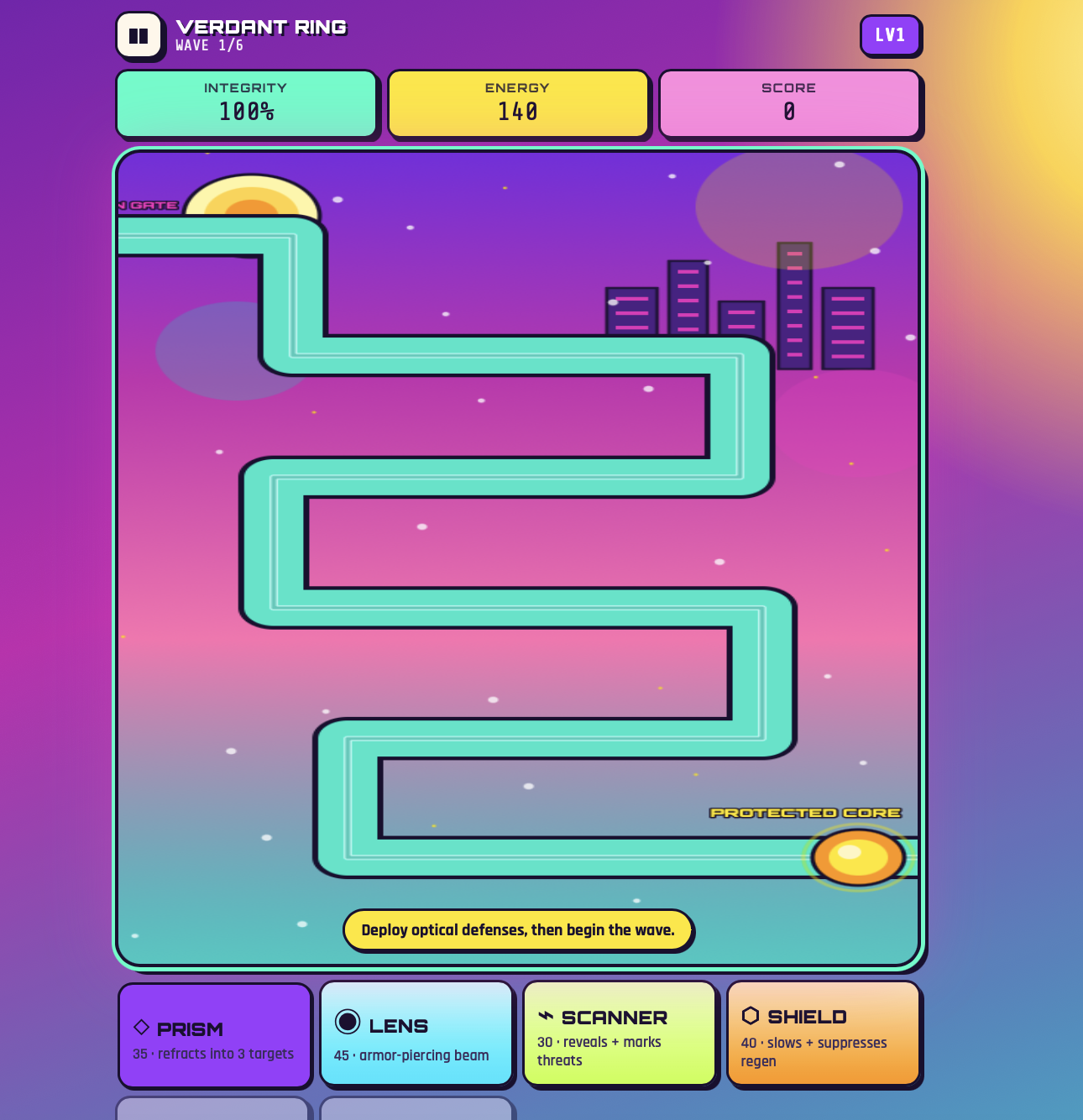
Instead of conventional guns or turrets, the player deploys optical tools — prisms, lenses, scanners, and shields — to detect, expose, slow, and destroy mutated cells before they reach protected tissue. I wanted the mechanics to feel immediately readable as a game while borrowing the visual language of optics, imaging, and biological defense.
The result is a compact sci-fi defense prototype built around the phrase:
Bend the light. Expose the mutation. Protect the core.
What it does
Photon Warden is a browser-based strategy/tower-defense prototype.
The player defends a protected core against waves of mutant cells by placing different optical defenses around the battlefield:
- Prism — refracts attacks into multiple targets
- Lens — fires a powerful armor-piercing beam
- Scanner — reveals and marks threats
- Shield — slows enemies and suppresses regeneration
As the player progresses, additional defenses such as Pulse and Nova can be unlocked.
Enemies are not all identical. Different waves introduce standard, armored, veiled, regenerating, and swarm mutations, encouraging the player to combine complementary defenses instead of relying on one tower type.
The prototype currently includes four sectors, each with its own battlefield layout and visual identity, with six waves per sector. Players earn XP, increase their level, unlock new defenses, receive star ratings based on remaining core integrity, and can replay sectors to improve their score.
How I built it
I built Photon Warden as a lightweight web game using HTML5, CSS, and vanilla JavaScript.
The battlefield is rendered using the HTML5 Canvas API, while JavaScript handles enemy movement, tower targeting, projectiles, waves, upgrades, progression, scoring, visual effects, and game state.
I intentionally kept the prototype extremely portable. It requires no framework or build system and can run directly in a modern browser.
The game also uses:
- the Web Audio API for procedural sound effects and ambient audio
- localStorage for persistent XP, progression, settings, scores, and sector completion
- responsive HTML/CSS UI for menus, HUD elements, sector selection, upgrades, pause/settings screens, and results
- procedural canvas effects for attacks, particles, mutations, impacts, and battlefield feedback
This let me focus the prototype on the core interaction loop rather than infrastructure.
Challenges
One of the biggest challenges was making the different optical defenses feel mechanically distinct rather than simply becoming differently colored versions of the same tower.
The Scanner, for example, needed to make detection itself valuable. The Shield needed to influence enemy behavior without directly competing with damage-focused towers. The Lens and Prism needed different tactical niches despite both ultimately producing offensive effects.
Another challenge was communicating a relatively busy strategy game on a small screen. The player needs to understand enemy types, energy costs, tower ranges, waves, integrity, progression, and upgrades without the interface becoming overwhelming.
Balancing enemy waves and progression was also an iterative process. Adding armored, veiled, regenerating, and swarm enemies helped create situations where different combinations of defenses become useful.
What I learned
Building Photon Warden reinforced how much strategy-game depth can come from interactions between a small number of systems.
A tower does not need dozens of abilities to be interesting if enemy properties create reasons to use it differently. Detection, armor penetration, regeneration suppression, slowing, multi-target attacks, and positioning can combine into much richer decisions than raw damage alone.
I also learned that strong audiovisual feedback matters enormously in making a prototype feel playable. Screen shake, particles, hit effects, sound cues, wave transitions, score feedback, and progression all make the underlying mechanics easier to understand.
What's next
Photon Warden is still an early game prototype, so the next step would be expanding the idea rather than simply adding more content.
I would like to explore deeper interactions between optics and enemy biology: enemies that react differently to wavelength, concealment that must be actively scanned, beams that can be redirected through multiple optical elements, and battlefields where placement changes the geometry of light itself.
The long-term direction is a strategy game where the player is not merely placing towers — they are engineering an optical defense system.

Log in or sign up for Devpost to join the conversation.