Inspiration
I studied the humanities, not computer science, and I have always been interested in the emotional and social questions hidden inside literature.
However, many Korean classics are difficult for modern readers to approach. The language can feel old, the social systems are unfamiliar, and the historical context often creates distance before the reader has a chance to experience the story itself.
AI can explain vocabulary or summarize a passage, but I felt that explanation alone was not enough. Without first understanding the characters, conflicts, and emotional stakes, an AI reading tool can easily become little more than a dictionary.
I began wondering:
What if readers could experience a classic story before being asked to read it?
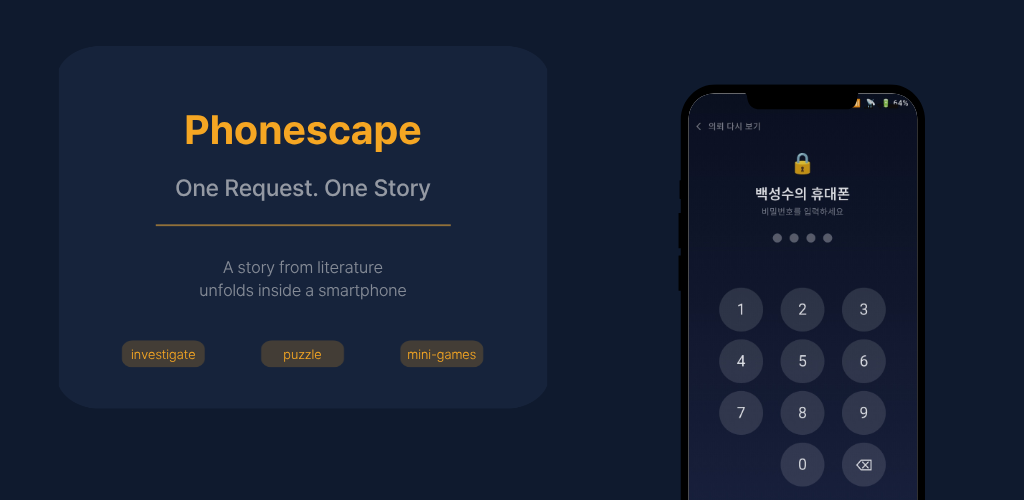
That question became Phonescape, a mobile escape-room game where players reconstruct a mystery through someone else's lost phone. Only after completing the case do they discover that the story was a modern adaptation of a Korean public-domain literary work.
The goal is not to replace reading. It is to create a meaningful entrance into it.
What it does
Phonescape transforms Korean public-domain literature into episodic smartphone mysteries.
Players explore a fictional phone containing:
- Messages and social media posts
- News articles
- Photos and recordings
- Notes, maps, and hidden files
- Password puzzles and narrative choices
Each source reveals a different part of the case. Players must compare information across apps, infer relationships, and decide what they believe happened.
At the end of the case, the original literary work is revealed.
The player then enters the AI Literature Restoration Room, where GPT-5.6 helps them connect their experience of the game to the original text.
Each case contains three verified literary learning goals. GPT-5.6 evaluates which concepts are already present in the player's response and focuses on one missing connection at a time.
Rather than immediately giving the interpretation, the guide:
- Acknowledges what the player already understood
- Asks a focused follow-up question
- Provides adaptive feedback
- Gradually introduces curated choices when more support is needed
- Asks the player to explain why the connection fits
After restoring all three connections, the player unlocks a verified adaptation map showing how the game's characters, conflicts, and symbols relate to the original work.
Finally, players can read the original text with an AI Reading Guide. They can ask general questions or select a sentence and ask which scene from the game connects to it.
The full learning flow is:
Play the case → reveal the original work → restore three literary connections → unlock the adaptation map → read the original with an AI guide
How we built it
Phonescape was built as a Flutter application with local progress storage.
The main architecture consists of:
- Flutter app: Game interface, local state, language settings, puzzles, literature restoration flow, and original-text reader
- Cloudflare Worker: Request validation, trusted case context, learning rules, and communication with the OpenAI API
- OpenAI Responses API with GPT-5.6: Adaptive literary feedback and original-text reading support
The model does not control the entire learning experience.
The application and Worker determine:
- Supported cases
- Verified literary concepts
- Question order
- Unlock conditions
- Input and output validation
- Curated guidance choices
GPT-5.6 provides flexibility within that bounded educational structure.
Player progress is stored locally. The Worker receives only a bounded case identifier and the answers needed for the current activity. It does not maintain user accounts or persist conversations, and OpenAI requests use store: false.
I used different OpenAI tools for different stages of the project.
I developed the original narrative concept and educational direction through conversations with ChatGPT.
During Build Week, I worked with Codex through an iterative creator workflow:
Rough idea → feature design → implementation → creator QA → refinement → testing
I gave Codex story ideas, literary learning goals, interface requirements, and detailed feedback. Codex helped transform them into:
- Feature specifications and implementation plans
- Working Flutter features
- Cloudflare Worker and API integration
- English localization
- Visual and audio asset creation and refinement
- Automated tests
- UI and interaction improvements
After each implementation, I played the build myself, identified what felt unclear or emotionally incorrect, and asked Codex to revise the experience.
This was not a one-prompt build. It was a repeated cycle of design, implementation, creative review, refinement, and testing.
Inside the completed product, GPT-5.6 serves a different role: it is the adaptive literary guide experienced by the player.
I also used GPT to help plan, structure, and edit the project's submission video.
Challenges we ran into
Turning literature into gameplay without reducing it to trivia
The most time-consuming part of Phonescape is not implementation. It is deciding how to transform a literary work into a sequence of clues, apps, puzzles, and choices without losing what makes the original meaningful.
A passage cannot simply become a password, and a theme cannot simply become a quiz answer. Every puzzle needs to work on three levels:
- It must be understandable and satisfying as a game mechanic.
- It must reveal something about the characters or conflict.
- It must preserve a meaningful connection to the original work.
This requires repeatedly reading the source, identifying its emotional and ethical structure, imagining how those ideas might appear through a modern phone, and testing whether the resulting puzzle still feels natural to a player.
This adaptation design remains the largest creative bottleneck in the project.
Finding a useful role for AI in literary puzzle design
Earlier AI models were helpful for implementation and brainstorming, but contributed very little to the hardest part: finding a convincing way to translate a literary scene or theme into interactive puzzle structure.
The suggestions were often too generic, too literal, or disconnected from the emotional logic of the original work. The final adaptation direction therefore remained almost entirely creator-led.
With GPT-5.6 Sol, I began to see the possibility of a gradual change. It still does not replace close reading or creative judgment, but it can contribute more meaningfully to early-stage exploration: comparing adaptation directions, challenging weak connections, and helping develop rough literary ideas into more concrete interactive possibilities.
This is still an emerging workflow rather than a solved problem. However, it suggests that future versions of Phonescape may be able to use AI not only for implementation and tutoring, but also as a more capable creative partner during adaptation design.
Designing an AI tutor that does not give away the answer
A general-purpose chatbot can easily summarize the work or provide a complete interpretation too quickly.
I wanted players to make the connection themselves.
To solve this, I created three verified learning goals for each case and limited the AI to case-specific literary context. The tutor identifies what the player has already understood, then asks about one missing connection instead of returning a full answer.
Maintaining reliable behavior around generative AI
The game needed to remain usable even if an AI request failed or produced an invalid response.
The Worker validates requests and outputs, controls progression, and prevents the model from unlocking content directly. The original ending and text reader also remain accessible even if the AI guide is temporarily unavailable.
Building as a solo humanities creator
I did not begin this project with a traditional computer science background.
I had to work across narrative design, Flutter development, backend architecture, localization, testing, visual assets, audio, and literary research.
Codex made it possible to move between these areas much more quickly, but I still needed to review every result and make the final narrative, literary, and creative decisions.
Localizing a culturally specific experience
The source works come from Korean literary and historical contexts that may be unfamiliar to international players.
The English version needed to be understandable without erasing the cultural details that made the original work meaningful.
The first two stages were localized into English with Codex assistance and creator review.
Accomplishments that we're proud of
I am especially proud that Phonescape became more than either a game or a chatbot.
It now has a complete educational journey connecting:
- Interactive narrative
- Player interpretation
- Adaptive AI feedback
- Verified literary context
- Original-text reading
Two stages are currently playable:
- The Flame Sonata — exploring ethical questions beneath unfamiliar language
- Camellias — revealing universal emotions beneath unfamiliar social context
I am also proud of the AI Literature Restoration Room.
The tutor does not simply tell players what the work means. It recognizes partial understanding and helps the player develop their own interpretation.
Another accomplishment was building a controlled AI architecture where GPT-5.6 provides adaptive conversation while the application remains responsible for educational rules, progression, validation, and safety.
Finally, as a humanities-based solo creator, I am proud that I was able to turn a literary idea into a working mobile product through an iterative collaboration with ChatGPT and Codex.
What we learned
The most important lesson was that AI is often most useful when its role is clearly bounded.
GPT-5.6 became more effective when it was not asked to teach “everything” about a literary work. Giving it verified case material, specific learning goals, and a controlled progression made its feedback more focused and educationally meaningful.
I also learned that interactive experience can create a different kind of understanding from explanation alone.
After players have investigated the characters' messages, choices, and conflicts themselves, questions about the original text become connected to something they already experienced.
From the development process, I learned that AI-assisted creation works best as a conversation and revision loop, not as a single generation step.
Codex could implement features quickly, but creator judgment was still essential. I needed to test the experience, explain what felt wrong, refine the narrative intent, and decide when the result was complete.
I also learned that different parts of creative work are advancing at different speeds.
AI can now contribute strongly to implementation, localization, asset iteration, testing, and bounded tutoring. Literary puzzle design is still much harder because it requires interpretation, emotional judgment, and a coherent relationship between source, mechanic, and player experience.
However, GPT-5.6 Sol showed early signs of being able to contribute more to this difficult creative stage. That made me see a future in which AI does not merely execute a finished design, but helps a humanities creator examine and develop possible adaptation structures before implementation begins.
Most importantly, this project showed me that my humanities background was not a limitation.
With tools such as ChatGPT and Codex, literary imagination could become a real, interactive technical product.
What's next for Phonescape
The next major goal is to complete the third stage, based on Wings by Yi Sang.
This case will explore not only story and theme, but also the relationship between literary form, fragmented perspective, and interactive experience.
I also want to develop a more systematic workflow for the most difficult part of production: turning a source work into meaningful gameplay.
This may include:
- Mapping each work's emotional, ethical, and structural elements before designing puzzles
- Evaluating whether every puzzle expresses a literary connection rather than only hiding information
- Using GPT-5.6 Sol to explore and critique multiple adaptation directions
- Keeping the creator responsible for final interpretation and narrative decisions
- Documenting reusable patterns for adapting literature without reducing it to trivia
After that, I would like to:
- Adapt more Korean public-domain literary works
- Improve the English localization and support additional languages
- Add more original-text reading tools
- Expand the verified adaptation maps
- Develop optional educator-facing materials
- Explore how the same structure could introduce readers to classics from other cultures
Ultimately, I want Phonescape to become a new way of encountering literature:
First as an experience, then as an interpretation, and finally as a text.
Try It Out note: To manage ongoing API costs, the public Google Play build currently excludes the AI tutor feature. Please refer to the submitted demo video and judge-access build for the complete AI learning experience.
Built With
- chatgpt
- codex
- dart
- flutter

Log in or sign up for Devpost to join the conversation.