
Inspiration
I was inspired to make a screen time app after I tried to get off my phone and I couldn't. All the tools out there fell into a couple categories: Rigid blockers, which would set a time limit on certain apps, micro-friction, where opening an app would take a bit of time, gamified rewards, where you would be incentivized to stay off the apps to prevent a tree from dying or breaking your streak, or minimalist launchers, which tried to keep your entire phone minimalist so you wouldn't want to use it.
Literally none of these worked for me. It would become extremely irritating, and I would eventually disable or uninstall them. As I talked to other people about these issues, I realized that there are some brains which are able to self-regulate better, and other brains, usually associated with ADHD, addiction, neurodivergence, etc. which have a much more difficult time doing so.
However, I didn't like the idea of stripping away autonomy. The entire idea of blockers is that even if you really want to do it, it wouldn't let you. The entire market was built on how to make it as hard to circumvent as possible. But that isn't a long term solution. It's like when your parents take your phone away. You aren't ever making those decisions in the moment for yourself; because there is an external authority that is forcing you, you never learn to develop the skills to put the phone down yourself.
But there was something that worked. I was trying to quit watching porn once, and my friend said they wanted to do the same. We decided to create a pact, but not one that prevented us necessarily. Instead, it would allow us to do whatever we wanted, provided we face the consequences, which was just visibility. If we chose to watch, we would just tell the other person that we did.
Just this simple mechanism allowed me to not watch porn for a month, and it actually felt easy. It was so interesting how whenever I felt the urge, my friend's face would just pop up in my mind, and I would just steer away.
I understood that we don't fall into addiction easily when we are being perceived. It is when we are alone that it manifests within us without restraint much more powerfully.
That's why I wanted to build PhonePact. I, like many others, am addicted to my phone. And it's not necessarily my fault. We are going up against the most sophisticated psychological attention trap ever engineered. Expecting to beat it alone is unrealistic, so we shouldn't have to.
What it does
PhonePact follows this simple process of social awareness.
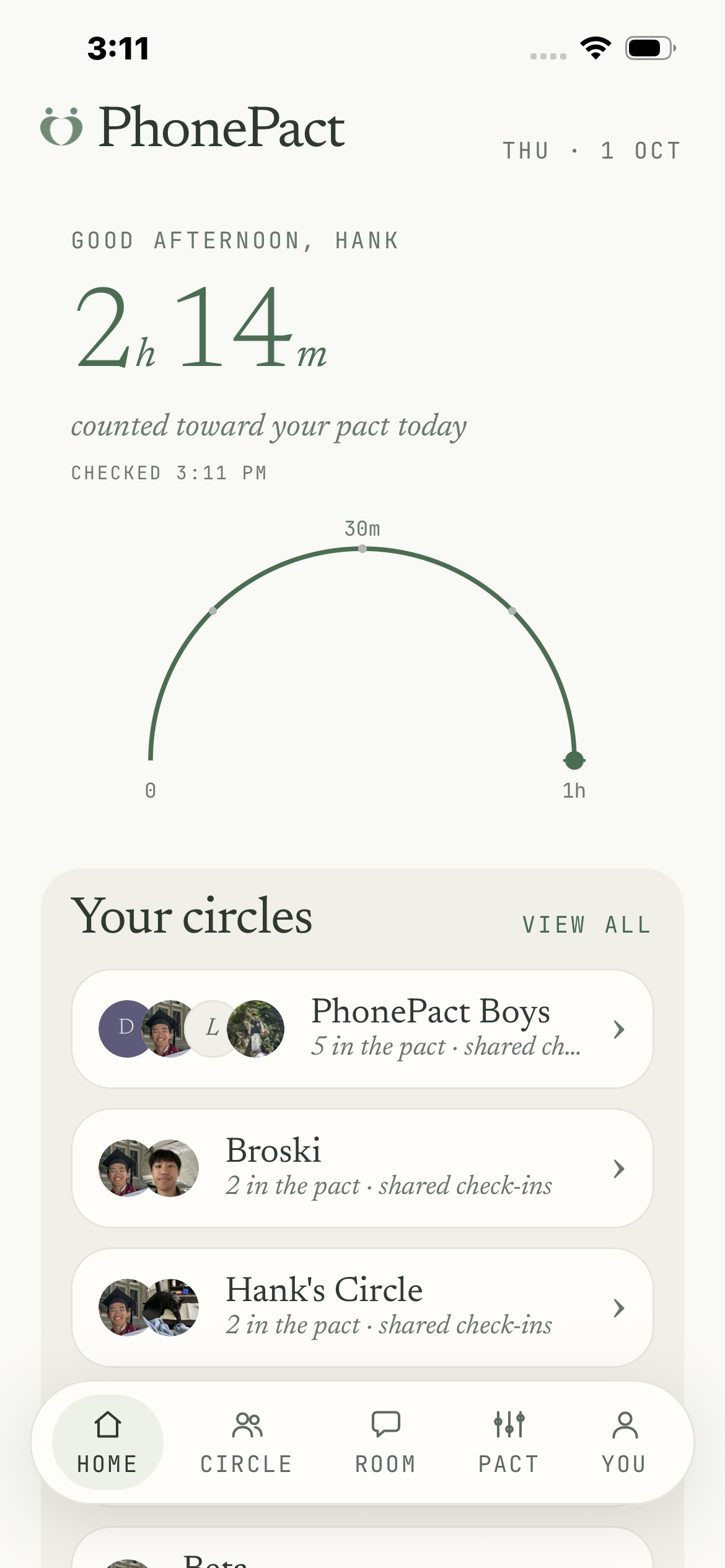
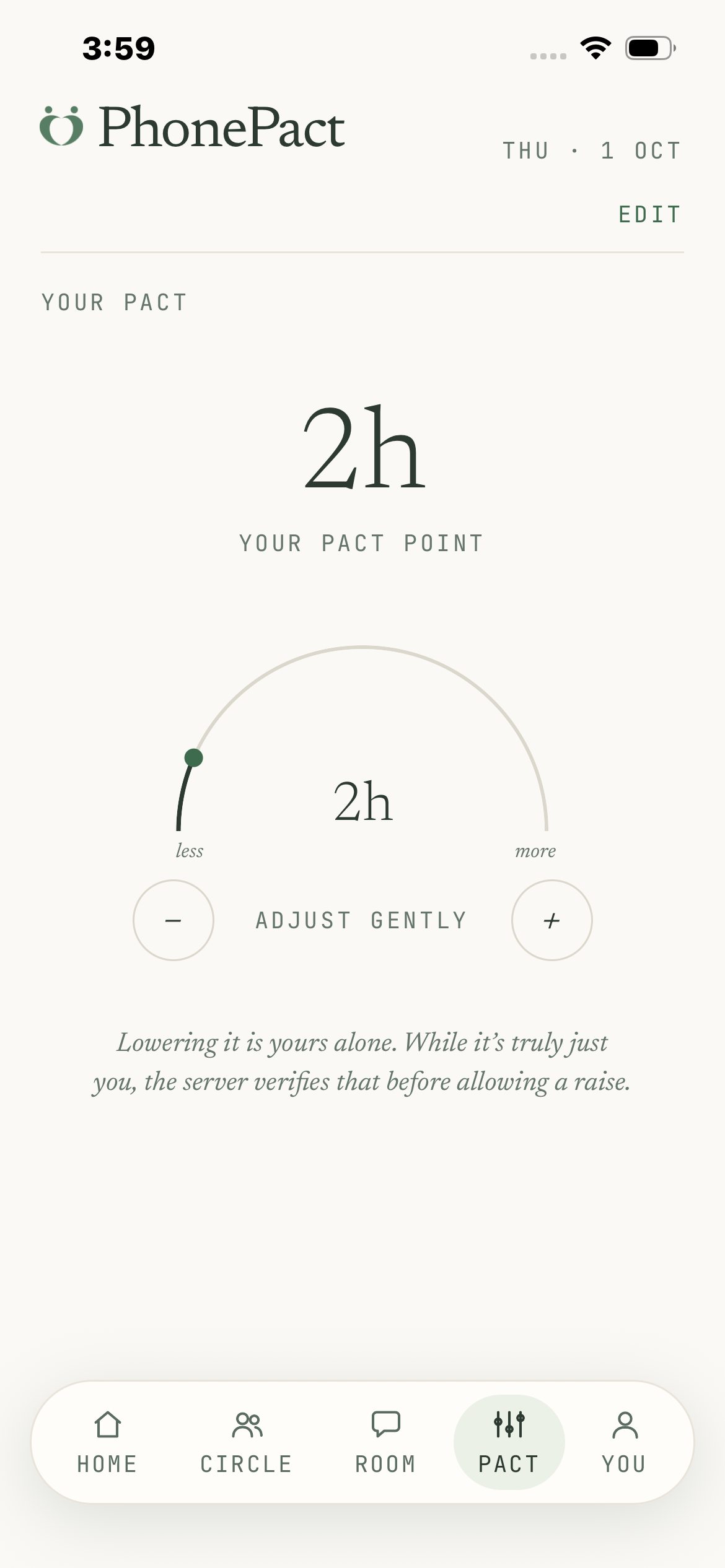
First, you are able to choose your own pact time: how long you want to spend on your phone in a day. Then, you can join a circle of friends, family, partners, or whoever, who also have their own pact time. If you reach you allotted time, everyone in your circle is notified simply, "X's iPhone has reached 3h today."
The words are intentionally designed to be shame-free, because that's not our goal. In addition, we never want you to stay in a state of failure. That's why every thirty minutes after your initial notification, new notifications are sent out: "X's iPhone has reached 3h 30m today," "X's iPhone has reached 4h today."
Through this mechanism, we hope to offer some sense of autonomy. You chose your time, and you can break your time, but there just is a social consequence.
In order to help with time blindness and awareness, we also offer private notices where you can set up intervals where you receive time passing notifications.
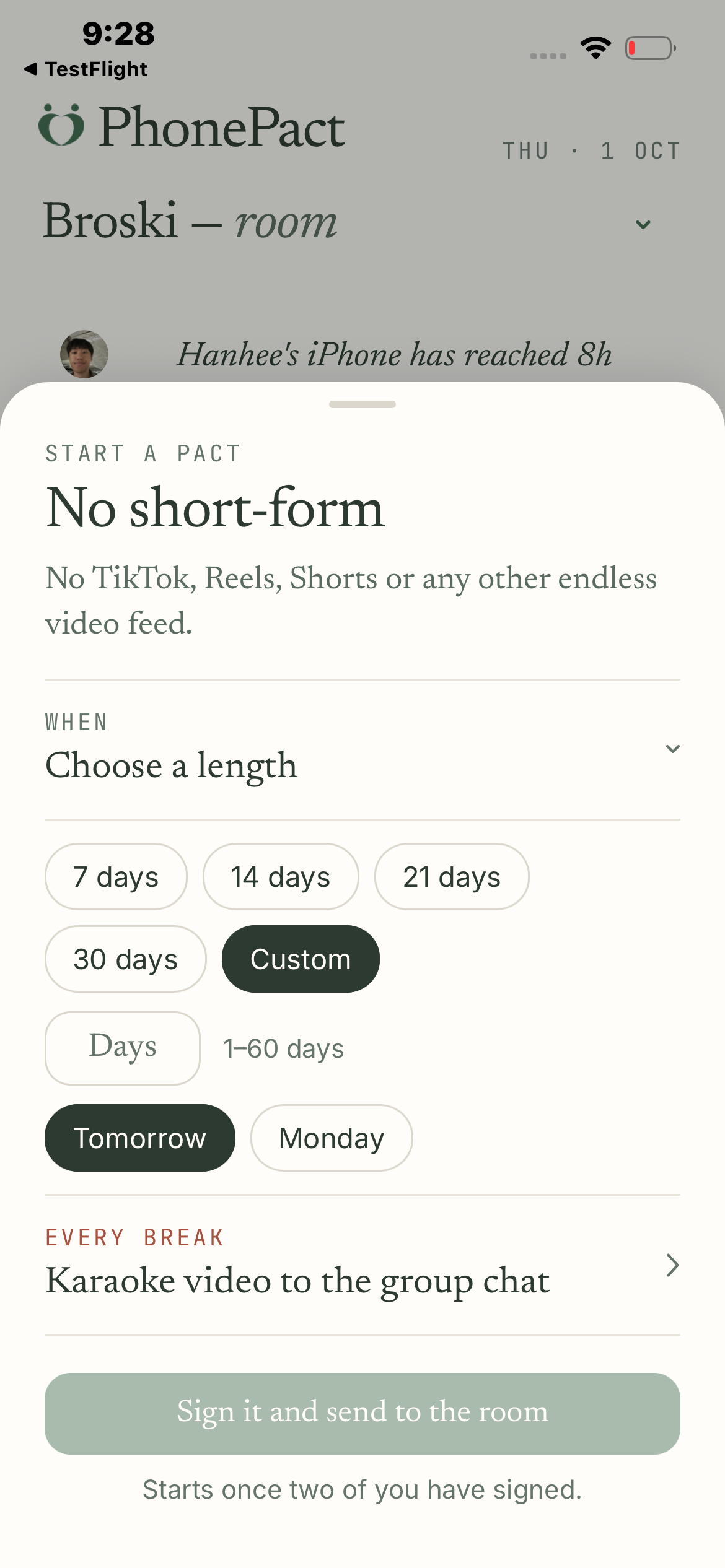
You can also decrease your pact time at any point, but increasing it requires someone else in your circle to sign off.
We are currently working on more features, such as a circle pact option where you are all able to participate in a group pact, where for a certain length of time, you can agree to stick to a screen time or something entirely else, like go to the gym 3x a week, with whatever consequence you would like. This is more like the original pact that I had with a friend that worked wonderfully.
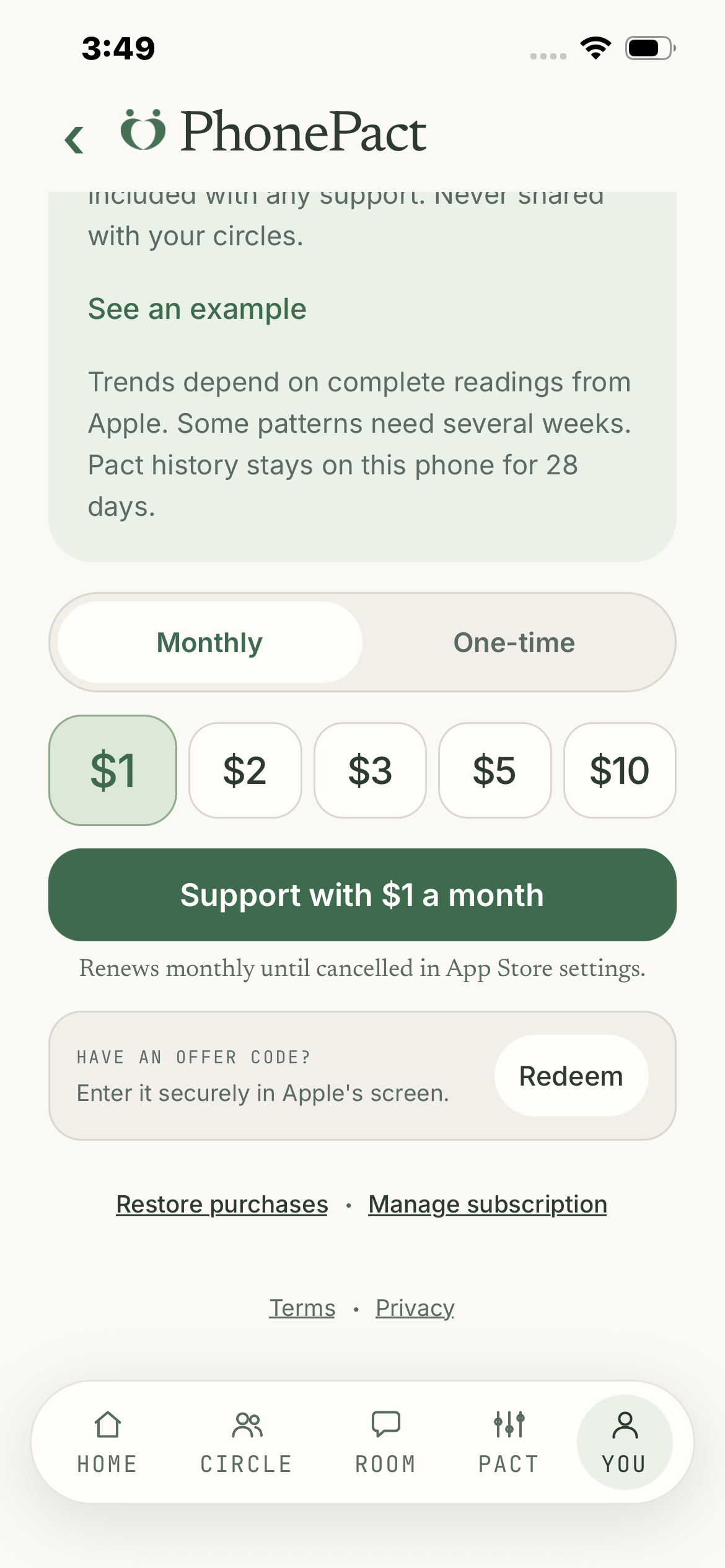
Right now, we are offering deeper insights for people who want to monetarily support PhonePact. However, I feel like it is important for us to keep the core functions free because our services rely on widespread social nets, and any friction to do that within a friend group could bring the entire idea down for the initial person who was interested.
How we built it
I built most of the infrastructure using Claude and ChatGPT. I have no background in coding, so I recruited some friends to help me set everything (such as GitHub repos, Expo, etc) up, but once that was set up, I designed and created everything myself. Otherwise, I knew how to set up an LLC, website domains, emails, and other necessities of business, through prior experience.
Challenges we ran into
Due to my inexperience and also a lack of a Macbook, we had to use Expo Application Services, and when we ran out of free credits, we used Lance's generous AI credits in the ShipKit to submit to the AppStore. Unfortunately, there were so many back and forths as I couldn't validate whether the code worked or not in Swift due to the lack of XCode, that we had to submit many TestFlight builds through a paid plan.
I also initially bought the Claude $200 Max Subscription, and later switched to the ChatGPT $100 Max Subscription. I would switch between time when I would get stuck on a problem one just couldn't seem to solve.
Later, I transferred everything over to Android using AI, which took a long time and a lot of credits but transferred well. However, after I released both, any changes I wanted to make had to happen congruently, and I fell behind on that as time went on.
There were so many issues with Apple's privacy with showing the right screen time, not loading in correctly, and more, which can be seen through so many back and forth conversations with AI, with most kinks hopefully ironed out.
I just graduated from Harvard Divinity School and didn't have a job, so I had a lot of free time on my hands. But the slog of waiting for AI responses is such a huge brain drain, I had difficult motivating myself when things didn't work out, and I wished that I could go in the code and know what to fix myself. However, having a deadline such as Shipaton was helpful to keep moving forward.
Accomplishments that we're proud of
We're really proud that it works. It has genuinely helped me regulate my own screen time on my phone. One of the issues what that although it could help prevent doomscrolling that lasted 7-12 hours, it was a little more difficult to keep yourself under a more rigid time frame. That's why we are innovating now and trying to create circle pacts rather than just individual pacts that can feel more involved and more of a commitment.
What I want to say is, it is important to eat your own dogfood. I really created this as a solution for myself, and seeing that it actually begins to work for myself is something I'm proud of.
What we learned
I learned a lot from this experience. I learned time management. I learned of how quickly AI develops and how powerful it has become over the course of just a few months. I learned of how important it is to have the correct tools and motivations to succeed. If this entire app wasn't for a cause I really believed in, I doubt I would have gotten this far.
What's next for PhonePact
I want to keep iterating on the iOS and Android versions, and later spread to computer use and more. I also want to tinker with easier options that you can access without an app, which is what I'm working on here: https://getphonepact.com/pacts.
The hope is that I learn how to delegate tasks better to a team of people who have expertise in areas that I don't have. I want to learn how to monetize, but not in a way that is predatory.
I am primarily an artist and graphic designer, so I tried my hardest to make the user experience seamless and beautiful, but due to my lack of code understanding, it was sometimes really difficult to execute my vision. Hopefully I can get more help with that in the future!

Log in or sign up for Devpost to join the conversation.