-
-
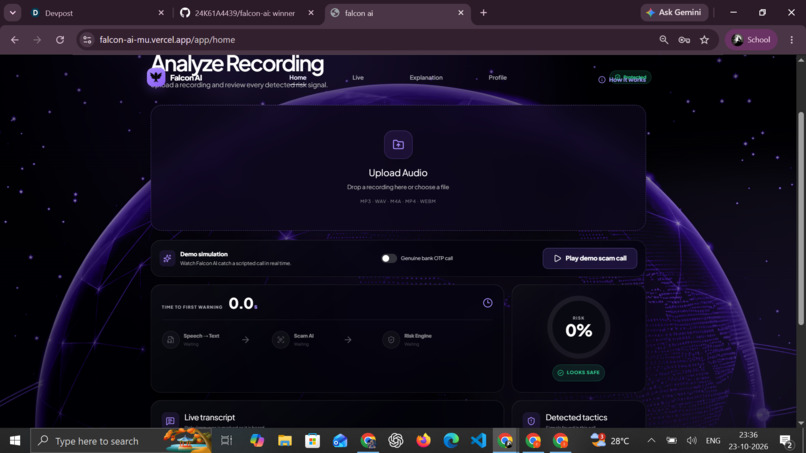
home page of working prototype
-
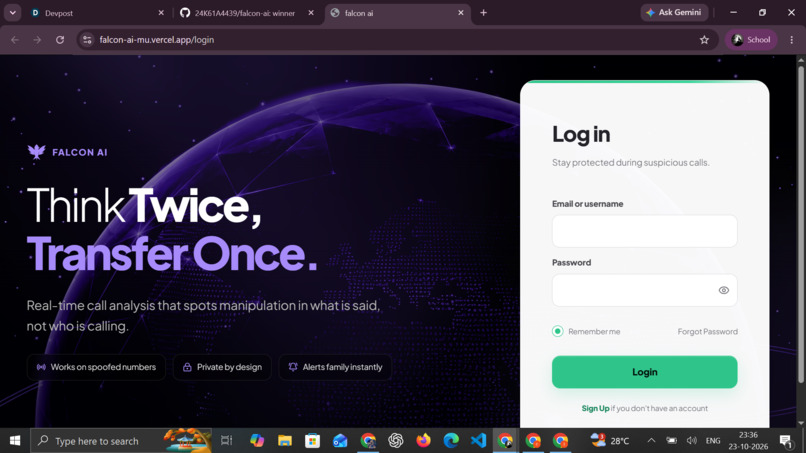
opening animated page or login page
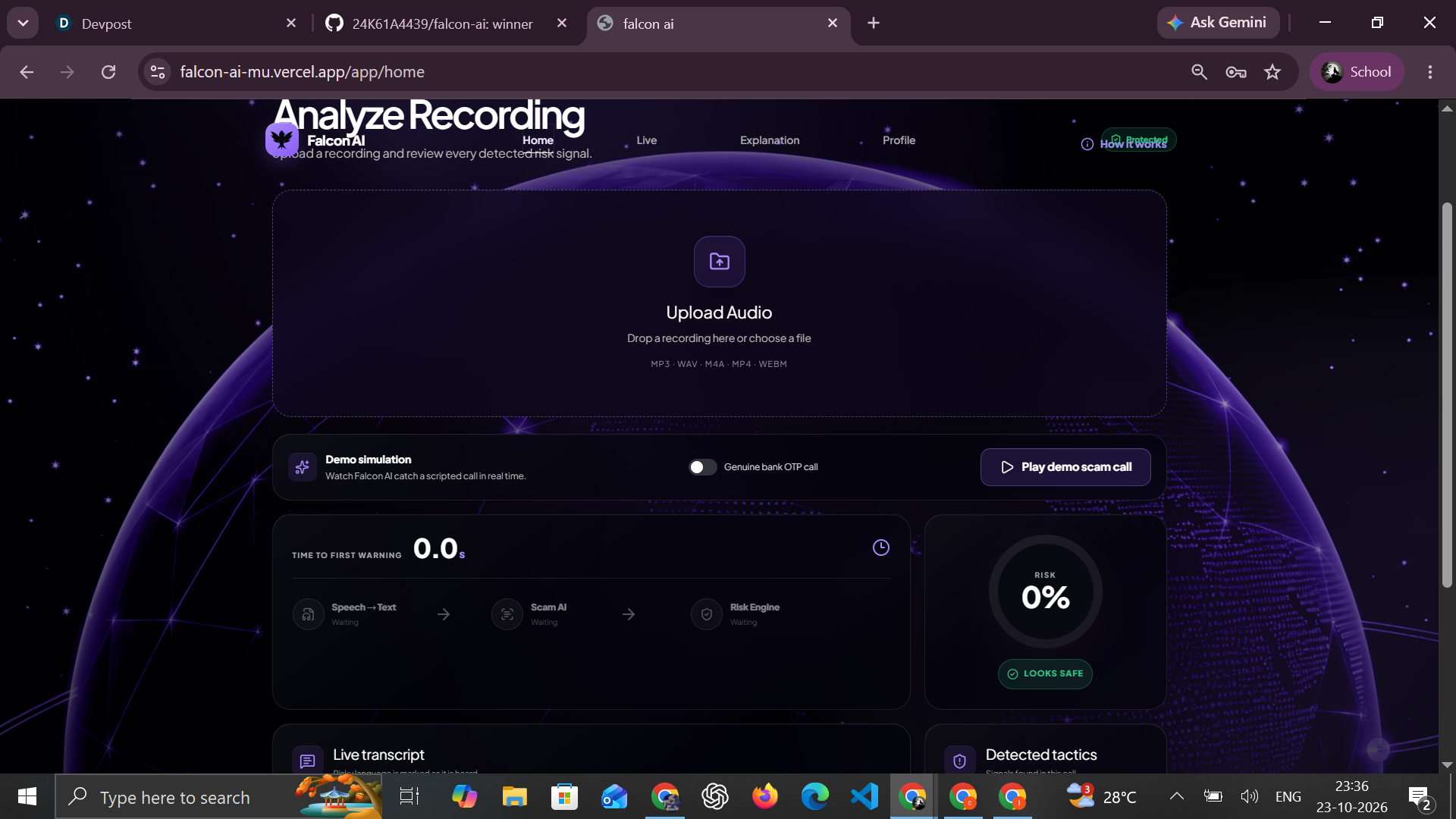
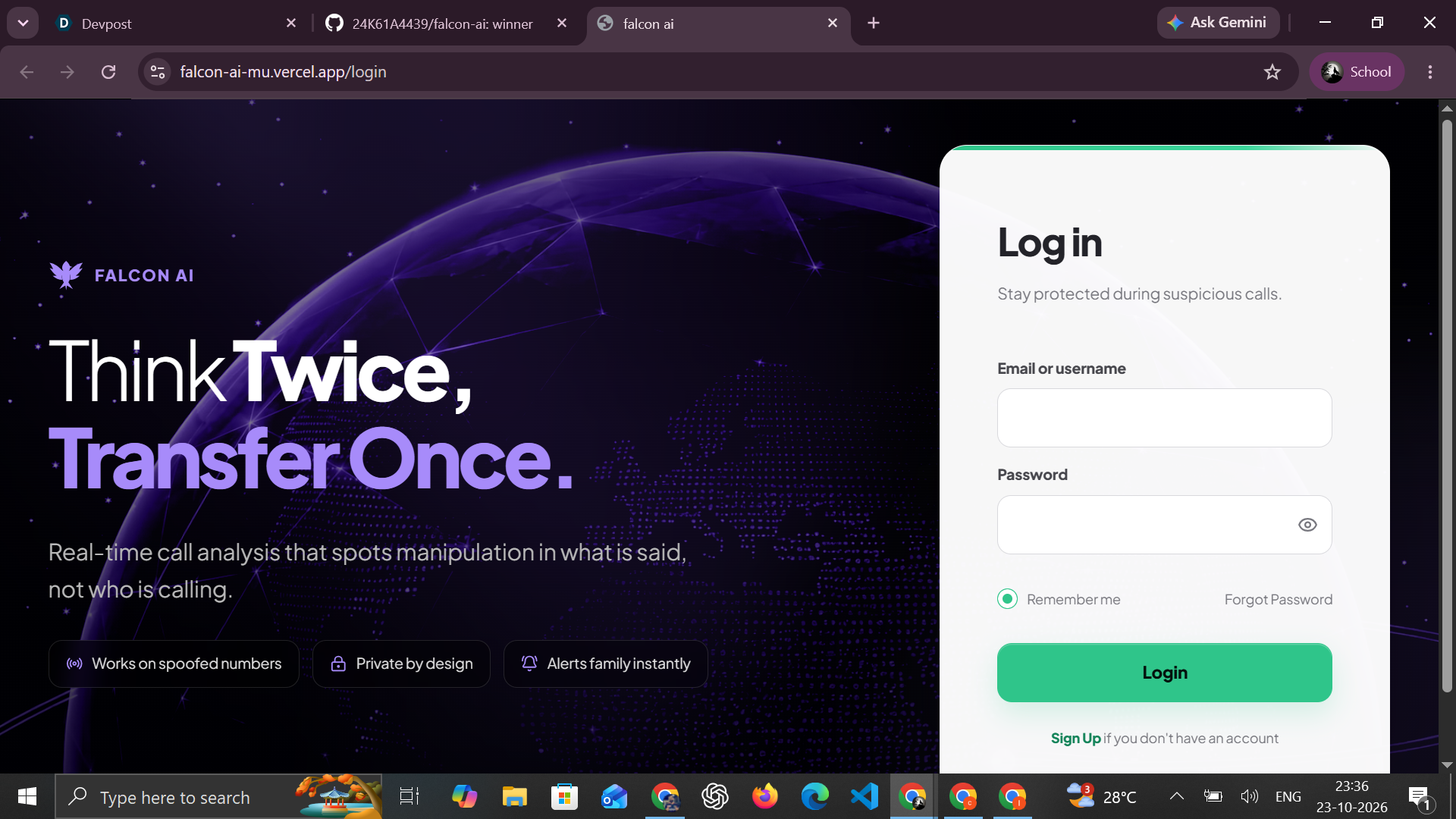
Inspiration# Falcon AI: Real-Time Phone Call Fraud Detection System
1. Overview
Falcon AI is an AI-powered, real-time phone call fraud detection system designed to identify potential scams during ongoing conversations. It analyzes live call transcripts, detects suspicious phrases and social engineering tactics, and provides immediate risk assessments to help users recognize potential fraud.
Unlike traditional fraud detection systems that primarily rely on known spam numbers or previously reported incidents, Falcon AI focuses on the content and context of conversations to identify potential threats as they emerge.
2. Problem Statement
Phone scams are becoming increasingly sophisticated. Fraudsters frequently impersonate bank officials, customer support representatives, government authorities, and trusted organizations to manipulate individuals into revealing sensitive information or transferring money.
Traditional caller identification applications cannot reliably detect every scam, particularly when fraudulent activity originates from unknown numbers or involves new social engineering techniques.
An intelligent solution is needed to analyze conversations in real time, identify suspicious behavior, and warn users before they make potentially harmful decisions.
3. Proposed Solution
Falcon AI combines real-time communication, speech-to-text processing, and AI-powered conversation analysis to identify potential fraud during a call.
The system evaluates conversation transcripts for suspicious language, urgency, impersonation, requests for confidential information, and other indicators associated with phone scams. Based on the detected evidence, it generates a risk assessment and displays appropriate security warnings through an interactive dashboard.
4. Key Features
- Real-Time Call Monitoring: Monitors supported live-call sessions and processes available conversation data.
- Live Transcription: Converts available call audio into text for further analysis.
- AI-Powered Fraud Detection: Identifies suspicious phrases, social engineering tactics, and potential scam patterns.
- Instant Security Alerts: Displays warnings when potentially fraudulent behavior is detected.
- Suspicious Phrase Highlighting: Highlights potentially dangerous statements, including requests for OTPs, banking credentials, or urgent money transfers.
- Dynamic Risk Assessment: Updates the risk classification as new transcript information becomes available.
- Explainable Fraud Detection: Presents the suspicious indicators and supporting evidence behind each risk assessment.
- Privacy-Aware Processing: Aims to minimize unnecessary exposure of sensitive conversation information.
5. System Workflow
- Call Initiation: The user initiates or joins a supported call session.
- Audio Processing: Available audio is captured and processed according to device permissions and platform capabilities.
- Speech Recognition: The audio is converted into text using the configured speech-to-text service.
- Conversation Analysis: The AI analyzes transcript segments for suspicious patterns and potential social engineering techniques.
- Risk Assessment: The system evaluates the detected indicators and determines an estimated risk level.
- Alert Generation: The dashboard displays the risk classification, suspicious phrases, supporting evidence, and recommended precautions.
6. System Architecture
Live Call Session
        |
        v
Audio Capture
        |
        v
Speech-to-Text Processing
        |
        v
Transcript Analysis
        |
        v
AI Fraud Detection Engine
        |
        v
Risk Assessment
        |
        v
Real-Time Dashboard and Alerts
7. Mathematical Model
The fraud detection system can represent conversation risk using a weighted combination of suspicious indicators.
The estimated risk score can be expressed as:
$$ R = \sum_{i=1}^{n} w_i x_i $$
Where:
- (R) represents the estimated fraud risk.
- (x_i) represents the normalized value of a suspicious indicator.
- (w_i) represents the weight assigned to that indicator.
- (n) represents the total number of indicators considered.
For a normalized risk score between 0 and 100:
$$ R_{\text{score}} = 100 \times \min(1,\max(0,R)) $$
The resulting score can be mapped to configurable risk categories, such as low, medium, and high.
The final classification depends on the detection and scoring logic implemented in the system. These equations describe a possible scoring approach and should be adjusted to match the actual implementation.
8. Technology Stack
- Frontend: React.js, Vite, HTML, CSS, and JavaScript
- Backend and Database Services: Supabase
- Real-Time Communication: WebRTC and Supabase Realtime signaling
- AI-Based Analysis: Large language model API for transcript analysis
- Speech Processing: Configured speech-to-text integration
- Deployment Platform: Vercel
Only technologies and integrations used in the working implementation are included in the final submission.
9. Innovation and Impact
Falcon AI emphasizes conversational context and suspicious intent rather than relying exclusively on caller identification or previously reported phone numbers.
The system aims to provide the following benefits:
- Early identification of potential phone scams.
- Context-aware detection of social engineering patterns.
- Explainable risk assessments to support informed decisions.
- Immediate warnings during supported live-call sessions.
- Potential applications in digital banking awareness, personal security, and fraud prevention.
10. Future Scope
- Support for regional Indian languages, including Telugu and Hindi.
- Improved recognition of regional-language scam patterns.
- Integration with authorized telephony platforms.
- Enhanced detection using verified scam and legitimate-call datasets.
- Privacy-preserving on-device processing.
- Performance improvements to reduce transcription and analysis latency.
- Continuous evaluation to improve detection accuracy and reduce false positives.
11. Limitations
Detection performance depends on audio quality, transcription accuracy, supported languages, and the AI analysis model. Legitimate conversations may contain suspicious-sounding phrases, resulting in false positives, while sophisticated scams may go undetected.
Access to phone-call audio also depends on device permissions, operating system restrictions, and the capabilities of the integrated communication platform.
Falcon AI provides decision support and security awareness. It does not guarantee the detection of every fraudulent call or replace independent verification and human judgment.
12. Conclusion
Falcon AI aims to improve phone-call security by combining live transcription, AI-powered conversation analysis, explainable risk assessment, and real-time security alerts.
By identifying potential warning signs while a conversation is in progress, the system seeks to help users recognize suspicious behavior earlier and make safer decisions.
Project Mission: Detect potential threats early, identify suspicious conversations, and support real-time fraud prevention.
What it does
How we built it
Challenges we ran into
Accomplishments that we're proud of
What we learned
What's next for phone call fraud intelligence
Built With
- ai
- css
- css-**frontend-development:**-react.js
- fraud-detection
- fraud-detection-**speech-processing:**-speech-to-text
- git
- github
- html
- javascript
- live-call-monitoring
- live-transcription-**fraud-analysis:**-suspicious-word-detection
- react.js
- risk-scoring-**deployment:**-website-hosting-**development-tools:**-git
- speech-to-text
- vs-code
- website
- website-design-**backend-development:**-server-side-programming-**real-time-communication:**-live-call-connection-**artificial-intelligence:**-ai


Log in or sign up for Devpost to join the conversation.