-
-
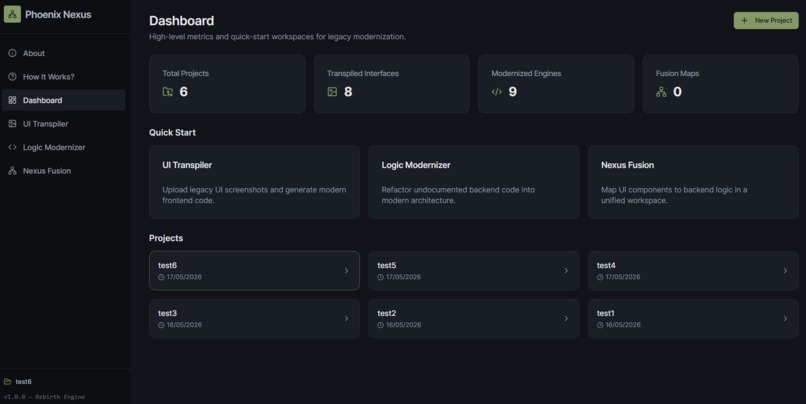
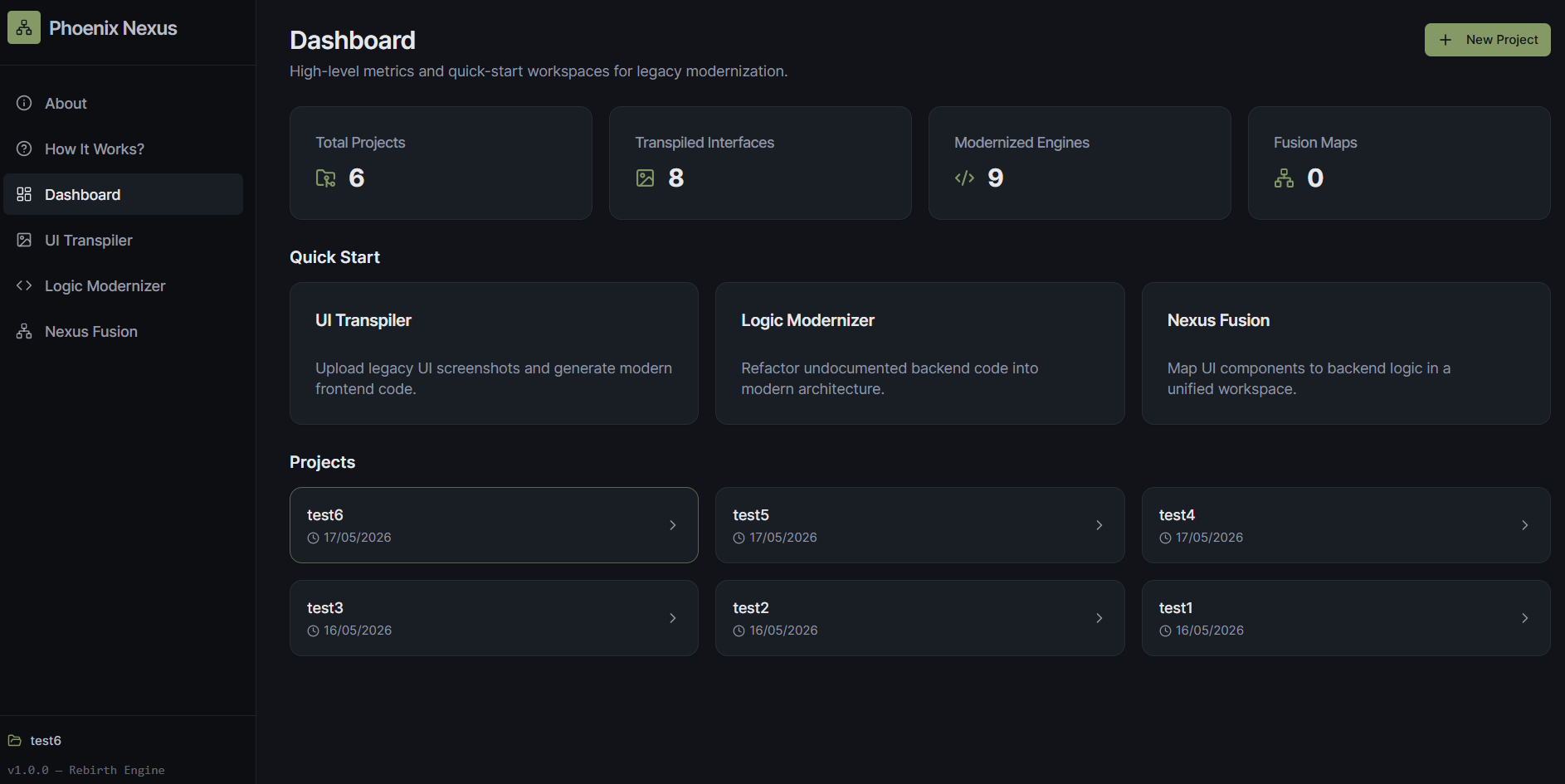
Dashboard
-
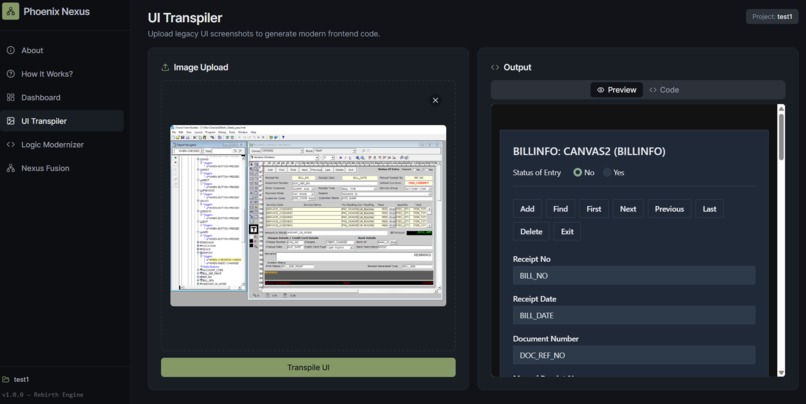
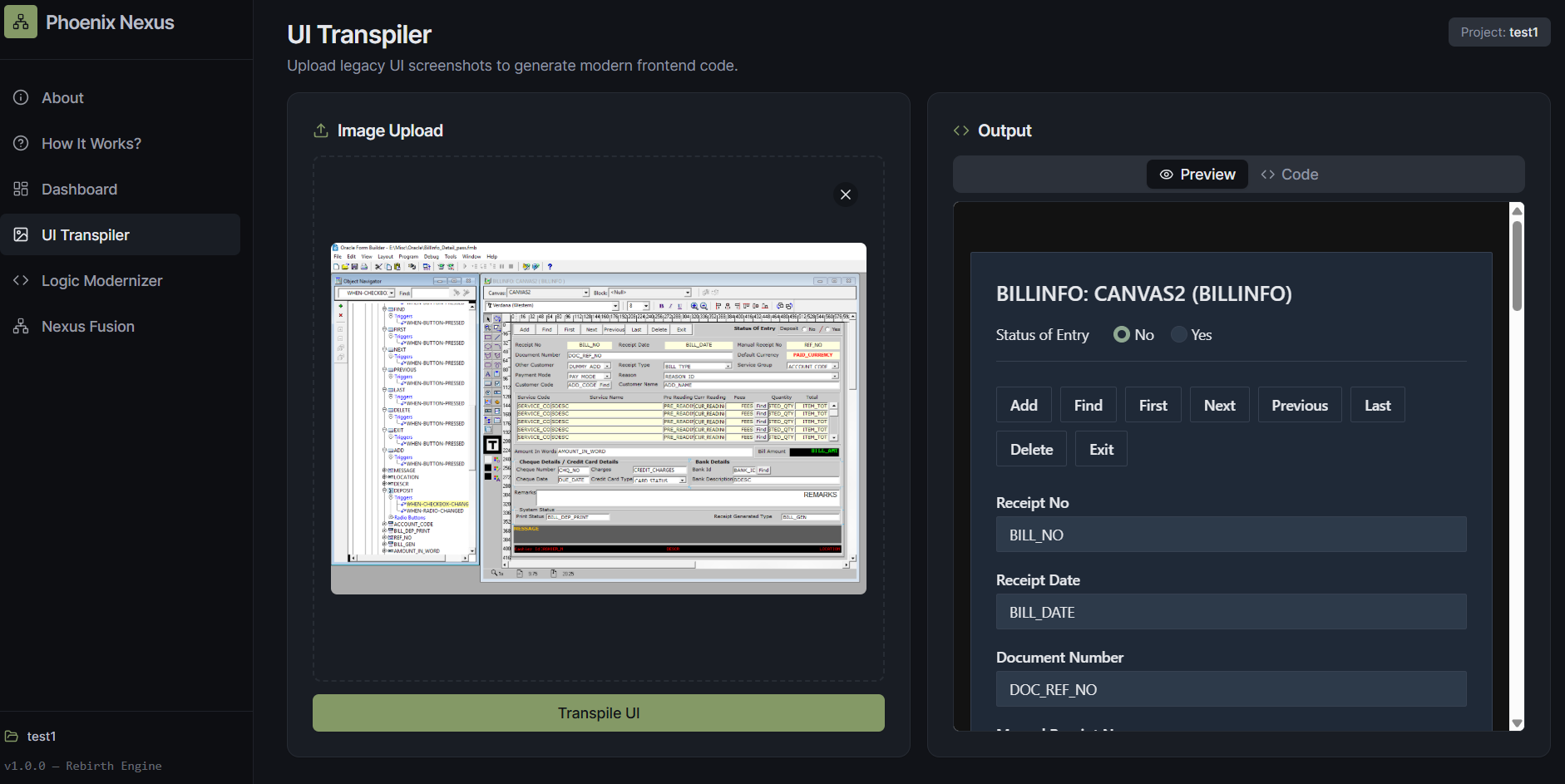
UI Transpiler - transform old software screenshots to mordern UI code and preview
-
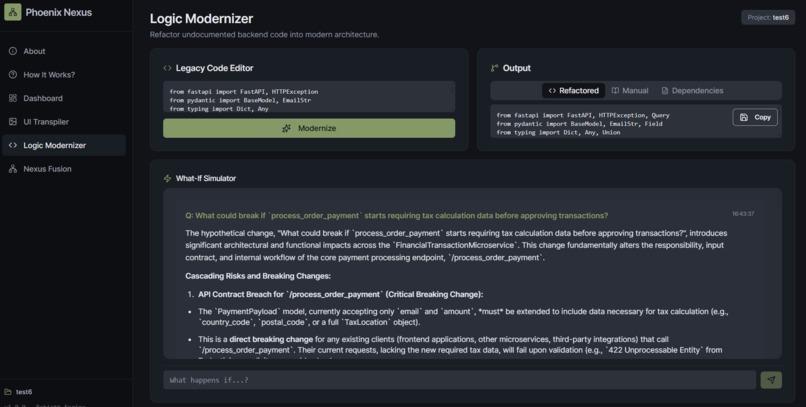
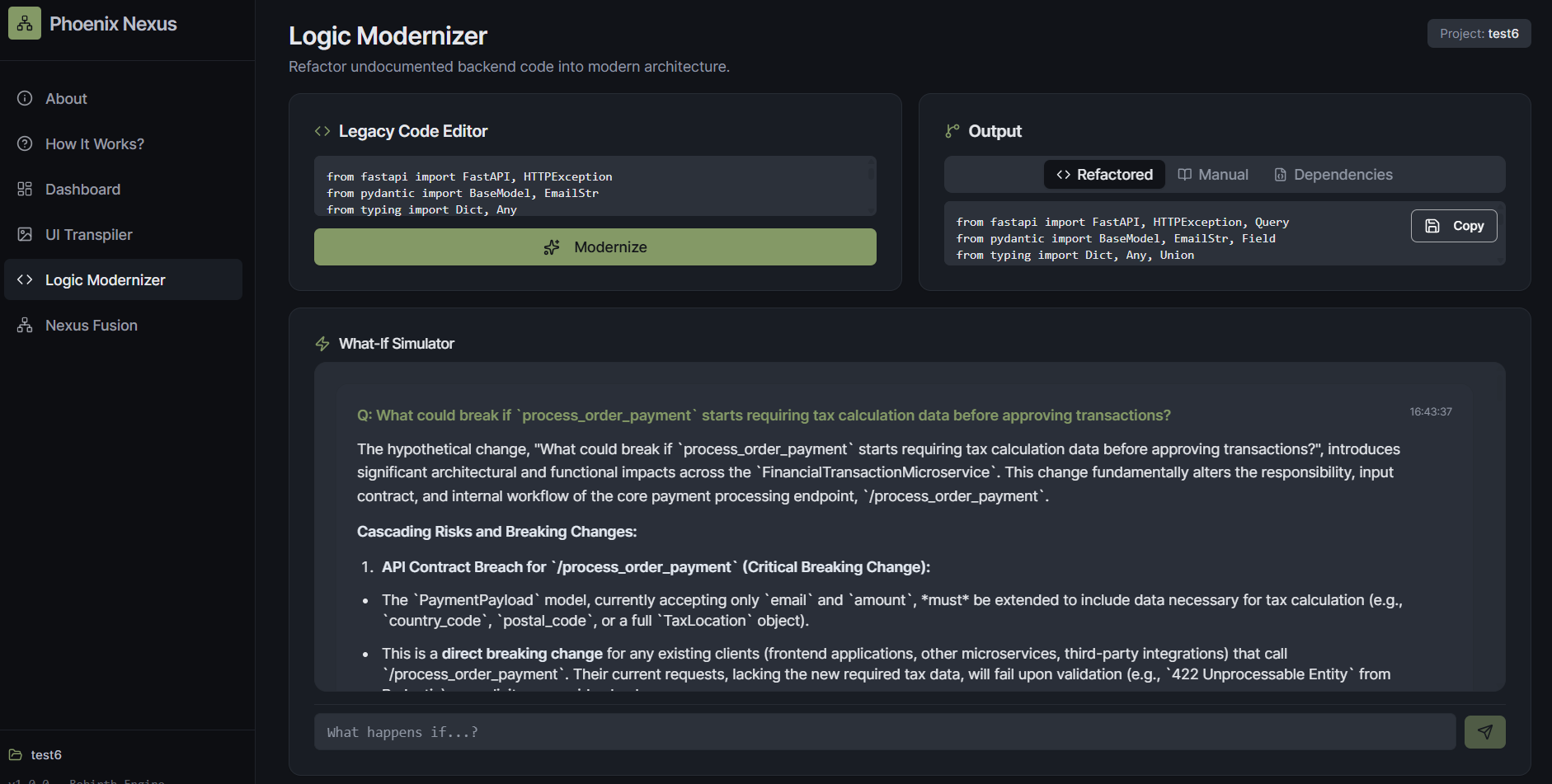
Logic Modernizer - legacy code to refactored code, manual and dependencies with what if simulator
-
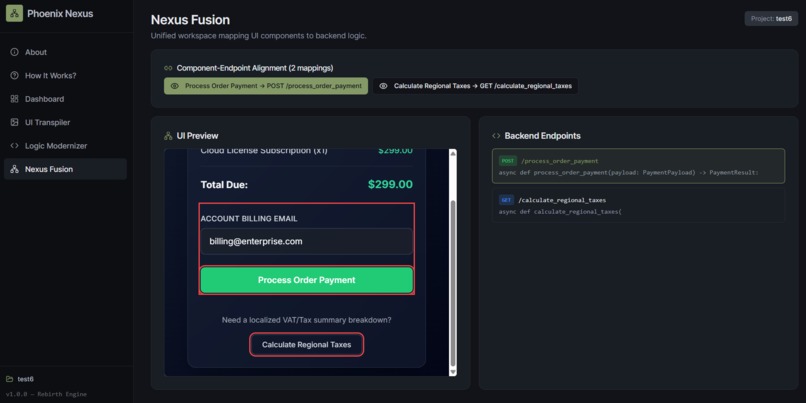
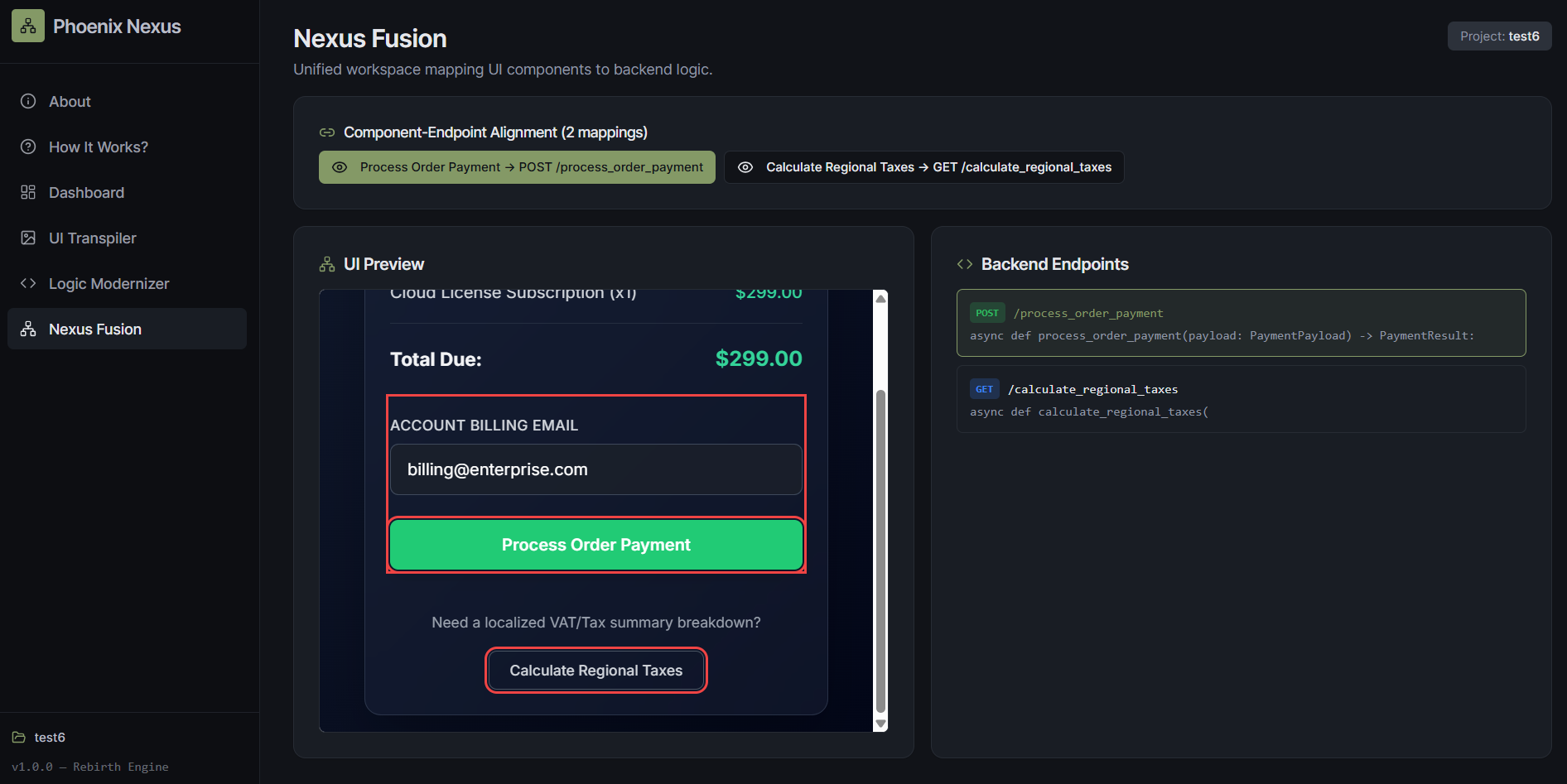
Nexus Fusion - combines the powers of transpiler and modernizer
-
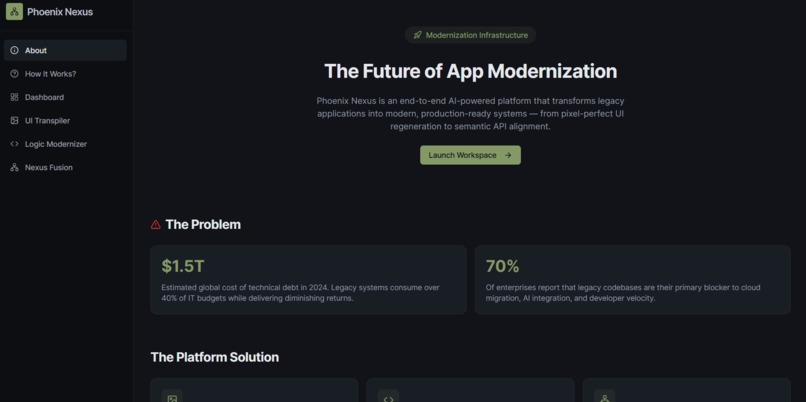
About Page
Phoenix Nexus: Rebirth Engine
About the Project
The Inspiration
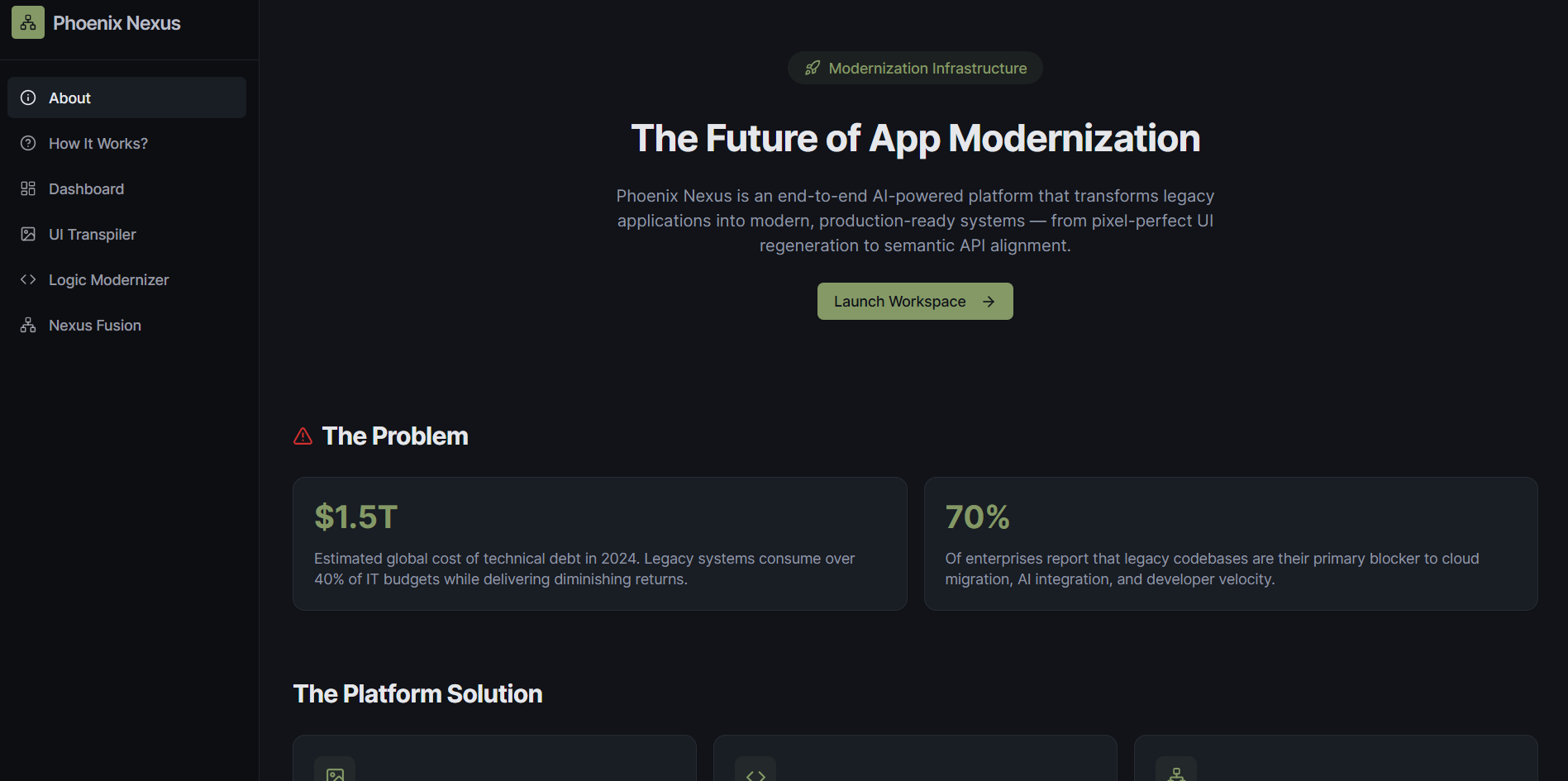
Software is eating the world, but legacy technical debt is slowing it down. Millions of core enterprise systems globally run on obsolete backends and fragmented, unmaintainable frontend codebases. Re-architecting these systems manually costs organizations billions of dollars and risks breaking critical business logic.
Phoenix Nexus: Rebirth Engine was inspired by a simple question: What if we could automate the architectural migration pipeline entirely? We built this platform to act as developer infrastructure—an AI-driven modernization ecosystem that seamlessly breathes new life into dead code, instantly transforming legacy fragments into unified, high-performance SaaS stacks.
The Problem It Solves
Engineering teams face a massive velocity crisis: up to 70%+ of enterprise IT budgets are consumed solely by maintaining legacy systems, creating a 10x slowdown in delivering new product features. The platform solves three core enterprise issues:
- Visual Decay: Legacy user interfaces are locked out of modern, responsive layouts and premium design frameworks.
- Architectural Stagnation: Outdated backend controllers are slow, synchronous, hard to test, and lack modern type-safety or automatic documentation.
- The Semantic Gap: When components are upgraded separately, the critical binding maps between UI elements and server routes break, requiring laborious human realignment.
Technical Architecture & Core Functionality
Phoenix Nexus divides this massive problem space into three distinct, interconnected platform modules, operating under a sleek, high-contrast dark palette featuring monochromatic slate panels and deep sage-green accents.
       +-----------------------------------------------------------+
       |                     LEGACY INGESTION                      |
       |     [ UI Screenshot / Markup ]    [ Monolithic Backend ]  |
       +-------------------+---------------------------+-----------+
                           |                           |
                           v                           v
               +-----------+-----------+   +-----------+-----------+
               |     UI TRANSPILER     |   |   LOGIC MODERNIZER    |
               |  Decomposes Visuals   |   |   Refactors Backend   |
               |  Generates Tailwind   |   |   Generates FastAPI   |
               +-----------+-----------+   +-----------+-----------+
                           |                           |
                           +-----------+---------------+
                                       |
                                       v
                           +-----------+-----------+
                           |     NEXUS FUSION      |
                           |   Heuristic Mapping   |
                           |   Micro-Frontend IO   |
                           +-----------------------+
1. UI Transpiler (/transpiler)
The vision-driven asset gateway. Users upload flat interface screenshots or outdated HTML files. An advanced multi-modal AI proxy layer analyzes the typography, spatial hierarchies, and original color landscapes. Instead of lazily mimicking our host platform's color themes, the engine elevates the source brand into a modern design system (such as edge-to-edge dark glassmorphism or clean neo-brutalism) using semantic Tailwind CSS utilities.
To prevent rendering layout jitter, the UI utilizes a strictly synchronized loading lifecycle. The custom sage-green spinner remains locked until the streaming pipeline completes, code blocks are isolated, and asset rows are written securely to the remote database. The resulting live preview is rendered inside an auto-scaling iframe wrapper using CSS transforms (transform-origin: top left), containing the preview entirely without clipping or leaking scrollbars.
2. Logic Modernizer (/modernizer)
The backend modernization engine. It ingests legacy backend code blocks and extracts their internal business workflows, converting them into fully decoupled, asynchronous, type-safe FastAPI web services. The generated layer introduces structured, self-documenting Pydantic validation schemas. Concurrently, it produces a deep-dive developer execution manual rendered inside a smoothly independent scrollable Markdown container.
The "What-If" Architectural Risk Simulator
Positioned as a full-width, IDE-terminal style container spanning the bottom of the workspace, this engine allows developers to interrogate their code transformations prior to deployment. When a developer inputs a structural change query, the simulator evaluates cascading impacts across the full execution route.
The report text is parsed line-by-line via a real-time Markdown-to-JSX tokenizer, separating responses into distinct card rows. High-risk vectors are instantly swapped with vibrant, color-coded ambient badges:
- (High Risk) instances are transformed into crisp crimson tags:
bg-red-500/10 text-red-400 border-red-500/20 - (Medium Risk) items are wrapped in warm amber shields:
bg-amber-500/10 text-amber-400 border-amber-500/20
To maintain an uncompromised development environment, the simulation history is lifted into global context and backed by a Supabase storage layer. If a developer navigates across workspaces to tweak an element and returns, the history hydrates instantly. The data maps newest-first, unshifting incoming responses to the absolute top of the feed with high-contrast text.
3. Nexus Fusion (/fusion)
The synchronization fabric of the platform. It uses cross-domain data contracts to map semantic hooks between the frontend and backend. When a backend FastAPI asset updates its endpoint schemas, the Fusion parser discovers the new signatures.
Inside the micro-frontend map, clicking a backend route card instantly emits a secure postMessage proxy call directly into the UI preview iframe. The frame captures the event payload, evaluates the targeted node, and flashes a highlighted outline around the corresponding interactive element in real time. This ensures a 100% verified full-stack link before pressing the final one-click deployment node.
Critical Architectural Rule: Nexus Fusion requires the asset fed into the UI Transpiler (the visual interface) and the code processed by the Logic Modernizer (the backend service) to originate from the same legacy system. Because the Fusion engine maps structural hooks, if the visual components do not contextually match the data model schemas, the semantic boundaries break down, and cross-frame event payloads will fail to find their matching interactive triggers.
Engineering with MeDo
Conversation Strategy & Structuring
Collaborating with MeDo required a highly strategic, iterative workflow to safely construct an 87-file ecosystem without accumulating code sprawl or breaking global hooks. The conversation structure followed an intentional, sequential pattern:
- Architecture Initialization: Mapping core states, database columns, and initial routing frames.
- Isolated Module Optimization: Focusing heavily on a single view (e.g., refining the Transpiler iframe scaling) before introducing the next complex subsystem.
- Consolidated Execution Pipelines: Combining multiple layout dependencies into single, targeted prompts to allow MeDo to evaluate structural conflicts (like top-and-bottom split IDE panels) in a single compiler pass.
- Targeted Feature Extractions: When features required removal or clean refactoring (e.g., stripping out the experimental Code Diff Engine), strict single-responsibility deletion commands were issued to preserve surrounding nodes.
- Global Production Protection: The final end-to-end review was secured using deep preservation guardrails, locking down our active regex heuristics, custom parsing blocks, and Supabase JSONB arrays from generic boilerplate overwrites.
The Most Impressive Feature Created
The crown jewel of the collaboration is the fully unified What-If Terminal Pipeline. Managing real-time data persistence alongside custom localized text tokens across multiple unmounting routes is notoriously difficult.
MeDo brilliantly integrated a custom line-by-line tokenizer inside a React-virtualized card wrapper. By capturing unstructured markdown layout returns, splitting them down on raw text breaks, wrapping lists into explicit Tailwind grid listings, and seamlessly overlaying high-contrast white text badges over risk tags without shifting line layouts, MeDo achieved an elite, native IDE-terminal experience.
// Architectural representation of the persisted simulation history entry
interface SimulationHistoryItem {
  id: string;          // Crypto-generated UUID
  query: string;       // User's architectural interrogation prompt
  riskReport: string;  // Line-by-line parsed Markdown string
  impactedNodes: string[]; // State-bound affected code paths
  timestamp: string;   // ISO-standard chronological tag
}
Leveraging Plugins and Extends
To achieve production quality, we deeply configured the platform across multiple external core frameworks:
- Supabase Storage & Data Layer: Utilized real-time serverless bindings and integrated a dynamic
JSONBarray schema matrix into the centralAssetstable. This allows individual rows to act as long-term historical time-series storage for system states. - Gemini 2.5 Flash Processing Matrix: Configured deep system text frames inside our serverless edge handlers. By embedding clear operational guidelines, the AI model behaves as an advanced code-refactoring machine, returning crisp code syntax, localized error bounds, and precise data models.
- Micro-Frontend Iframe Proxy: Extended standard browser sandboxing configurations using highly secure event loops. By building strict origin filters inside the window event listeners, our separate micro-frontends can securely trigger cross-frame highlight indicators without exposing the core window scope to unauthorized code injection.
Key Challenges & Lessons Learned
Challenges Faced
- Heuristic Mapping Shifts: During initial tests, refactored backend logic drifted away from frontend asset links because the AI generalized raw routes (e.g., mutating
/process_order_paymentto a generic/paymentsREST signature). We resolved this by modifying our parser mapping logic to intercept explicit function signatures directly from python decorators. - State Unmounting Amnesia: Moving between workspace tabs initially cleared active chat logs, which lowered the app's usability. We overcame this by shifting local terminal states out of component scopes and into global project context layers backed by persistent relational tables.
- Raw Markdown Visual Breakdown: Standard markdown render blocks consistently broke our layout parameters when dealing with deep nested code blocks or symbols. Building a dedicated linear block splitter fixed our styling parameters completely.
What We Learned
Building Phoenix Nexus reinforced that enterprise-grade AI applications are entirely dependent on strict data contracts. AI intelligence is incredibly powerful, but it requires structured pipelines, robust type boundaries, and explicit communication guardrails to become reliable developer infrastructure.
Through clean multi-module separation and defensive state synchronization, we succeeded in taking an incredibly complex, full-stack architectural design from an abstract concept to a stable, production-ready modernization engine. Phoenix Nexus is fully deployed, optimized for desktop and mobile devices, and ready to erase technical debt!
What's next for Phoenix Nexus
With the core infrastructure of the Phoenix Nexus: Rebirth Engine fully modernized, optimized, and ready for deployment, the foundational pipeline is rock-solid. To scale this from a successful hackathon project into a dominant enterprise-grade SaaS infrastructure product, the roadmap focuses on deepening its architectural capabilities and expanding its operational footprint.
Here is what is on the immediate horizon for Phoenix Nexus:
1. Advanced Structural Refactoring Engines
While translating legacy visual layouts to Tailwind CSS and backend functions to async FastAPI endpoints solves immediate modernization roadblocks, enterprise code bases often suffer from deeper structural design flaws.
- Monolith-to-Microservices Decomposition: Future iterations will feature an automated decomposition layout. Instead of refactoring code blocks into a single flat service file, the analyzer will map out complex logic blocks using domain-driven design principles, automatically separating tight monolithic classes into independent, Docker-ready microservices.
- Abstract Syntax Tree (AST) Type Inference: We plan to implement deep AST semantic analysis layers. This will allow the platform to inspect completely untyped, older languages (like legacy Python 2 or raw PHP/JS) and infer precise, production-grade static types, mapping complex multi-layered objects directly to strict TypeScript interfaces and Pydantic models with minimal human oversight.
2. Deepening the Nexus Fusion Engine
The current micro-frontend communication gateway allows for high-fidelity endpoint-to-UI highlighting via postMessage proxy loops. The next evolution will make this integration completely bi-directional and fully automated.
- Autonomous E2E Test Suite Generation: Once Nexus Fusion traces the semantic boundaries matching frontend action triggers to your new backend API endpoints, it will automatically synthesize ready-to-run End-to-End (E2E) integration testing suites using frameworks like Playwright or Cypress.
- Live Schema Invariant Enforcement: By continuously listening to network payload structures within the preview sandbox, the Fusion engine will dynamically flag breaking data changes in real time. If a developer alters a Pydantic payload field inside the Logic Modernizer, the system will instantly highlight the exact frontend components that will experience runtime exceptions due to the missing property.
3. High-Fidelity Simulator Enhancements
The "What-If" Architectural Risk Simulator currently tracks cascading dependencies across historical local runs. We aim to supercharge this terminal interface into an predictive forecasting workspace.
- Big-O Performance Modeling: In addition to highlighting compliance and business logic risks (High/Medium Risk badges), the simulation engine will analyze loop depths, recursive calls, and database query layouts to calculate mathematical algorithmic complexity ($O(n)$ notation). It will warn developers if a refactored endpoint introduces structural latency hazards or database N+1 performance bottlenecks.
- Localized LLM Orchestration Layer: To support strict enterprise privacy compliance frameworks, we plan to enable toggleable offline processing. Teams will be able to switch the AI translation proxy from cloud endpoints to localized open-weight foundational models executing entirely within a secure, air-gapped container environment.
4. Collaborative Lifecycle Operations
To transition Phoenix Nexus into an active, day-to-day team workspace, we will build out collaborative development lifecycle modules directly above our persistent Supabase data streams.
- Time-Travel Architectural Version Control: Leveraging our current sequential JSONB
simulation_historydata structure, we will introduce a Git-style timeline visualization. Teams will be able to step backward and forward through different iteration loops of their modernized assets, comparing structural risk profiles side-by-side. - Interactive Multi-User Code Canvas: Introducing real-time collaborative editing sessions where multiple architects can simultaneously review transpiled frontend elements, execute concurrent simulator interrogations, and approve unified API data contracts prior to triggering the final cloud deployment phase.

Log in or sign up for Devpost to join the conversation.