Inspiration
A new travel experience. Redefining inclusivity. Highlighting accessibility. Playing smarter. 🌟
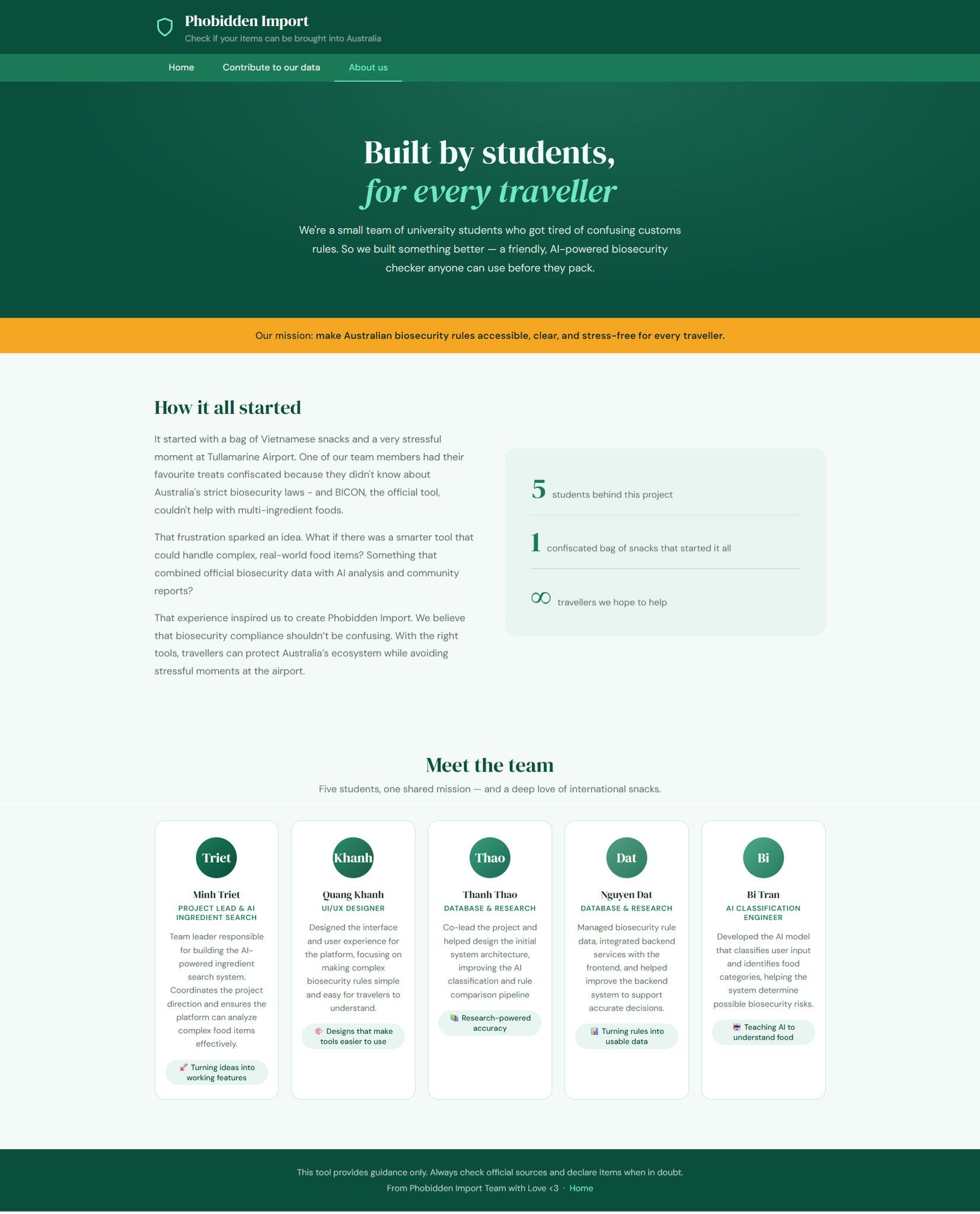
It started with a bag of Vietnamese snacks and a high-stress moment at Tullamarine Airport. One of our team members watched their favorite treats get confiscated, not out of a desire to break the rules, but because they simply couldn't navigate Australia’s strict biosecurity laws. The official tool, BICON, is built for experts—it isn't designed to handle the reality of multi-ingredient cultural foods or the confusion of a language barrier.
That frustration sparked a mission: Why should flavor be limited by confusion? We realized that traditional accessibility often falls short in capturing the diversity of what travelers actually carry. If biosecurity is about protecting our home, it should be an inclusive process that everyone can participate in with confidence.
That’s when we went on Phobidden Imports. We’ve created a system that connects people to the rules—regardless of their English level or technical knowledge. By combining official data with AI analysis and community reporting, we’re ensuring that everyone has a fair seat at the table (and a full suitcase) when they land. Because at the end of the day, protecting our ecosystem should be simple, and fun is for everyone.
What it does
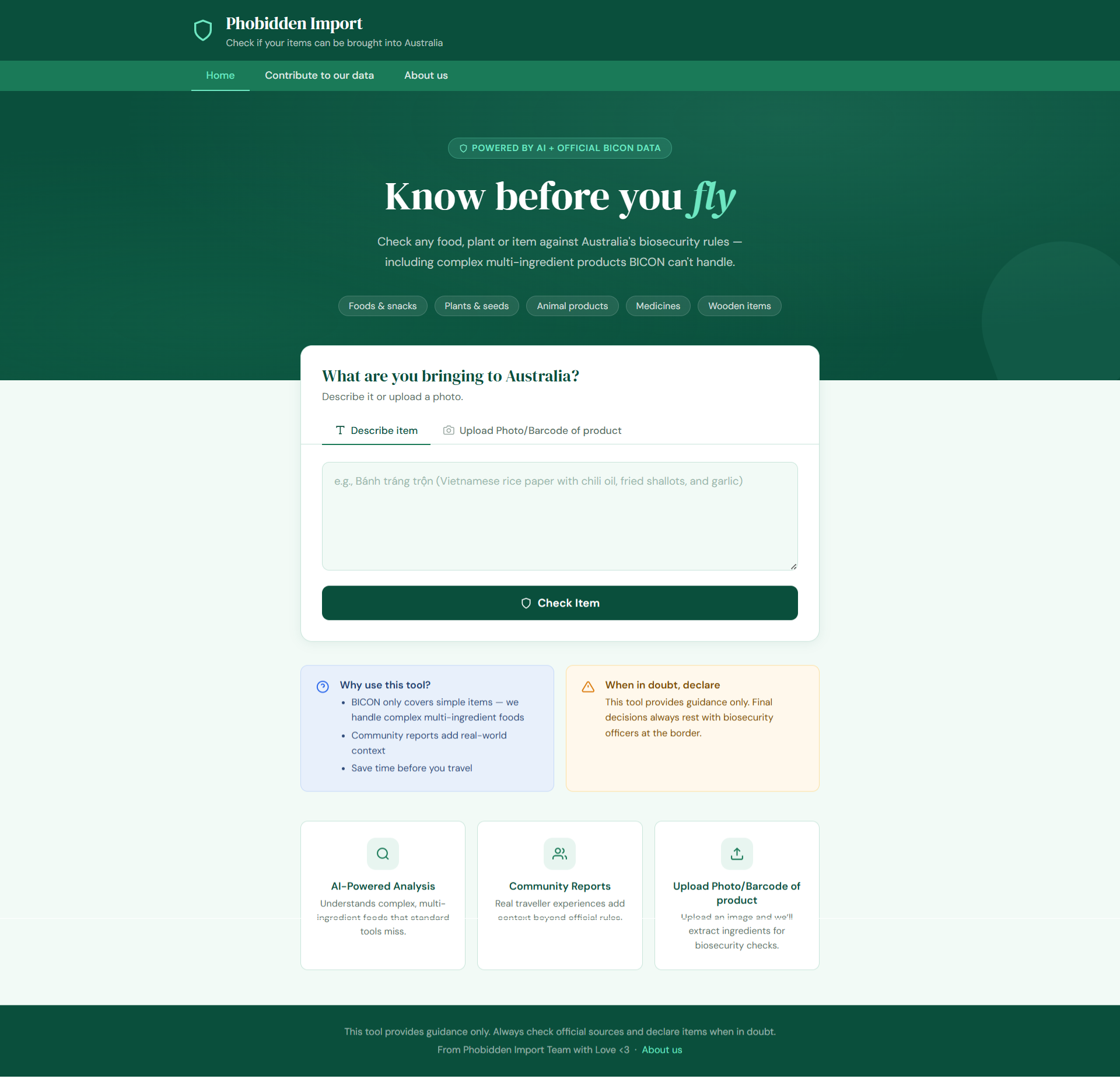
Phobidden Imports acts as a "Biosecurity Translator."
🔹AI Deconstruction: Users upload a photo or description of a product. Our AI analyzes the packaging and breaks it down into individual ingredients.
🔹Risk Mapping: It cross-references these ingredients against biosecurity categories to provide a simplified classification: Allowed, Declare, or Prohibited.
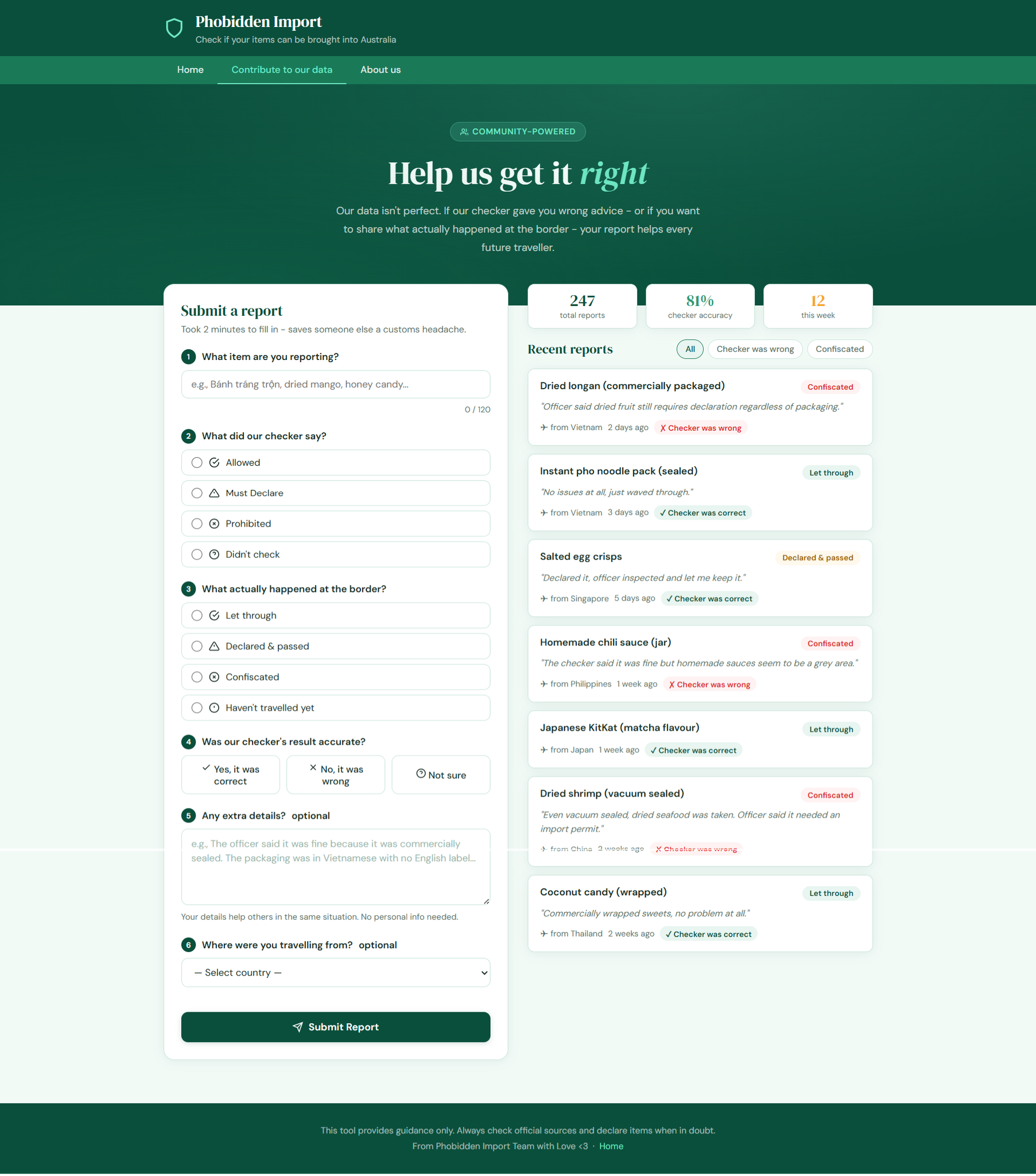
🔹Social Reports: A “Community Clearance” percentage could be developed later to show how often other users were successfully allowed to bring similar items through customs.
🔹Accessibility: By focusing on visual inputs and simple language, we help travelers who may struggle with English technical terms avoid accidental fines.
How we built it
🔹 Frontend: Built with HTML, CSS, and JavaScript for a responsive, mobile-first experience that travelers can use on the go.
🔹Backend: Powered by Python and Flask, handling the logic between user inputs and our data models.
🔹AI Engine: We utilized an LLM-based system to understand images and extract ingredients from product labels, and an LLM-based classifier to map those ingredients against biosecurity risk categories. The final verdict is determined by a deterministic rule engine that applies official Australian biosecurity rules, ensuring consistent and auditable results.
🔹Database: A curated vector database of biosecurity rules to allow for fast, "fuzzy" matching of ingredient names to official categories.
Challenges we ran into
During development, our primary challenge was bridging the gap between AI-driven predictions and the strict, binary nature of Australian biosecurity laws. We realized that raw AI output often fails to distinguish between complex legal exceptions, such as the difference between a standard biscuit and a restricted cheesecake. To solve this, we implemented a custom Priority-Based Rules Engine that uses AI for data extraction while our logic layer makes the final decision. Additionally, we had to harmonize data from heterogeneous sources, merging structured barcode data from Open Food Facts with unstructured image analysis from Gemini. We overcame this by developing a Unified Boolean Schema, forcing all inputs into standardized biosecurity flags. Finally, we addressed the lack of English metadata for niche Vietnamese snacks by utilizing Gemini’s contextual intelligence to normalize cultural ingredients and map them directly to official BICON risk categories.
Accomplishments that we're proud of
🧠Multi-Ingredient Analysis in Real Products
One feature we are especially proud of is our Multi-Ingredient Analysis. Many food products contain a mixture of ingredients that fall under different biosecurity rules, making them difficult to evaluate quickly. Our system analyzes each ingredient individually and provides a more accurate recommendation instead of a simple “Yes” or “No.” For example, we tested the system with a Vietnamese product like the one shown above—a jar from “Chị Tròn” containing items such as dried seafood and chili sauce. The app was able to successfully detect and categorize the ingredients, identifying which ones are allowed and which ones may need to be declared at the border. Seeing the system correctly analyze a complex, real-world product like this was a huge milestone for our team.
📷Image-Based Product Checking
We’re also proud of how users can simply upload a product image or barcode and quickly receive useful information. The system analyzes the product and matches it with our database to help travelers understand Australia’s strict biosecurity rules before arriving at the airport. This makes the process faster and much easier than manually searching through government websites.
🎨Simple and Clear User Experience
We put effort into designing an interface that is clean, intuitive, and easy to use, especially for international travelers who may not be familiar with Australia’s biosecurity regulations. Users can quickly upload an image, view ingredient analysis, and see clear guidance on what to declare.
🤝Teamwork and Learning
Finally, we’re proud of how our team collaborated throughout the hackathon. Within a short amount of time, we went from an idea to a working prototype with AI analysis, a database system, and a user-friendly interface. Each member contributed to different parts of the project, and working together under time pressure helped us learn a lot.
What we learned
🔹The Power of AI in Translation:We learned that AI isn't just for generating text; it’s a powerful tool for translating concepts—in this case, translating legal biosecurity rules into everyday kitchen language.
🔹User-Centric Design: We realized that for biosecurity, "perceived risk" is just as important as the actual rule. Adding community reporting helped reduce the "customs anxiety" that many of our team members have felt personally.
🔹Parallel Development:Working in a hackathon environment taught us how to build the AI backend and the UI frontend simultaneously by agreeing on strict API specifications early on.
What's next for Phobidden Imports
We are just scratching the surface of global travel. Our next steps include:
🔹Barcode Integration: Connecting to the Open Food Facts API to instantly pull ingredient data without needing a clear photo of the label.
🔹Expanded Jurisdictions: Adapting the logic for other countries with strict biosecurity, such as New Zealand and Japan.
🔹*Social Reports: * Providing a "Community Clearance" percentage, showing how often other users were successfully allowed to bring similar items through customs.
🔹Official Collaboration: Exploring ways to integrate with official government APIs to provide even more "official" peace of mind for travelers.
Built With
- css
- flask
- google-gemini-api
- html
- javascript
- open-food-facts-api
- python


Log in or sign up for Devpost to join the conversation.