-
-
insights
-
research
Inspiration
HerPattern started from seeing how women close to me struggled with reproductive health conditions that were difficult to predict and manage. One friend has endometriosis and recently underwent surgery after living with recurring pain and uncertainty. Another friend experienced an ovarian cyst during pregnancy and eventually delivered by C-section.
Their experiences showed me that symptoms are rarely simple or consistent. Pain, fatigue, sleep, stress, medication, and cycle changes can interact differently from one day to the next. Many women collect this information, but they still receive very little help understanding what may happen tomorrow.
I wanted to explore whether daily health data could become something more useful: an early signal that helps women plan their day and gives researchers a clearer view of individual symptom patterns.
What it does
HerPattern is a personalized symptom-forecasting platform for people living with endometriosis and related hormonal health conditions.
Users record daily information such as pain, fatigue, sleep, stress, cycle phase, medication, and other symptoms. HerPattern analyzes these patterns and estimates the user’s likely symptom burden for the following day.
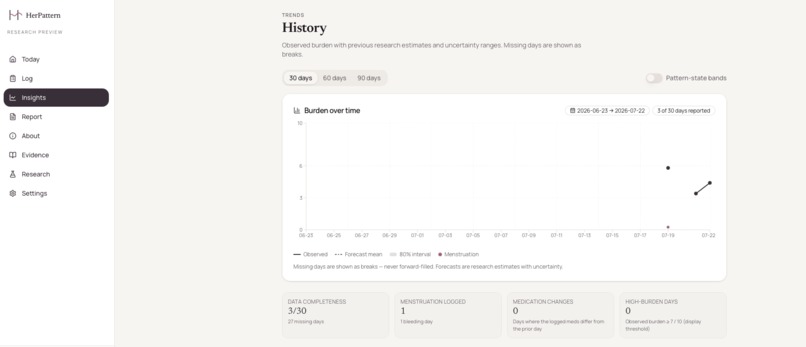
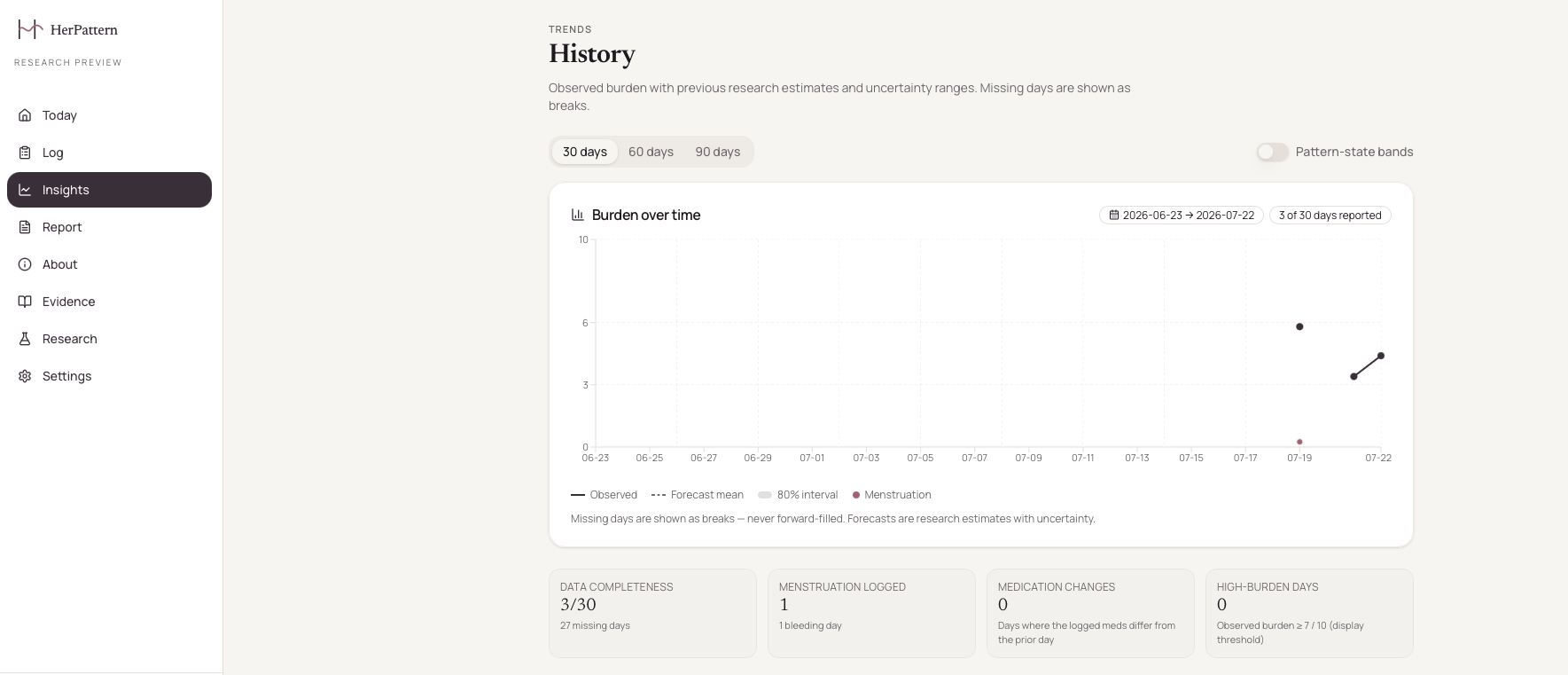
Instead of presenting a single overconfident prediction, it shows uncertainty and explains which recent factors may have influenced the forecast. The platform also includes trend visualization, symptom-state tracking, research insights, and voice-based summaries.
HerPattern is designed as a planning and research-support tool, not as a diagnostic system or a replacement for professional medical care.
How we built it
We built the application interface and user journey with Lovable, focusing on making daily tracking fast, calm, and understandable.
The forecasting design combines:
- Hierarchical Bayesian autoregression for personalized predictions, partial pooling, and uncertainty estimates.
- A switching state-space model for identifying transitions between lower, moderate, and higher symptom-burden states.
- CatBoost as a practical nonlinear benchmark for tabular health data.
The platform uses OpenAI for understandable explanations and ElevenLabs for optional voice summaries. The system was designed to separate model output from user-facing language so that predictions remain transparent and are not presented as medical conclusions.
Challenges we ran into
The largest challenge was working with limited and highly individual health data. Endometriosis symptoms differ significantly between people, and one person may also experience very different symptoms across time.
We therefore had to avoid building a generic model that assumes every user follows the same cycle or symptom pattern. We focused on personalization, uncertainty ranges, and honest communication when the available data is insufficient.
Another challenge was translating complex statistical outputs into information that feels useful without becoming alarming or misleading. We had to balance technical depth with a simple experience that people could realistically use every day.
We also worked under strict hackathon time and resource constraints, which required us to prioritize the strongest end-to-end experience rather than attempting to build every possible feature.
Accomplishments that we're proud of
We are proud that HerPattern goes beyond being another symptom diary. It turns repeated daily entries into personalized forecasts, symptom-state insights, and understandable explanations.
We created a complete product flow from symptom logging to next-day forecasting, uncertainty visualization, and voice-based summaries.
We are also proud that the platform treats uncertainty as an important part of the experience rather than hiding it. In women’s health, a responsible prediction should communicate what the model knows, what it does not know, and how much confidence a user should place in the result.
Most importantly, we built something inspired by real people and real experiences rather than starting from technology alone.
What we learned
We learned that personalization is essential in women’s health. A model trained only on population averages can easily miss the patterns that matter most to an individual.
We also learned that uncertainty can be useful when it is explained clearly. Users do not necessarily need a perfect prediction. Even a careful indication that tomorrow may be a higher-burden day could help someone adjust work, exercise, travel, or rest.
Finally, we learned that responsible health technology requires more than an accurate model. It also requires thoughtful language, privacy, explainability, and clear boundaries between supportive insights and medical advice.
What's next for HerPattern
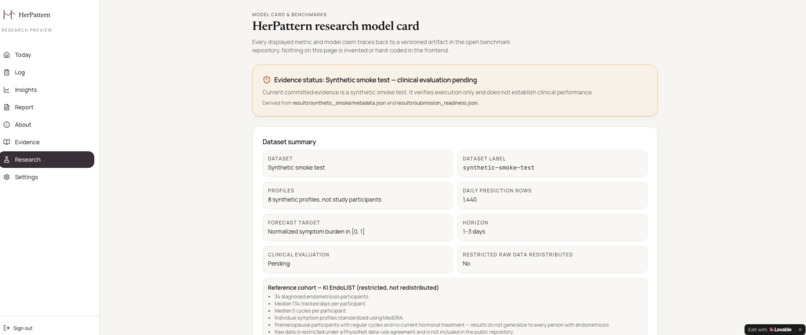
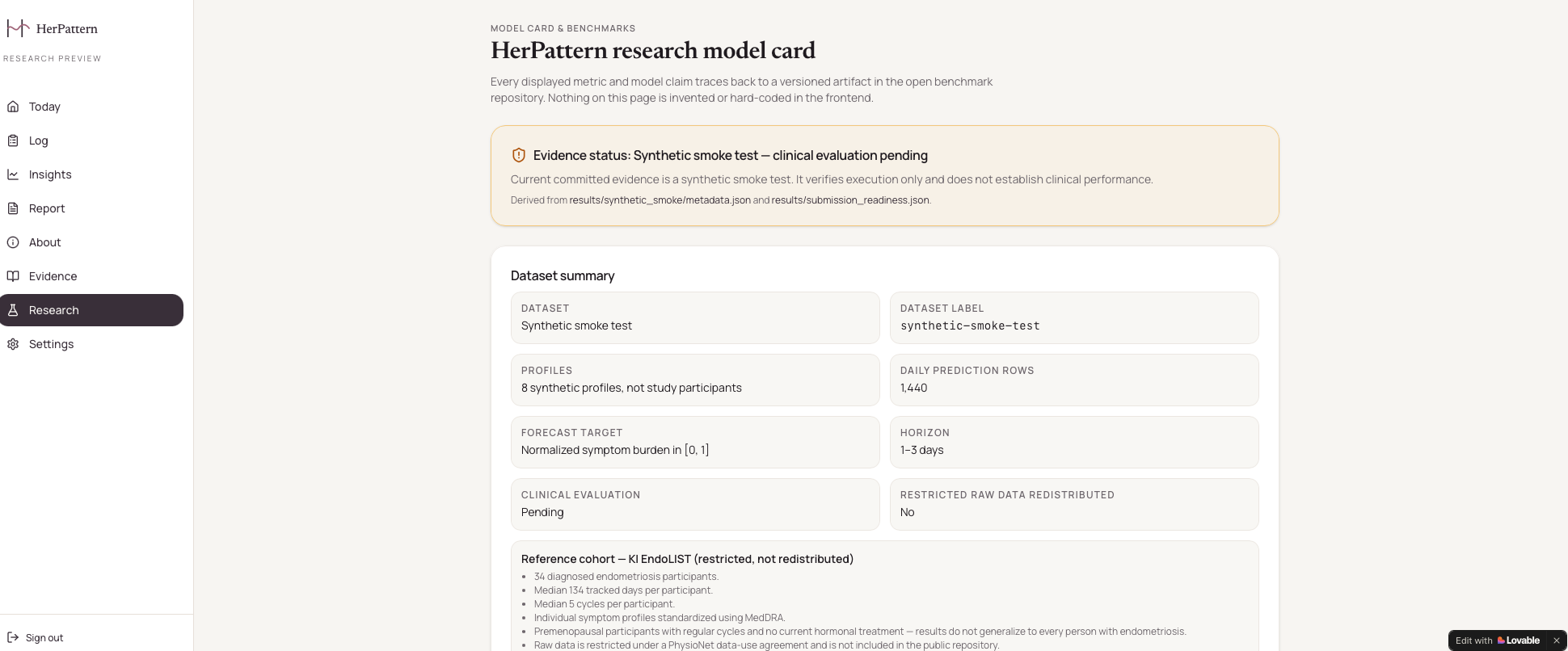
The next step is to validate HerPattern with larger, ethically sourced longitudinal datasets and measure forecasting performance across different symptom profiles.
We also want to collaborate with patients, clinicians, and researchers to improve the daily tracking experience and determine which insights are genuinely useful.
Future versions could support additional conditions involving recurring or fluctuating symptoms, while keeping each model condition-specific and carefully validated.
Our longer-term goal is to create an open, transparent benchmark for personalized women’s health forecasting and help turn everyday symptom data into evidence that supports better research, better conversations, and more informed daily planning.
Built With
- lovable
- sol

Log in or sign up for Devpost to join the conversation.