Inspiration
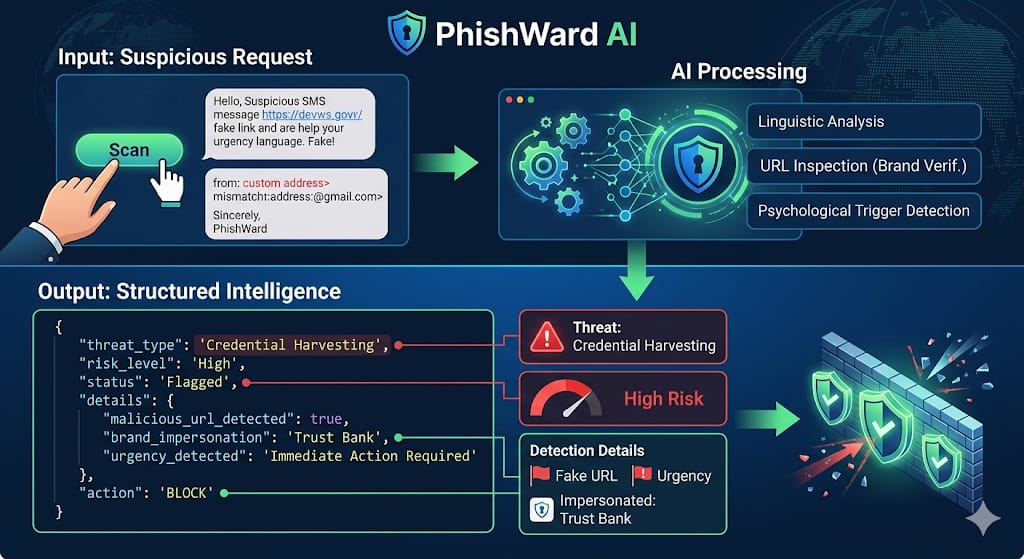
Phishing attacks are becoming increasingly sophisticated, often bypassing traditional filters by exploiting human emotions. We were inspired to bridge this gap by creating an AI that doesn’t just look at URL reputation, but understands the psychological tactics behind scams. ## What it does PhishWard AI is an intelligent security agent that analyzes suspicious links and messages in real-time. It detects brand impersonation, urgent threats, and social engineering traps, providing structured JSON insights to stop attacks before they occur. ## How we built it We utilized the Google Agent Platform and Gemini 3.5 Flash for high-speed, deep reasoning. The system is architected to perform multi-layered analysis: inspecting URL structures, linguistic patterns, and psychological triggers, outputting the final security verdict in a machine-readable format. ## Challenges we ran into The biggest challenge was ensuring low latency while performing deep semantic analysis. Balancing high-accuracy threat detection with the speed required for a real-time security agent tested our ability to optimize AI prompts and structure the logic flow efficiently. Accomplishments that we're proud of We are proud of building a system that successfully identifies subtle social engineering tactics often missed by standard filters. Implementing a robust, structured JSON output that is ready for enterprise-grade API integration is a major milestone for us. ## What we learned We learned how to effectively leverage high-speed reasoning models for security applications. This project taught us that AI's true power lies in its ability to understand context, not just data points—a critical skill for modern cybersecurity. ## What's next for PhishWard AI We plan to expand PhishWard AI into a browser extension for seamless, real-time browsing protection. Future iterations will include automated mobile SMS alerts and a community-driven intelligence dashboard to crowdsource threat data.

Log in or sign up for Devpost to join the conversation.