Inspiration
Phishing remains one of the most widespread attack vectors targeting both individuals and organizations. While exploring cybersecurity cases, I noticed a recurring pattern: users don’t fail because they are careless, they fail because phishing attacks are designed to mimic trust. This sparked the idea for PhishShield AI — a system that can recognize phishing attempts in real-time using machine learning, instead of relying solely on outdated blocklists.
What it does
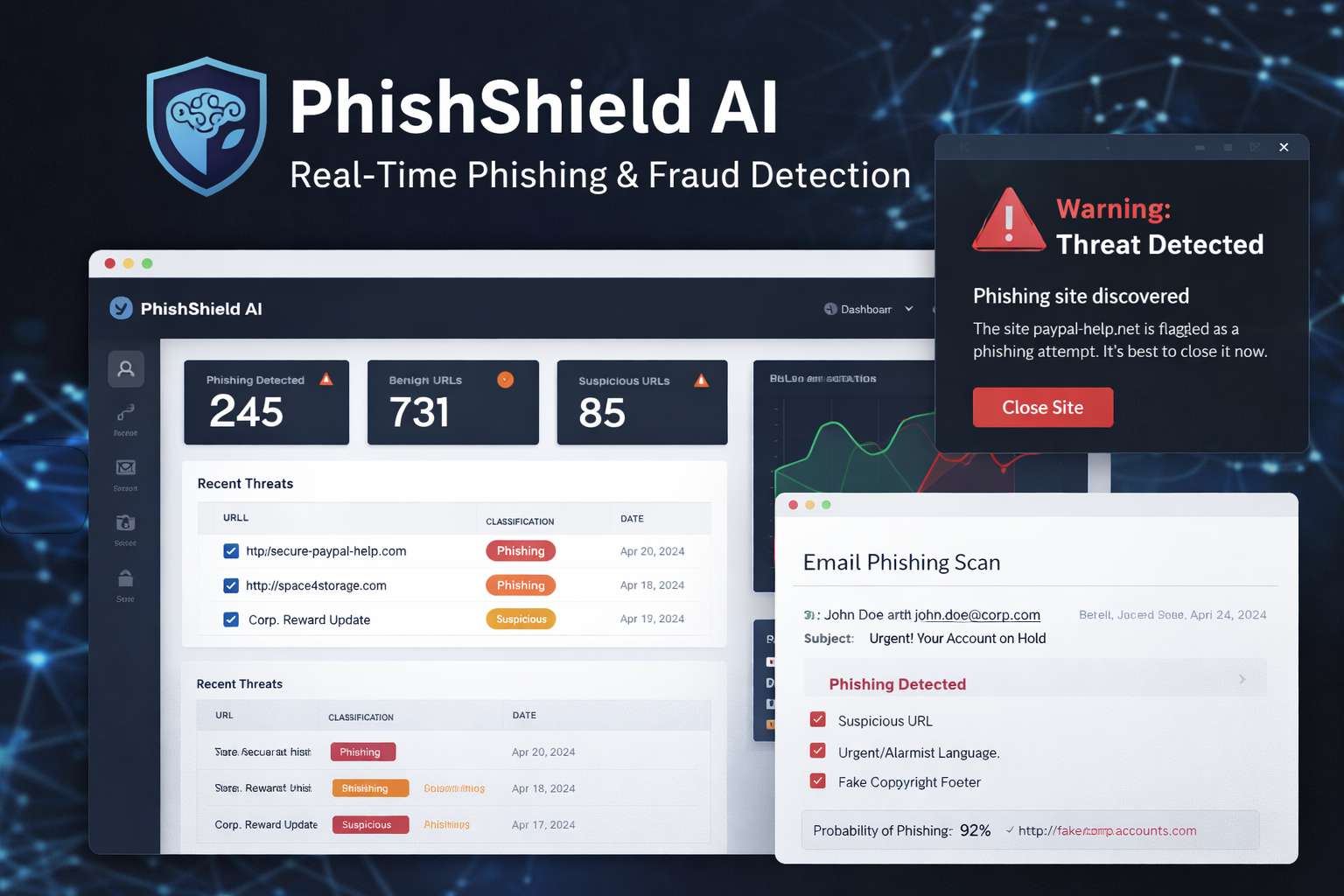
PhishShield AI analyzes URLs, website content, and metadata to classify suspicious activity and detect phishing attempts in real-time. Users or applications can submit URLs or email content to the system, and PhishShield returns:
Probability of phishing
Classification labels (benign / suspicious / phishing)
Key features influencing the decision
Threat logs for review It essentially acts as an AI-driven safety layer that reduces the chance of successful phishing attacks.
How we built it
We developed PhishShield AI as a multi-stage detection pipeline:
Data Collection
Aggregated phishing samples from open threat intel feeds, phishing databases, and email dumps
Collected benign samples from trusted domains for balance
Feature Engineering
URL lexical features (length, tokens, special characters, entropy)
Host-based features (DNS age, SSL certificate, WHOIS info)
HTML/DOM features (forms, scripts, redirects)
NLP/Content features from page text
Model Training
Tested ML models like Logistic Regression, Random Forest, SVM, XGBoost
Tuned hyperparameters and thresholding to reduce false positives
Real-Time Scanning API
Wrapped the model in a lightweight API for on-demand scanning
Added caching + async calls to optimize performance
Dashboard UI (optional depending on your actual build)
Displayed classification logs, model performance metrics, and detection history
Challenges we ran into
Some of the main challenges during development were:
Data Imbalance: phishing samples are far fewer than benign ones, causing skewed training
Evasion Techniques: attackers frequently rotate domains and use HTTPS to appear legitimate
Latency Constraints: real-time inference requires fast processing and caching strategies
Feature Diversity: combining URL, NLP, and HTML data into one pipeline adds complexity
Threshold Tuning: too many warnings reduce usability, too few reduce protection
Accomplishments that we're proud of
Built a functioning phishing detection system using machine learning
Successfully integrated multiple feature extraction techniques (URL + HTML + NLP)
Achieved strong precision/recall performance during testing
Designed a clean inference pipeline for real-time usage
Gained real-world insight into how phishing attacks are engineered
What we learned
While working on PhishShield AI, we learned:
How real phishing campaigns operate and how they evolve
How to clean, balance, and label real-world datasets
Practical ML workflow: preprocessing → modeling → evaluation → deployment
The importance of usability and low false-positive rates in security tools
How cybersecurity + machine learning can complement each other
This project also demonstrated that threat prevention is not just technical — it’s psychological, because attackers exploit trust, not just technology.
What's next for PhishShield AI: Real-Time Phishing & Fraud Detection
Here are the future improvements planned:
Browser Extension: Real-time scanning while users browse the web
Email Integration: Automatic scanning on incoming messages (IMAP/Gmail/Outlook)
Threat Intelligence Feeds: Integration with domain/IP reputation services
Visual Similarity Detection: Compare page appearance to known brand login pages
Model Retraining: Continuously update with fresh phishing campaigns
Enterprise API: Offer detection-as-a-service for apps and SOC teams
The long-term goal is to turn PhishShield AI into a practical security layer that protects everyday users and businesses from phishing, credential theft, and online fraud.
Built With
- beautiful-soup
- dnspython
- docker
- flask/fastapi
- git
- html-parser
- numpy
- pandas
- python
- requests
- scikit-learn
- whois
- xgboost

Log in or sign up for Devpost to join the conversation.