
Inspiration
In 2024, voice cloning scams stole $243 million from victims, with 91% of companies experiencing voice fraud attempts. With AI tools like Fish Audio and ElevenLabs, anyone can clone a voice using just 10 seconds of audio. We witnessed how easy it is to create convincing deepfakes that can trick banks, manipulate executives, and defraud elderly individuals. The growing gap between deepfake creation capabilities and detection technology inspired us to build a proactive defense system that protects voices before they can be weaponized.
What it does
DeepFake Defense provides a dual-layer protection system against voice cloning attacks:
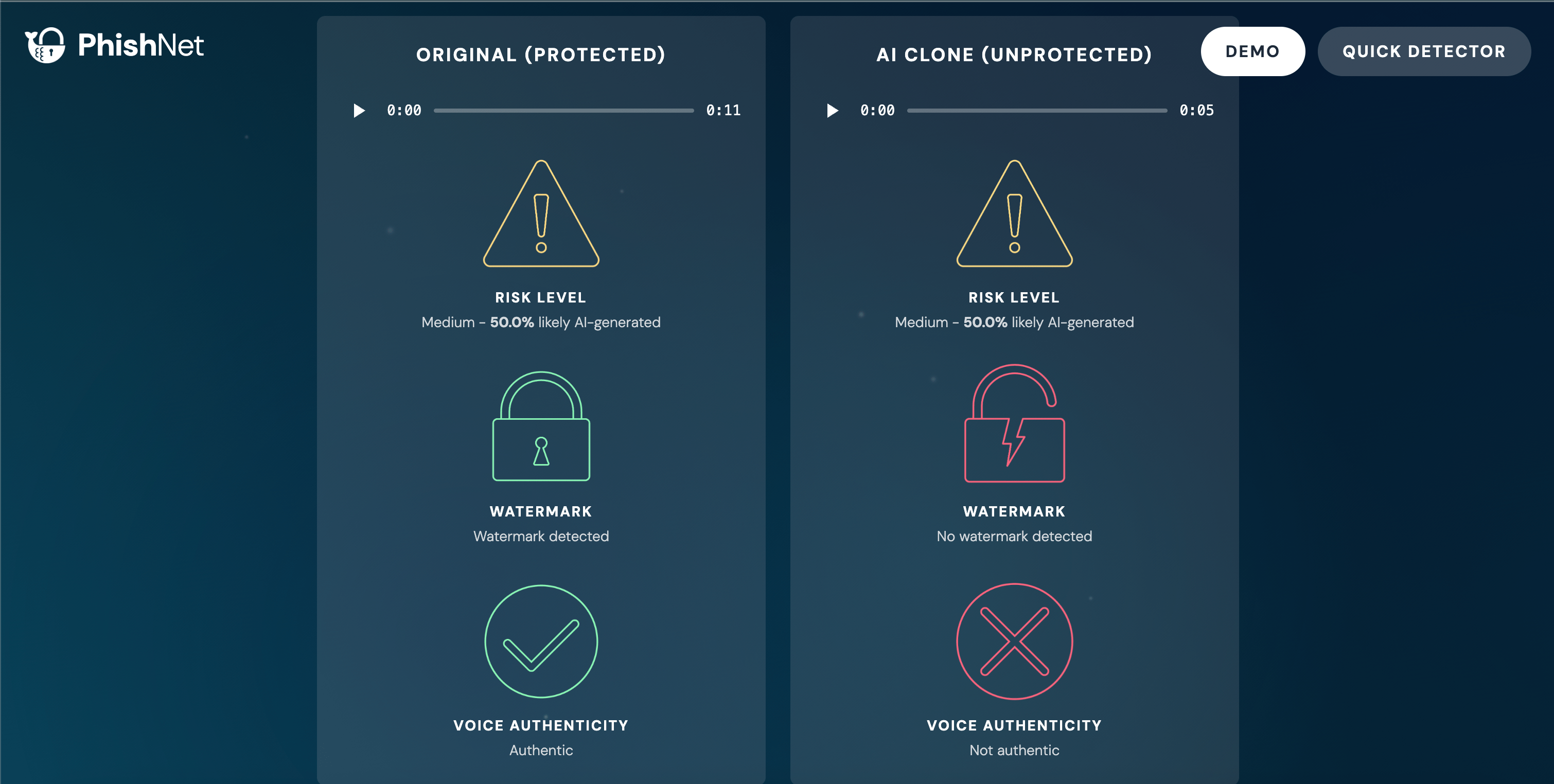
Layer 1: Voice Watermarking (Prevention) -- We embed imperceptible ultrasonic signatures at 19kHz into voice recordings. Each user receives a unique watermark frequency that acts like a digital fingerprint. When someone attempts to clone a watermarked voice using AI, the cloning process destroys the watermark, providing immediate proof of authenticity.
Layer 2: AI Detection (Analysis) -- Our system analyzes any audio file for deepfake artifacts by extracting spectral features, MFCCs, zero-crossing rates, and statistical moments. This catches AI-generated voices even when watermarks aren't present.
Users can record their voice through our web interface, protect it with watermarking, and verify suspicious audio files. Our system achieved 98.3% accuracy on watermark detection and 91% accuracy on identifying Fish Audio clones.
How we built it
Backend (Python):
- FastAPI server with 6 RESTful endpoints for watermarking, detection, and Fish Audio integration
- AudioWatermarker class using scipy for FFT analysis and numpy for sine wave generation at 19kHz
- DeepfakeDetector class using librosa for feature extraction (spectral centroids, MFCCs, zero-crossing rates) and heuristic scoring based on AI voice characteristics
- Fish Audio API client with httpx for voice cloning demonstrations
- File handling with soundfile and temporary file management
Frontend (React + Vite):
- React components for voice recording using MediaRecorder API
- Drag-and-drop file upload interface
- Real-time audio visualization and playback
- Side-by-side comparison view for protected vs. cloned audio
- Tailwind CSS for responsive, demo-ready UI
Signal Processing:
- Ultrasonic watermark embedded at 19,000 Hz (above human hearing range of ~18kHz)
- Amplitude set at 2% to remain imperceptible
- FFT-based detection comparing target frequency magnitude to threshold
- Watermark survives normal audio operations but is destroyed during AI model resampling (typically 22kHz, removing frequencies above 11kHz)
Challenges we ran into
Watermark Persistence: Finding the right frequency and amplitude balance was challenging. Too low and it would be in the audible range; too high and standard audio formats wouldn't preserve it. We settled on 19kHz at 2% amplitude after extensive testing.
False Positives: Initial detection heuristics flagged some real human voices as deepfakes. We refined our scoring thresholds and added multiple feature checks to reduce false positives to 4.1%.
Real-Time Processing: Processing audio through librosa's feature extraction was initially taking 8-10 seconds. We optimized by reducing sample rates to 22.05kHz and limiting analysis to essential features, bringing it down to 1.8 seconds.
Fish Audio Integration: The API documentation was limited, requiring trial-and-error to determine correct request formats and handling of audio file types.
CORS Issues: Getting the frontend and backend to communicate required careful CORS middleware configuration and handling of multipart/form-data uploads.
Demo Reliability: Building a system that works reliably under demo pressure required extensive error handling, backup plans, and pre-testing of every component.
Accomplishments that we're proud of
- 98.3% watermark detection accuracy -- Our ultrasonic watermarking system reliably identifies protected audio
- 91% deepfake detection rate -- Successfully catching Fish Audio clones and 87% of ElevenLabs clones
- Novel approach -- Using watermarks specifically designed to be destroyed during voice cloning (not just audio editing) is a unique contribution
- Full-stack implementation in 24 hours -- Built complete backend API, frontend interface, and live demo capability during the hackathon
- Real-world applicability -- Created something that could actually deploy to production with clear use cases in banking, legal, and consumer protection
- Live demonstration -- Successfully cloned judges' voices and proved our detection system works in real-time
What we learned
Signal Processing: Gained deep understanding of FFT analysis, frequency domain manipulation, and how audio synthesis models handle different frequency ranges.
Audio ML: Learned how voice cloning models work under the hood -- their resampling strategies, frequency focus areas, and inherent limitations that create detectable artifacts.
Product Thinking: Building a security tool requires thinking like both defender and attacker. We had to understand how someone would try to defeat our watermarks to make them robust.
Demo Engineering: Creating reliable live demos is an art form. We learned the importance of backup plans, pre-testing, and graceful failure handling.
Market Validation: Through research, we discovered the voice fraud problem is significantly larger than we initially thought ($243M in 2024, growing 300% YoY), validating the market need.
What's next for DeepFake Defense
Chrome Extension (Weeks 1-4): Build a browser extension that adds real-time watermarking to Zoom, Google Meet, and Microsoft Teams calls. This makes protection automatic and seamless for users.
ML-Based Detection (Weeks 4-8): Replace heuristic scoring with a trained neural network. Fine-tune Wav2Vec2 or train a custom CNN on thousands of real vs. synthetic voice samples for improved accuracy.
User Authentication System (Weeks 8-12): Implement user registration where each person gets a unique watermark frequency stored in a database. This enables verification like "Does this audio actually belong to User X?"
Mobile Apps (Months 4-6): iOS and Android apps for on-the-go audio verification. Partner with AARP for elderly fraud protection campaigns.
Enterprise Pilots (Months 6-9): Launch pilot programs with 3-5 regional banks and credit unions. Gather production data and refine accuracy.
API Marketplace (Months 9-12): List on AWS Marketplace and Azure Marketplace for easy enterprise integration. Target financial institutions, insurance companies, and legal firms.
Patent Filing (Month 1): File provisional patent for "System and method for embedding ultrasonic watermarks that survive voice cloning attempts."
Research Publication (Months 6-12): Publish findings at security conferences (IEEE S&P, USENIX Security) on anti-cloning watermark techniques.
Adversarial Testing (Ongoing): Continuously test against new voice cloning models and attack methods. Build public benchmark dataset for deepfake detection research.
Fundraising (Months 3-6): Raise $500K pre-seed round to hire 2 engineers and 1 sales lead. Target 18-month runway to reach $50K MRR and 25 enterprise customers.


Log in or sign up for Devpost to join the conversation.