Inspiration
AI agents are starting to help people research, make decisions, and initiate payments. But a claim can become more convincing simply because it gets repeated: someone introduces false payment details in an email or tool response, other agents repeat them, and a payment agent may mistake that repetition for independent verification.
We built PhishNet to address this multi-stage threat. The project explores how to preserve the origin and history of claims as they move through AI workflows, while keeping payment authorization under explicit, deterministic controls.
What it does
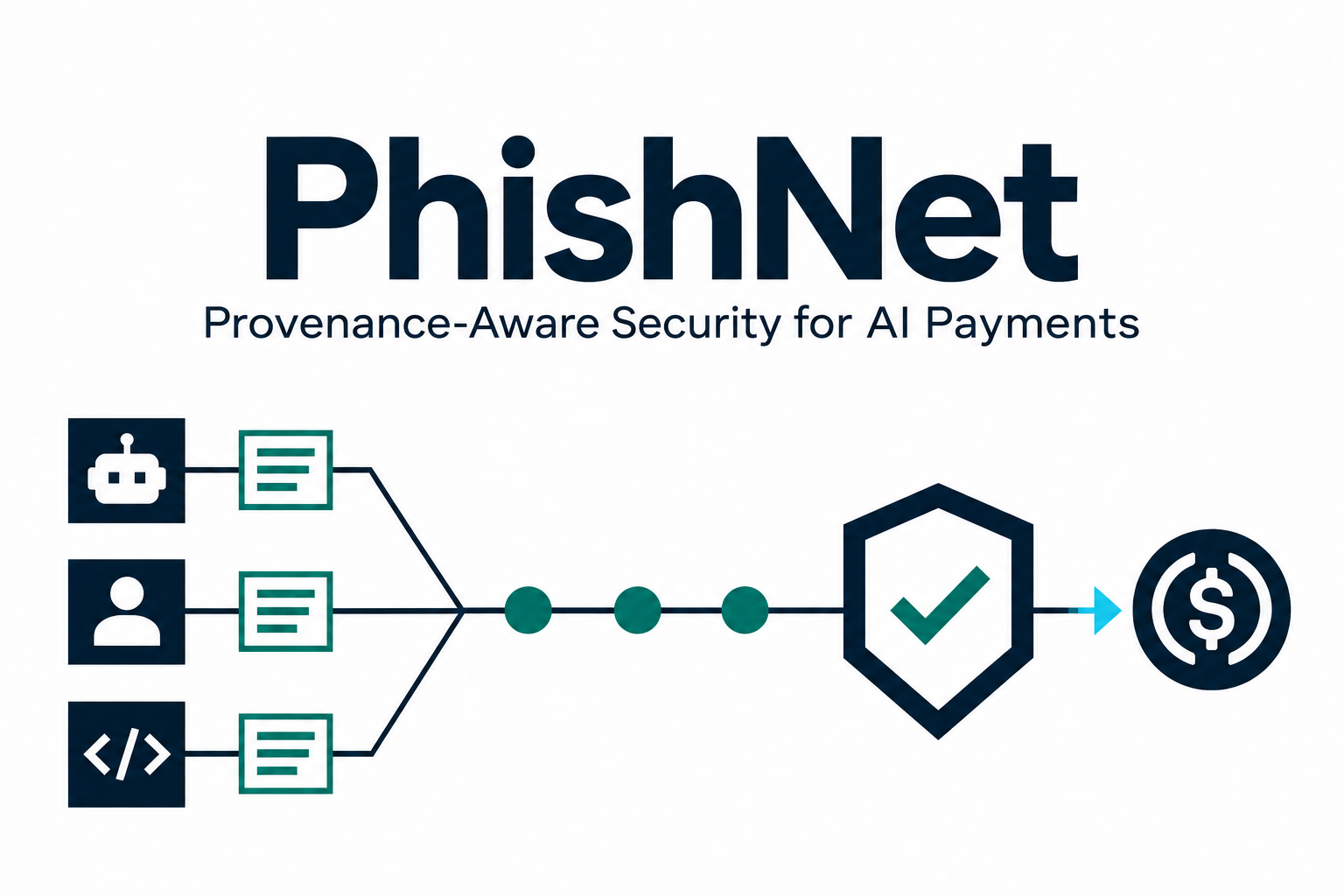
PhishNet combines an agent behavior inspector with a payment policy gate. It records interactions as a provenance graph and an append-only cryptographic audit log, then analyzes claims and potential manipulation cues to produce advisory risk recommendations.
Payment authorization is handled separately by deterministic policy checks. These enforce recipient matching, amount and cumulative budget limits, chain and token details, mandate expiration, nonce replay protection, and human approval requirements for certain payments. The analyzer can recommend review or escalation, but it cannot override the authorization gate.
The prototype integrates with Circle Arc Testnet and explores Google AP2 payment mandates and x402 micropayments. Demonstrations use testnet USDC; local simulations are explicitly labeled as simulated.
How we built it
We built PhishNet as a mobile-first application with two connected surfaces: an agent activity and provenance dashboard, and an on-device wallet with a deterministic payment policy gate.
The provenance layer links events and claims to their sources, detects repeated claims and source convergence, and records events in a SHA-256-based Merkle audit trail. The risk analyzer extracts claims and evidence references and looks for signals such as urgency, unverified authority, and changed payment details. A separate authorization engine evaluates the proposed transaction against signed mandates and policy rules before allowing, holding, or denying it.
The repository includes a Node.js implementation and a native PowerShell server and test runner for Windows.
Challenges we ran into
The central challenge was distinguishing repetition from verification. In a multi-agent workflow, several agents can repeat the same unsupported claim, making it appear well corroborated. We addressed this by tracing claim lineage and treating provenance analysis as advisory, while relying on independent deterministic rules for payment authorization.
We also had to make the boundaries of the prototype clear. Cryptographic proofs can show that recorded events have not been altered, but they cannot prove that the original history was complete or that an external source was honest. Likewise, passing controlled regression scenarios is not evidence of performance against real-world scam prevalence.
Accomplishments that we're proud of
We built a working prototype that connects interaction provenance, risk analysis, cryptographic audit records, and payment authorization in one system.
In the repository’s reported automated evaluation, the controlled scenarios showed zero unauthorized approvals, zero false blocks in the authorized cases, full resistance to the tested LLM override prompt, and successful Merkle tamper detection. The project also includes 16 controlled provenance regression cases. These are test results for the included fixtures, not field performance claims.
What we learned
We learned that trustworthy payment workflows need more than a convincing model response. Claims need traceable origins, repeated assertions should not be confused with independent evidence, and financial authorization should be enforced by rules that an LLM cannot override.
We also learned to state what each safeguard proves. Provenance can help explain where recorded claims came from; a Merkle tree can detect changes to recorded events; neither alone guarantees that the record is complete or that a source is trustworthy.
What's next for PhishNet
Next, we want to improve the provenance dashboard and make claim lineage easier to inspect, expand the controlled scenarios to cover more multi-agent and payment workflows, and test the system with a broader range of legitimate and adversarial cases.
We also plan to continue refining the integrations with AP2, x402, and Circle Arc Testnet, while keeping testnet activity and simulated transactions clearly distinguished from real settlement.
