Inspiration
Everyone gets these links. A text, an email, a DM — "your PayPal account is locked", "claim your prize". They look real. They even have the padlock. And most people have no way to check before they click. I kept thinking about that one question everyone asks: is this link safe, and why? That is what I wanted to build. The idea is mine — I wrote it up as a final-year project proposal for my cousin's CS team, and I built this version fresh during the IceHacks week.
What it does
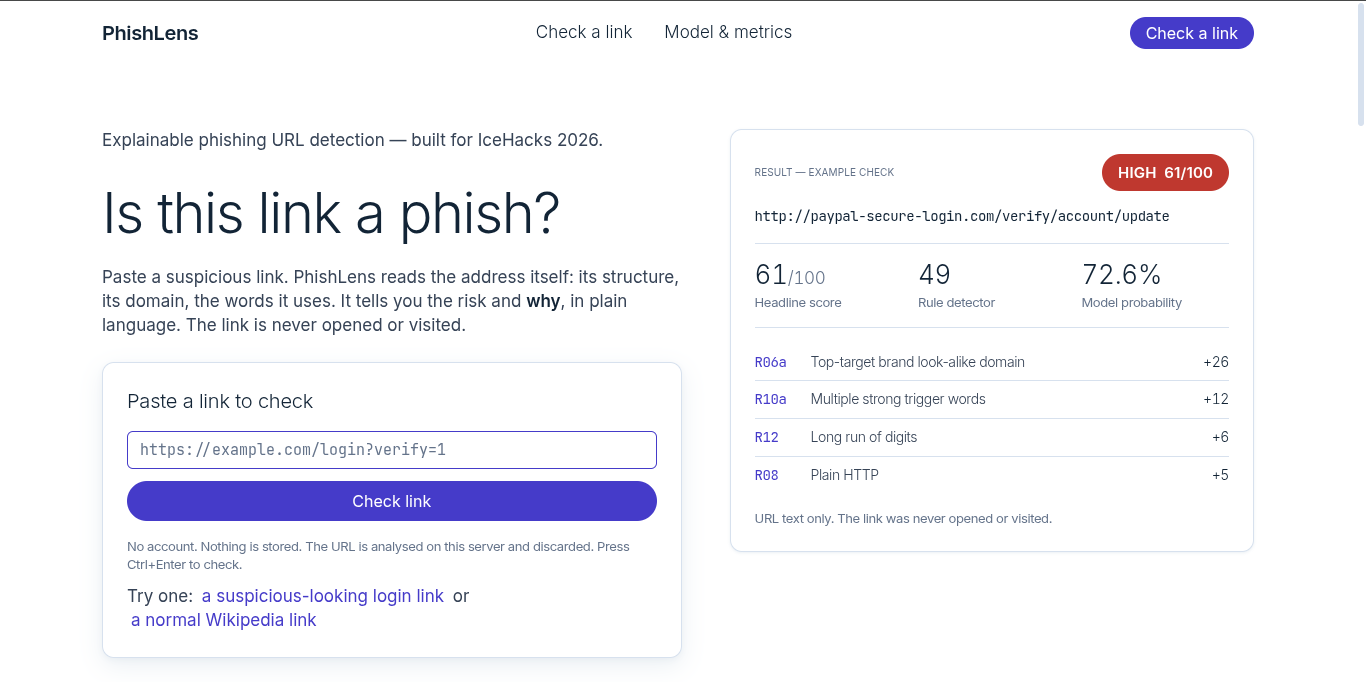
You paste a suspicious link. PhishLens reads the address itself — it never opens the link, never visits it — and gives you a Low, Medium or High verdict, a score out of 100, and the reasons in plain words. Two things check the link at the same time: a rule-based detector that scores 29 warning signs, and a Random Forest model (120 trees, 45 features from the URL only) trained on real phishing URLs from PhishTank against Tranco's top domains. It also circles the exact tricks right on the URL, like a forensic examiner. On 2,934 URLs it had never seen: 89.6% accuracy, 89.0% precision, 85.6% recall, F1 87.3%, ROC-AUC 0.952. And the limits are written on the /metrics page too — I don't hide them.
How we built it
Python and Django for the app. scikit-learn for the Random Forest, SHAP for the explanations, tldextract for reading domains. Trained on PhishTank vs Tranco. Hosted on DeployXA, code public on GitHub. The 29 rules catch the stuff most checkers miss — the @ trick, typosquats, look-alike letters, open redirects, .zip domains that are actually websites, invisible characters, login pages on free hosting. 98 tests passing. The home page reads the same live metrics file as /metrics, so the numbers are never hardcoded.
Challenges we ran into
The first version flagged real websites. My own site, toolixy.online, came back High — that was embarrassing, but it forced me to retune the rules until real sites score Low and actual phishing still gets caught. The model retrains on every deploy, so the numbers move a little each time — you can't quote them from memory, only the live page counts. Today the deploy didn't even trigger and I had to redeploy it by hand. And the hardest limit is one I chose on purpose: since the app never visits the link, it can only judge the address. Phishing on a real, hacked website is something URL-only checks can't catch, and I say that on the page.
Accomplishments that we're proud of
89.6% accuracy on URLs it never saw, and every verdict comes with a reason a normal person can read — not just a number. A fake PayPal login scores High 61 and the page shows you exactly which tricks it used. It's live, it's public, it's tested, and the whole thing was built inside the hack week.
What we learned
The padlock means almost nothing now. Most phishing sites have one, so we only count HTTPS as a weak signal. People don't trust a score on its own — they trust a reason. And a deploy isn't done until you check the live site yourself. Today proved that.
What's next for PhishLens
After the hackathon this keeps going as the full final-year project — a bigger build on the same code. Page-content checks are possible later, but they'd break the "never visits the link" promise, so that's a real decision, not a small one. More rules, more data, and making it easier to check a link wherever you see it.
