-
-
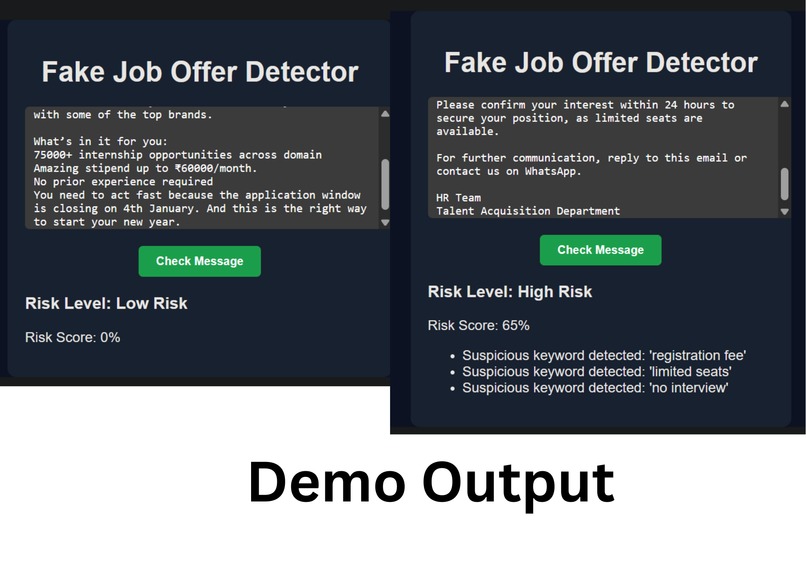
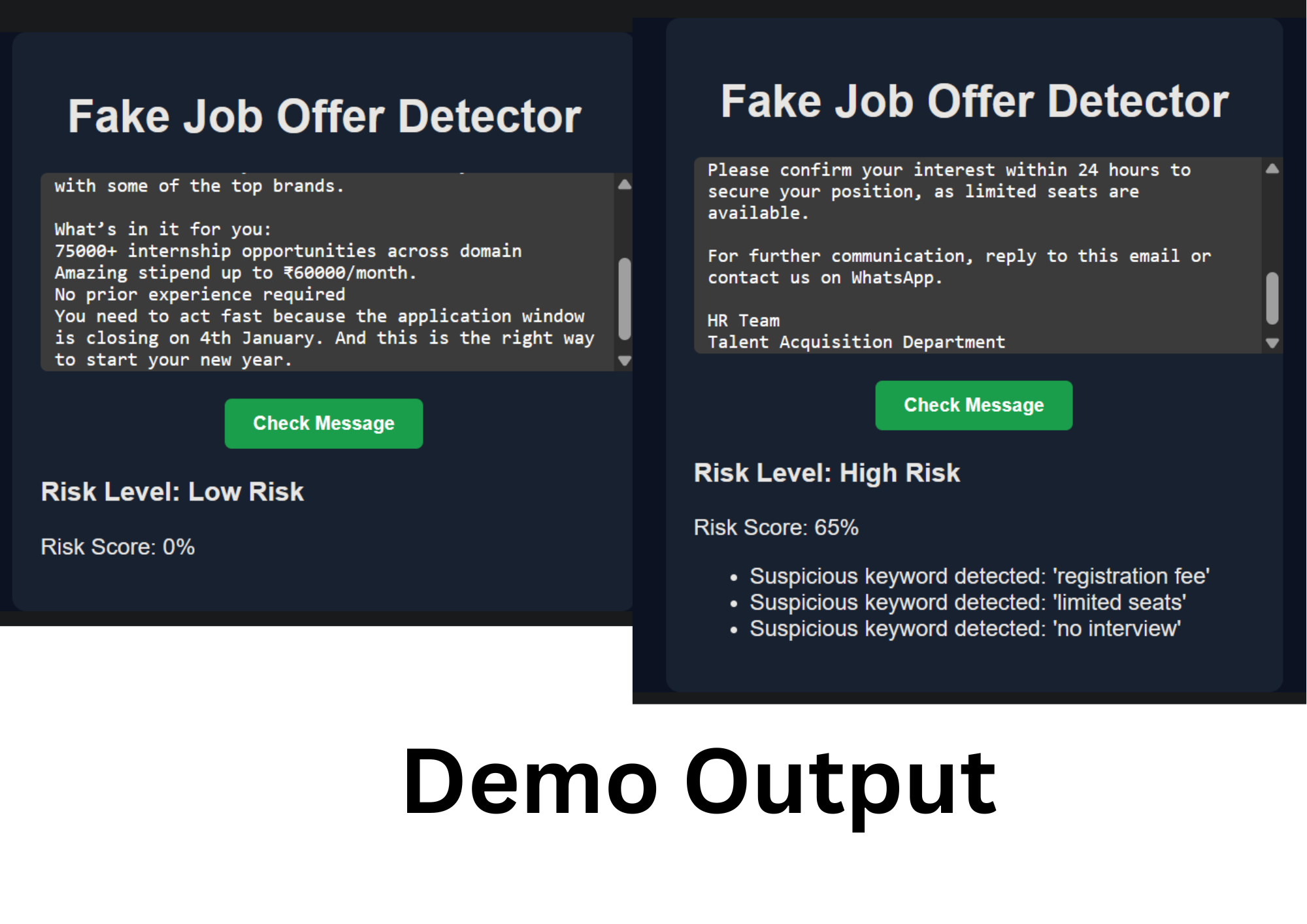
Fake Job Offer Detector identifying scam patterns in real-time.
🛡️Fake Job Offer Detector 📌About the Project
Fake job and internship scams are becoming very common, especially among students and fresh graduates. Many people receive job offers through WhatsApp, Telegram, email, or social media that promise high salaries, instant selection, or ask for registration fees. Unfortunately, many victims lose money and personal data because they are unable to identify whether a job offer is genuine or fake.
Fake Job Offer Detector is a simple cybersecurity tool that helps users quickly analyze job messages and identify potential scams using rule-based risk analysis.
💡Inspiration
The idea for this project came from real incidents where students were scammed by fake internship and job offers. These scams often look very convincing and create urgency, making people act without thinking. We realized that most users do not need a complex system — they need a quick and understandable warning system.
This motivated us to build a tool that focuses on awareness, simplicity, and real-world impact.
🧠 What We Learned
While building this project, we learned: How common scam patterns repeat across different job fraud cases Basics of cybersecurity risk analysis Designing user-friendly security tools Implementing rule-based detection logic Importance of explaining security results in a non-technical way We also learned that sometimes simple logic is more effective than complex systems in hackathon environments.
🛠️ How We Built the Project
The project works by analyzing the text of a job offer and assigning a risk score based on suspicious indicators.
🔍 Detection Logic The system checks for: Keywords like “registration fee”, “instant joining”, “urgent” Use of non-official email domains (e.g., @gmail.com) Unrealistic salary promises No interview or verification steps
The total risk score is calculated as: Risk Score=∑Suspicious Indicators
Based on the score:
🟢 Low Risk (0–30%) 🟡 Medium Risk (31–60%) 🔴 High Risk (61–100%)
⚙️ Tech Stack
Frontend: HTML, CSS, JavaScript Backend: Python (Flask) Logic: Rule-based text analysis No user data is stored, ensuring privacy and security.
🚧 Challenges We Faced
Designing detection rules that are effective but not overly complex Avoiding false positives while keeping the logic simple Presenting cybersecurity results in a way that non-technical users can understand Balancing speed, accuracy, and usability within limited hackathon time
🚀 Future Scope
Screenshot text analysis using OCR Browser extension for LinkedIn and email platforms Multi-language support Machine learning-based detection in future versions
🎯 Conclusion
Fake Job Offer Detector proves that cybersecurity tools do not need to be complicated to be impactful. By focusing on real problems and simple solutions, this project helps protect users from job scams and promotes digital awareness.


Log in or sign up for Devpost to join the conversation.