



Inspiration
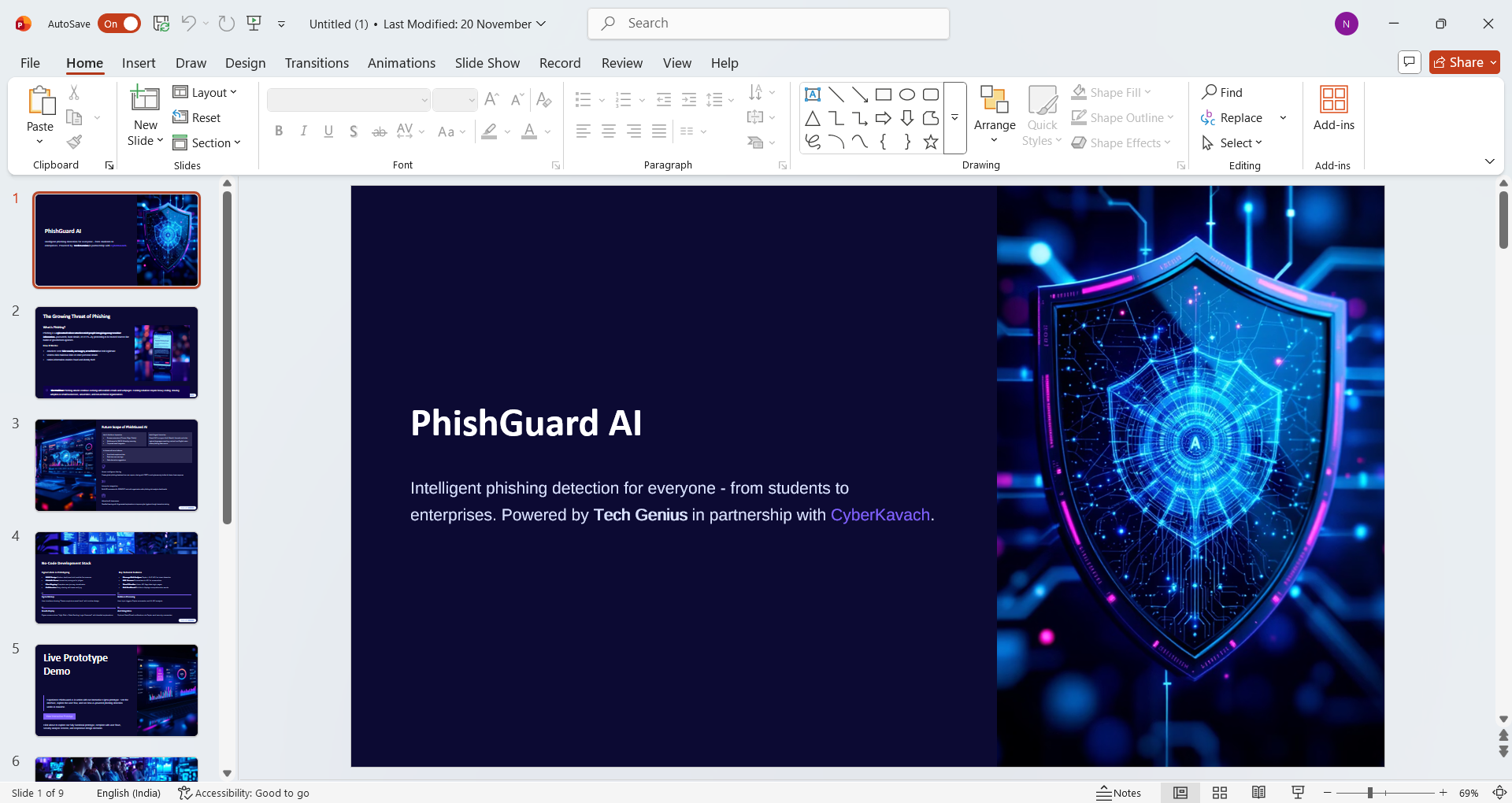
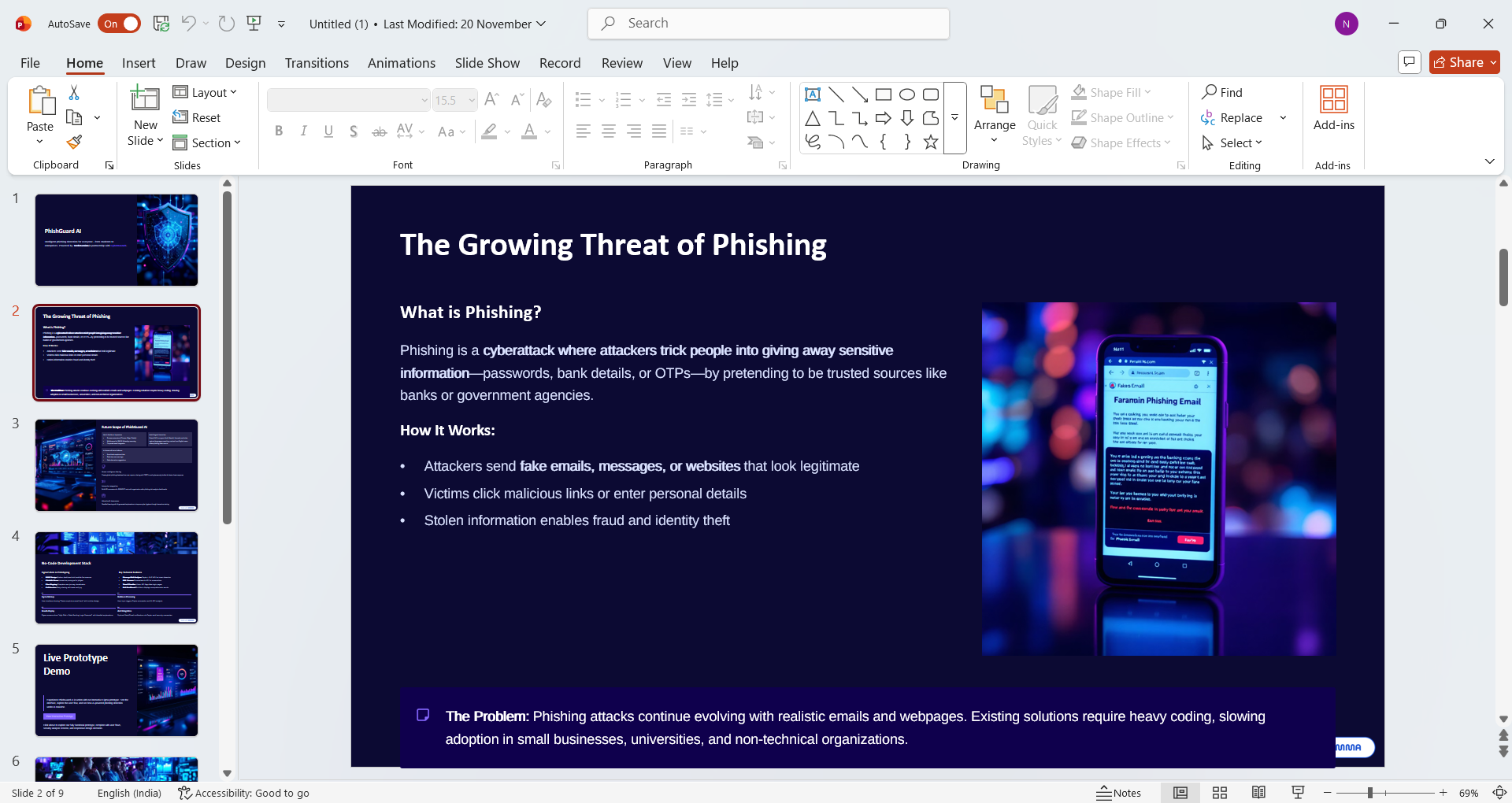
With the rapid growth of digital communication, phishing attacks have become one of the most common and dangerous cybersecurity threats. Many people, including students and professionals, unknowingly fall victim to fake emails, malicious links, and fraudulent websites every day. Despite existing security tools, phishing attacks continue to succeed due to social engineering and lack of user awareness. This inspired us to build PhishGuard AI, a smart and user-friendly solution that protects users before they click by using artificial intelligence to identify and prevent phishing threats in real time. What it does
PhishGuard AI is an AI-powered phishing detection system that analyzes emails, URLs, and websites to identify potential phishing attacks. It scans message content, sender details, domain information, and webpage behavior to calculate a risk score. Based on this analysis, the system instantly alerts users if a threat is detected and provides clear safety recommendations such as avoiding the link or verifying the sender. PhishGuard AI helps individuals and organizations stay protected from cyber fraud through real-time detection and intelligent warnings.
How we built it We built PhishGuard AI using a combination of machine learning, natural language processing, and web security techniques. The backend processes incoming emails and URLs, extracts key features such as suspicious keywords, domain mismatches, and SSL details, and passes them to an AI model trained to classify phishing threats. NLP techniques help analyze message tone and intent, while URL and website analysis identify malicious patterns. The frontend displays alerts, risk scores, and safe action suggestions in a simple and user-friendly interface. The system is designed to be scalable and can be integrated as a browser extension or email security tool.
Challenges we ran into One of the biggest challenges was reducing false positives while maintaining high detection accuracy. Phishing attacks often look very similar to legitimate emails, making classification difficult. Collecting reliable training data and handling different phishing patterns was also challenging. Additionally, integrating real-time detection while keeping system latency low required careful optimization. Designing alerts that are informative but not overwhelming for users was another important challenge we had to address.
Accomplishments that we're proud of We successfully developed a working AI-based phishing detection system that can analyze emails and links in real time. Our model accurately identifies common phishing patterns and provides actionable security warnings. We are proud of creating a solution that is both technically strong and user-friendly. The modular design allows future expansion into browser plugins, mobile apps, and enterprise-level integrations, making PhishGuard AI a scalable and impactful cybersecurity solution.
What we learned
Through this project, we gained hands-on experience in applying machine learning and NLP to real-world cybersecurity problems. We learned how phishing attacks operate, how attackers exploit human psychology, and how AI can be used to counter such threats. We also improved our skills in system design, API integration, teamwork, and problem-solving under time constraints. Most importantly, we learned the importance of building technology that prioritizes user trust and clarity.
What's next for Phishguard AI
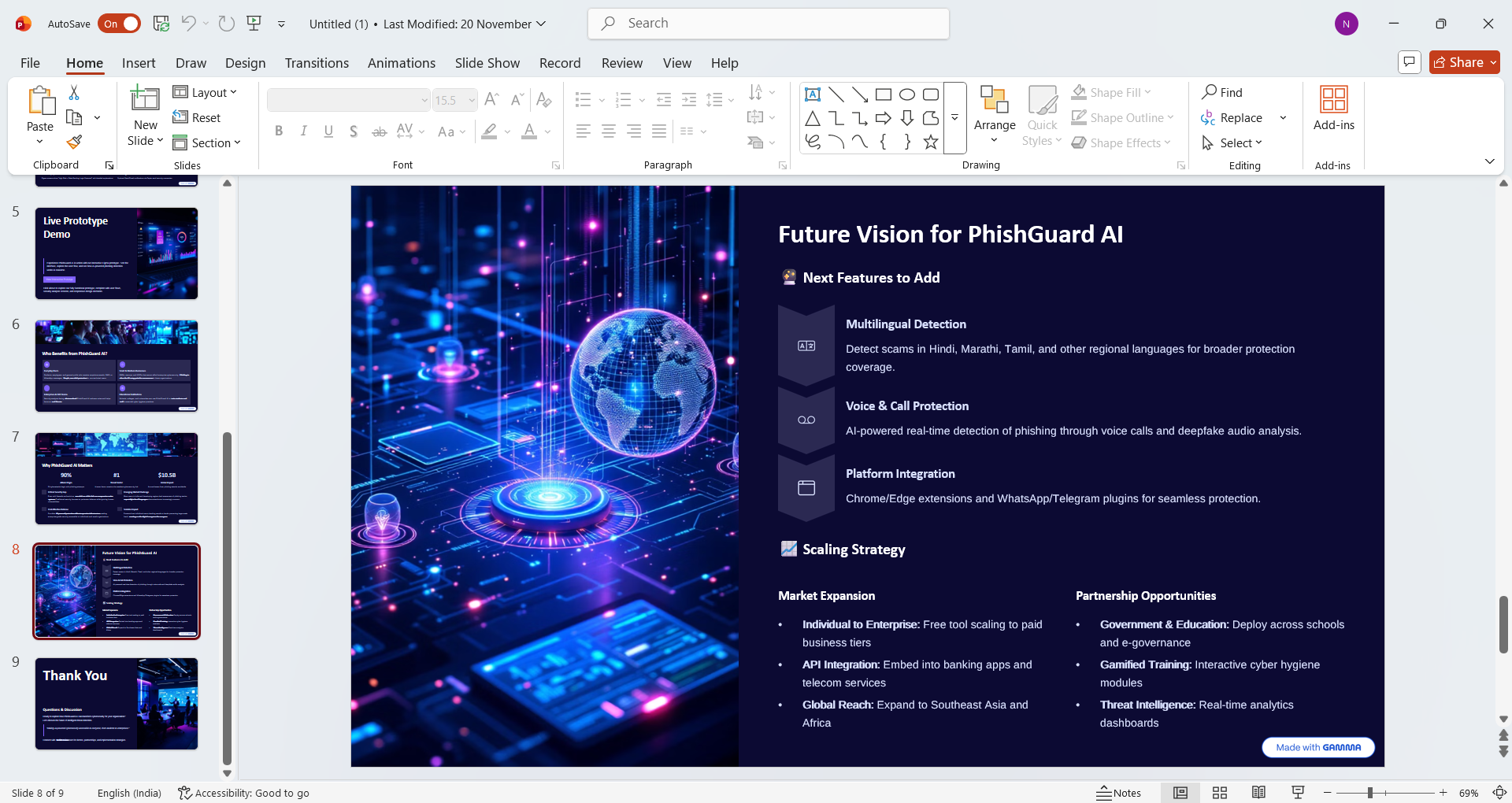
In the future, we plan to expand PhishGuard AI by adding support for SMS and social media phishing detection. We aim to improve accuracy using advanced deep-learning models and large language models (LLMs). Additional features such as multilingual detection, enterprise dashboards, and user awareness training modules are also planned. Our long-term vision is to make PhishGuard AI a comprehensive and accessible cybersecurity assistant for users across all digital platforms.
Built With
- base44
- bubble
- css
- figma
- html5
- javascript
- natural-language-processing
- python
- zapier
