Inspiration
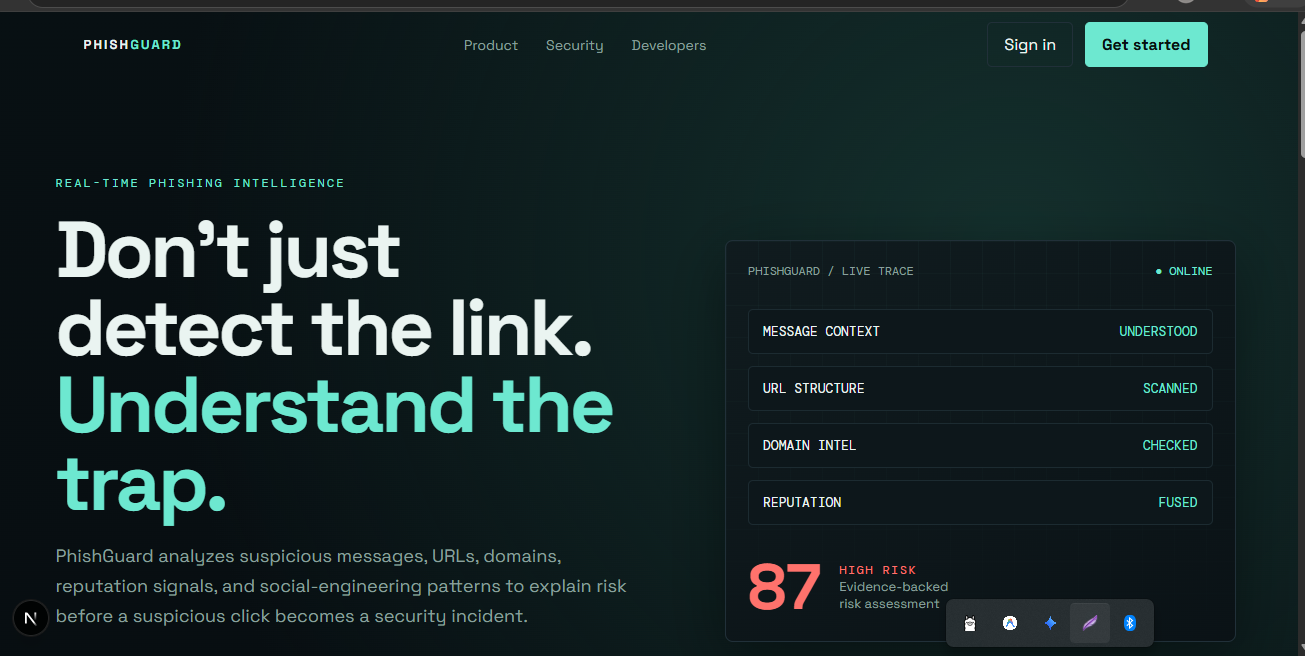
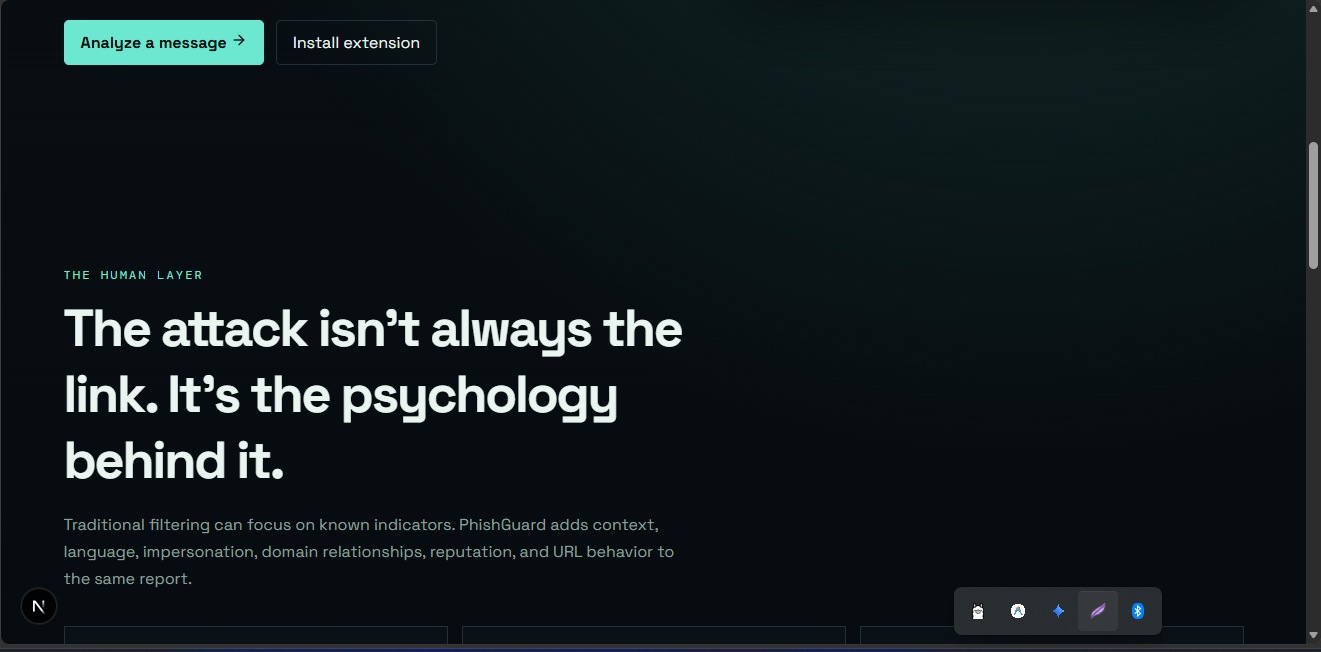
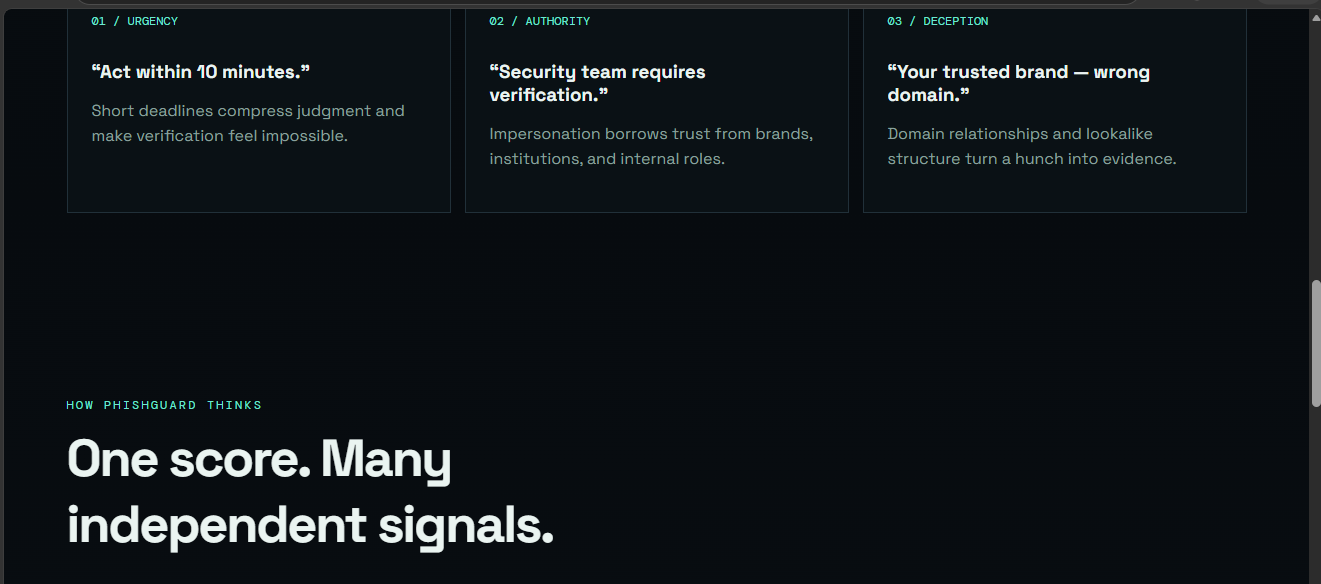
Traditional cybersecurity tools often treat phishing detection as a black-box binary: a link is either silently blocked or allowed. When end users never understand why a communication is deceptive—whether it exploits subtle punycode homoglyphs, urgent psychological triggers, or brand impersonation—they remain susceptible to the next variant. We built PhishGuard AI to bridge this gap by transforming threat detection into explainable intelligence. Our goal is to move beyond passive blocking and help users and analysts actually understand the anatomy of modern social-engineering traps.
What it does
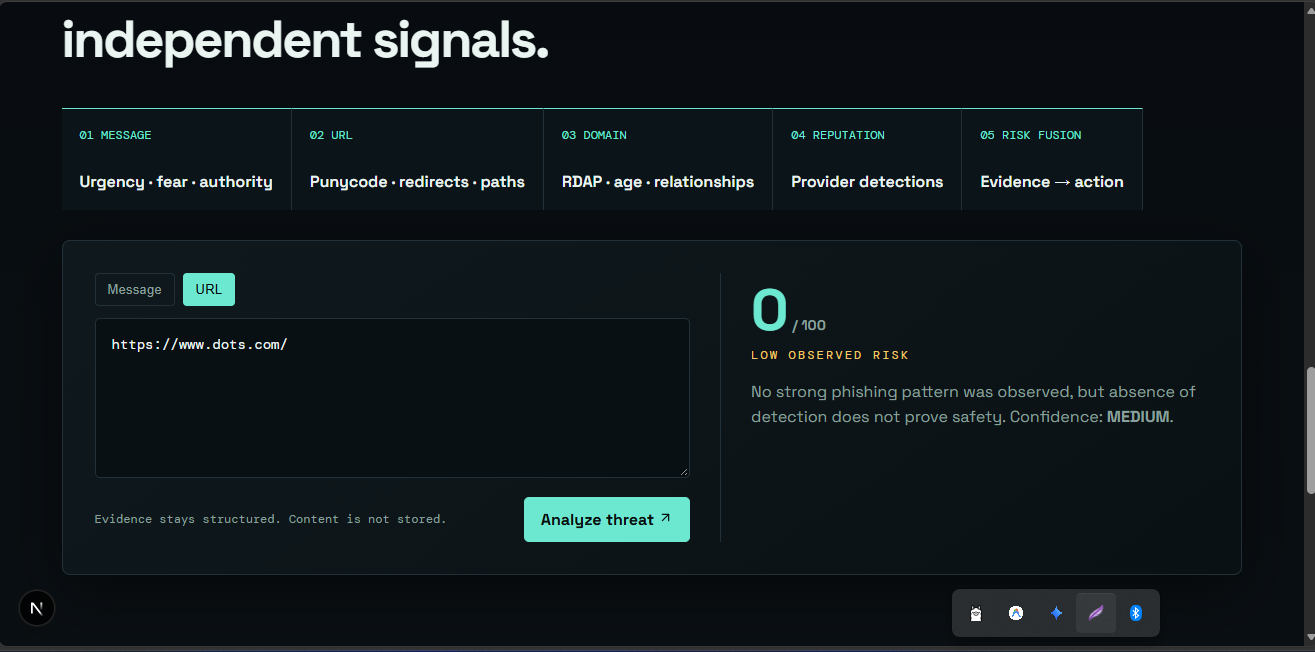
PhishGuard AI is an explainable phishing and social-engineering intelligence platform that inspects suspicious messages and links to deliver structured, evidence-backed risk reports:
- Deterministic URL & Brand Mismatch Engines: Identifies deceptive subdomains, suspicious URI path anomalies, and discrepancies between claimed corporate identities and actual destination hosts.
- Domain & Threat Intelligence: Automatically fetches RDAP registration telemetry (e.g., domain age, registrar legitimacy) and queries optional threat reputation providers such as VirusTotal.
- Explainable Semantic Analysis: Pairs deterministic rule-based linguistic flags with local language model reasoning (via Ollama / Qwen 2.5) to assess manipulative tone, urgency, and credential-harvesting tactics without transmitting sensitive text to external cloud providers.
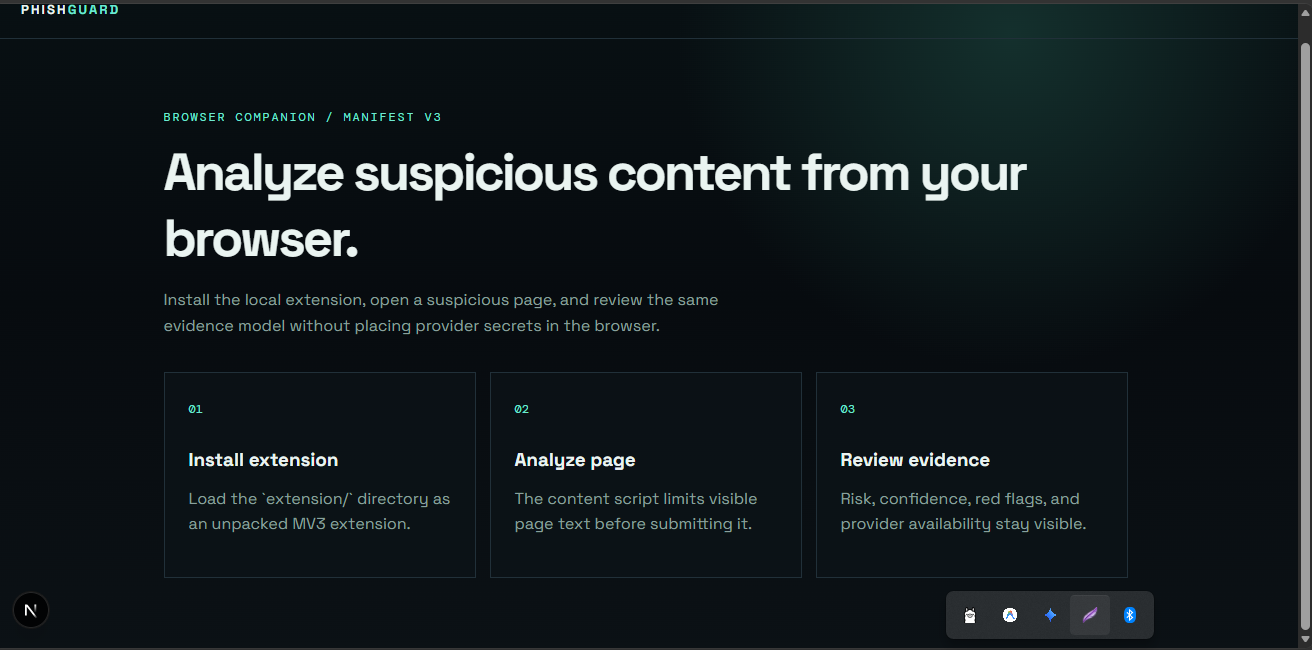
- Browser Companion: Features a Manifest V3 browser extension that brings frictionless, in-context threat checks directly into daily browsing workflows.
- Auditable Risk Scoring: Replaces arbitrary confidence percentages with an itemized breakdown of observed signals, provider availability statuses, and clear risk verdicts.
How we built it
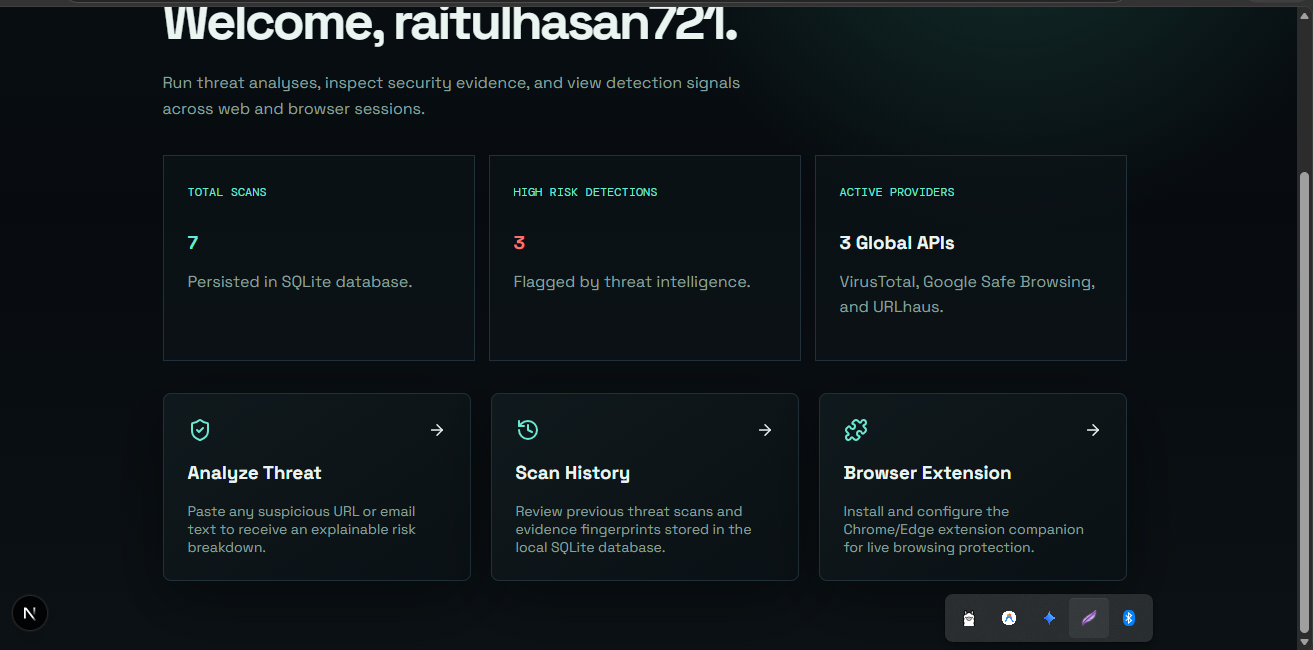
- Backend Core: Developed with FastAPI and SQLite, structured around a modular pipeline that isolates deterministic heuristics from external network providers.
- Frontend Web App: Built with Next.js (App Router) and Tailwind CSS to render clear signal hierarchies, provider status cards, and granular risk vectors.
- Browser Extension: Implemented as a lightweight Manifest V3 companion that communicates strictly with the configured backend API, ensuring no third-party API keys or credentials ever touch client-side storage.
- Privacy & Security Architecture:
- Zero Raw Content Persistence: Raw submitted messages are analyzed in-flight; scans store only a SHA-256 input hash alongside structured detection evidence.
- SSRF Protection: The URL engine validates and rejects loopback addresses (
localhost,127.0.0.1), link-local destinations, and private IP blocks (RFC 1918) before dispatching any network probes. - Prompt Isolation: All submitted message text is sanitized and treated as untrusted user data when generating prompts for the local LLM.
Challenges we ran into
- Graceful Degradation: Balancing deterministic speed with third-party network latency. If external reputation services hit rate limits or a local Ollama instance is offline, PhishGuard AI must still deliver an accurate, clearly labeled verdict using rule-based heuristics without crashing or hanging.
- Mitigating Exploitation Vectors: Ensuring that an analysis tool does not introduce attack surfaces. Defending against Server-Side Request Forgery (SSRF) and prompt injection required strict multi-stage validation before any engine touched incoming URLs or text.
Accomplishments that we're proud of
- True Explainability: Delivering transparent threat breakdowns where every risk verdict is backed by concrete indicators—such as domain registration age, lexical anomalies, and mismatched brand targets—rather than an opaque probability score.
- End-to-End Architecture: Successfully deploying a synchronized system across a FastAPI backend, a Next.js web application, and a Manifest V3 browser extension with full local-first capability.
- Privacy-Preserving AI: Demonstrating that local open-weight models (Qwen running on Ollama) can execute nuanced social-engineering analysis entirely on-device, preserving data confidentiality.
What we learned
- Why explainable AI beats black-box scores: In high-stakes phishing defense, users and security teams are far more vigilant when they can inspect the exact evidence chain behind an alert.
- Building defensive security tools requires treating every incoming payload as actively adversarial, demanding strict input validation at every layer.
What's next for PhishGuard AI
- Model Context Protocol (MCP) Server: Implementing an MCP interface to enable autonomous AI agents and developer workflows to invoke PhishGuard AI as a security auditing tool.
- Safe Redirect Chain Sandbox: Tracing multi-hop HTTP redirect cascades, cloaked shorteners, and client-side JavaScript redirects in an isolated execution sandbox.
- Enterprise Collaboration & Alerting: Introducing API key management, team audit logs, and automated threat alerting integrations for Slack and Telegram.
Built With
- chrome
- cybersecurity
- fastapi
- intelligence
- manifest-v3
- next.js
- ollama
- python
- qwen
- rdap
- react
- rest-api
- sqlite
- tailwind-css
- threat
- typescript
- virustotal-api


Log in or sign up for Devpost to join the conversation.