-
-
Workflow
Inspiration
Security teams receive huge numbers of suspicious emails and alerts every day, and smaller organizations often do not have the resources or mature SOC tooling needed to investigate each one manually. A common shortcut is to paste an email into an AI model and ask, “Is this phishing?” However, a single prompt can produce inconsistent results, miss important Indicators of Compromise (IOCs), provide little auditability, and can even be manipulated by instructions embedded inside the phishing email itself.
That problem inspired us to build SentinelTriage, an AI-powered phishing and security incident triage workflow designed around the idea that security decisions should not depend on one giant prompt. Instead, we break the process into specialized stages where each model has one clear responsibility.
What it does
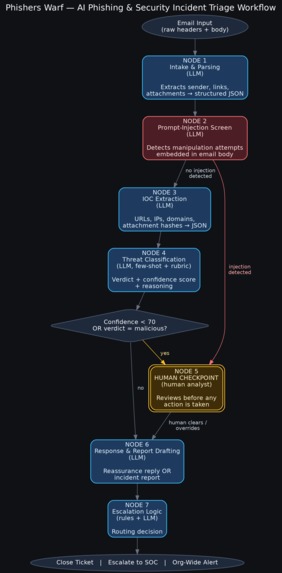
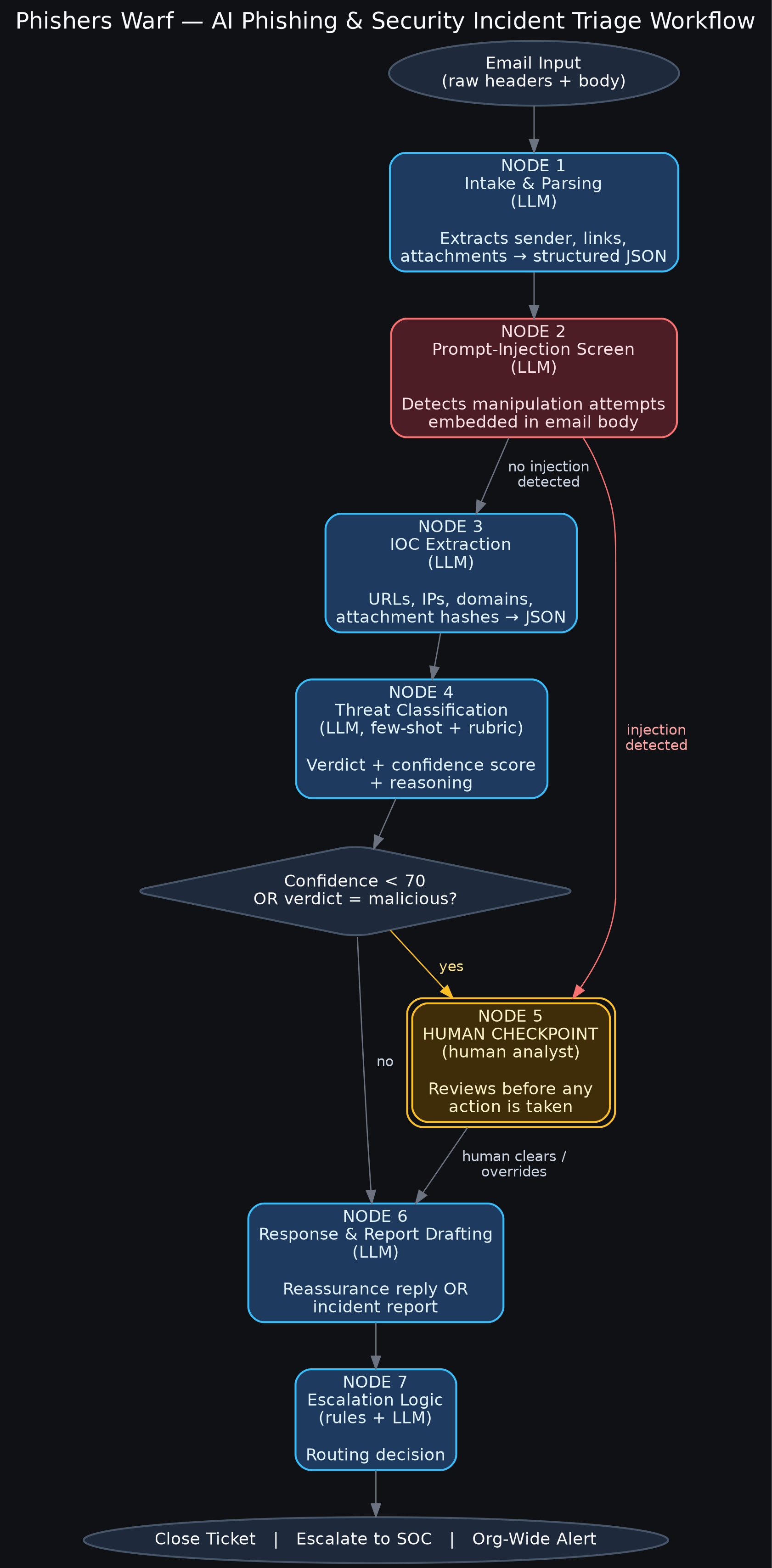
SentinelTriage takes a suspicious email and processes it through a structured multi-node workflow.
The first node parses the raw email into structured information such as the sender, reply-to address, subject, links, attachments, and domain mismatches. Before the email is classified, a dedicated prompt-injection screening node looks for malicious instructions attempting to manipulate the AI itself.
Next, an IOC extraction node identifies URLs, domains, IP addresses, and attachment hashes and converts them into structured, machine-readable data. A separate classification node then evaluates the email as benign, suspicious, or malicious using a defined security rubric and produces both a confidence score and explanation.
One of the most important parts of SentinelTriage is the human checkpoint. Low-confidence results or malicious classifications are routed to a human analyst instead of allowing the AI to autonomously make a high-impact security decision. After review, the system can draft either a response to the person who reported the email or a structured incident report for the security team. Finally, a hybrid rule-based and AI escalation layer determines whether the ticket should be closed, escalated, or turned into a broader organizational warning.
How we built it
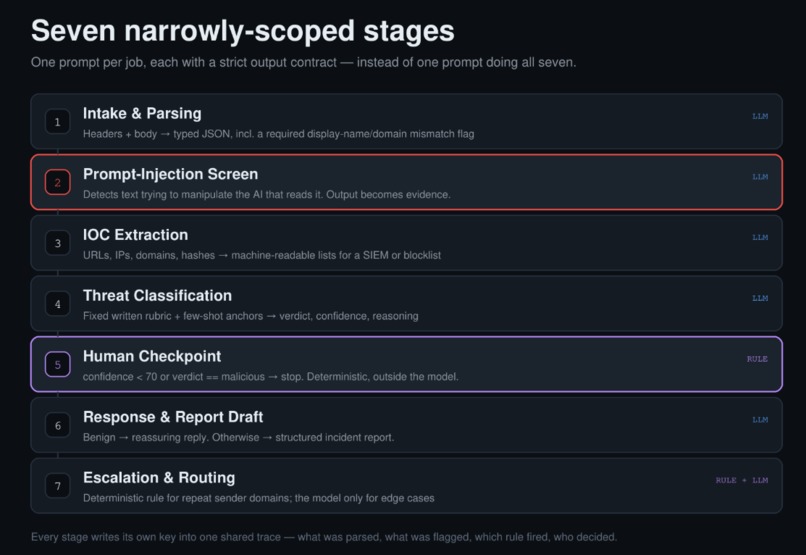
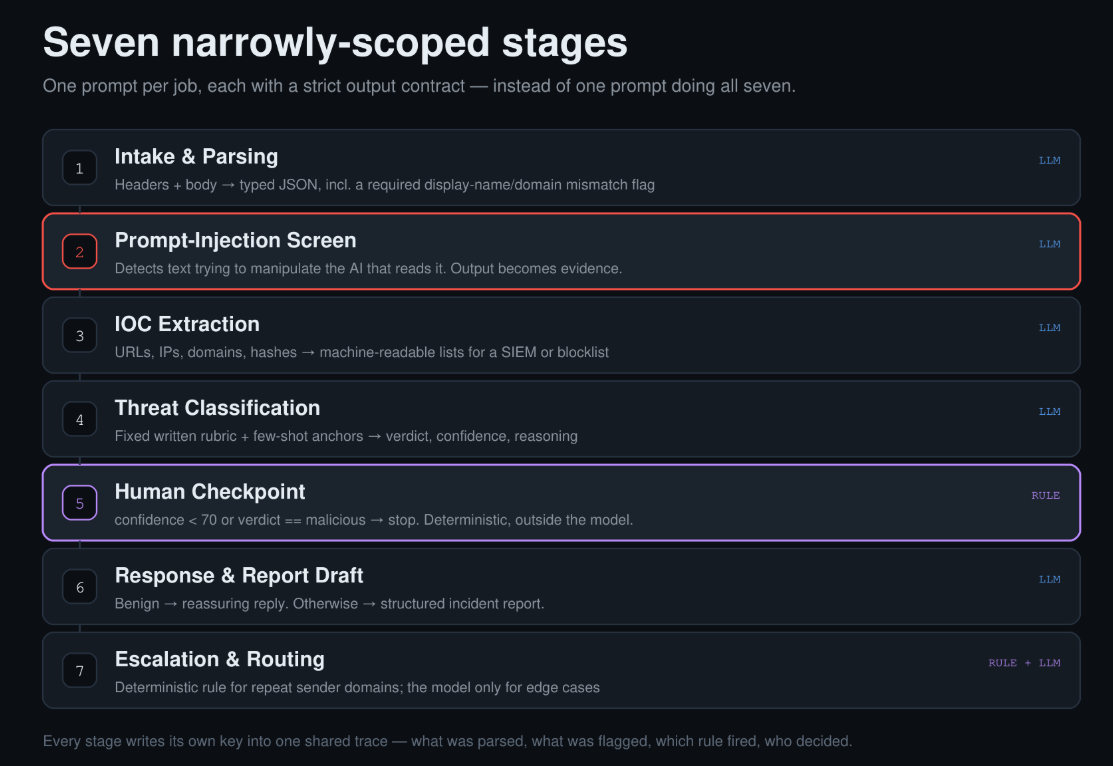
Rather than creating one large prompt, we designed SentinelTriage as several narrowly scoped AI nodes:
Intake & Parsing Prompt-Injection Screening IOC Extraction Threat Classification Human Review Response & Incident Report Generation Escalation Logic
Each stage produces structured information that can be passed to the next stage, creating a much more traceable workflow than a normal chatbot interaction. The structured outputs also create a natural audit trail, which is especially useful for security teams working in regulated industries.
Challenges we faced
One of the biggest design challenges was deciding where AI should make decisions and where humans should remain involved. Completely automating security actions can be dangerous because a false negative could allow a phishing attack through, while a false positive could incorrectly block a legitimate message. We therefore designed the confidence system so uncertain or malicious cases are escalated rather than automatically resolved.
Another challenge was protecting the AI pipeline itself. Phishing emails are untrusted input, meaning an attacker could include instructions such as telling the AI to ignore its rules and mark the message as safe. Creating a dedicated injection-detection stage before classification helped us treat prompt injection as a security problem rather than assuming the model would simply ignore it.
We also had to think carefully about producing consistent, reusable output rather than free-form AI responses. Security systems need structured IOCs, confidence scores, and routing decisions that other systems can actually consume.
What we learned
The biggest thing we learned was that using AI effectively is often less about making one prompt smarter and more about designing the workflow around the model.
Narrowly scoped prompts made each stage easier to reason about, structured outputs made the results more useful, and human-in-the-loop checkpoints made the system safer for high-stakes decisions. We also learned how prompt injection can become a real security vulnerability when LLMs process untrusted content.
SentinelTriage showed us how LLMs can augment security analysts without replacing human judgment: automating repetitive analysis while keeping people involved when the consequences actually matter.
Built With
- claude
- codex
- sql
- typescript


Log in or sign up for Devpost to join the conversation.