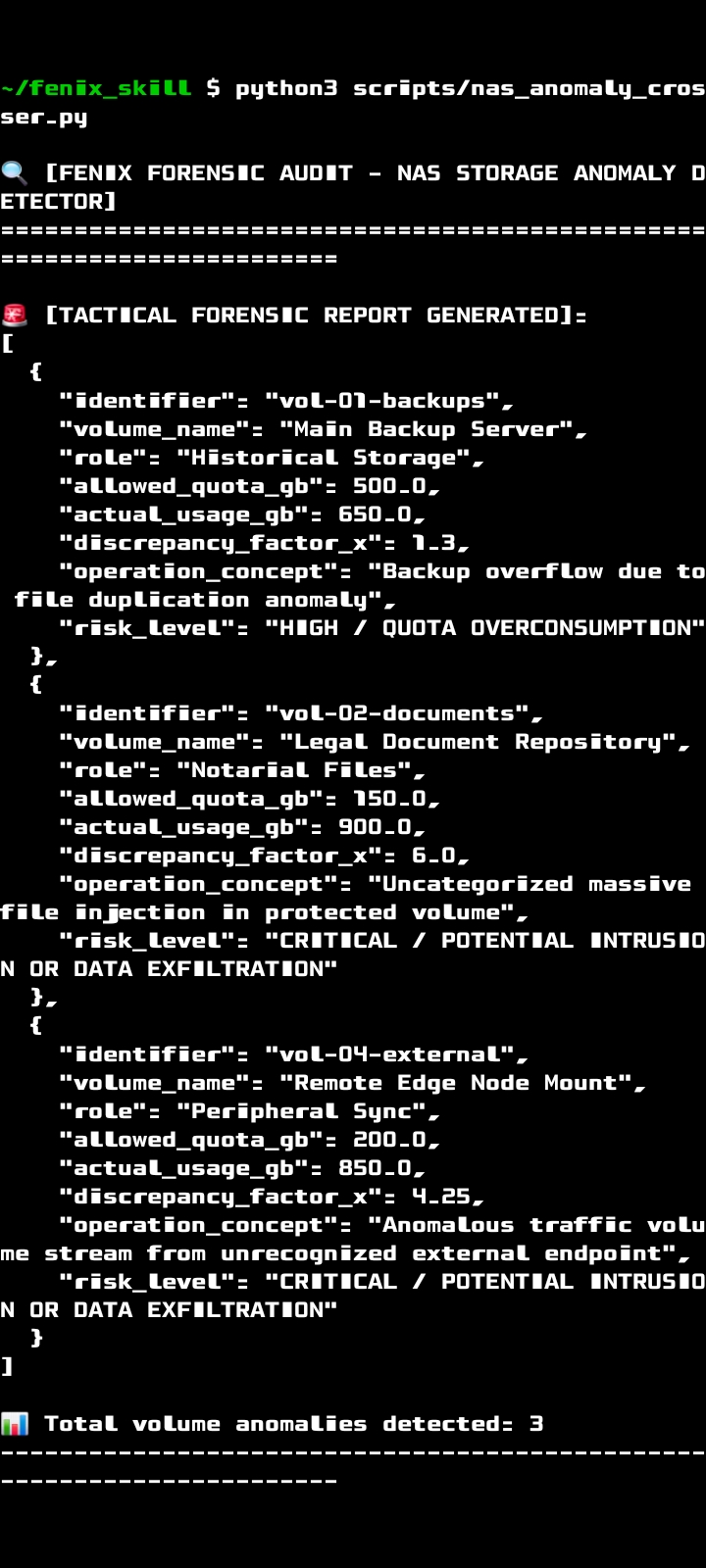
Modern Network Attached Storage (NAS) environments require constant monitoring against data corruption, unauthorized access escalation, and volumetric anomalies. Traditional enterprise antivirus solutions are often bloated, resource-heavy, and rely on cloud dependencies. Fenix NAS Forensic Engine was created to address this challenge by providing a lightweight, zero-dependency, and sovereign forensic daemon optimized specifically for UGREEN UGOS NAS hardware.
What it does
Fenix NAS Forensic Engine operates as an autonomous security and audit skill:
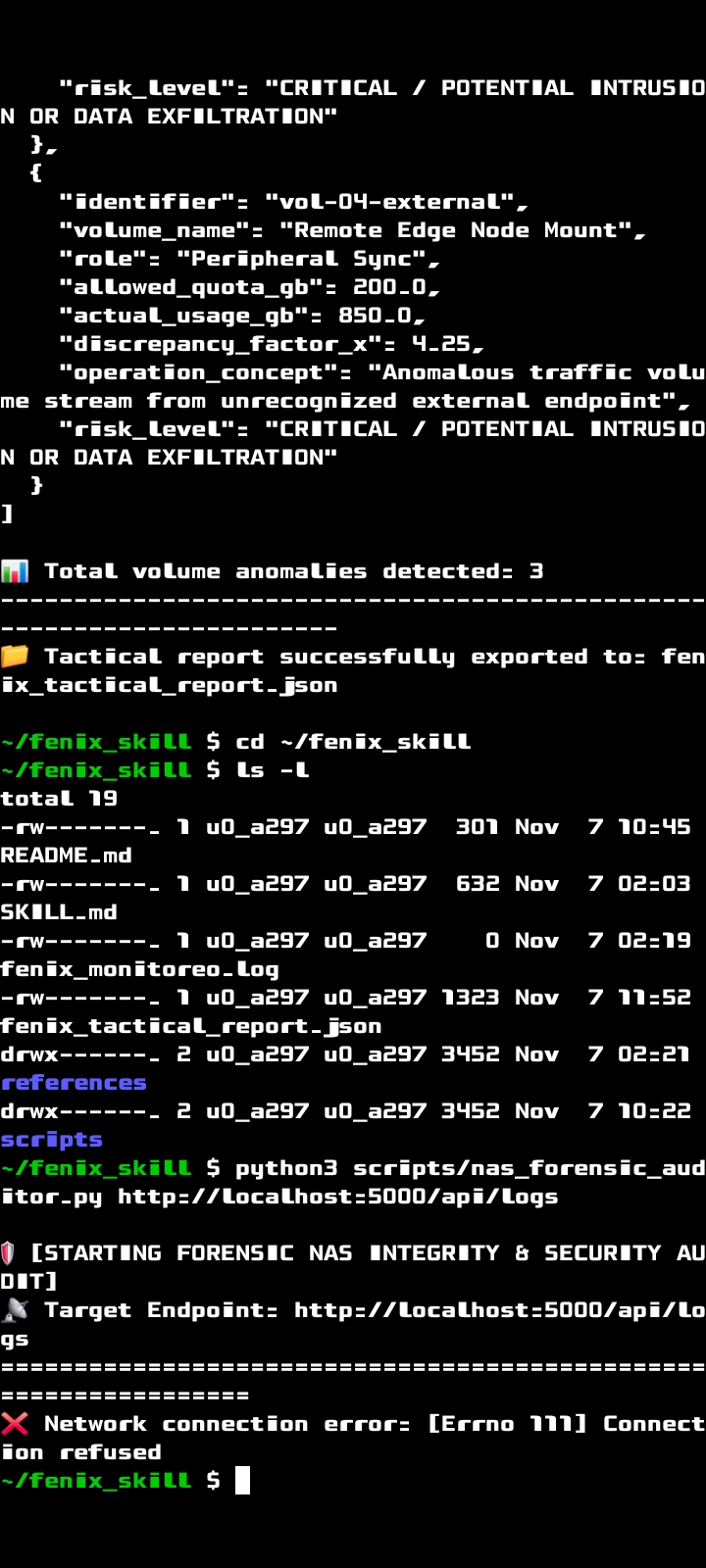
- Forensic Integrity Audit (
nas_forensic_auditor.py): Scans JSON access streams and metadata logs to isolate critical security vectors (permission_denied,checksum_mismatch,bulk_modification,unauthorized_ip). - Storage Quota & Anomaly Cross-Referencer (
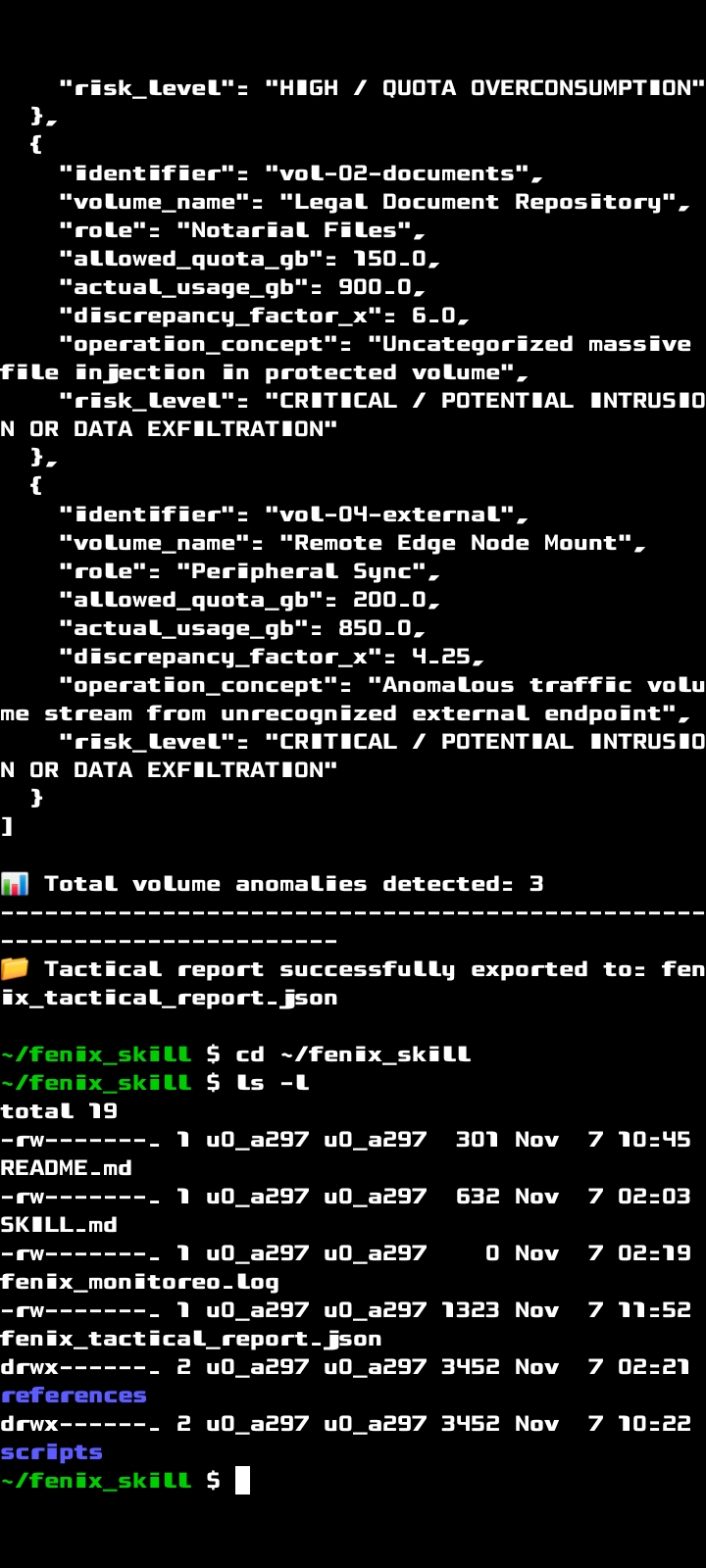
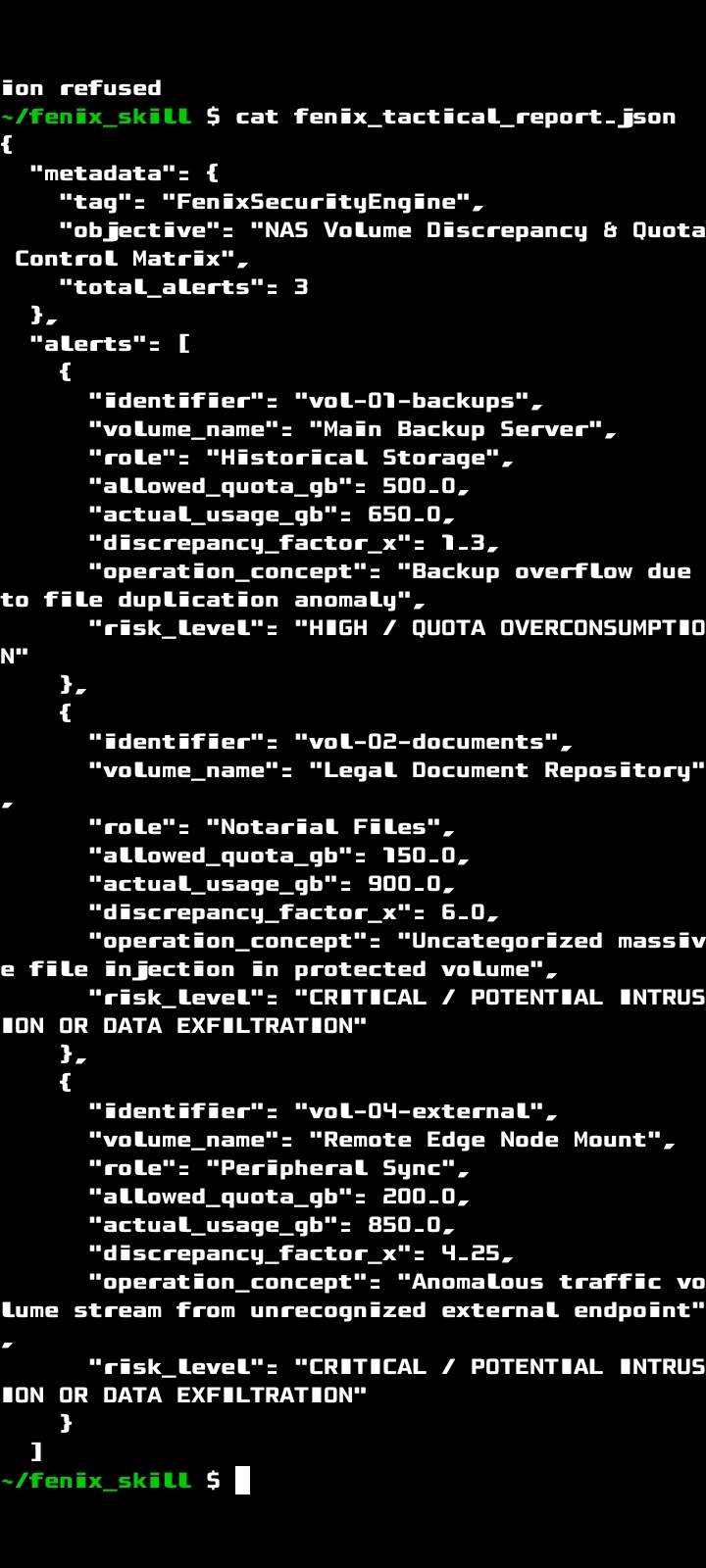
nas_anomaly_crosser.py): Calculates real-time mathematical discrepancy factors between allocated storage quotas and physical disk consumption, immediately flagging overconsumption or potential data exfiltration. - Structured Tactical Reporting: Automatically generates standard JSON reports (
fenix_tactical_report.json) for operator analysis or downstream SIEM ingestion.
How we built it
- Field Electrician Logic & Physical Determinism: Built from the ground up without prior traditional programming experience. As a field electrical operator, the architecture stems directly from real-world electrical laws—where systems demand absolute balances, strict circuit continuity, and deterministic states, leaving zero room for conditional patches, messy code, or software crutches.
- Mobile-Only POSIX Environment (No PC): Entirely architected, coded, and tested on a smartphone via Termux without access to a desktop or laptop workstation, while in active recovery 22 days post-major surgery.
- Zero-Dependency Python Core: Engineered using pure standard Python 3 libraries (
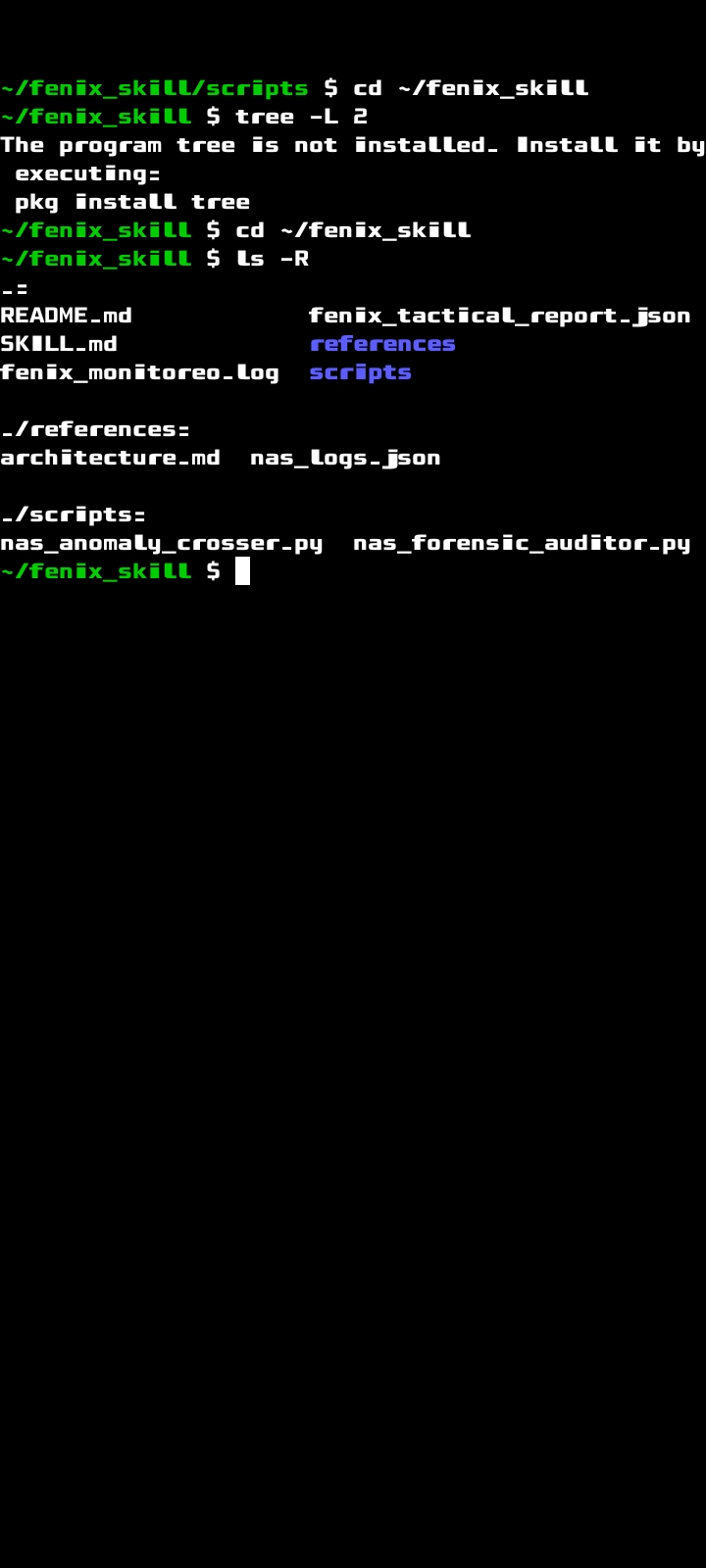
json,urllib,sys) to ensure sub-second response times without external package overhead. - Modular Skill Standard: Structured according to strict skill manifest specifications (
SKILL.mdandREADME.md) for seamless deployment in edge nodes and UGREEN UGOS environments.
Challenges we ran into
- Translating Field Physics to Code: Translating the uncompromising logic of physical electrical engineering into software architecture—enforcing strict error balances, immediate logical cutoffs, and absolute stability without relying on standard programming libraries.
- Hardware, Ergonomic & Medical Constraints: Developing, debugging, and structuring a production-grade forensic engine exclusively from a mobile phone while recovering from a major surgery (22 days post-op) under strict physical limitations.
- Resource Minimization: Ensuring comprehensive log processing and quota cross-referencing without causing CPU overhead or memory spikes on consumer NAS hardware.
Accomplishments that we're proud of
- Proving that an autodidact field electrical operator can architect and deploy a production-grade, zero-dependency forensic engine entirely from a mobile device during medical recovery, without a PC or prior programming background.
- Delivering a self-contained tool that executes in seconds on low-power hardware, driven by uncompromising physical logic and zero external cloud dependencies.
What we learned
- Mastering zero-dependency Python design patterns by treating software logic through the lens of electrical circuit behavior, system equilibrium, and unyielding hardware resilience.
- Perfecting modular skill structuring and CLI-driven forensic log parsing under strict mobile Linux environments and severe physical constraints.
What's next for Fenix NAS Forensic Engine
- eBPF / Kernel-Level Hooks: Extending anomaly detection directly into the network and filesystem driver space for low-level packet and block inspection.
- Remediation & Circuit Breakers: Implementing automated quarantine triggers and hard logical cutoffs upon detecting critical volume discrepancies, functioning like an absolute electrical circuit breaker.
