Inspiration
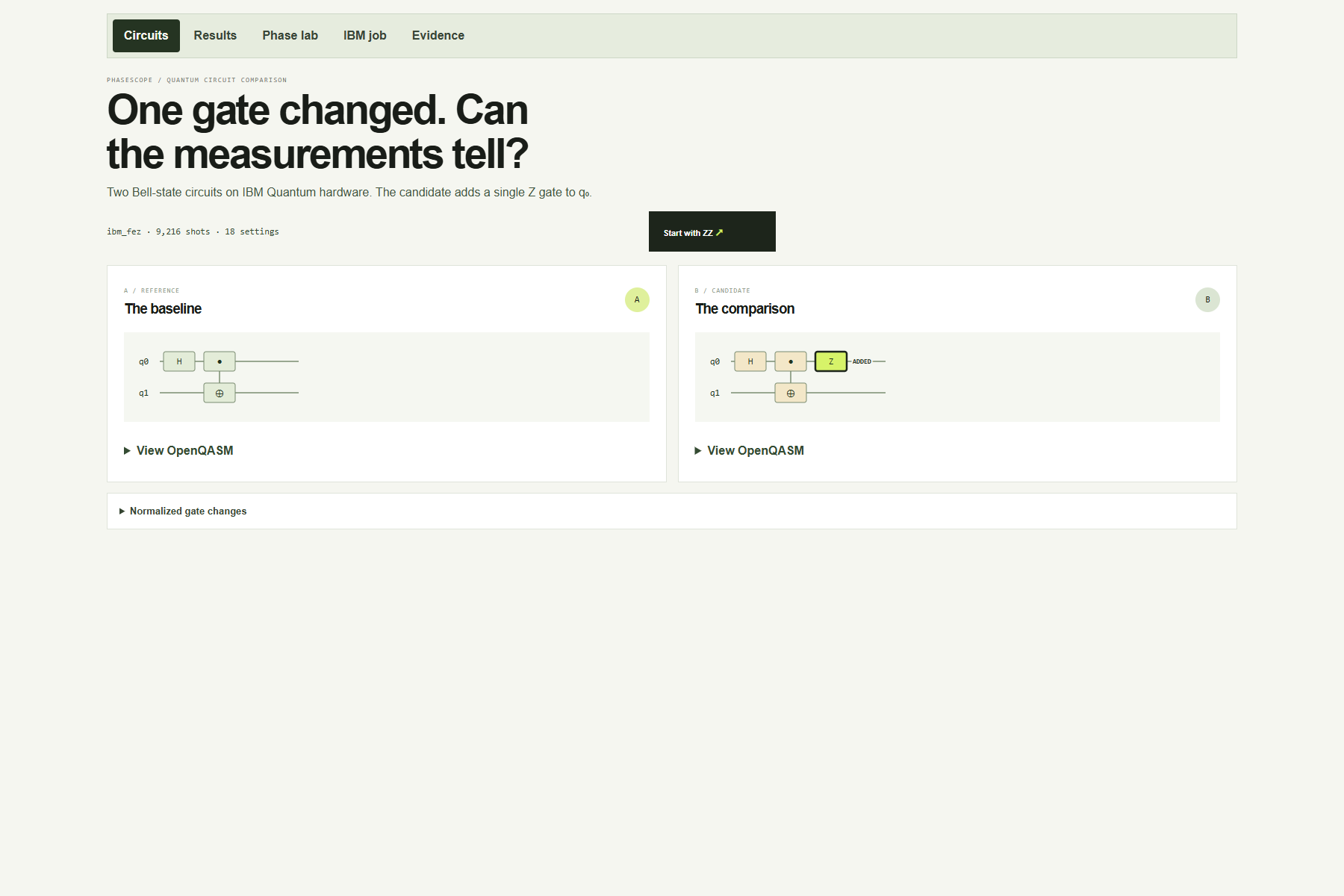
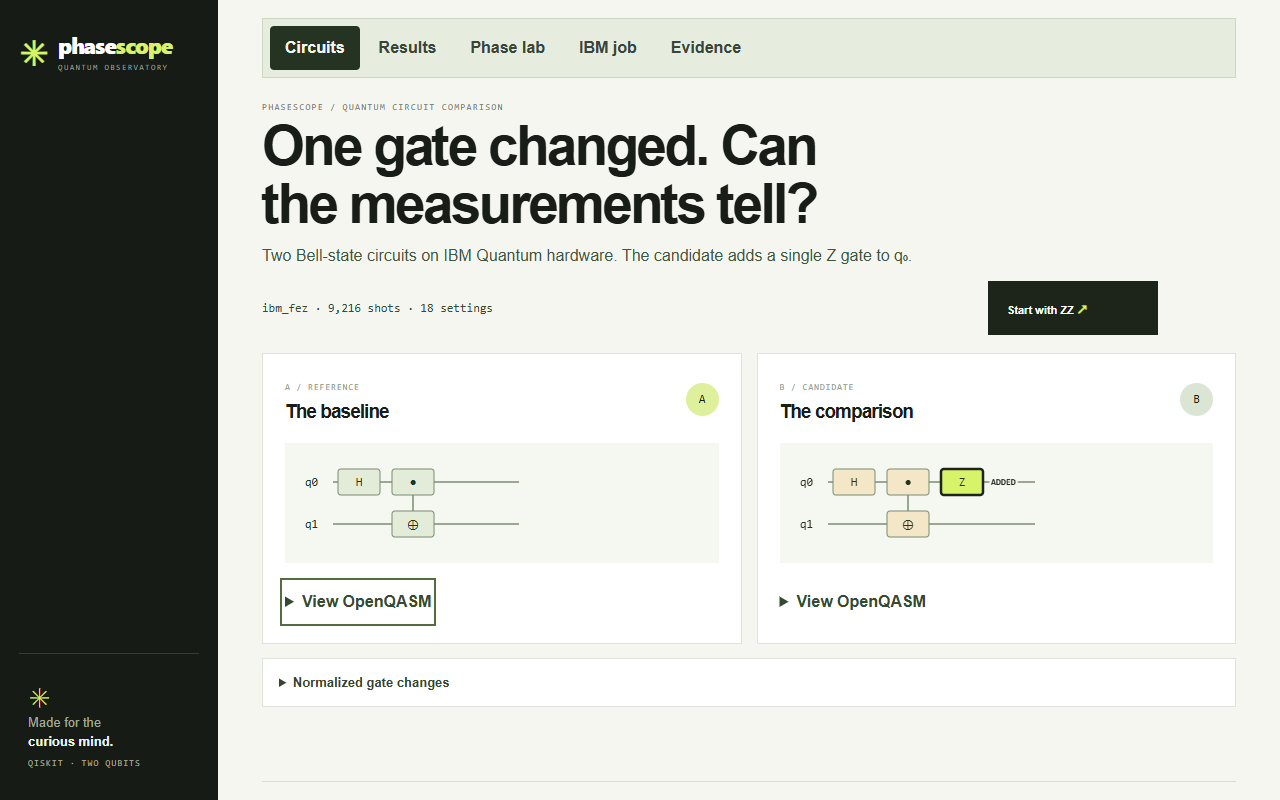
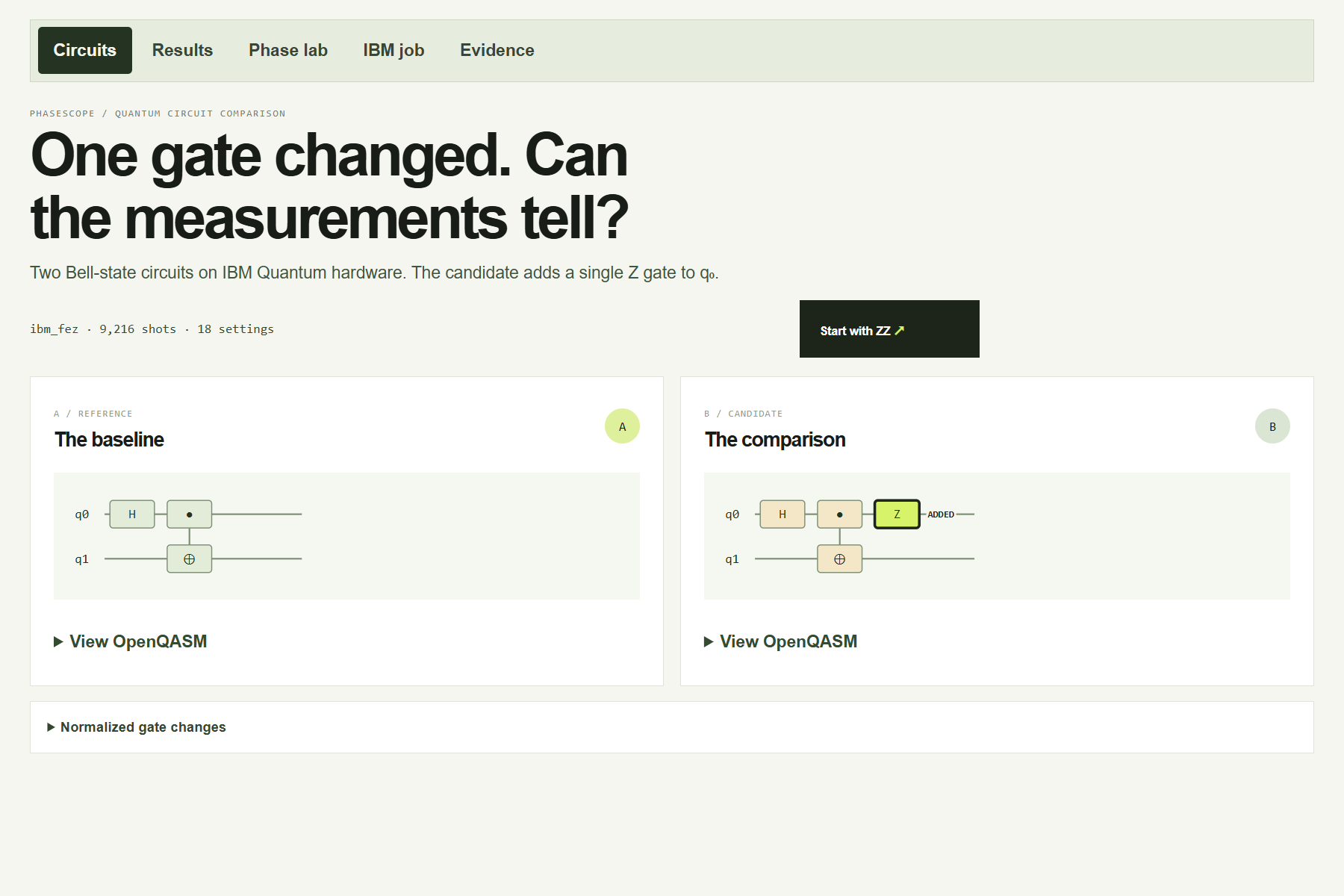
A one-gate change can hide in an ordinary measurement. PhaseScope started from that blind spot: if two two-qubit preparations look alike in the computational basis, which other measurements reveal the difference, and can that claim be traced back to the raw hardware counts?
What I learned
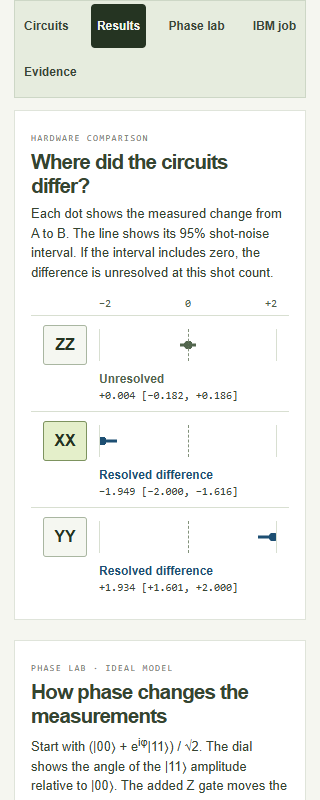
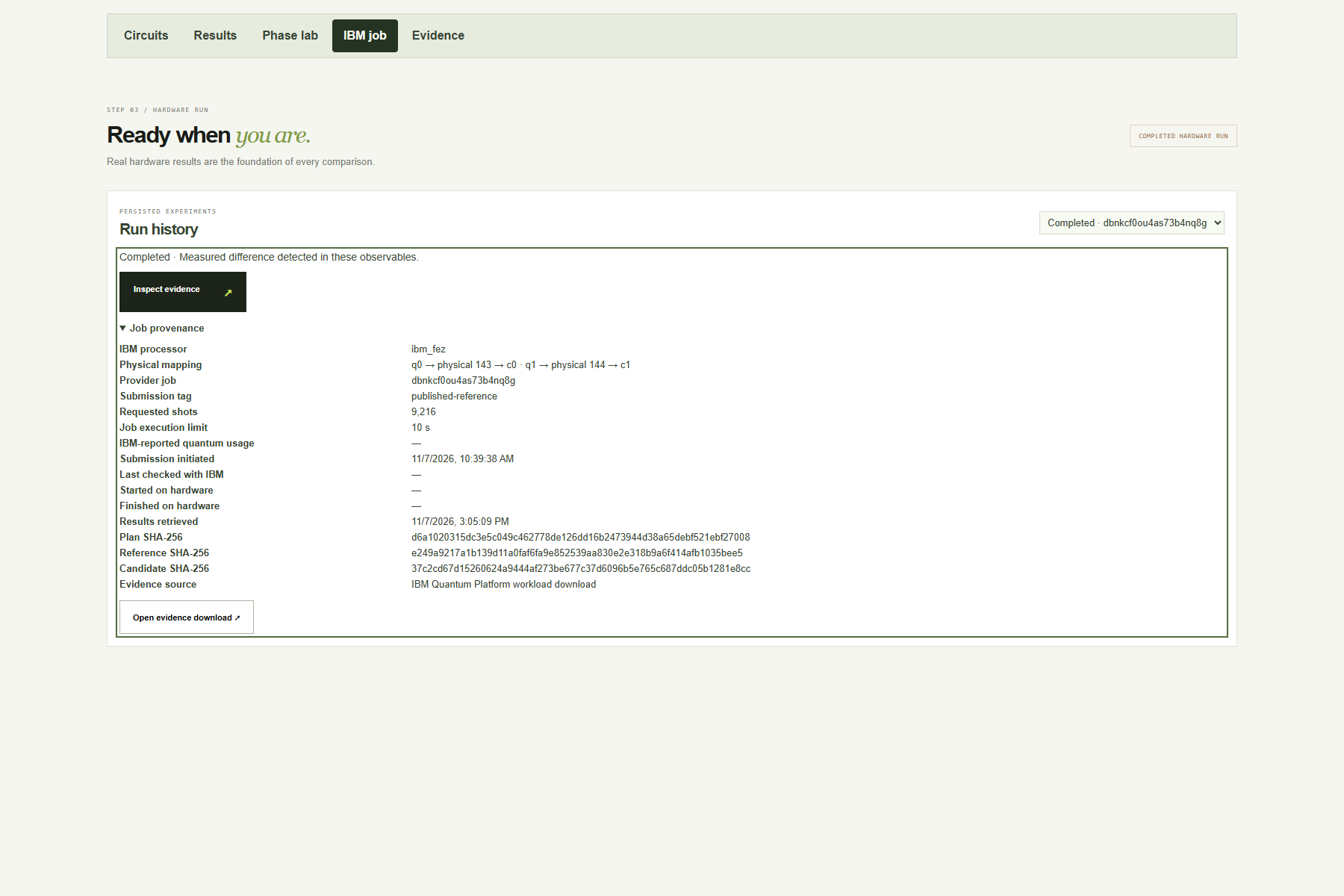
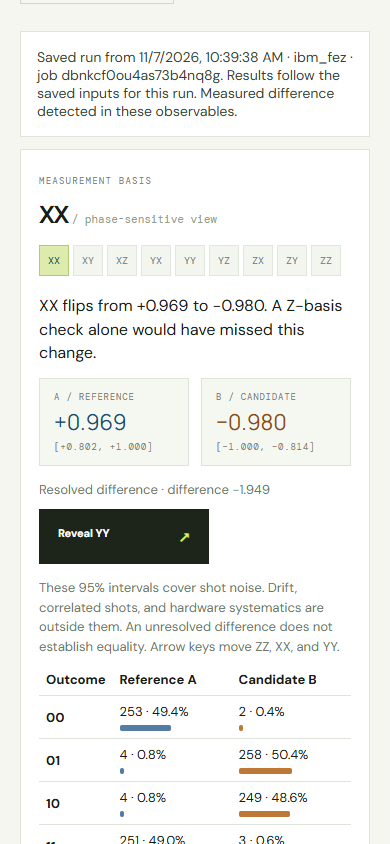
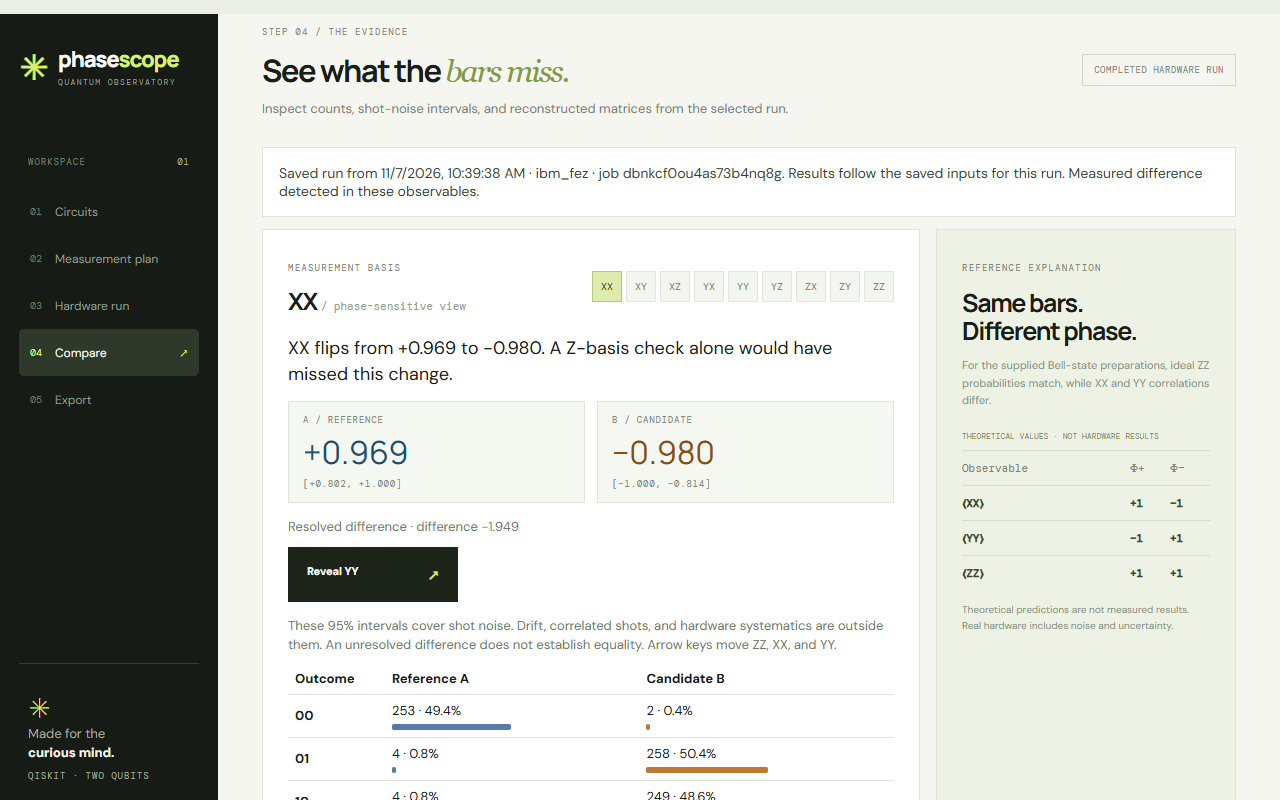
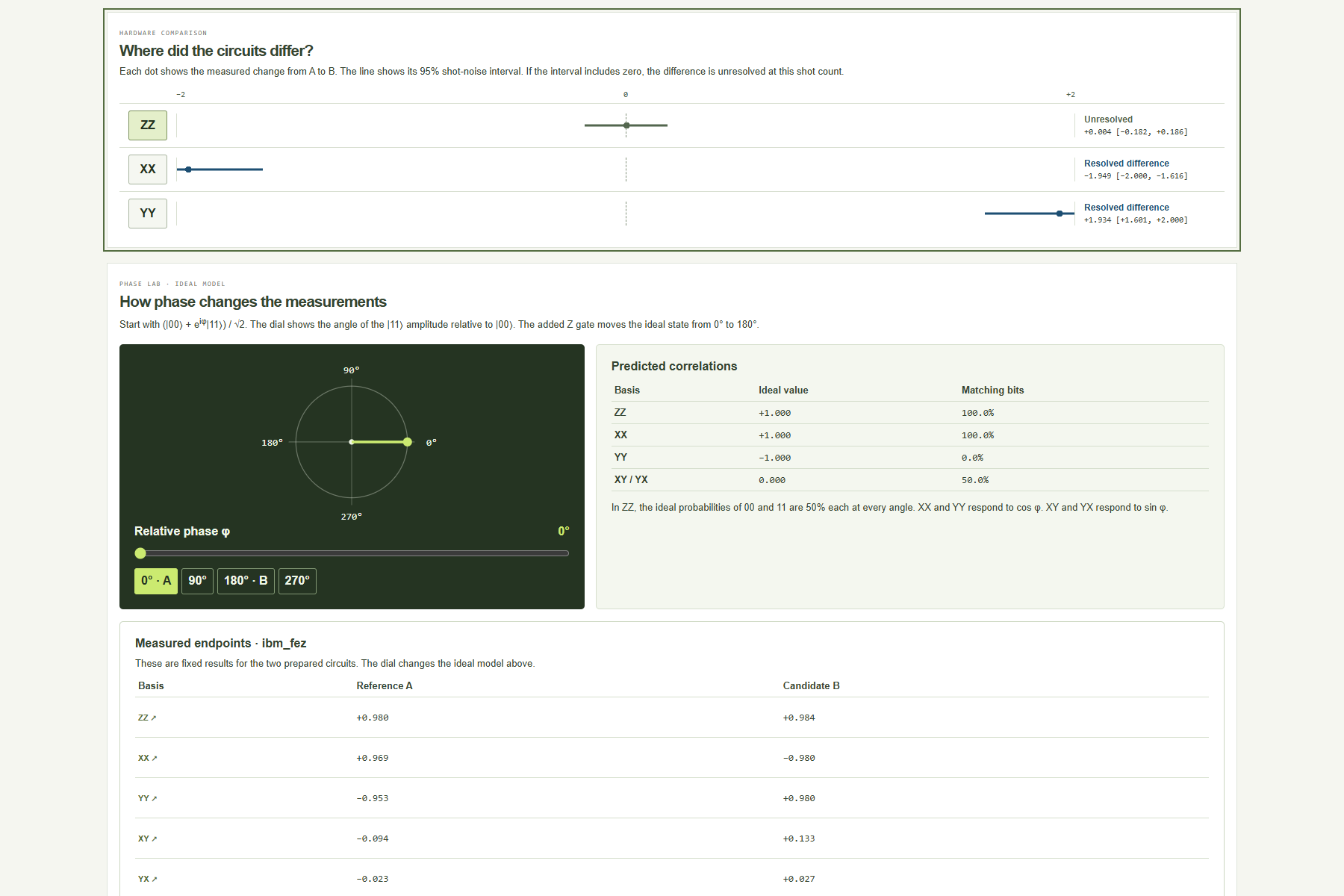
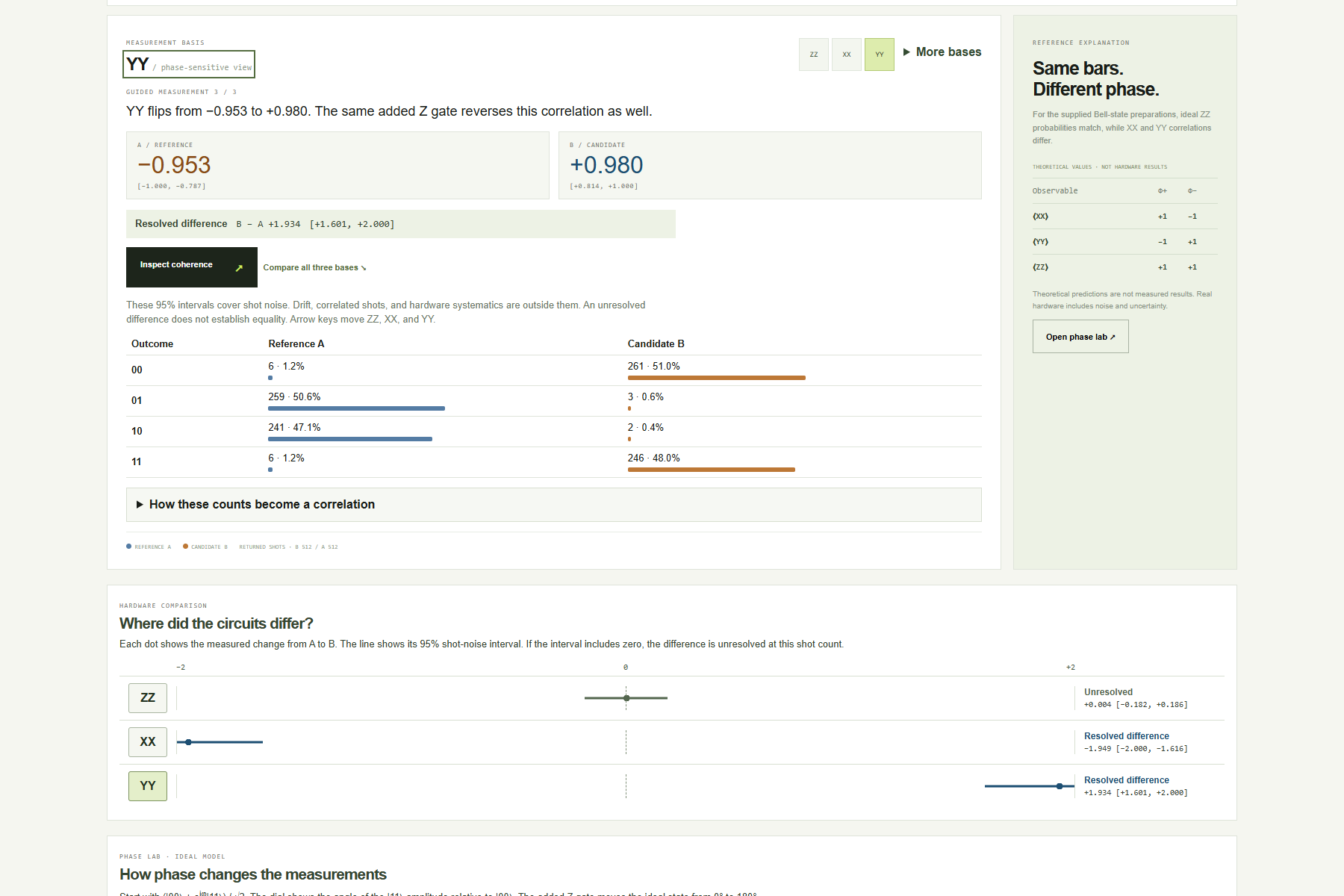
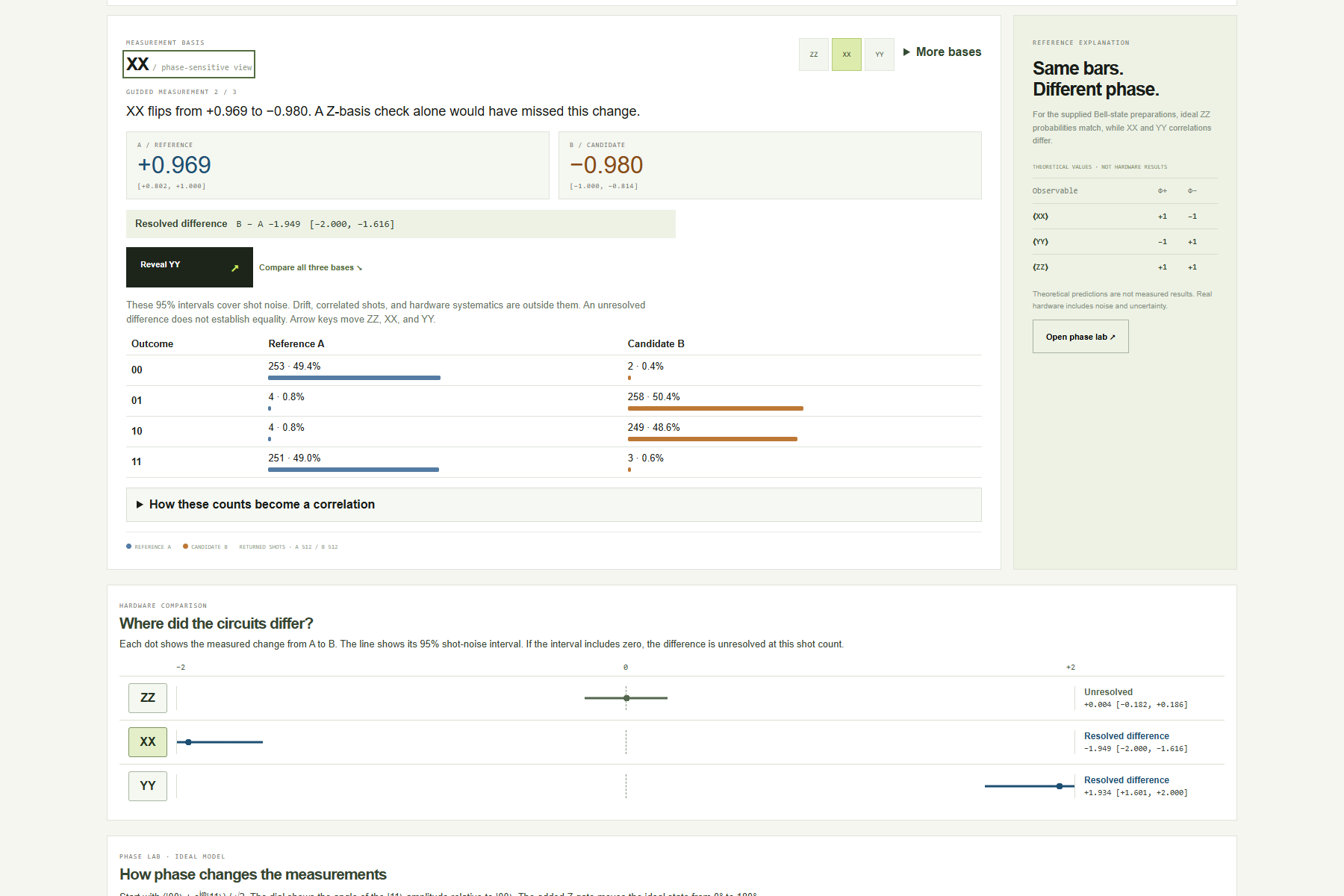
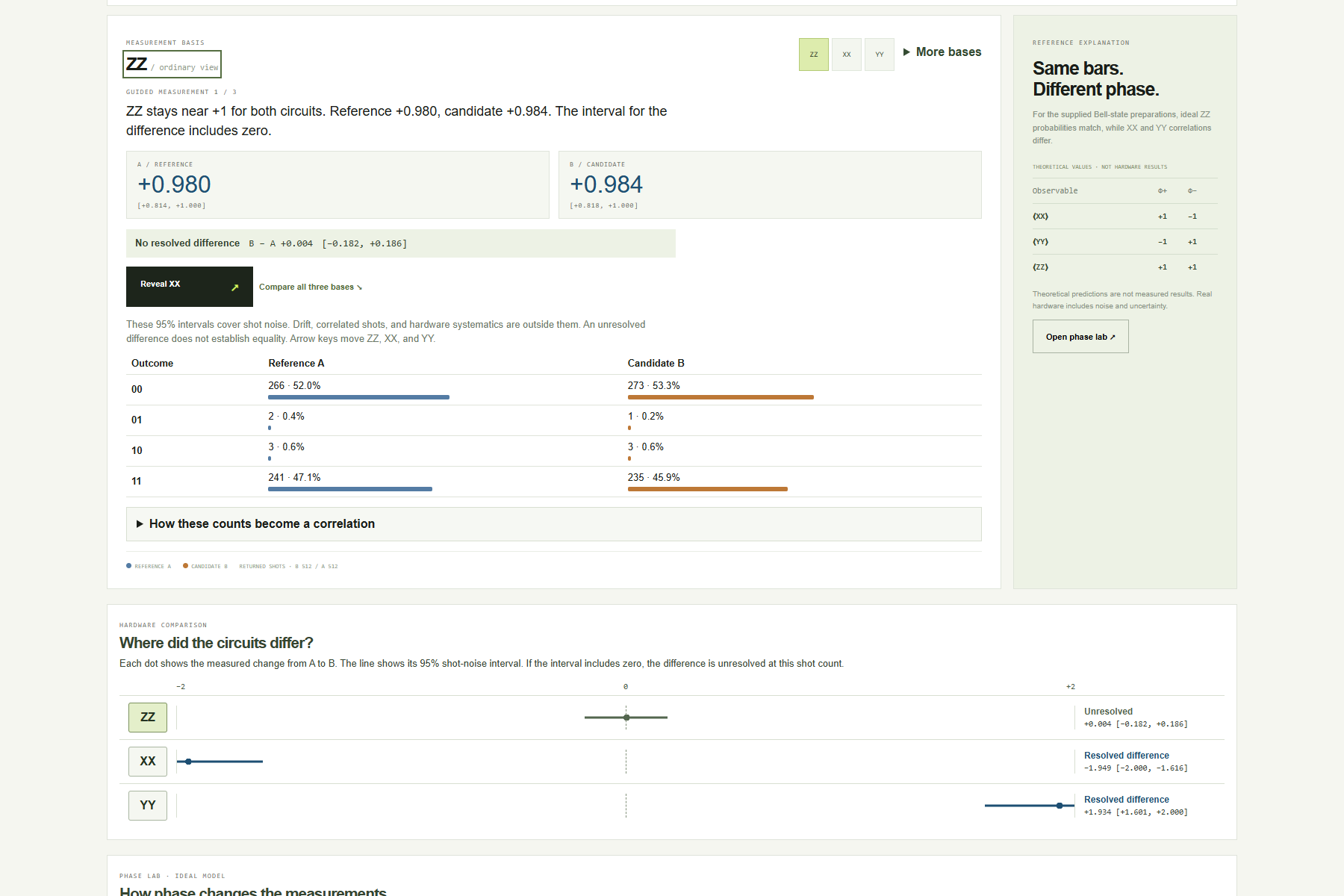
On a completed IBM Quantum job, ibm_fez job dbnkcf0ou4as73b4nq8g, one added Z gate was enough to flip two correlations and leave the third unresolved. Across 9,216 shots, 512 on each of 18 settings:
- ZZ stayed near +1. The difference was +0.004, and its shot-noise interval included zero.
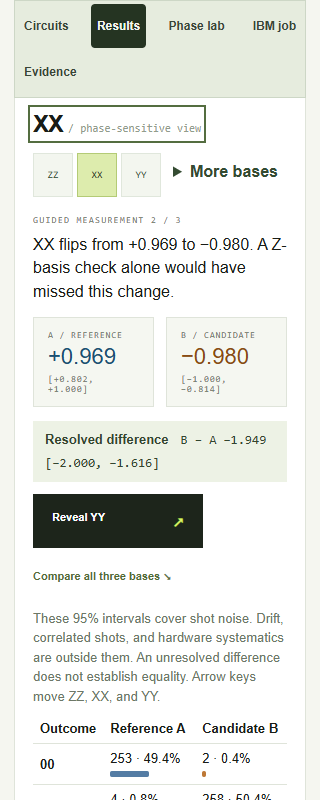
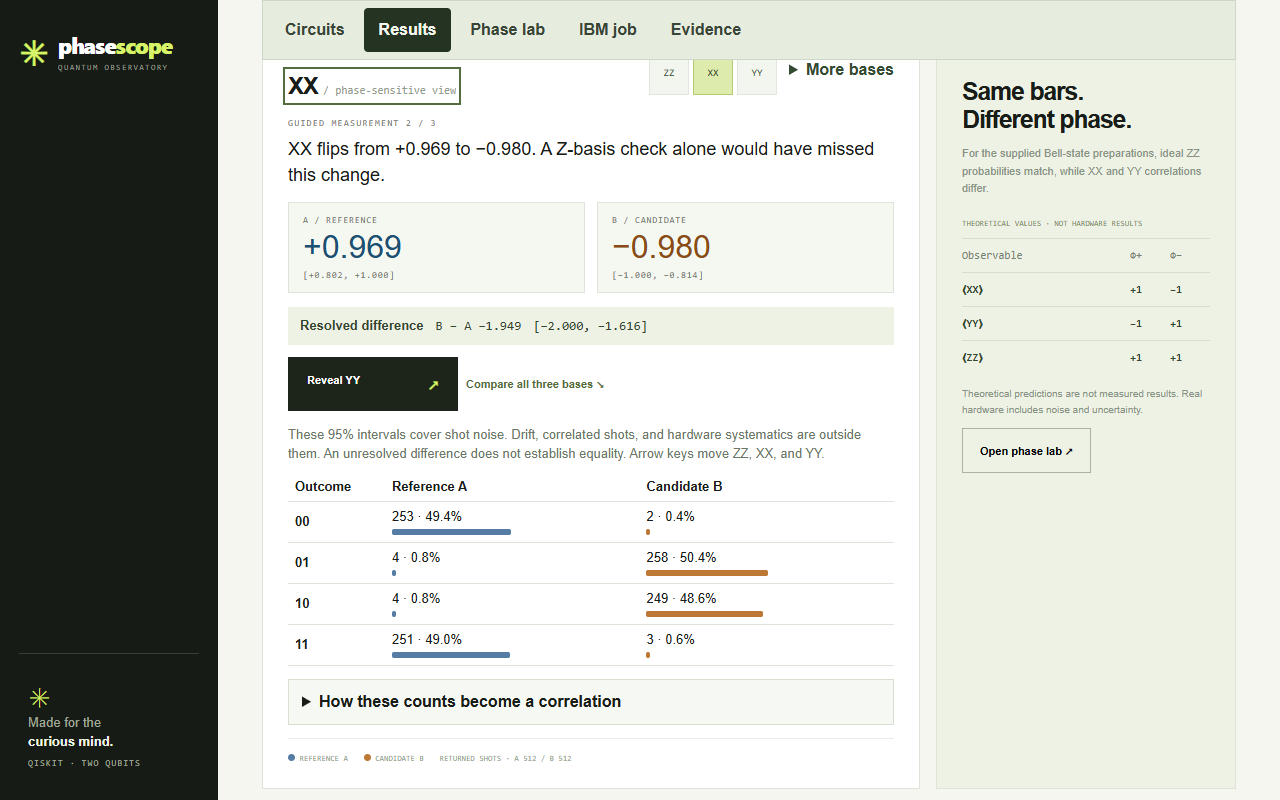
- XX went from +0.969 to −0.980.
- YY went from −0.953 to +0.980.
A Z-basis check alone would have missed the change. An unresolved difference does not mean the circuits are equal. The intervals cover shot noise only.
Each correlation is the share of matching outcomes minus the share of different ones:
\[ \langle P \rangle = (n_{00} + n_{11} - n_{01} - n_{10}) / N \]
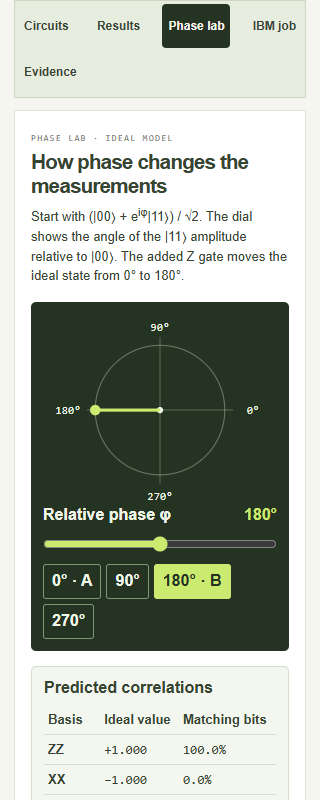
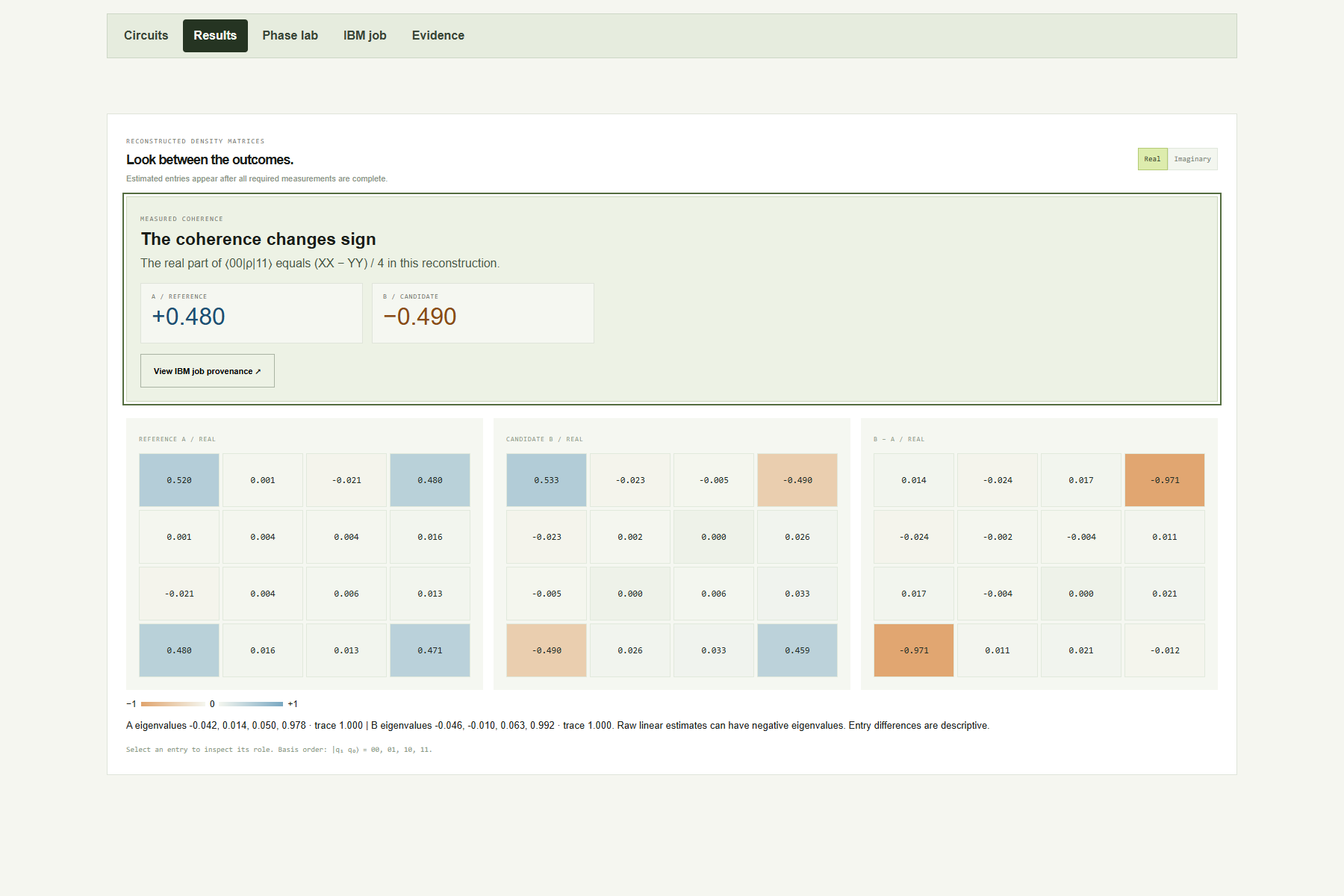
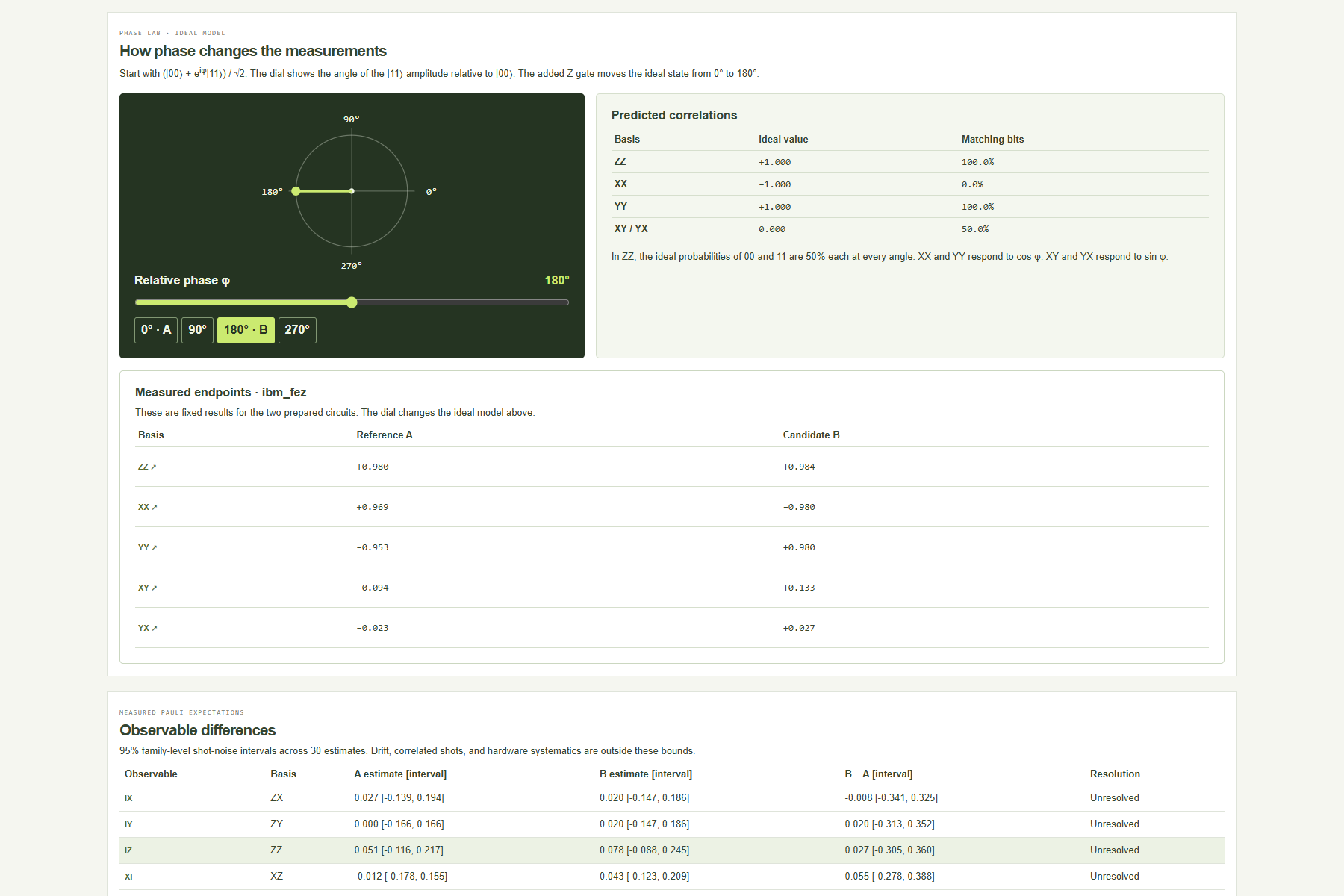
The reconstructed coherence changes sign with the same counts: the real part of \( \langle 00 | \rho | 11 \rangle \) is \( (\langle XX \rangle - \langle YY \rangle) / 4 \).
How I built it
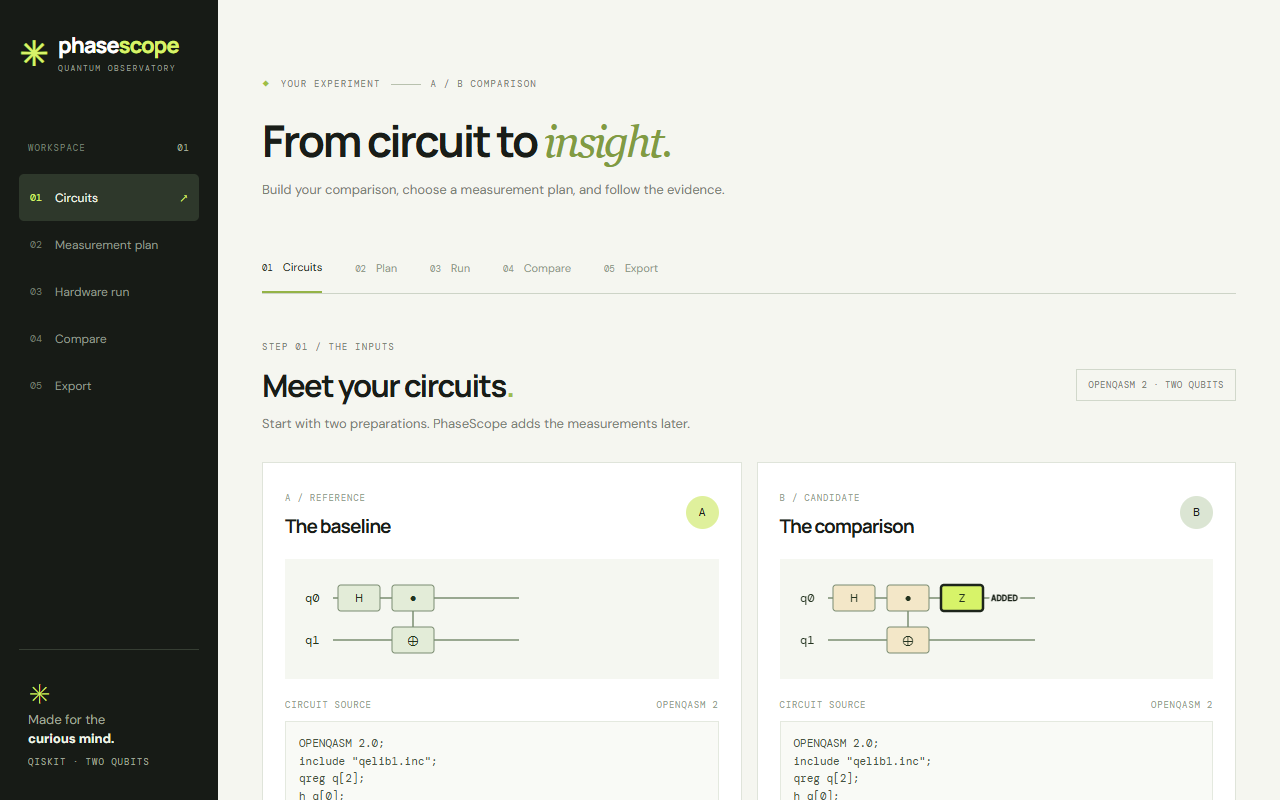
Qiskit validates the two OpenQASM 2 preparations and expands each one into nine Pauli bases. Qiskit transpiles all 18 circuits separately, with routing disabled, onto one connected pair. Qiskit IBM Runtime’s Sampler ran the job. Qiskit 2.6.2 and Qiskit IBM Runtime 0.51.0 compiled it. Logical q0 and q1 mapped to physical qubits 143 and 144.
The public exhibit opens on the highlighted Z gate. Start with ZZ, then XX, then YY. Each step shows the correlation, the interval, and the exact bit counts. A phase lab compares an ideal relative phase with those fixed hardware endpoints. The evidence ZIP holds the inputs, compiled circuits, counts, and analysis.
A separate verifier, using only Python and NumPy, recomputes the verdict, correlations, intervals, and density matrices from the saved counts. That checks the package and the arithmetic. It does not, by itself, prove that the counts came from IBM.
Challenges
The useful result was already on the hardware. The hard part was making one job understandable in about a minute without hiding its limits. There is one comparison and no identical-circuit control. The matrices are raw linear estimates and can be unphysical. Shot noise is not a full hardware error budget.
