-
-
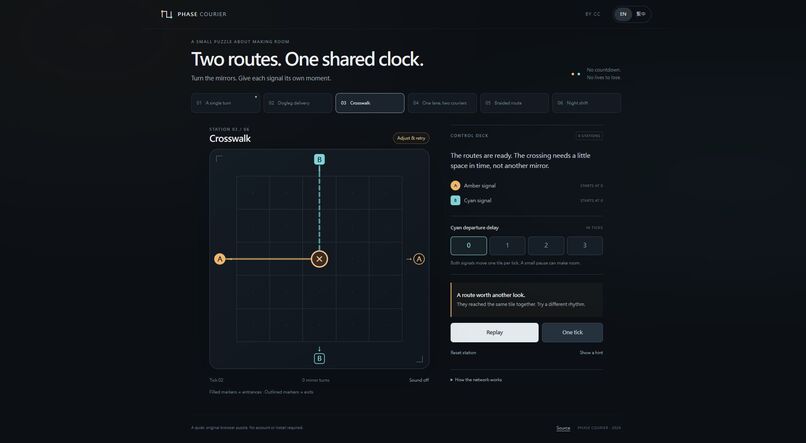
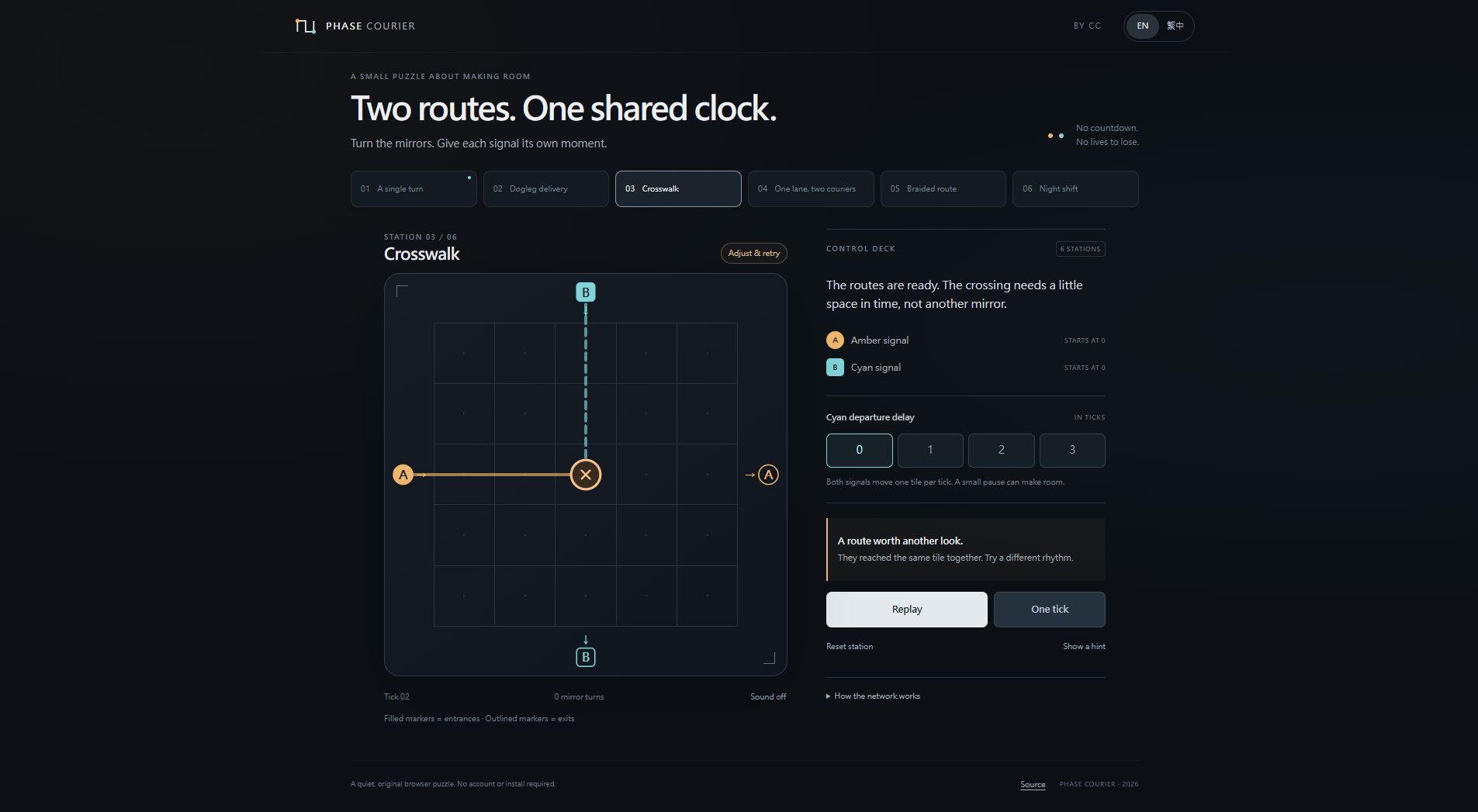
Crosswalk (Station 3): both signals reach the same tile at tick 02.
-
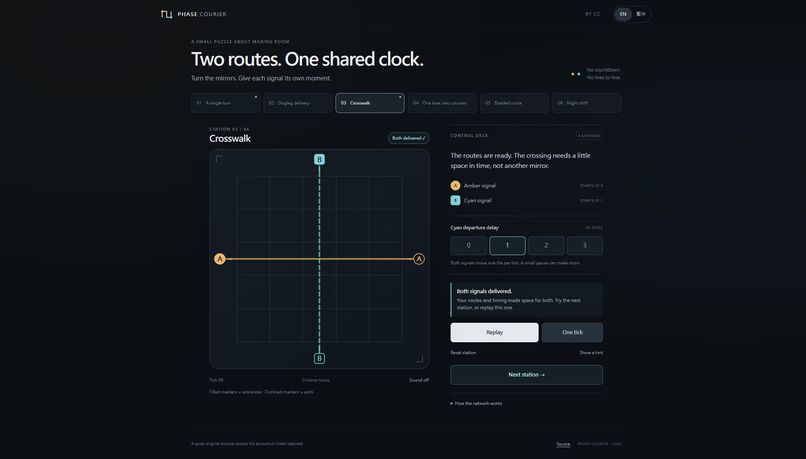
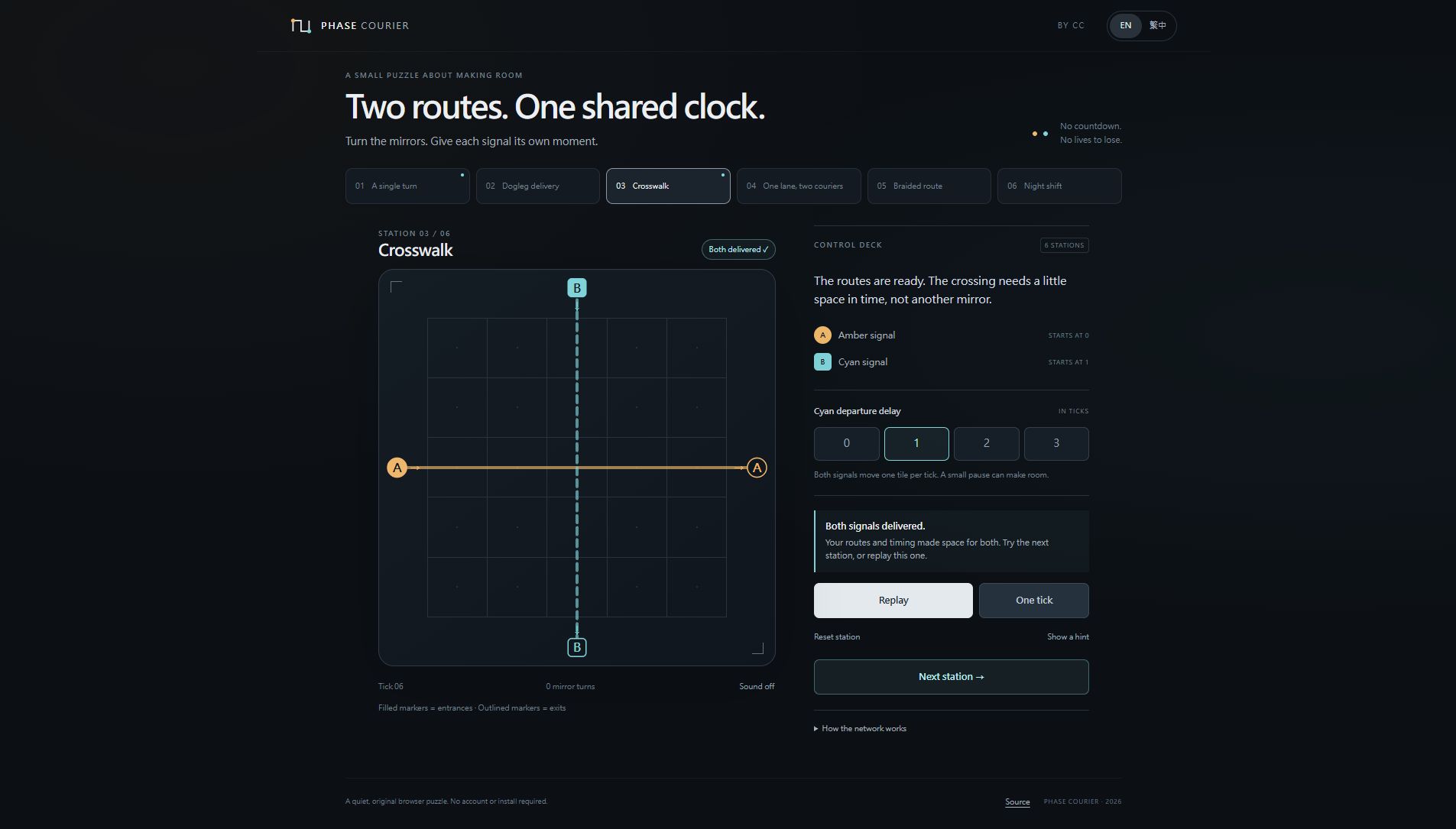
Crosswalk (Station 3): delaying cyan by one tick keeps the crossing clear. Both signals delivered.
Inspiration
Two routes can be individually correct and still get in each other's way. Phase Courier turns that small tension into a quiet puzzle: changing when a signal starts can matter as much as changing where it goes. There is no countdown, no lives to lose and no score penalty for trying another route.
What it does
Guide an amber A signal and a cyan B signal to their matching exits across six stations. Turn the raised mirrors and choose a cyan departure delay from zero to three ticks. Both signals advance on the same clock. They cannot occupy one tile together or cross the same link in opposite directions during one tick.
Send the signals to watch a route, pause to inspect it, or advance one tick at a time. Each station has a hint and can be reset or revisited freely. The interface supports English and Traditional Chinese, keyboard interaction, and desktop and phone layouts. Optional sound starts off on each page load.
How it was built
Phase Courier was built for Wolfjam 2026 with HTML, CSS and native JavaScript modules. A pure simulation engine produces finite tick states; authored station data and the browser interface live in separate modules. HTML and SVG render the board and routes. Web Audio synthesizes optional short sounds.
The game runs from ordinary static files, with no application backend or external AI service. Browser local storage holds only the language choice and completed station IDs. Play continues without persistence if storage is unavailable.
OpenAI Codex assisted game design, implementation, CSS/SVG artwork, procedural sound, station construction and simulation verification. No third-party game engine, image, font file, music sample or library is bundled.
Challenges
Timing needed clear rules and visible consequences. A collision includes both arriving at one tile together and crossing a link in opposite directions. Shared entrance/exit positions also needed distinct filled and outlined markers so their roles remained readable.
The phone layout was revised to keep transport controls directly below the board without covering its edge ports. Tick-by-tick inspection, reset and concise feedback help players understand a failed route without losing progress or facing a penalty.
Accomplishments
The result is a complete small game with six authored stations, two interface languages, keyboard controls, optional procedural sound and readable source. Twenty-two pure-simulation checks passed, covering authored solutions and collision, boundary, delay and reset behavior. Developer browser playthroughs exercised all six stations locally; follow-up checks covered the revised phone controls and narrow layouts. The deployed game also passed a representative station completion, reset, language, phone-control and source-download check.
These are developer checks, not a claim of independent player research or measured learning outcomes.
What was learned
A solvable simulation and a readable puzzle are separate concerns. Showing direction, timing and the next useful action matters as much as detecting the final state. Keeping controls near the board and distinguishing shared ports can make an underlying rule much easier to understand.
What's next
Gather feedback from players, refine the progression between stations and consider a small set of additional puzzles. Further work should preserve the low-pressure format and keep new mechanics understandable through visible, step-by-step behavior.
Play and access instructions
Play Phase Courier in a current browser with JavaScript enabled. No account, installation, API key or paid service is required to play.
- Choose a station. All six are available for practice.
- Click a raised mirror to turn it. Keyboard users can reach mirrors with Tab and activate them with Enter or Space.
- Select the cyan signal's departure delay.
- Choose Send signals to play or One tick to inspect the route. Reset station restores its starting arrangement.
- Deliver both letters to their matching exits. A successful station offers the next one, and completed stations can be revisited.
Use the language buttons to switch between English and Traditional Chinese. Sound remains off until enabled.
Source, credits and license
Source files, running instructions and license are available from the game. Save the six runtime files together and serve the directory over ordinary HTTP; ES modules should not be launched by opening the HTML as a local file. The README includes a local Python server example.
OpenAI Codex assisted the original design and development as described above. The delivered game executes a deterministic local simulation and embeds no external model, API key or AI service. No third-party game engine, image, font file, music sample or library is bundled.
The MIT license applies only to the Phase Courier source package, excluding the hosting website and other projects. The game does not claim to invent mirror-routing or timing puzzles as a genre.
Built with
HTML, CSS, JavaScript, SVG, Web Audio API.
Development assistance: OpenAI Codex.
