-
-
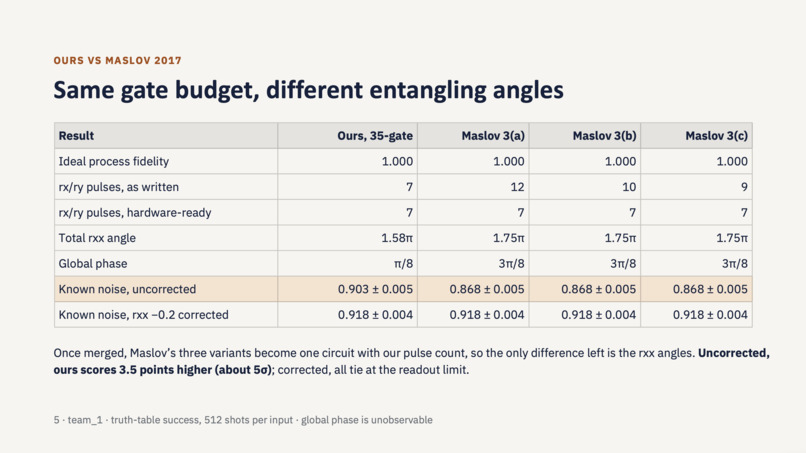
Experimental results
-
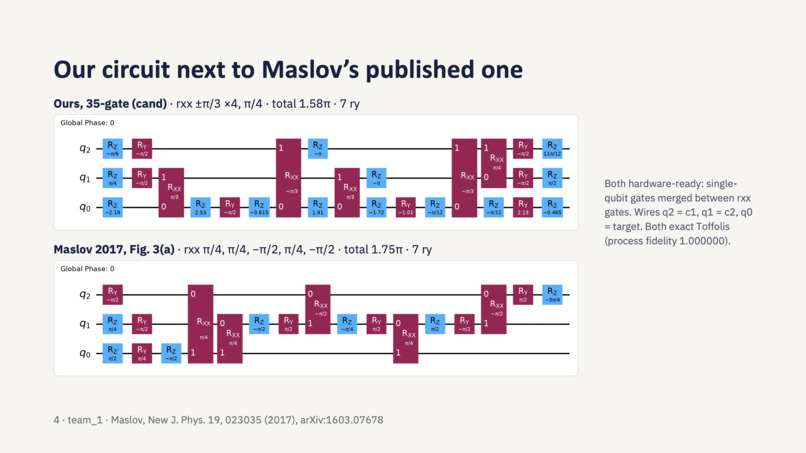
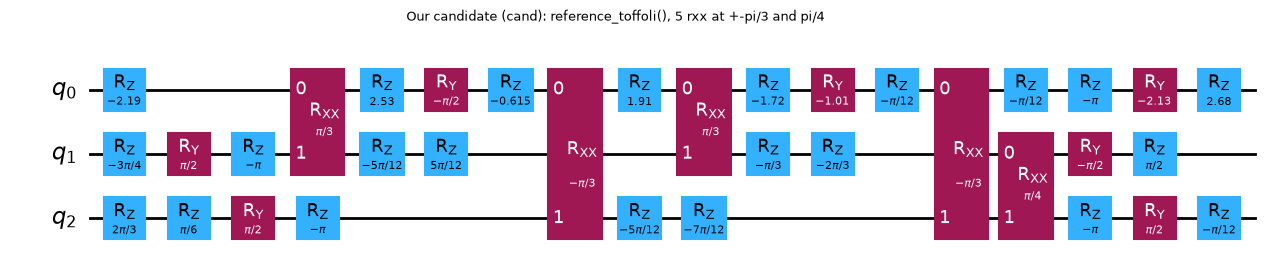
35-gate model
-
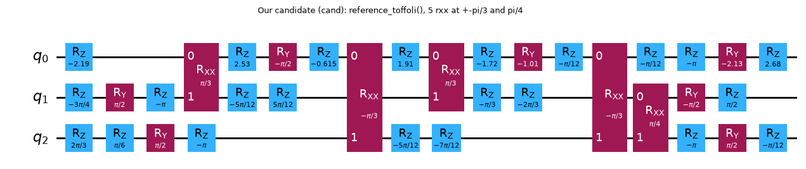
29-gate model
-
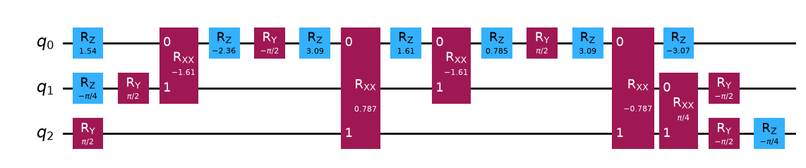
Final quantum circuit; 20-gate model
Inspiration
Our inspiration stems from the profound connection between physics and computer science. Quantum computing represents a fundamental shift that unifies the physical laws of nature with computational logic, and exploring the multitude of different aspects from quantum mechanics to algorithmic optimization drove our team to tackle this challenge.
What it does
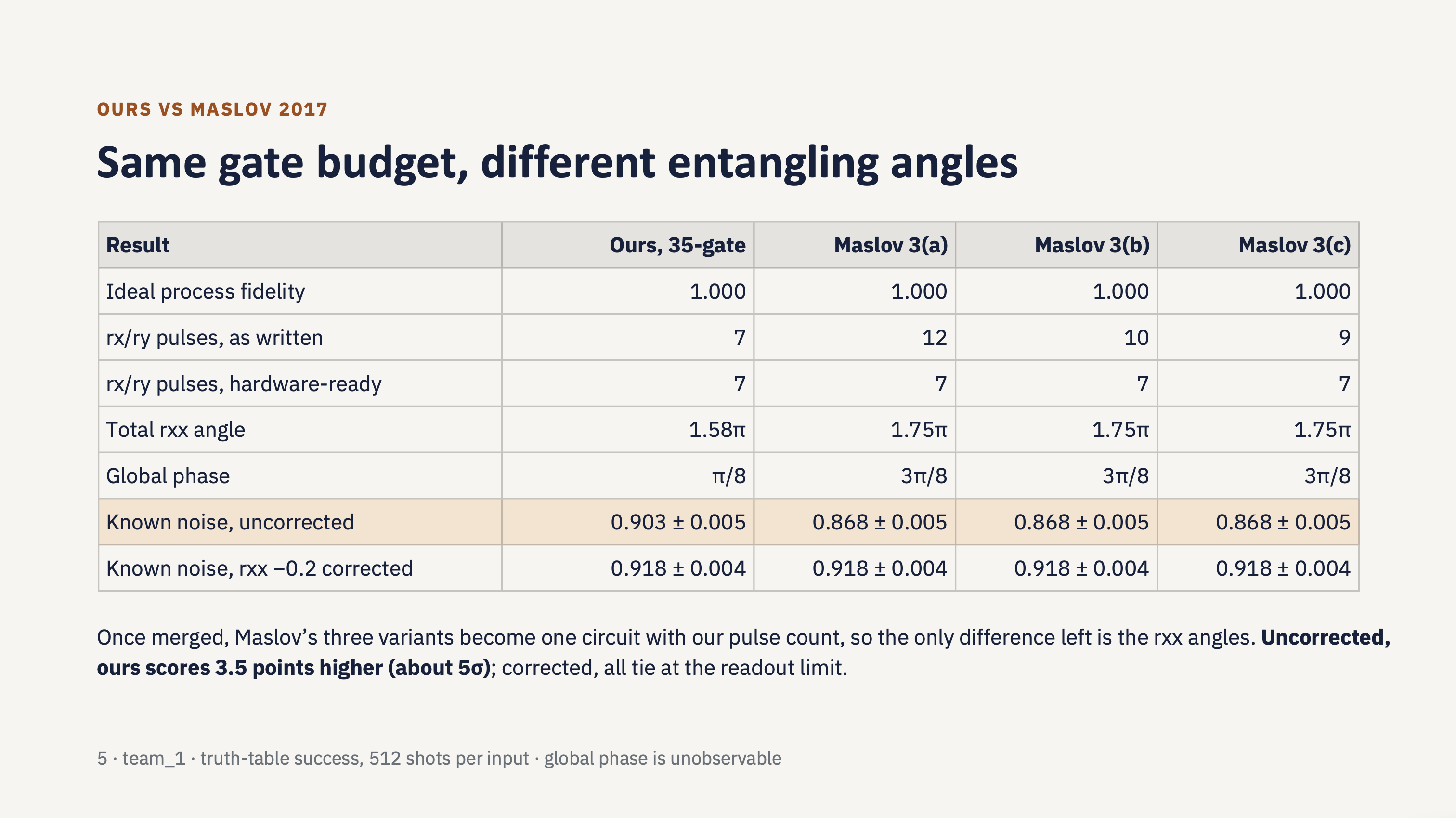
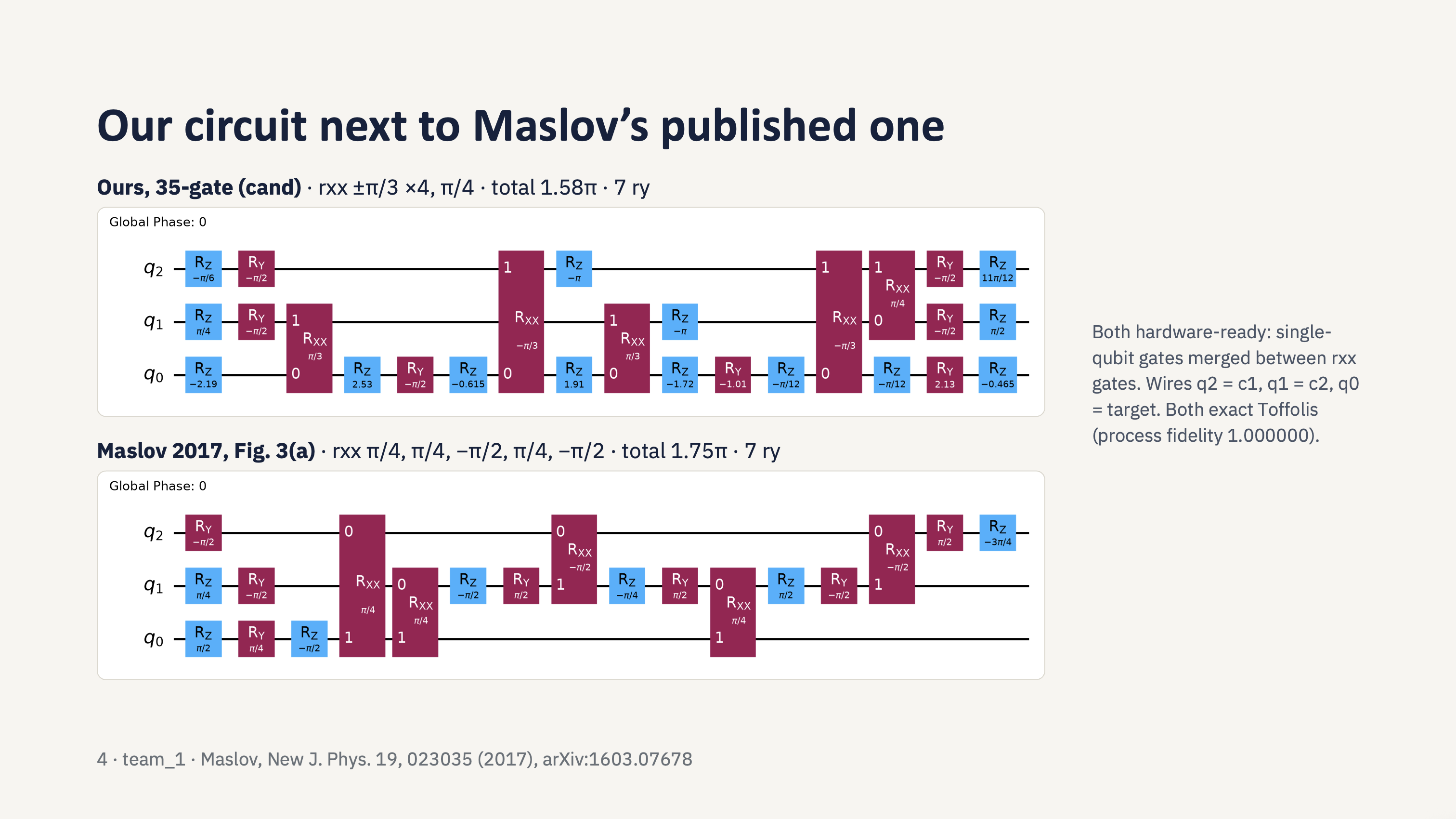
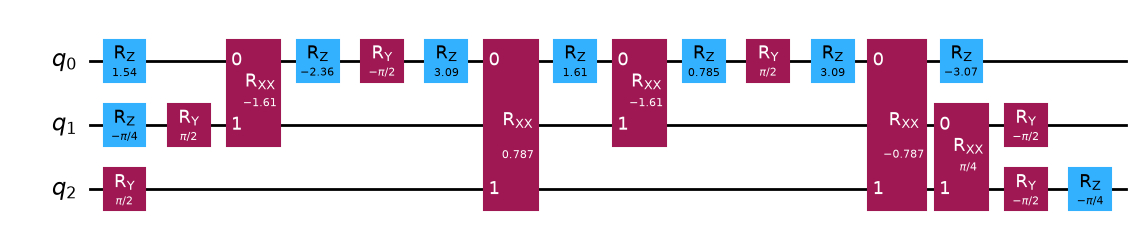
We developed a Variational Quantum Algorithm pipeline to construct a highly accurate, native Toffoli gate. Instead of relying on standard theoretical models, our project synthesizes a custom quantum circuit that strictly utilizes a provided native hardware gate set to execute controlled quantum operations with the highest possible fidelity.
We also devised a test that proved that it was a true toffoli.
How we built it
We built our solution using Qiskit and the COBYLA optimizer. We constructed a parameterized ansatz and ran it through a variational loop. To prepare for physical hardware execution, we implemented an exact unitary fidelity based cost function and structured a robust queueing system to extract precise phase information across multiple measurement axes like XXX and XZX.
Challenges we ran into
Our biggest hurdle was the phase blindness trap. For much of the hackathon, our optimization loops resulted in circuits that produced perfect classical truth tables but exhibited severe phase errors and low overall quantum fidelity because the cost function was only evaluating $Z$ basis measurements. Compounding this was a severe time crunch, as we were racing against a strict 12:00 PM cutoff to lock in our circuits for the real hardware queue.
Accomplishments that we're proud of
We successfully diagnosed and corrected the phase blindness issue by rewriting our cost function to evaluate true quantum state fidelity rather than just classical bit flips. We are incredibly proud of mapping out the precise experiments needed to prove our optimized circuit is a mathematically perfect quantum Toffoli on real hardware, backed by robust readout error mitigation.
What we learned
This project was a deep dive into quantum noise, and for one of our team members, it served as an incredible first interaction with formal information theory. We learned that the noise introduced by the two qubit $R_{xx}(\theta)$ gate is highly dependent on its specific rotation angles. Furthermore, we discovered that single qubit operations $R_x$ and $R_y$ are the primary culprits that lead to destructive phase errors. In contrast, $R_z$ rotations primarily contribute to the global phase $e^{i\phi}$, which mathematically factors out of the final probability amplitudes and does not impact measurement outcomes.
What's next for ToXoffoli
Our next step is analyzing the raw shot by shot hardware outcomes from the lab to calculate our final physical fidelity scores. We also plan to adapt this variational approach for larger multiqubit gates and explore deploying our pipeline on broader cloud quantum infrastructure.
Built With
- ionq
- jupyter
- python
- qiskit

Log in or sign up for Devpost to join the conversation.