Inspiration
The idea for PharmaSync AI came from something very simple: people forget things. Not because they don’t care, but because life gets chaotic. We wake up late, get stuck in traffic, skip meals, work late, or fall asleep early. And somewhere in the middle of all that, a medication reminder quietly gets ignored.
I kept thinking: “What if the problem isn’t the reminder… but the timing?”
Everyone has a natural rhythm — moments where they’re more alert, more consistent, or more likely to stick to a routine. I wanted to build something that understands that rhythm and works with it.
Instead of telling people when they should take their medication, why not help them figure out when they are most likely to remember it themselves?
That’s where PharmaSync AI started.
What it does
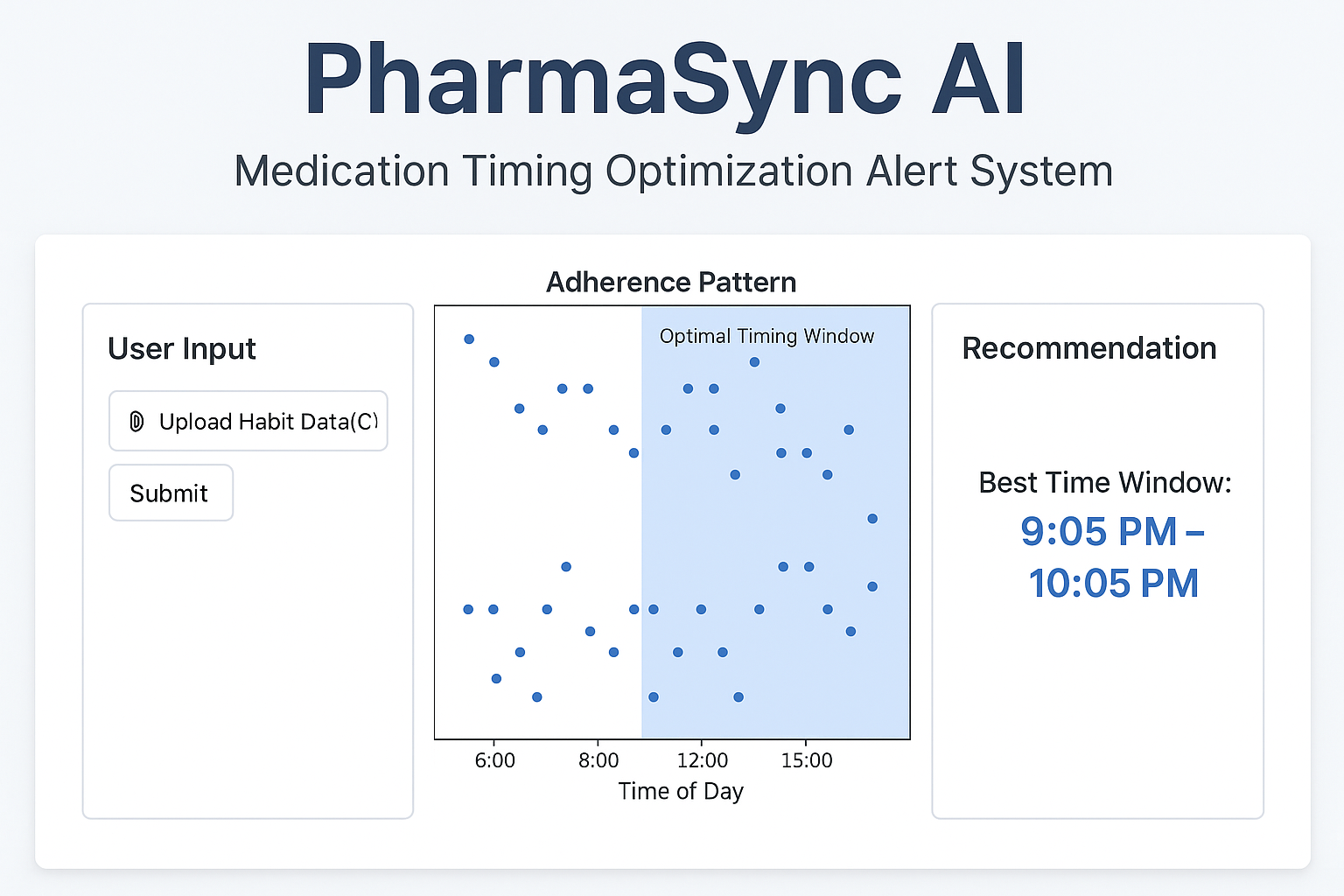
PharmaSync AI looks at a user’s daily habits — when they wake up, go to sleep, eat, or usually remember things — and uses a simple machine learning model to find the time of day when they’re most consistent.
It gives users a personalized suggestion like: “Your best medication window is between 9:00 PM and 10:15 PM.”
It doesn’t give any medical advice or dosage recommendations. It just helps people sync their medication schedule with a time they’re most likely to remember.
How we built it
I built the project in small pieces:
Creating a synthetic habit dataset Since real patient data can’t be used, I generated a dataset that imitates how people behave in daily life times they remembered, forgot, slept late, or had meals.
Building the ML model I used K-Means clustering to group together the times where the user most often remembered their medication. The “center” of that cluster becomes the recommended window.
Designing the interface Using Streamlit, I built a simple UI where users can upload a CSV or enter their routine. The app shows: habit patterns success/failure plot predicted best timing window
Challenges we ran into
Finding the right modeling approach: Predicting human behavior isn’t like predicting numbers — patterns are messy. Clustering turned out to be the best fit.
Making sure everything stayed safe and non-clinical: I had to be very careful to avoid anything that could be interpreted as medical advice.
Creating realistic synthetic data: It took a while to design examples that felt authentic without being real.
Converting time into machine-friendly values: Mapping times like “9:30 PM” into usable numerical features was trickier than expected.
Accomplishments that we're proud of
Built a fully working ML model that predicts behavioral timing, not medical outcomes
Created safe, realistic synthetic datasets
Designed a clean interface that even non-technical users can understand
Developed a project that solves a real-life problem in a fresh, non-traditional way
What we learned
Machine learning can support health without crossing into dangerous territory
Human habits follow patterns we don’t always notice
Simpler models often solve the problem better than complex ones
UI clarity is just as important as model accuracy
Good health tech doesn’t always need to be clinical — it can be behavioral too
What's next for PharmaSync AI
Adding weekly habit insights and “stability scores”
Allowing users to log daily medication attempts directly in the app
Supporting multiple medications
Visualizing long-term habit trends
Creating a gentle reminder system tied to the predicted timing window
Exploring integrations with wearable data (while staying safe and non-medical)
Built With
- behavioral
- matplotlib
- numpy
- pandas
- python
- scikit-learn
- streamlit
- synthetic

Log in or sign up for Devpost to join the conversation.