-
-
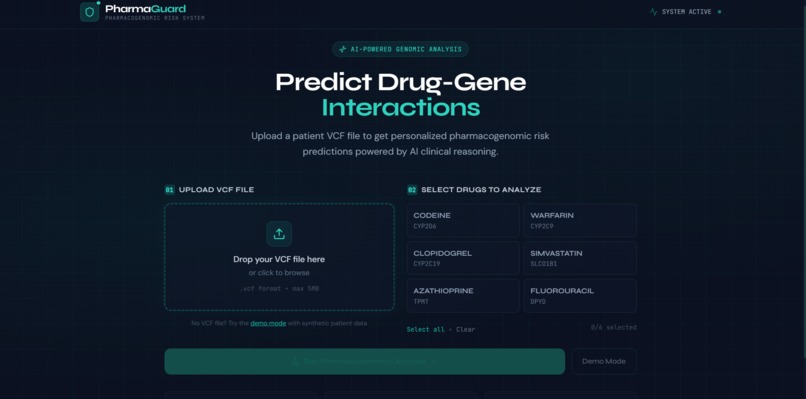
its dashboard
-
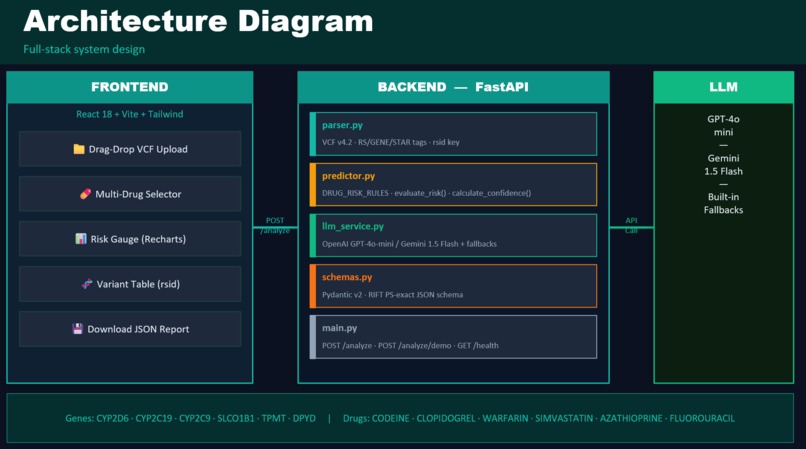
architecture Diagram
-
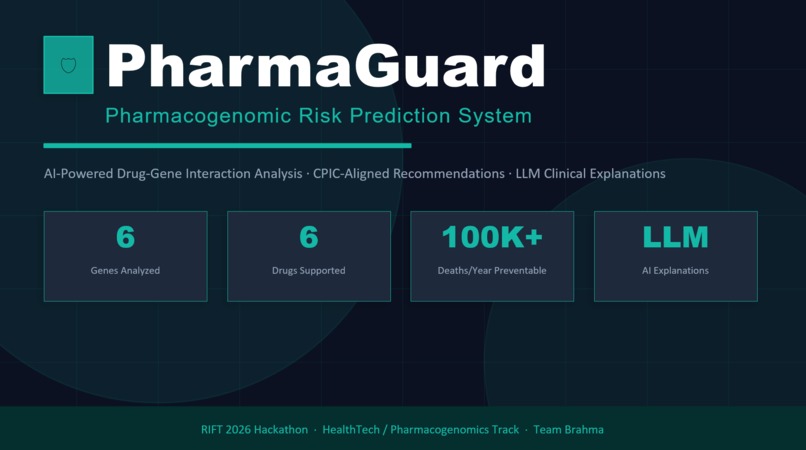
Problem i am solving


Inspiration
Adverse drug reactions caused by genetic differences are a major challenge in modern healthcare. Many patients unknowingly carry genetic variants that affect how their bodies metabolize specific medications. This can lead to severe side effects, ineffective treatment, or even life-threatening complications.
We were inspired by the growing importance of precision medicine and the need for accessible tools that can bridge the gap between complex genomic data and real-world clinical decision-making.
PharmaGuard was created to make pharmacogenomic insights simple, understandable, and actionable using AI.
What it does
PharmaGuard is an AI-powered pharmacogenomic risk prediction platform that analyzes patient DNA data (VCF files) to detect high-risk drug-gene interactions.
The system:
- Identifies genetic variants affecting drug metabolism
- Predicts risk levels for specific medications
- Generates AI-driven clinical explanations
- Presents results through an intuitive dashboard
This enables healthcare professionals to make safer and more personalized medication decisions.
How we built it
PharmaGuard combines multiple technologies to create an end-to-end intelligent system:
- Genomic data processing using VCF file parsing and variant extraction
- Drug-gene interaction mapping using pharmacogenomic databases
- AI explanation generation using large language models
- Backend processing pipeline developed in Python
- Frontend web dashboard for visualization and reporting
- Secure handling of patient data with encryption and privacy-focused design
The architecture ensures accurate analysis while maintaining usability for non-technical users.
What we learned
During development, we gained deep insights into:
- Pharmacogenomics and personalized medicine
- Handling large-scale genetic datasets
- Integrating AI models for healthcare interpretation
- Designing user-friendly dashboards for complex data
- Ethical and secure handling of sensitive medical information
This project significantly strengthened our skills in AI, healthcare technology, and full-stack development.
Challenges we ran into
One of the biggest challenges was translating highly technical genomic data into meaningful clinical insights that are easy to understand.
Other challenges included:
- Mapping genetic variants accurately to drug interaction databases
- Ensuring fast processing of large VCF files
- Designing clear visualizations for complex risk data
- Generating reliable AI explanations without medical ambiguity
Overcoming these challenges helped us build a robust and scalable system.
Impact and future scope
PharmaGuard has the potential to support hospitals, clinics, and telemedicine platforms by reducing adverse drug reactions and enabling personalized treatment.
Future enhancements include:
- Real-time electronic health record integration
- Expanded drug interaction databases
- AI-driven treatment recommendations
- Clinical validation studies
- Mobile application deployment
The long-term vision is to make personalized medicine accessible, affordable, and actionable worldwide.

