-
-
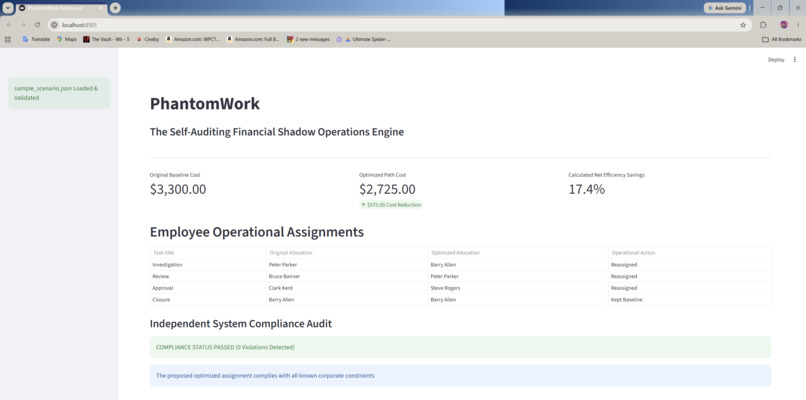
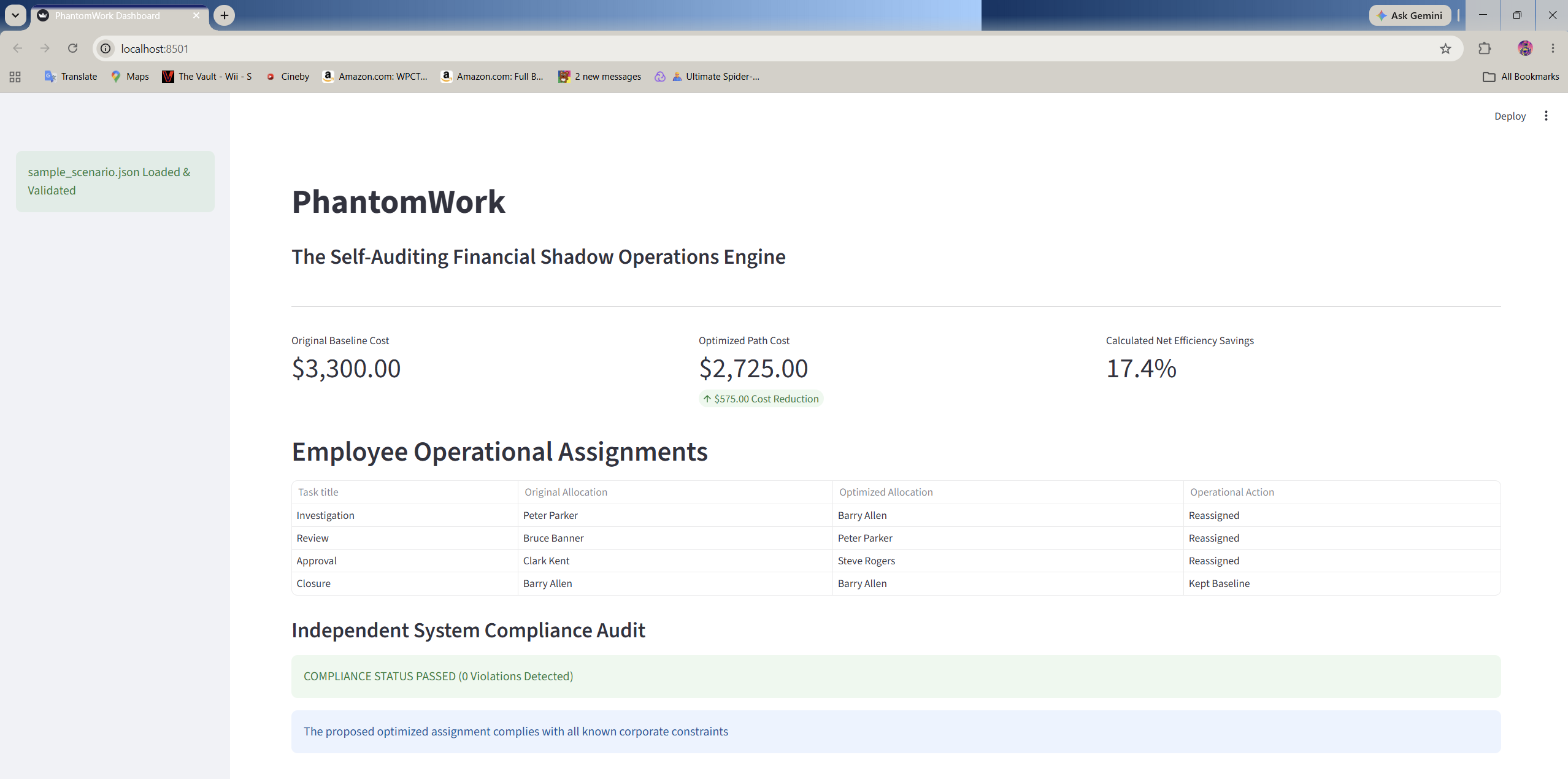
PhantomWork - Workflow Optimization Dashboard
-
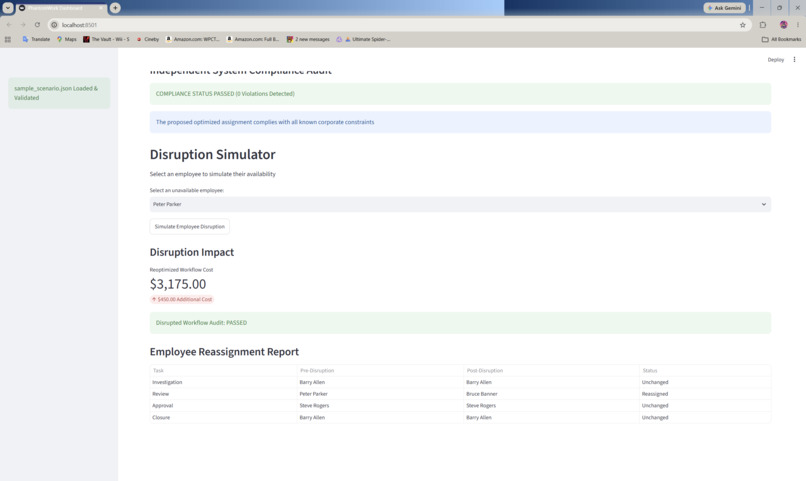
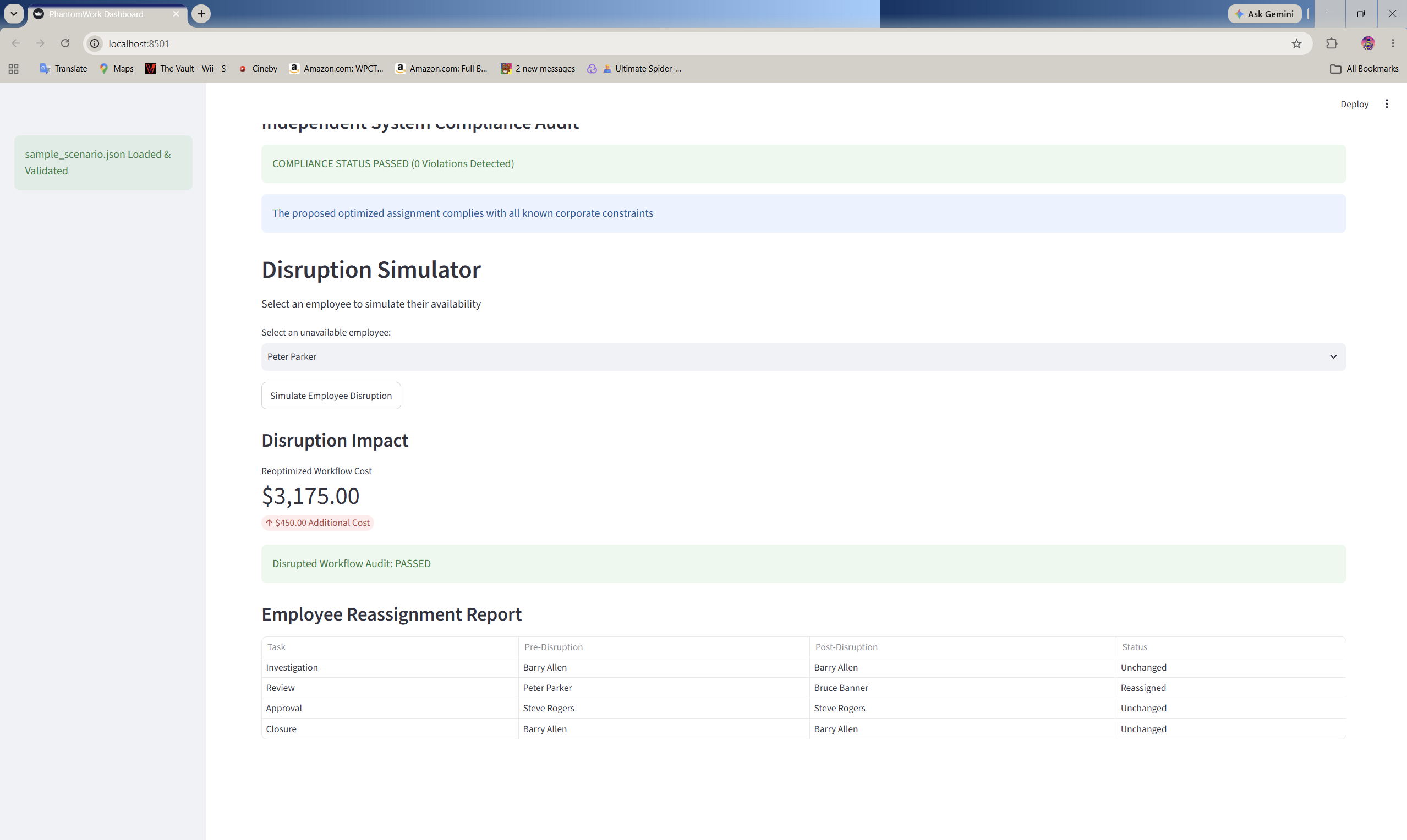
PhantomWork - Employee Disruption Simulation
Inspiration
Financial organizations need to assign work efficiently while following firm guidelines regarding employee authorization, workload, and separation of duties. I wanted to study whether optimization could help reduce operational costs without sacrificing these irrefutable corporate policies.
What it does
PhantomWork takes a fictional financial workflow and finds cost efficient employee assignments within the constraints of business guidelines.
Its main features include:
- Workflow Optimization: Finds lower-cost employee assignments while adhering to authorization, capacity, availability, and separation-of-duties guidelines.
- Cost Comparison: Displays baseline and optimized workflow costs alongside alongside savings as a result of optimized workflow.
- Disruption Simulation: Simulates unavailability of an employee and recalculates assignments.**
- Reassignment Reporting: Shows which tasks change ownership following a disruption
How we built it
I built PhantomWork using Python, Google OR-Tools, Pydantic, and Streamlit -JSON: Stores sample scenario data, including employees, tasks, costs, and business workflow guidelines.
- Python: Handles workflow logic, employee disruption, cost calculations, and compliance verification
- Google OR-Tools: Uses constraint optimization to find the lowest-cost employee assignment while adhering to corporate parameters.
- Pydantic: Validates employee, task, and scenario data before optimization. -Streamlit Powers user friendly interactive dashboard.
Python-Application logic and workflow coordination
Challenges we ran into
One of my biggest challenges was translating the workflow requirements into mathematical parameters that could be understood by the program solver. I also had to ensure that the compliance verification process checked generated assignments completely independent from other variables rather than simply trusting the optimizer's approach. Another difficulty was developing the backend logic behind the user-friendly interface that clearly communicates the optimization results and responds to simulated disruptions.
Accomplishments that we're proud of
I am primarily proud of building a functional user interface that combines constrained optimization, verification, and adaptation to disruption within the time allotted to complete the project.
What we learned
Through this project, I learned how to properly defined parameters within mathematical and variable based code that the software can understand. I also learned the importance of verification, as finding the most optimal solution does not guarantee it is a permitted solution.
What's next for PhantomWork-The Self-Auditing Financial Shadow
Future improvements could include:
- Supporting larger and more complex financial workflows.
- Allowing users to upload custom economic data.
- Expanding the compliance engine to support a wide variety of business policies and well as common practice legal parameters.
- Generating downloadable professionally formatted audit reports.
- Comparing multiple disruptive scenarios simultaneously and their financial impacts.

Log in or sign up for Devpost to join the conversation.